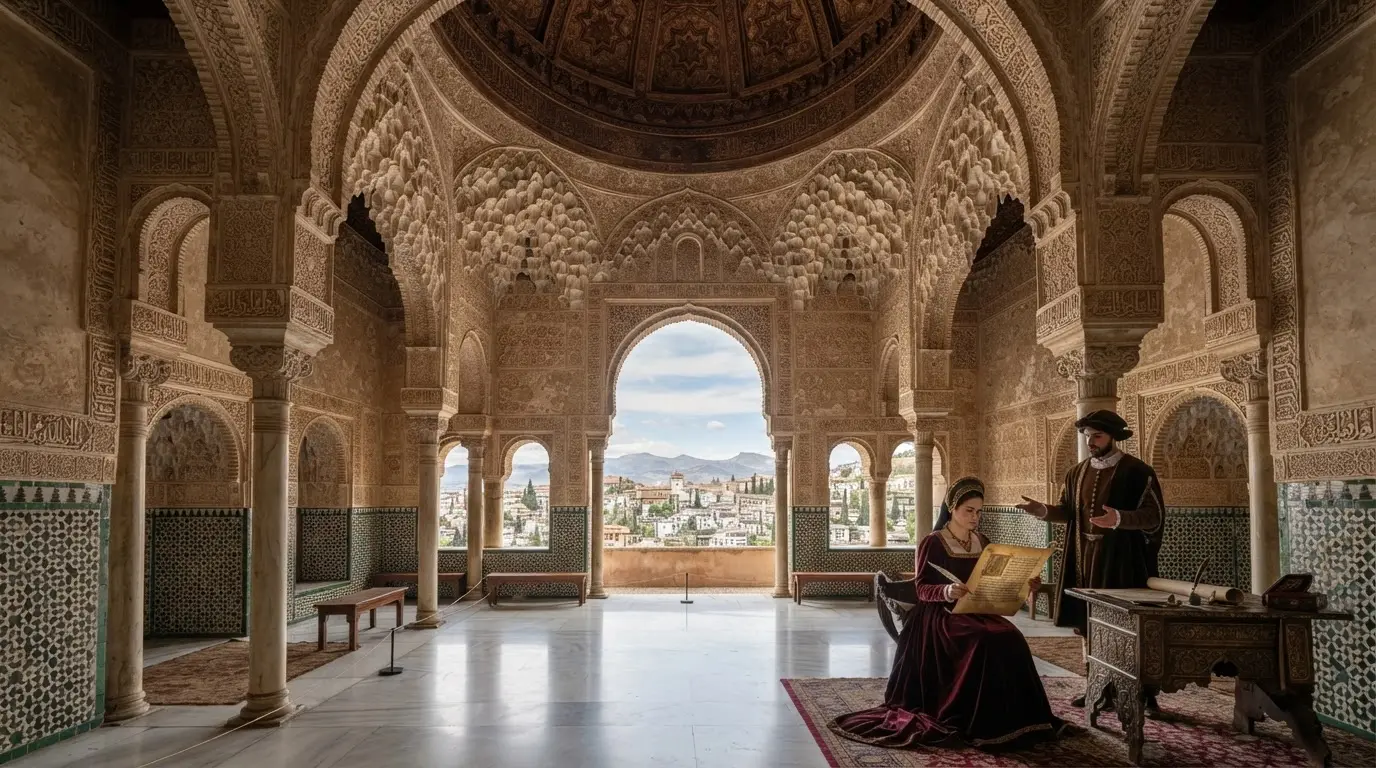

The document and its signing
The full Spanish title was Edicto de Expulsión de los Judíos de España; in Spain it is also referred to as the Edicto de Granada (Edict of Granada), for the city and the palace where it was signed. Ferdinand and Isabella signed it on 31 March 1492 at the Alhambra palace in Granada, the city they had conquered from the Nasrid emir Boabdil just eleven weeks earlier.[1] The deadline they set was 31 July 1492: any Jewish person still on Spanish soil after that date who had not converted to Christianity faced death.
The decree applied across all territories of Castile and Aragon, including Sicily and other Crown of Aragon possessions.[1] Jewish people could take their personal property out of Spain but were forbidden from taking gold, silver, or minted coin. Royal debts owed to Jewish creditors were cancelled; property that could not be liquidated in four months was forfeit.
31 July 1492
The Inquisitor General, Tomás de Torquemada, is widely credited with pressing for the expulsion, though how much of that attribution reflects historical fact rather than later reputation is contested.[1] The Inquisition had been investigating conversos — Jewish converts to Christianity — since 1478, on the theory that many continued practising Judaism in private. The decree's stated logic followed directly: remove the Jewish communities and the converso problem would resolve itself. The argument was theological cover for what was also a financial seizure on a national scale.
Granada's Jewish community before 1492
Jewish people had lived in the territory that became Granada for roughly 1,500 years before the decree.[2] The community survived Roman administration, Visigothic legislation that periodically stripped their rights, and the arrival of Islam in the 8th century, which brought the dhimmi system — protected status that allowed them to practise their religion while keeping them out of authority over Muslims.
The peak came in the 11th century under the Zirid dynasty, the Berber rulers who founded Granada as a city. The Zirid period produced one of the most improbable careers in medieval history. Samuel HaNagid (Samuel ibn Naghrillah) arrived in Granada around 1020, rose through the Zirid court, and by 1037 had been appointed grand vizier and military commander of the Granadan army by emir Badis ibn Habus.[2] A Jewish man commanding Muslim soldiers and running a Muslim state: it violated every convention of dhimmi law, and Badis kept the arrangement for nearly two decades. Samuel HaNagid also produced three major collections of Hebrew poetry between military campaigns.
His son Joseph succeeded him as vizier, and the arrangement ended violently. On 30 December 1066, Joseph was assassinated and a mob moved through the Realejo — the Jewish quarter south of the Alhambra hill — killing several thousand people.[2] The 1066 massacre, covered in full in the dedicated article on the 1066 Granada massacre, destroyed the community as a civic entity. It rebuilt under Nasrid rule over the following centuries, but never again reached the political position it had held under Samuel HaNagid.
Explore nearby · Monument
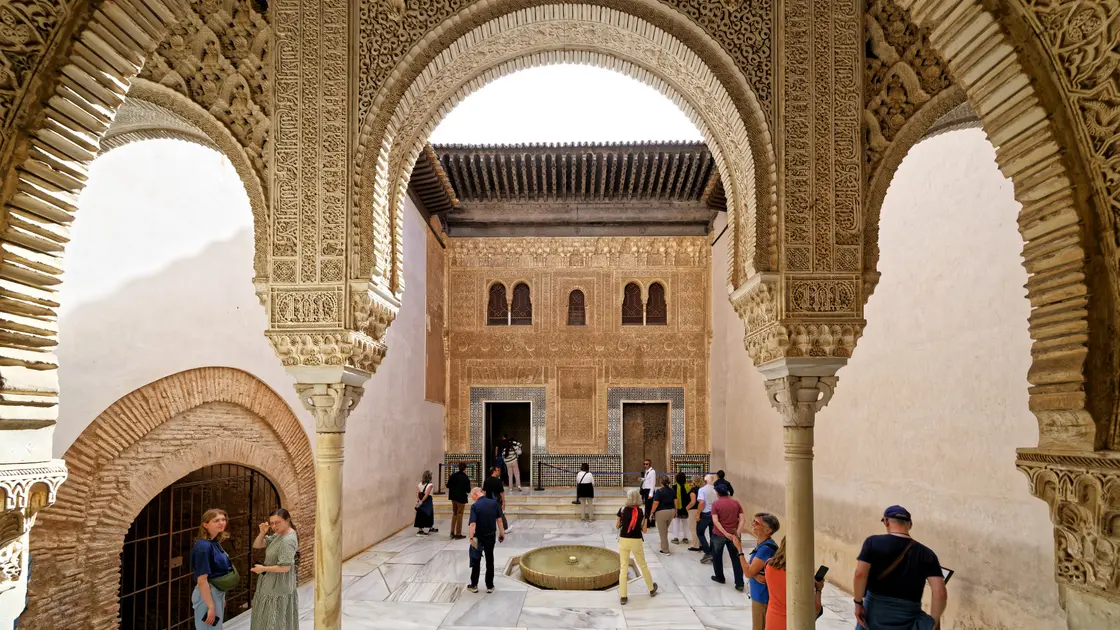
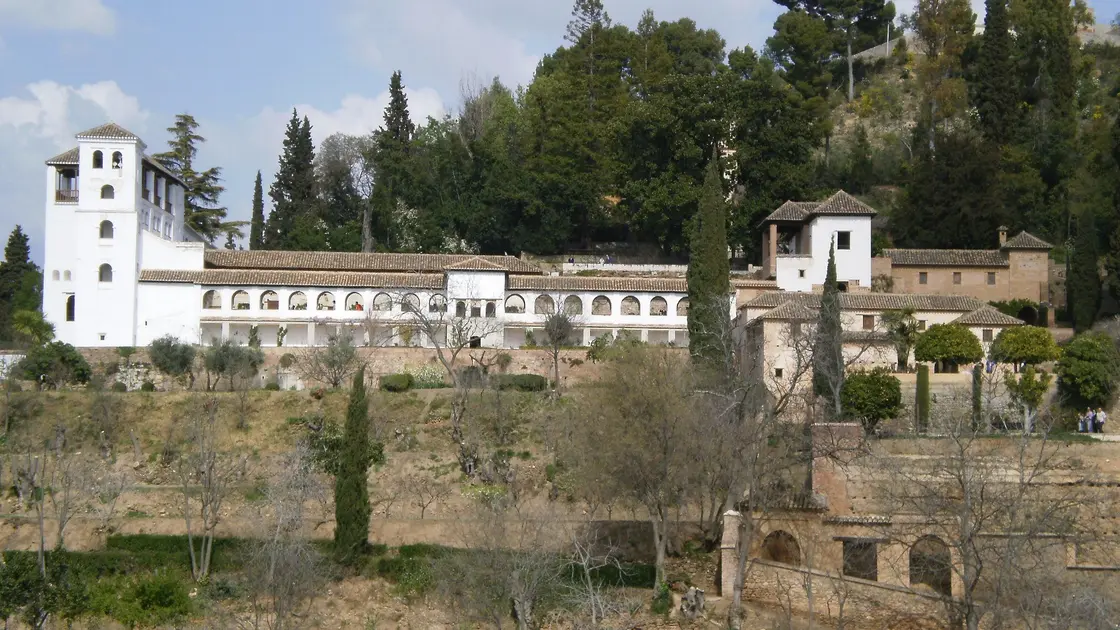
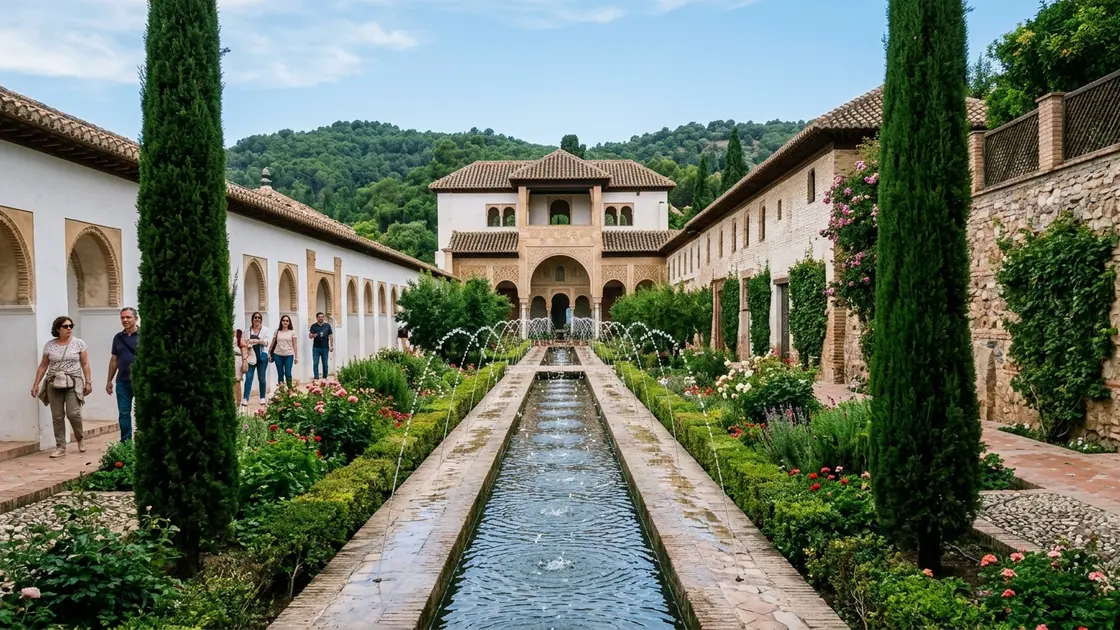
Alhambra
The Alhambra is Granada's UNESCO fortress-palace: Nasrid Palaces, Alcazaba and Generalife gardens. Tickets sell out weeks ahead; book via the Patronato site.
The former Jewish quarter today preserves the street layout of that medieval Judería. The church of Santiago el Mayor at the quarter's upper end was built on or adjacent to the site of the former main synagogue after 1492. The synagogue structure did not survive.
Why 1492? The causes of the expulsion
The year 1492 was not arbitrary. Three events converged in the first months of that year that made the expulsion both possible and, in Ferdinand and Isabella's framing, necessary.
The first was the fall of Granada on 2 January 1492. The completion of the Reconquista gave the Catholic Monarchs a unified Christian kingdom stretching from the Atlantic to the Mediterranean. A religiously plural state, functional in various forms for seven centuries, had just been replaced by a project of confessional unity. The decree three months later was part of the same political logic.
The second was the Inquisition, established in Castile in 1478 and extended to Aragon in 1483.[1] Its targets were not Jews, who were protected under Spanish law, but conversos — the tens of thousands of Jewish converts to Christianity who had converted, often under threat, during the violence of 1391 and after. The Inquisition suspected, with some basis, that many conversos observed Jewish practices in private. Its method was interrogation, torture, and execution at the auto de fe.
Recommended tours
Tours are selected for quality, not commission. We earn a small fee if you book — at no extra cost to you.
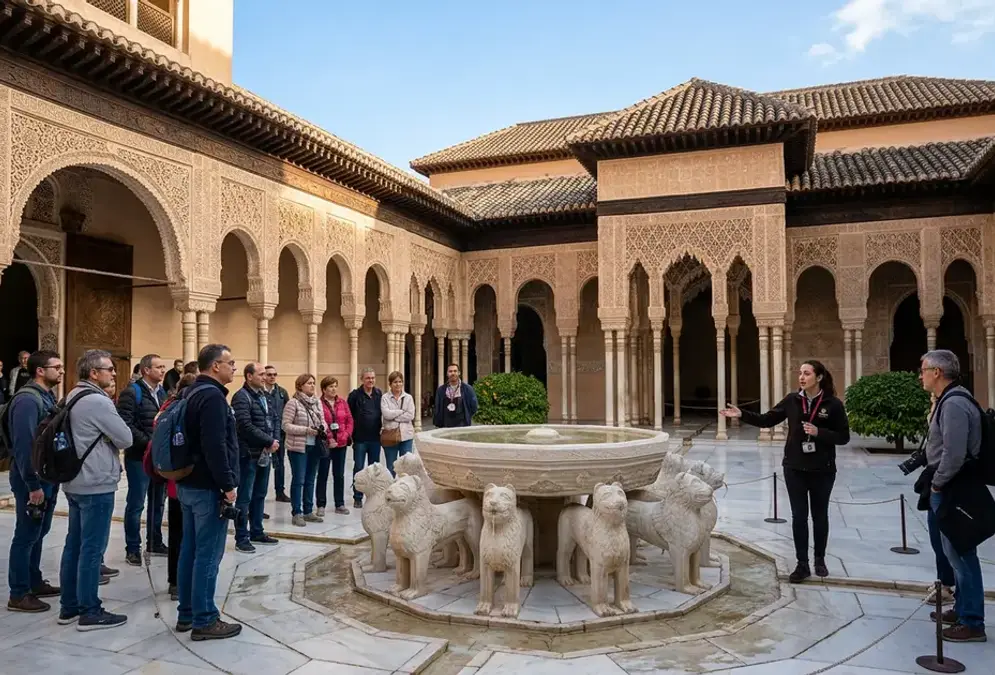
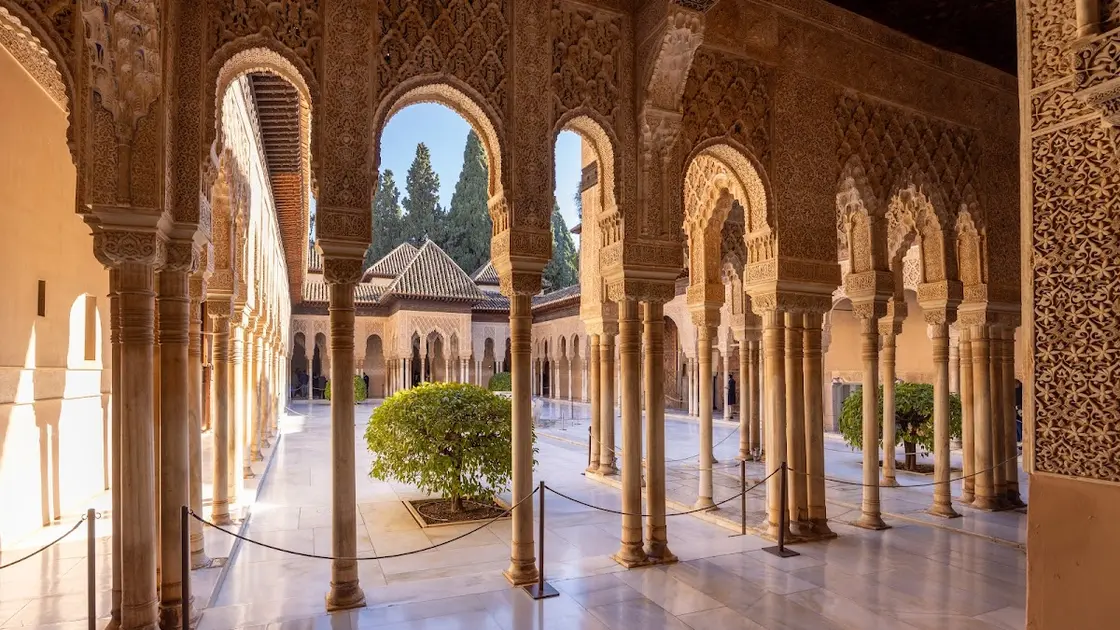
The third element was the financial reality of the Jewish communities' place in Spanish economic life. Jewish creditors held royal and noble debts; Jewish tax collectors administered revenues; Jewish physicians staffed royal courts. Cancelling debts owed to Jewish creditors and seizing property that could not be liquidated in four months was a windfall for the crown, whatever the theological justification said.
Conversos who had already converted were not expelled. They remained in Spain as subjects, under Inquisitorial surveillance. The people who left were those who refused conversion, choosing exile over apostasy. That refusal defined the Sephardic diaspora. The Muslim population of Granada would face a parallel decree ten years later: a 1502 royal order forced all Muslims in Castile to convert or leave, producing the community known as Granada's Morisco community — forced converts who continued practising Islam in secret for another century before Philip III expelled them entirely in 1609.
What else happened in Spain in 1492?
The Alhambra Decree was one of several events that made 1492 the year Spain's medieval map ended and its overseas one began, and all of them trace back to the same royal household camped in and around Granada. On 2 January, the city surrendered, ending eight centuries of Muslim rule in the peninsula. On 31 March, Ferdinand and Isabella signed the Alhambra Decree inside the palace they had just taken. On 17 April, the same monarchs signed the Capitulations of Santa Fe with Christopher Columbus at Santa Fe, the fortified camp they had built during the siege and kept using as a royal residence after the conquest. Columbus's first fleet departed from Palos de la Frontera on 3 August, three days after the decree's own deadline for Jewish departure had passed. Historians disagree on how directly royal finances connected the expulsion to the voyage; what is not in dispute is the chronology — the end of Al-Andalus, the expulsion of Granada's and Spain's Jewish population, and the authorization of Spain's first transatlantic voyage all happened within the same eight months, from the same court.
The exodus and the Ottoman welcome
Estimates of the total number of people expelled range from 40,000 to 200,000, with most historians placing the figure above 100,000.[2] The largest single destination was the Ottoman Empire.
Sultan Bayezid II responded to the expulsion with a decision that shaped Sephardic history for four centuries. Bayezid sent his navy to evacuate the refugees and issued a firman commanding provincial governors to welcome them.[3] His reported remark — that Ferdinand and Isabella had impoverished Spain while enriching his empire — may be apocryphal, but the policy was real. An estimated 100,000 to 150,000 Sephardic Jews settled in Ottoman territories.[3]
Portugal absorbed some refugees but expelled its own Jewish population in 1497 under dynastic marriage pressure from Spain.[2] North Africa — Morocco, Tunisia, Algeria — received communities that persist today. Italian cities, including Venice, Genoa, Rome, and Naples, absorbed Sephardic families on more conditional terms.
In Thessaloniki, Sephardic Jews became so numerous that by 1519 they made up more than half the city's population.[3] They ran its wool trade with Venice and the textile industry that supplied Ottoman armies. Saturday functioned as the city's weekly market holiday because the Jewish merchants who dominated trade would not work on the Sabbath. In 1493, one year after the expulsion, Sephardic refugees established the first printing press in Constantinople, producing Hebrew books in what would become the intellectual centre of the Sephardic world.[4]
Those who settled in Ottoman cities brought with them their language, their trades, their medical knowledge, and their commercial networks. The Ottoman Empire's millet system allowed them to govern their own communal affairs, maintain schools and courts, and practise their religion without the threat of an Inquisition. Gracia Mendes Nasi, from a converso family that fled Portugal in the 1530s, eventually controlled one of the largest financial networks in Europe from her Ottoman base, and organised escape routes for conversos still facing the Inquisition.[2]
The Nasrid dynasty had ended in January 1492. The empire that sheltered its displaced Jewish subjects outlasted it by another four centuries.
Sephardic identity and Ladino: the language that survived
The Jews expelled from Spain in 1492 carried their language into exile. Ladino (also called Judeo-Spanish or Judezmo) was the medieval Castilian they spoke in 1492, preserved in diaspora communities while the Spanish language itself continued to change.[4] Communities in Thessaloniki, Istanbul, Sofia, and Sarajevo were still speaking a recognisably 15th-century Spanish into the 20th century, a linguistic time capsule that linguists have studied extensively. A Ladino speaker from 1900 could read Spanish texts from the 1490s that a modern Spanish speaker would find difficult.
Sephardic communities did not only preserve language. They maintained liturgical melodies (cantares), cooking traditions with specific Iberian roots, and a mythology of Spain as a lost world. Granada occupied a particular place in this mythology: the last Andalusian city to fall, where the community had reached its highest point under Samuel HaNagid, and from whose palace the final decree had been signed.
The memory compressed and simplified history — the 400 years between the 1066 massacre and 1492 had seen significant contraction of Jewish life in Granada — but memory does not require accuracy to carry emotional weight. Sephardic families in Istanbul in the 17th century who had never seen Spain kept keys to houses their great-grandparents had left in Seville, Toledo, and Granada. The houses were long gone, owned by others. The keys survived because the idea of return survived, even when return was not seriously contemplated.
Deep dive · Article
Convivencia in Granada: how three faiths lived side by side
Christians, Muslims, and Jews in Nasrid Granada: the legal framework, the intellectual exchange, and the episodic violence that convivencia contained.
Ladino as a spoken vernacular suffered its greatest blow in the Holocaust. The Sephardic community of Thessaloniki, which had maintained the language for four centuries in its fullest form, lost 96 per cent of its members between 1943 and 1945.[2] Today Ladino is classified as an endangered language, spoken by a small number of people worldwide, most of them elderly. The 15th-century Castilian that left Granada with the exiles is close to extinction.
Granada today: the Jewish legacy on foot
The physical remains of Granada's Jewish community before 1492 are sparse, but the neighbourhood that was once the Judería rewards a slow walk with some preparation.
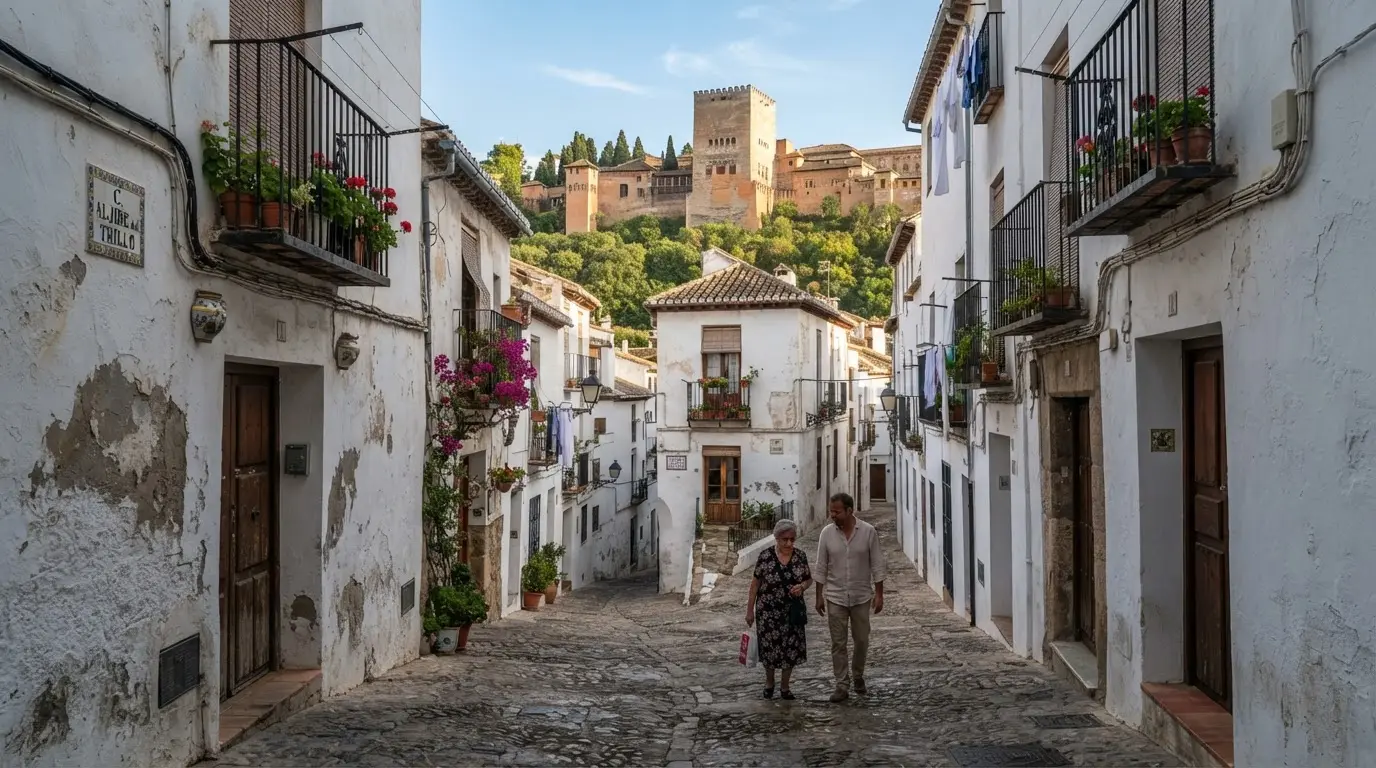
The Realejo is the place to start. The medieval quarter — called Garnata al-Yahud, Granada of the Jews — covered the slopes south of the Alhambra hill. The street layout follows the medieval plan: narrow lanes, sudden courtyards, dead ends where the hill drops sharply. At the upper end of the Realejo, the church of Santiago el Mayor occupies the site of the former main synagogue. After 1492, conversion of synagogues to churches was standard across Spain; the earlier structure is entirely gone, but the site location matters.
Read next · Neighborhood
Realejo / Jewish Quarter
Medieval Granada's Jewish quarter, now a neighbourhood of historic palaces, street art, and the city's finest tapas bars — all at the foot of the Alhambra.
The Sephardic Museum of Granada (Casa de los Mártires), on Calle Calderería Nueva, documents the expulsion and the subsequent Sephardic diaspora. It is a small institution not prominent on the main tourist circuit, which means it is usually quiet — a better environment for the material than a crowded gallery would be.
Two minutes from the Realejo, the Royal Chapel (Capilla Real) on Calle Oficios is the burial site of Ferdinand and Isabella. They chose Granada for their mausoleum because it was the prize of the Reconquista. Standing at their tomb, inside the chapel adjacent to a cathedral built where a mosque stood, near the neighbourhood that was once the city's Jewish quarter: the layers are legible if you know what to look for.
In 2015, Spain passed a law offering citizenship to Sephardic descendants who could prove their heritage through Ladino proficiency, documented family origin, or other means.[5] The application process was demanding and the deadline passed without large uptake, but the law was a formal acknowledgement that the expulsion was a wrong. The Realejo, for its part, remains a functioning neighbourhood — bars, laundry lines, children heading to school — on top of ground that carries five centuries of history beneath it.