The Alhambra is the best-preserved medieval Islamic palatial complex in the world, a fortified city on the Sabika hill above Granada that combines military architecture, royal palaces, and formal gardens into a single UNESCO World Heritage Site. Construction began under the Nasrid emir Muhammad I in the mid-13th century and continued under his successors for two hundred years, until the Catholic Monarchs took the city in 1492.
Its Arabic name, al-Hamra or "the red one", describes the reddish fortress walls.
What survives is extraordinary in its completeness: towers, walls, the Nasrid Palaces, the Generalife summer retreat, and the Renaissance Palace of Charles V, all inside one fortified perimeter.
When to Visit
Best season
March to May and September to November
Quietest hours
First entry at 8:30 or post-lunch slot around 14:00
Visit duration
3 to 4 hours
What to see inside the Alhambra
The complex divides into four areas, each built at a different point across the Alhambra's 250-year construction. The Alcazaba, the oldest part, is the military fortress at the western end, whose watchtower gives the clearest view of the Albaicin hillside opposite. Its construction runs some 350 years earlier than the Nasrid Palaces, a sequence covered in the Alcazaba, older than the Alhambra. The Alhambra came closest to total loss during the French occupation of 1810 to 1812: as the garrison withdrew, it blew up several towers along the walls, leaving the Torre de Siete Suelos and the Torre del Agua in ruins, an episode detailed in Granada under Napoleon.
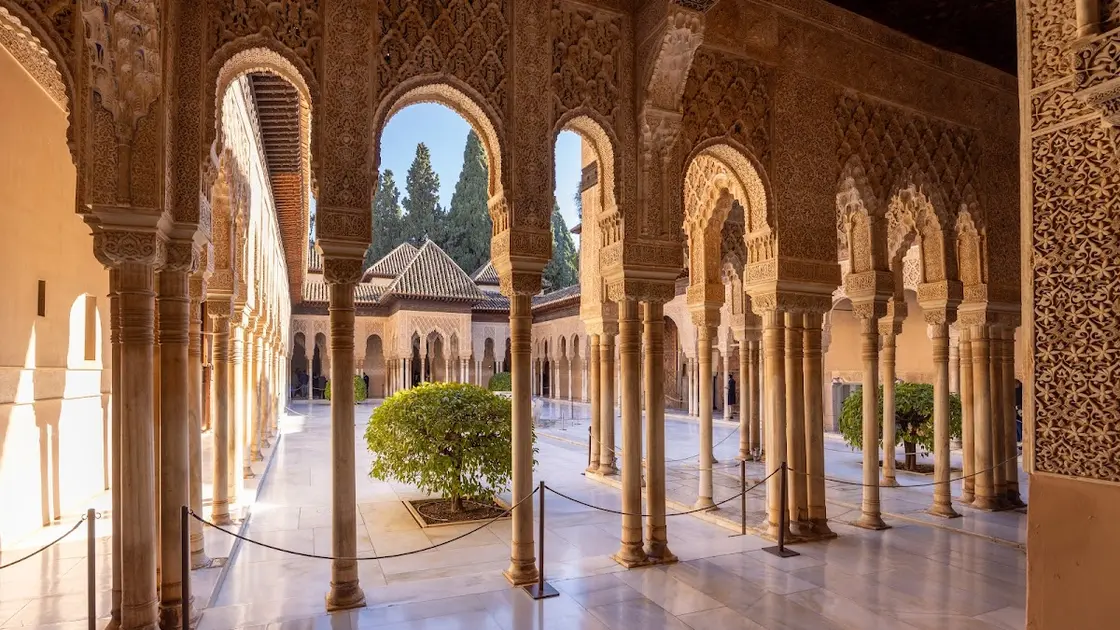
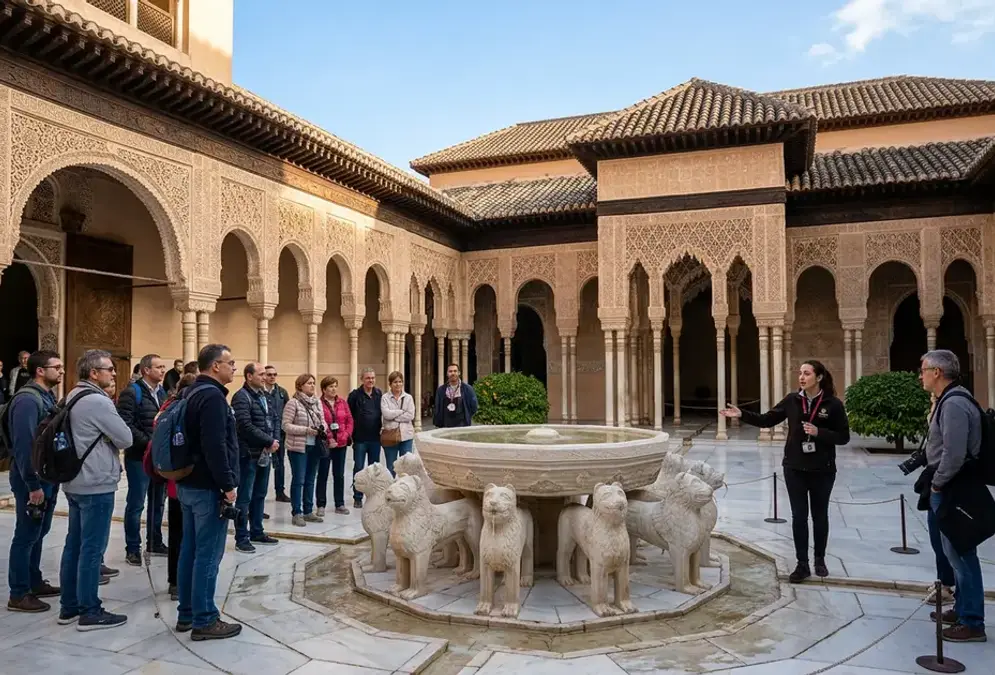
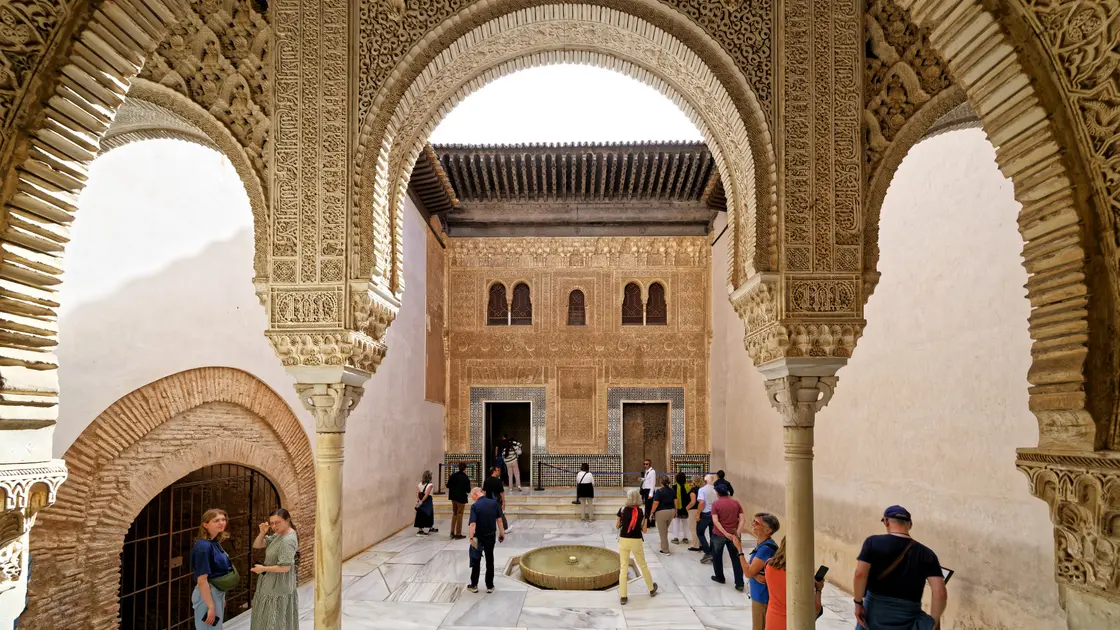
The Nasrid Palaces are the palatial core: three interconnected royal houses, the Mexuar (administrative and judicial chambers), the Comares Palace (the sultan's official residence, built around the Court of the Myrtles), and the Palace of the Lions (the private royal quarters). Their plasterwork and tile are among the most elaborate surviving examples of Andalusian Islamic art. At the heart of the Palace of the Lions, the Court of the Lions, built by Muhammad V between 1362 and 1391, is a private royal courtyard whose twelve-lion fountain, 124 marble columns, and four paradise-garden water channels make it the most decoded space in the complex.
The Arabic verse inscriptions lining its friezes and fountain basin were composed by Ibn Zamrak, Muhammad V's court poet and vizier, whose casidas are carved into the stucco of the Hall of the Two Sisters and the Court of the Lions and survive today. Not every room escaped unscathed: fire gutted the Comares Palace's Sala de la Barca in 1890, and the carved wooden dome visitors see there now is a 1965 reconstruction built from pre-fire drawings and photographs, a story told in the 1890 fire in the Sala de la Barca.
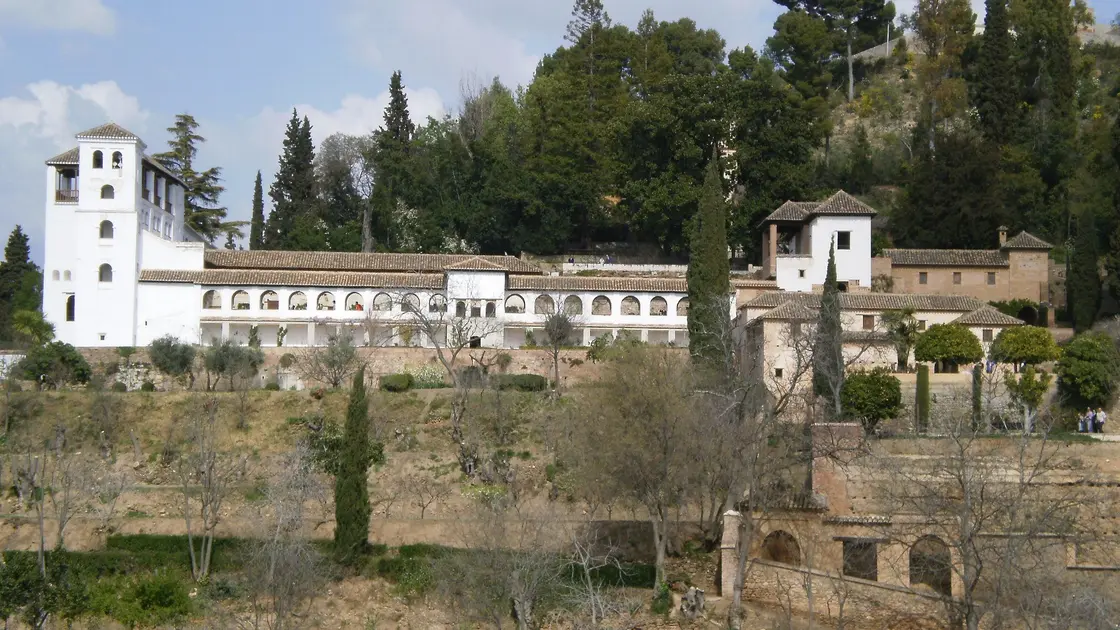
The Palace of Charles V, begun in 1527, is a square Renaissance building with a circular inner courtyard that sits somewhat incongruously within the Moorish complex but holds an excellent Alhambra museum. The Generalife, reached by a short path through the upper gardens, was the Nasrid sultans' country estate, with its own celebrated water garden.
Your entry slot for the Nasrid Palaces is fixed — plan everything else around it
When you book, you choose a 30-minute window to enter the Nasrid Palaces. Miss it and you lose access. Plan to arrive at the Alhambra 45 minutes before that slot, using the time for the Alcazaba or gardens first.
- Mid-13th century
Muhammad I begins construction
The Nasrid dynasty's founding emir starts building on the Sabika hill.
- 1362–1391
Muhammad V builds the Court of the Lions
The palace's most celebrated courtyard, with its twelve-lion fountain and 124 columns.
- 1492
Catholic Monarchs take Granada
The Nasrid dynasty's two centuries of rule over the Alhambra come to an end.
- 1527
Palace of Charles V begun
A square Renaissance palace with a circular inner courtyard, added inside the Moorish complex.
- 1810–1812
Retreating French troops blow up towers
Napoleon's garrison mines the walls as it withdraws; the Torre de Siete Suelos and Torre del Agua are left in ruins.
Tickets, hours, and booking
Practical planning matters here more than at almost any other monument in Spain. Daily entry to the Nasrid Palaces is capped at 300 visitors per timed half-hour slot, and tickets sell out weeks or months ahead in spring and summer. The official booking channel is tickets.alhambra-patronato.es; third-party sellers charge a premium for the same allocation.
That cap is the latest stage of a management history going back to 1993: see how the Alhambra learned to ration a 200-year-old pilgrimage. Night visits are centred on the Nasrid Palaces, with the Palace of Charles V and the Gate of Justice on the route but not the Alcazaba or Generalife gardens, and run Tuesday to Saturday from 22:00 to 23:30 in the April-to-October season or Friday and Saturday from 20:00 to 21:30 in winter; they provide an entirely different atmosphere and are easier to book at short notice than a daytime slot.
300
How to plan your visit
Allow a full half-day, ideally three to four hours. Most visits start at the Alcazaba, move through the Nasrid Palaces at the booked time slot, and finish with the Generalife gardens, though the order can run either way around the fixed Nasrid slot.
Walking the complete circuit from the Alcazaba through the Nasrid Palaces and up to the Generalife covers around three kilometres on uneven historic paving, so comfortable shoes and water are essential. The Alhambra sits roughly 100 metres above the city centre and is reached on foot via the steep Cuesta de Gomerez, by the dedicated Alhambra bus from Plaza Isabel Catolica, or by road if arriving by taxi or car.
The same recognisability that draws millions of visitors keeps film crews away. Steven Spielberg scouted the Nasrid Palaces for Indiana Jones and the Last Crusade, then judged the monument too visually familiar to pass off as anywhere else, sending his production to Guadix instead: why the Alhambra rarely appears on screen is its own story.