Ibn al-Ahmar, the Ploughman Who Founded Nasrid Granada
Ibn al-Ahmar rebelled at Arjona in 1232, surrendered Jaén in 1246 and founded Nasrid Granada, the last Muslim state in Iberia. How a vassal bought time.
Seven years resident in Granada. Specialist in Nasrid architecture, Al-Andalus history, and Andalusian walking routes.
Published
On 16 July 1232 a mosque assembly in Arjona declared the town's independence[1]; the man behind it, Ibn al-Ahmar, whom the Castilians called Alhamar el Rojo for his coppery beard[2], would found the Nasrid dynasty of Granada. His emirate outlived him by two centuries[3] because in 1246 he surrendered Jaén and accepted Ferdinand III's overlordship in return for a 20-year truce[4]. If you came for the Court of the Lions, that is a later sultan's story; this one is about the man who made the hill worth decorating.
Before 1232 Muhammad ibn Yusuf was, in the Primera Crónica General's unkind phrase, a man whose only trade was following the oxen and the plough[5]. He came from Arjona, a frontier town. His supposed descent from Sa'd ibn Ubadah, a companion of the Prophet, is read by the University of Granada historian Bárbara Boloix as a prestigious genealogy created to legitimise the power of his new line[6]; the fullest version comes from the Nasrid court author Ibn al-Khatib[7].
The world he rebelled in was already in pieces. The death of Caliph Yusuf II without an heir in 1224 had cracked the Almohad caliphate and left Al-Andalus to rival taifa rulers[8]; by 1232 the strongest of them was Ibn Hud, and Muhammad ibn Yusuf rose against him from his own town[9].
Nothing about that July promised a state. He held one fortified town in a country where strongmen rose and fell within a few years, and his next four years proved how little that was worth. The Almohad collapse had opened the field, but it opened it to anyone with a few hundred men and a grievance. What set him apart was not the first move; it was how many times he was willing to change the second.
Switching sides: from Córdoba to Granada
The proclamation was the easy part. Seville, taken in 1234, lasted barely a month in his hands[10].
So in 1236 he made the choice that explains everything after it: he turned on Ibn Hud and helped Ferdinand III of Castile take Córdoba, ending centuries of Muslim rule in the old caliphal capital[11]. It is an uncomfortable fact for anyone who wants a pure hero, and it is the clearest sign of the logic that governed his reign. Survival came first, and loyalty to a cause came a long way behind.
Granada was the reward. In 1237 or 1238, depending on the source, the city's notables invited him in and he made it his capital[12]. When he rode in, as Ibn al-Khatib tells it, he looked like a sufi, in a plain wool cap, coarse clothes and sandals[13]. It is hard not to read that as a message, my reading rather than a documented one: the man who had just helped Castile take Córdoba arrived looking like a penitent, not a conqueror.
The red hill: what he actually built
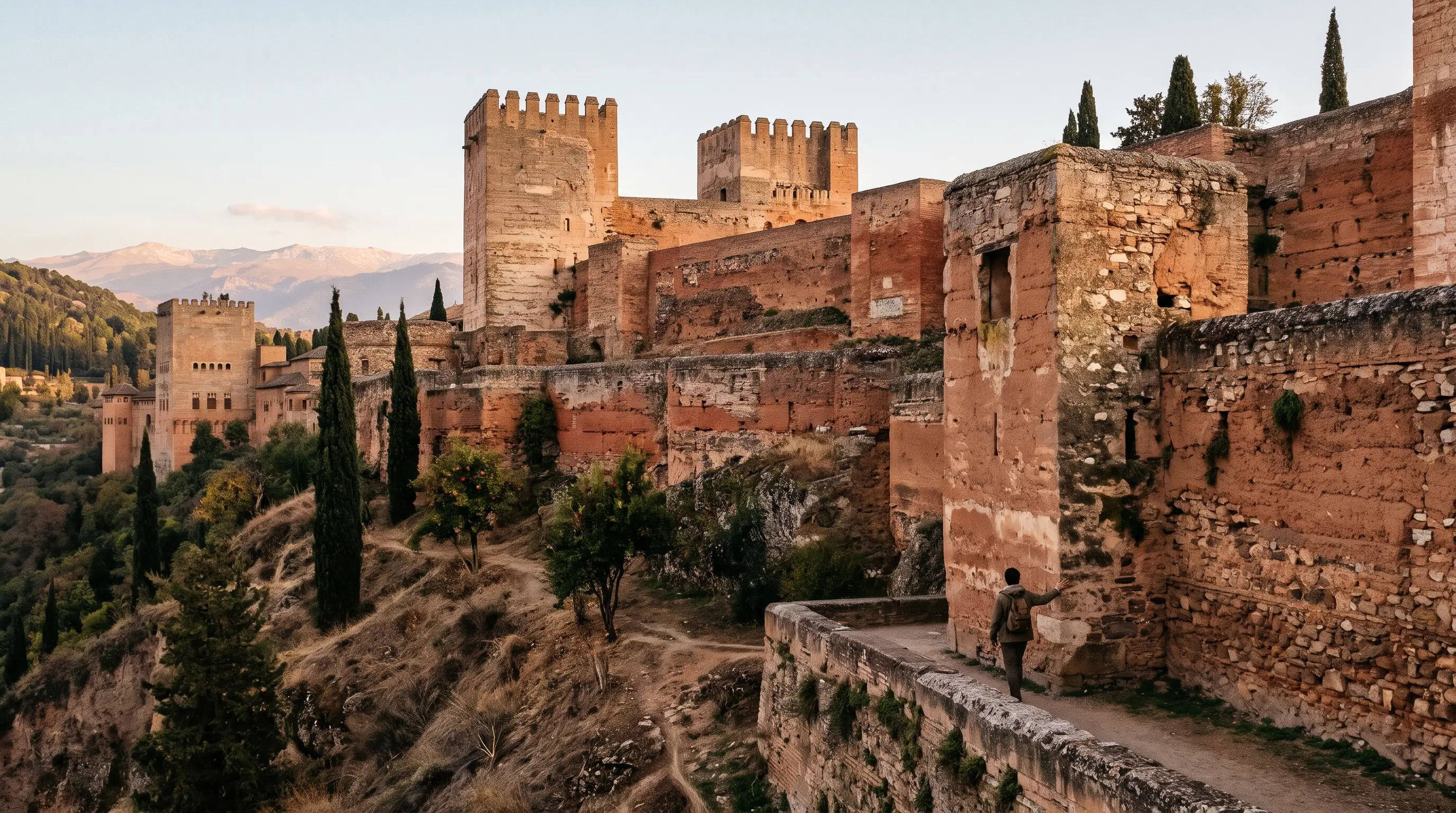
Ibn al-Ahmar chose his hill before he chose his palace. After taking Granada he inspected al-Hamra, where a small fortress already stood, and laid foundations there for his future residence and fortress[14]. The work was practical: three new towers on Sabika Hill, repairs to the ruined ones, and water channelled from the Darro River to make the summit habitable[15][16].
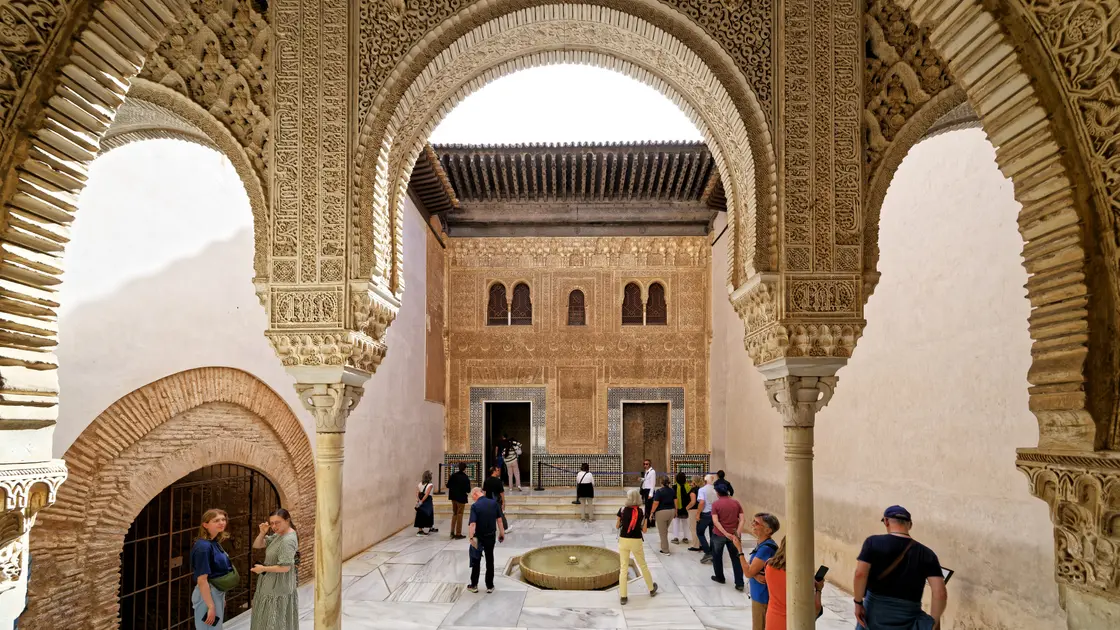
The credit needs care. The Alhambra was built mainly between 1238 and 1358 under Ibn al-Ahmar and his successors[17], and the Patronato that runs the site gives the title of first great builder to Yusuf I, not to him[18]. The founder's contribution was the unglamorous part, a defensible, watered hill that later sultans could decorate.
The bargain that defined his reign was struck outside Jaén. Castile besieged and took his hometown, Arjona, in 1244[19]; the next year Ferdinand III closed in on Jaén, judging it safer to cut the city off and starve it than to storm it[20]. In March 1246, seven months into the siege, Muhammad agreed terms[21].
As modern accounts give them, the terms were these:
He kissed Ferdinand's hand to mark his vassalage and promised "counsel and aid"[22]
He paid a yearly tribute that modern accounts put at 150,000 maravedíes[23]
He owed military help whenever Castile asked, for the 20 years of the truce[24]
Jaén's Muslim inhabitants were expelled once the Castilians entered[25]
Call it vassalage or protection money, the logic was brutal and it worked. Castile's kings preferred Nasrid gold, and Nasrid rulers preferred paying it to risking total war[26]. That trade of gold for time is the root of Nasrid tribute to Castile, and it kept the emirate alive for two more centuries[3].
The cost was real. A ruler who kisses a king's hand in public loses something among his own people, and Ibn al-Ahmar spent the rest of his life paying that debt in soldiers, tribute and careful diplomacy. For the next decades the question was never whether Granada was free, only how much unfreedom it could afford.
Loyal vassal, then revolt: 1248 to 1273
Ferdinand collected quickly. In 1248 Muhammad sent a contingent to help Castile take Muslim-held Seville[27], and one account puts it at about 500 horsemen[28]. In 1254 he attended the Cortes at Toledo, renewing his loyalty and tribute before Alfonso X[29].
The emirate this paid for was small but relatively wealthy and densely populated[30], and its population grew as Muslims expelled from Castilian conquests settled there[31]. Survival, for Ibn al-Ahmar, meant being a place refugees could reach and Castile could tax.
Timeline
1232
Arjona declares independence
1236
Córdoba falls to Castile
He helps Ferdinand III take the city
1237 or 1238
Granada becomes his capital
The city's notables invite him in
1246
Jaén surrendered
Vassalage and a 20-year truce
1248
Granadan contingent at Seville
1264-1266
Mudéjar revolt and the Ashqilula rebellion
1273
Dies after a fall from his horse
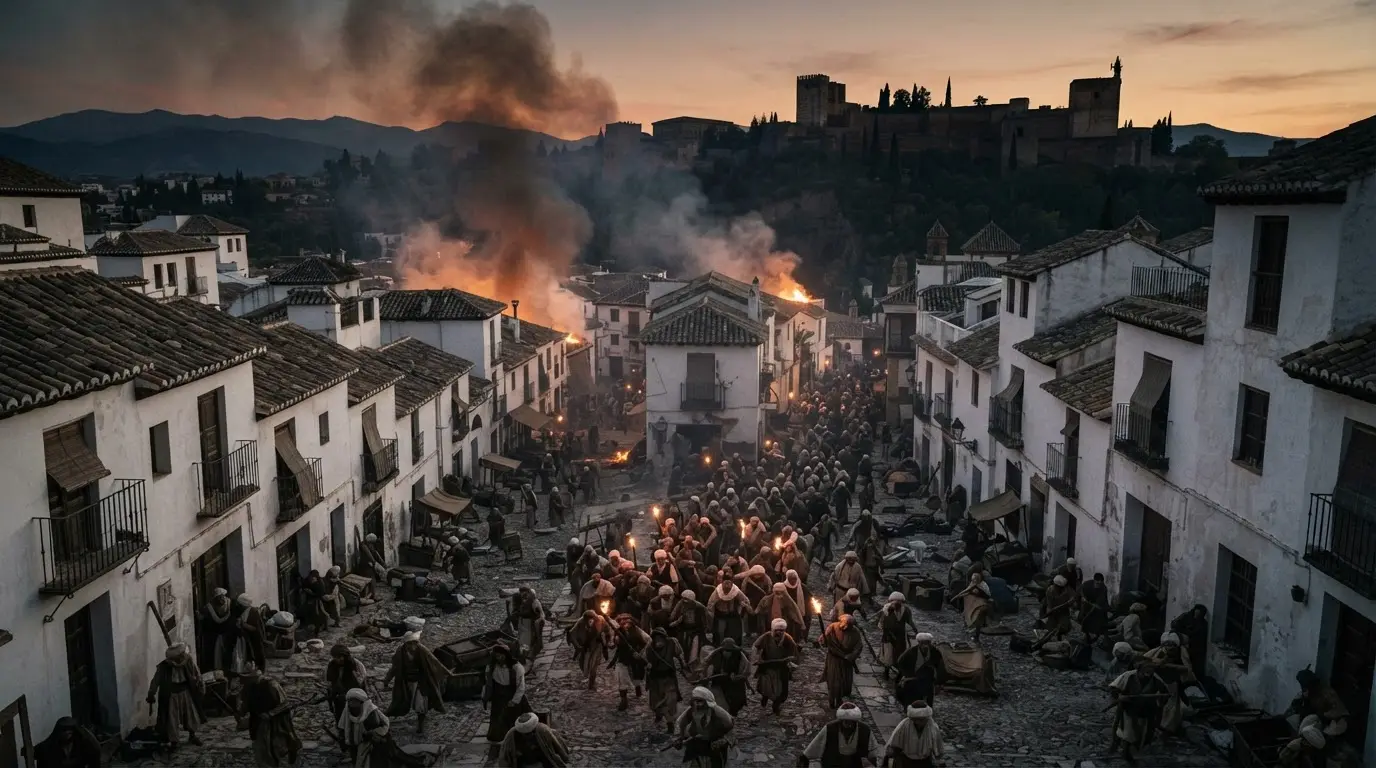
The peace broke in 1264. On a night in Seville that year the Castilians locked and barricaded the area where he was staying[32]. By 1266 Granada was still fighting in the Mudéjar revolt when the Banu Ashqilula, allies from his own rise, rebelled against him[33].
The treaty that ended the fighting was costly, but it ensured the emirate's survival and left Granada the only independent Muslim state in the peninsula[34].
Ibn al-Ahmar died after a fall from his horse on 22 January 1273[35]. He was buried in a cemetery on Sabika Hill, east of the Alhambra[36], and on his deathbed advised his heir, Muhammad II, to seek Marinid protection against the Christian kingdoms[37].
What survives on the hill today
The historian L. P. Harvey judged that he "managed to snatch from disaster ... a relatively secure refuge for Islam in the peninsula"[38]. It is a fair verdict on a man who bought time rather than victories.
Recommended tours
Tours are selected for quality, not commission. We earn a small fee if you book — at no extra cost to you.
The hill is the place to test it. Start at the Alcazaba, the fortress end of the Alhambra, and look down to the Darro: walls, towers and water were his programme. The Alhambra and the Albayzín are together a UNESCO World Heritage property, and the Alhambra is the only preserved palatine city of the Islamic period[39]. Give the walls an unhurried look before you head for the palaces; the point of the founder's work is that you were never meant to notice it.
The emirate lasted two centuries after him and ended when Castile annexed it in 1492[3]; the hill he fortified outlived both.
Frequently asked questions
Who was Ibn al-Ahmar?
Ibn al-Ahmar, born Muhammad ibn Yusuf in the frontier town of Arjona, founded the Nasrid dynasty and the Emirate of Granada. He rebelled in 1232, took Granada in 1237 or 1238 and, after surrendering Jaén in 1246, became a vassal of Ferdinand III. Ferdinand died in 1252 and the vassalage passed to Alfonso X; Muhammad broke with Castile in 1264 and died in 1273.
Why is Ibn al-Ahmar called the Nasrid founder?
The Nasrid house and the Emirate of Granada both begin with him. He took Granada in 1237 by invitation of its notables, made it his capital and began the fortress on the Alhambra hill. Some accounts date his entry to 1238, so the founding year is sometimes given differently.
Why was Muhammad I called Alhamar el Rojo?
Castilians gave him the nickname Alhamar el Rojo, the Red, for his coppery beard. Ibn al-Ahmar is the name under which he appears in most English accounts, and Muhammad I is his regnal numbering.
Why did Muhammad I become a vassal of Ferdinand III?
Because Jaén was being starved out. After Arjona fell in 1244 Ferdinand besieged Jaén, and in March 1246 Muhammad accepted overlordship in exchange for a 20-year truce, trading a hand-kiss, military aid and a yearly tribute for the survival of his emirate.
Who started building the Alhambra?
Muhammad I laid the foundations of a residence and fortress at al-Hamra, but the Patronato de la Alhambra calls Yusuf I the first great builder. Think of Ibn al-Ahmar as the founder of the hill's defences and water supply, and his descendants as the builders of the palaces.
How did Ibn al-Ahmar die, and where is he buried?
He died on 22 January 1273 after a fall from his horse. He was buried in a cemetery on Sabika Hill, east of the Alhambra, and his son Muhammad II succeeded him.
How much tribute did Granada pay Castile?
Modern accounts put the yearly tribute agreed after Jaén in 1246 at 150,000 maravedíes. The figure rests on a small number of secondary accounts, so treat it as an estimate rather than a ledger entry.
“Furthermore, the sources that offer the most detail were written by Nasrid authors closely linked to the sultans of the Alhambra, especially Ibn al-Khatib.”
“The Almohad caliphate, which had dominated Al-Andalus or the Muslim Iberia, was split by a dynastic struggle after Caliph Yusuf II died in 1224 without an heir.”
“Ferdinand did not want to risk assaulting the city, so his tactic was to cut it off from the rest of the Muslim territory and starve it into submission.”
“Muhammad surrendered the city and agreed to pay Ferdinand an annual tribute of 150,000 maravedíes—an amount that became Ferdinand's most important source of income.”
“hubo de declararse vasallo del rey castellano, pagar anualmente la cifra de 150.000 maravedíes al año y prestar ayuda militar si era requerido por un periodo de 20 años.”
“los reyes castellanos preferían su oro y los soberanos nazaríes estuvieron más dados a pagarlo anualmente o cuando fuera menester que a meterse en una guerra total”
“In 1254, Muhammad attended a Cortes, or an assembly of Alfonso's vassals, at the royal palace in Toledo, where he renewed his promise of loyalty and tributes”