
How the Granada Inquisition began: a 1499 court, a 1526 tribunal
The tribunal that sat in Granada from 1526[4] until 1834[5] is easy to misdate. In those 308 years it prosecuted 1,702 Moriscos by the historian García Ivars's count, or 2,017 if you include those who tried to flee to Africa.[3]
A first, short-lived court was set up on 7 September 1499, seven years after Granada joined the Crown of Castile, and it lasted only until 1501 or 1502.[6] So 1501 belongs to the end of that experiment, not to the lasting institution.
Before 1526 the kingdom of Granada answered to the Córdoba tribunal.[7] The Jaén court, set up in 1483 as the third in the peninsula after Seville and Córdoba,[8] was amalgamated with Córdoba's only in 1526,[9] the year Granada got a court of its own. That is when the inquisitorial map of Andalusia was redrawn.
The Holy Office entered the city in November 1526.[10] Garrad ties its arrival to the Congregation of the Royal Chapel, a church commission on religious reform in the diocese that wanted Muslim rites among the New Christians ended. A reform board asked, and a court of trial and confiscation was sent.
Jurisdiction, jails and confiscation
The tribunal's reach was wider than the city. It covered the whole Kingdom of Granada, plus three neighbouring dioceses and one abbey:[1]
- the bishopric of Málaga
- the bishopric of Guadix
- the bishopric of Almería
- the abbey of Baza
That took in the coast, the Alpujarras valleys and the Almería interior, so a denunciation from a village a long mule ride away could still end in a cell in Granada.
The jails stood in a lane running off calle Elvira, close to Plaza Nueva.[11] They were not generous places. In 1557 a jailer testified that there was nowhere to give a sick prisoner "a little sun", and Garrad quotes the line.[12] You can see the problem in that one sentence: a prison with no yard and no light was also where people waited, sometimes for years, for a hearing.
Conviction also had a financial side. Those condemned for heresy had their property confiscated.[13] For a family with land or a workshop, a verdict emptied the household as well as shaming it.
Who the Granada tribunal prosecuted: Moriscos first, conversos later
The Moriscos existed because of a decree. In 1502 the Catholic Monarchs required Muslims living in Spain to convert to Christianity.[14] The Granada court then spent much of its first century on what it saw as their leftover habits: it mostly pursued behaviour perceived as Islamic in origin, including speaking Arabic.[15] For the people on trial, the full story is in the Moriscos of Granada.
The early decades were less bloody than the myth suggests. Garrad's blunt comparison is that between 1529 and 1568 the military governors of the Alhambra had more Moriscos quartered for banditry than the Inquisition burned for heresy.[16] The tribunal's weight was pressure, surveillance and confiscation.
1,702
The second target was the descendants of Jews who had accepted baptism rather than leave under the Alhambra Decree of 1492. Over the tribunal's life, 2,091 people were prosecuted as Jews,[17] which is more than the Moriscos' 1,702 and shows how far attention swung over three centuries.
Some of these cases reached the city's elite. A 1591 auto became well known because some of the accused came from families whose members held posts in the Chancillería, the royal court of appeal.[18] The pattern lasted into the 1700s: one of the first notable early-18th-century cases was against Juan de Pineda, a tobacco merchant from Alcalá del Valle, and it opened a wave against converso merchants.[19]
A court founded to police Muslim ritual was still hunting alleged Judaizers in the 1700s. That drift tells you more about the institution than any single trial: it needed a category of suspects, and found the next one when the old one ran out.
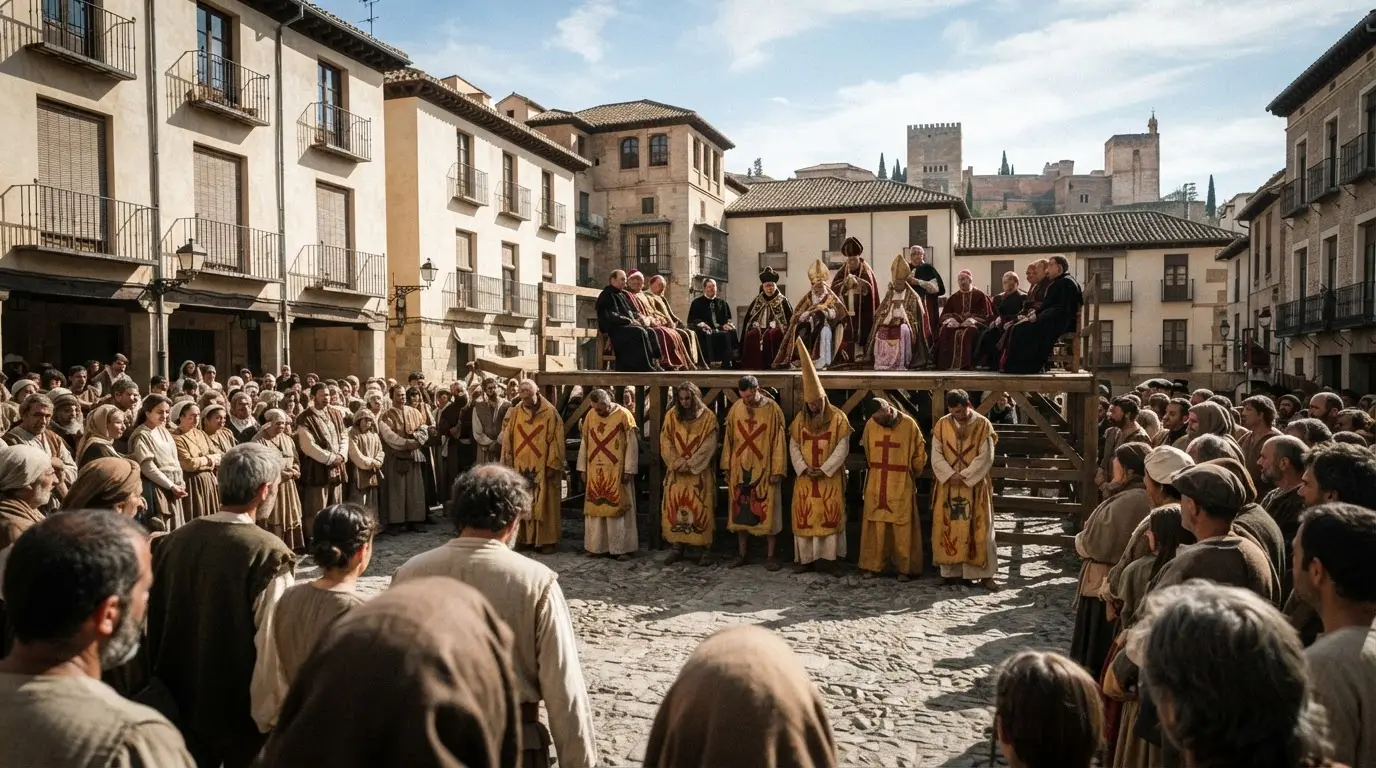
Autos de fe: Plaza Nueva, Bibarrambla and San Jerónimo
The public sentences moved around the city. Autos de fe were held in Plaza Nueva, near the Holy Office's jails, until 1593; from then on they were staged in Plaza Bibarrambla.[20] The first public auto with a complete surviving account is from 1550.[21]
Not every ceremony was a spectacle. An autillo was a smaller affair held inside a church, and the 17th century alone saw 146 of them, the great majority in the church of Santiago.[2] The scale of the grand square events, in other words, was the exception; most of the court's public work was done indoors and quietly.
The 1615 auto is a case where two sources give different counts. The chronicler Henríquez de Jorquera dates it to 28 May, Ascension Day, in Bibarrambla,[22] and says 83 people, men and women, were penitenced, many of them from the Carpio family line.[26] Another account puts the sentence at 34 people, 14 men and 20 women.[23] The two figures are left here as the sources give them.
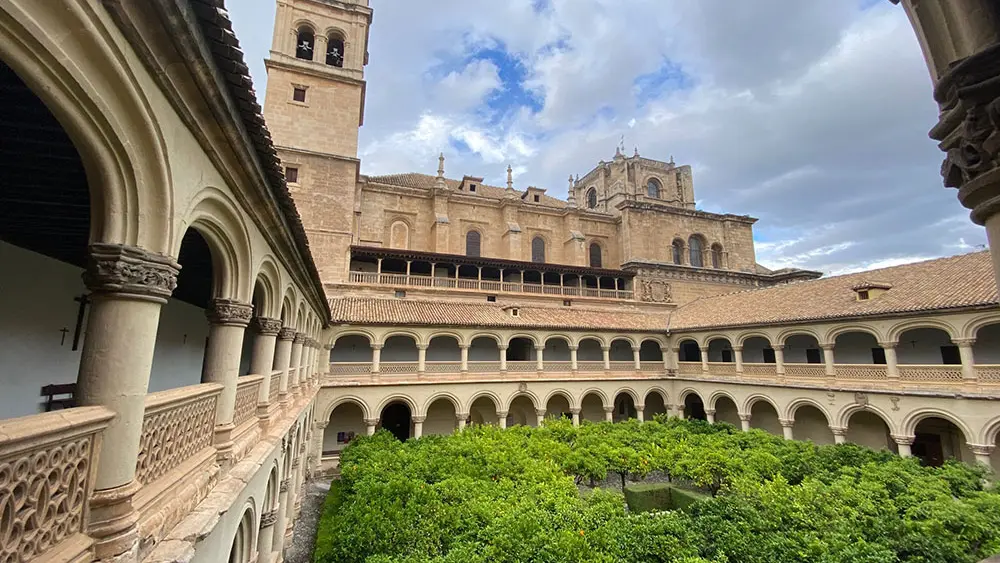
The monastery of San Jerónimo is the last stop. Here the last general auto de fe known to have been held in Granada took place.[24] The same building a visitor now enters for its Renaissance church was, on that day, a stage for public penance.
Explore nearby · Monument
Monastery of San Jerónimo
San Jerónimo holds the tomb of the Great Captain in a Renaissance church completed in 1522, with a carved altarpiece and gilded ceilings of exceptional quality.
The end of the Granada tribunal in 1834
The tribunal was extinguished in 1834.[5] The national institution went the same way, closed by royal decree on 15 July 1834, while Isabella II was still a minor and a regent governed in her name.[25]
That is 342 years after the fall of the Nasrid city, and long after the Moriscos it was built to watch had gone. If you want to read the institution on the ground, four places carry the story:
- the lane off calle Elvira, where the jails stood
- Plaza Nueva, the setting of autos until 1593
- Plaza Bibarrambla, the setting after that
- the monastery of San Jerónimo, site of the last general auto on record
Deep dive · Article
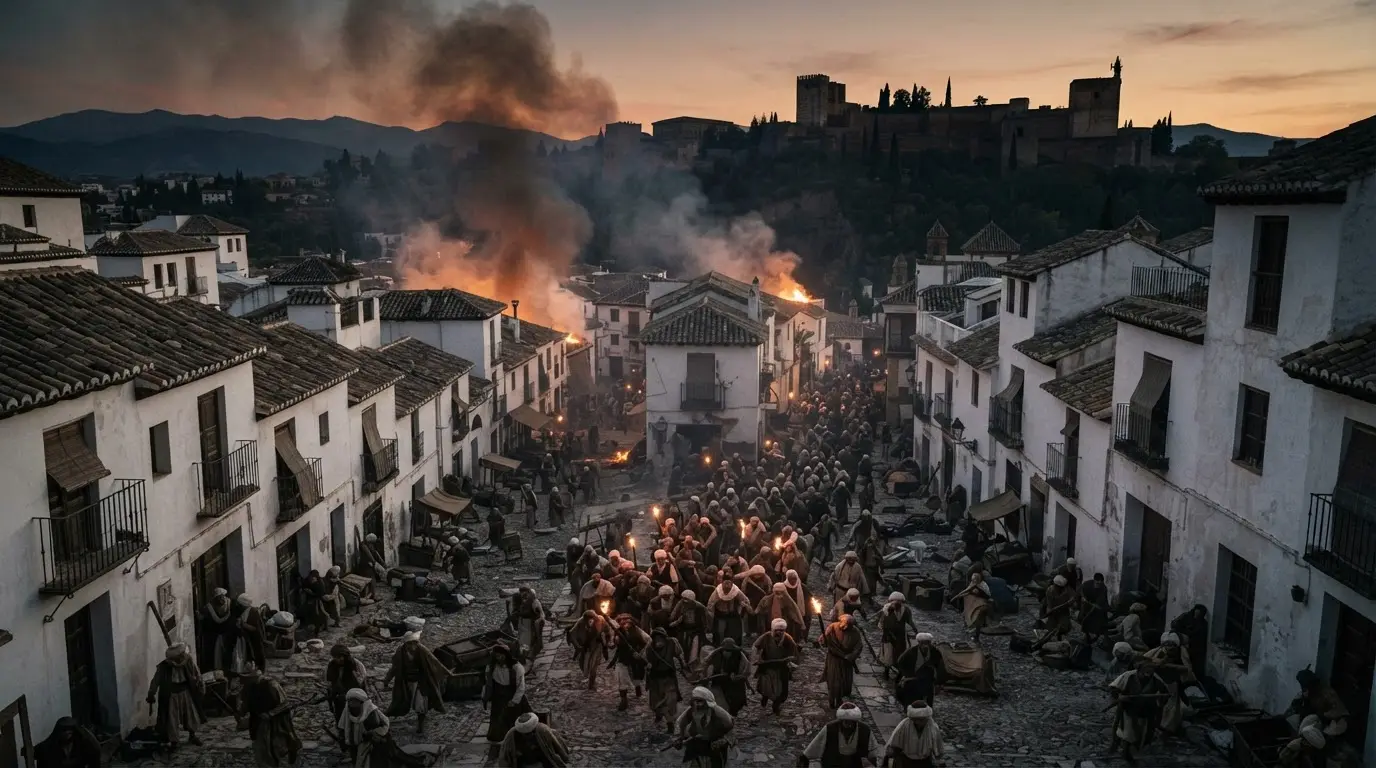
1066 Granada Massacre: When the Jewish Golden Age Ended in a Day
The 1066 Granada massacre killed Joseph ha-Nagid and thousands of the city's Jews in a single day, ending three decades of Jewish power under Samuel ha-Nagid.
The tribunal is best met in the archive and the street plan, not in a ticketed building. Most of the detailed scholarship is in Spanish, which is part of why English-language visitors rarely meet this institution at all.