Granada, August 1936: a city already at war
The Spanish Civil War began on 17 July 1936 with a military uprising in Spanish Morocco.[1] Within days, the Nationalist faction had seized control of Granada city. Republican supporters were arrested and executed in waves. The mayor, Manuel Fernández-Montesinos — married to Lorca's sister Concha — was among those detained. He would be shot on 19 August.
4,000+
Lorca had returned to Granada from Madrid in July, despite warnings from friends that the city was dangerous for a known leftist with a public profile. He had been a vocal supporter of the Popular Front government. He had signed manifestos. He had written poems mocking the conservative establishment. He was also homosexual, a fact the Nationalist press would use as a weapon.
By the first week of August, Lorca had moved from the Huerta de San Vicente — his family's summer home — into the house of his friend Luis Rosales, a poet and a member of the Falange Española. The Rosales family were prominent falangists. Lorca hoped their political connections would protect him. He was wrong.
16 August, morning: the arrest at the Rosales house
At around 10:30 on the morning of 16 August 1936, a group of armed men arrived at the Rosales family home on Calle de San Antón, in central Granada.[2] At their head was Ramón Ruiz Alonso, a former CEDA parliamentary deputy and a man with a personal grievance against Lorca.
Ruiz Alonso had been a right-wing journalist before entering politics. He claimed Lorca had mocked him in public. He also resented the Rosales family's protection of the poet. When he pushed through the front door, Luis Rosales tried to intervene. Ruiz Alonso told him to step aside or be arrested himself.
Lorca was found in an upstairs bedroom. He did not resist. He asked if he could pack a bag. He was told he would not need one.
“He was very pale, but he walked upright. He did not beg. He did not ask for anything. He went as if he had known this would happen.”
The arrest was carried out on the authority of the Civil Governor of Granada, José Valdés Guzmán, who had issued the order the previous evening. The official charge was never written down — the phrase used was actividades subversivas (subversive activities). In practice, the accusation was that Lorca was a socialist, a freemason, and a homosexual, and that he had written poems that damaged Spain.[3]
Lorca was taken on foot through the streets of central Granada to the Gobierno Civil (Civil Government building) on the Plaza de la Trinidad. Witnesses later recalled seeing him walk between his captors, pale but calm, wearing a grey summer suit.
48 hours inside the Gobierno Civil
For two days, Lorca was held in the Gobierno Civil building, under the direct supervision of the Civil Governor himself.[2] According to reconstructed witness testimony, he was kept in a small second-floor office with a desk, a chair, and a window onto an internal courtyard. The window was kept closed.[2]
He was not tortured, but he was interrogated repeatedly. The questioning focused on his political affiliations, his friendships with known Republicans — particularly Fernando de los Ríos, the former Minister of Education — and his writing. His homosexuality was raised as a moral charge. The interrogators used the word maricón (faggot).
Lorca did not name names. He admitted his support for the Republic but refused to implicate others. This may have sealed his fate.
Recommended tours
Tours are selected for quality, not commission. We earn a small fee if you book — at no extra cost to you.
During those two days, several people tried to save him. Luis Rosales appealed to his Falangist contacts, including his own brothers, who held senior positions in the party. The poet's family offered money. The Rosales family also reached out to José Antonio Primo de Rivera, the founder of the Falange, then held in a Republican prison in Alicante[2] — but he was in no position to help.
The intervention that might have worked came from Manuel de Falla, Lorca's old collaborator and a figure respected across political lines. Falla spoke to the military commander of Granada, Colonel José Baselga. Baselga indicated he was not opposed to Lorca's release. But the Civil Governor, Valdés Guzmán, and Ramón Ruiz Alonso overruled him. The decision to execute Lorca was made on the evening of 18 August.
- 16 August
Luis Rosales appeals to his Falangist brothers
- 17 August
Manuel de Falla speaks to Colonel José Baselga
- 18 August, evening
Valdés Guzmán and Ruiz Alonso overrule Baselga, confirm execution order
18 August, night: the road to Víznar
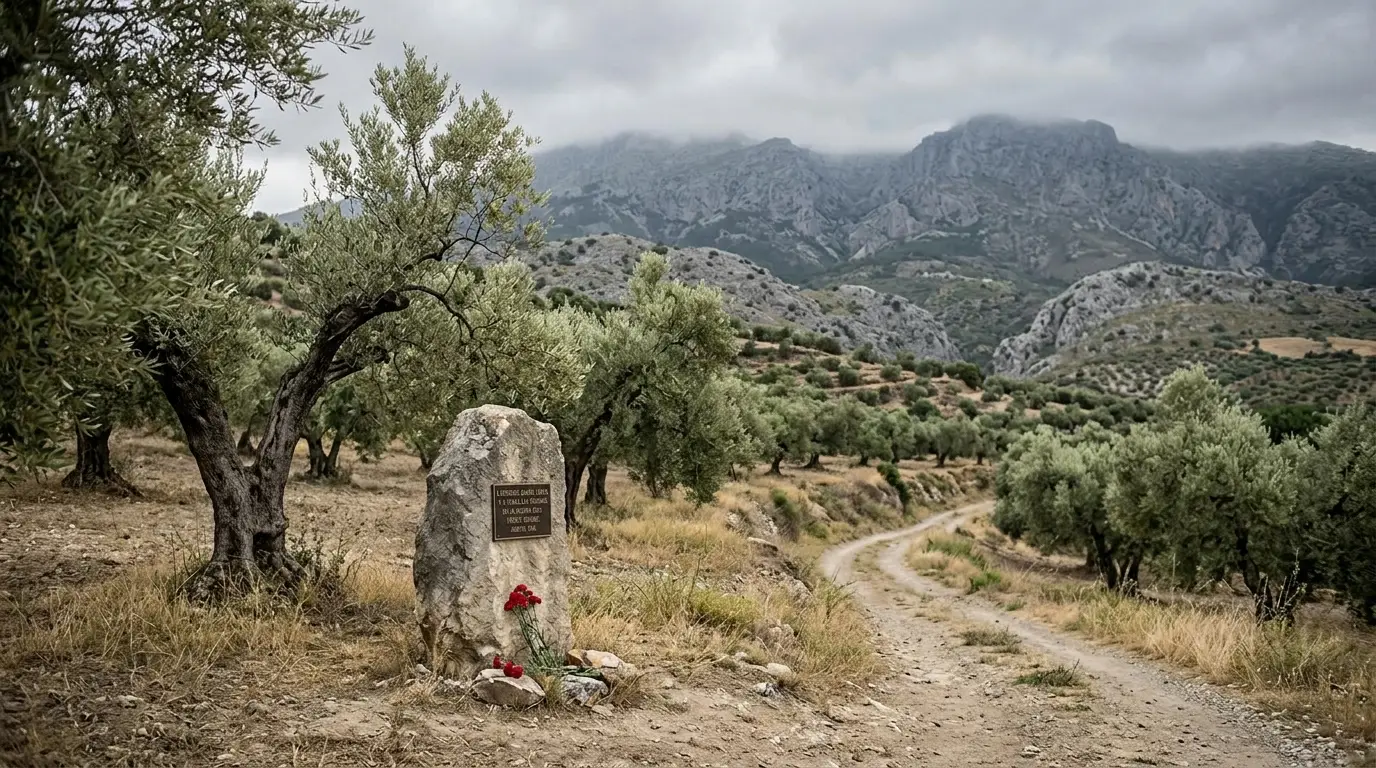
On the night of 18–19 August 1936 (sources disagree on the exact hour, with some placing it before midnight and others in the early hours of the 19th), Lorca was taken from the Gobierno Civil and placed in a car.[5] He was driven north out of Granada on the road that leads toward the Sierra de Huétor. The vehicle stopped at a place known as Fuente Grande (the Great Spring), an olive grove between the villages of Víznar and Alfacar, about 10 kilometres from the city centre.
Three other prisoners had been brought to the same spot: Joaquín Arcollas Cabezas, a banderillero; Francisco Galadí Melgar, a bullfighter; and Dióscoro Galindo González, a schoolmaster. All four were made to stand at the edge of a shallow ravine known as the Barranco de Víznar.
The firing squad was made up of local Falangist volunteers. The commanding officer was a Civil Guard lieutenant. Accounts differ on whether Lorca was shot first or last. All agree he died immediately.
The bodies were loaded onto a mule cart, taken a short distance, and buried in an unmarked grave. No record was made of the location. The men who did the digging were told to keep their mouths shut.
Lorca was 38 years old. He had completed The House of Bernarda Alba weeks earlier. The play had not yet been performed.
The men who ordered the killing
The chain of command that killed Lorca involved three men, and their roles have been picked apart by historians ever since.
Ramón Ruiz Alonso, the man who made the arrest, was the prime mover. A former journalist and CEDA deputy, he had lost his parliamentary seat in the February 1936 elections and was in Granada when the war broke out. He volunteered his services to the Nationalist authorities and used his local knowledge to identify Republican targets. Ian Gibson's research concluded that Ruiz Alonso was the man who denounced Lorca and insisted on his execution. He survived the war, returned to journalism, and never faced prosecution.
José Valdés Guzmán, the Civil Governor, signed the arrest warrant. A military officer of rigid Nationalist views, he controlled Granada's civil administration during the first months of the war. He ordered Lorca's execution despite the appeals for clemency. He died in 1939 from a heart attack — or, as some accounts claim, was killed in a hunting accident that may not have been accidental.
Colonel José Baselga was the military governor. He was the highest-ranking officer in Granada and the man Manuel de Falla appealed to. Baselga was reportedly willing to release Lorca, but he deferred to Valdés Guzmán and Ruiz Alonso. His failure to overrule them has made him a controversial figure in the historiography: was he weak, or complicit?
None of these men were ever tried for Lorca's murder. No judicial investigation was opened in Franco's Spain. The first official investigation began only in 2008, under a Spanish judge, and was closed without charges.[3] The case was reopened in Argentina in 2016 under universal jurisdiction, but no arrests have been made.[2]
The grave that never gave him back
Lorca's body has never been found, despite multiple excavations over 90 years.[7]
The first modern effort to locate the grave came in 2009, following Spain's Historical Memory Law (2007). Archaeologists from the University of Granada dug at Fuente Grande, the site identified by Ian Gibson using testimony from a man who claimed to have helped dig the grave in 1936. They found no human remains.
A second excavation in 2014, targeting a site less than a kilometre from the first, also came up empty. A third excavation at Alfacar in 2016 — using ground-penetrating radar — failed to locate the poet's remains, though it did find evidence of other burial pits.
The most recent research, as of 2025, centres on the Barranco de Víznar itself, where a team has been excavating mass graves since 2021. Hundreds of victims have been exhumed, but none have been identified as Lorca.
The difficulty is that the men who buried him deliberately obscured the location. The grave was unmarked, at night, in soft soil that left no permanent scar on the landscape. The tree that witnesses said marked the spot — an olive tree near Fuente Grande — was cut down decades ago.
Lorca's family has been divided on the subject. For years, his surviving relatives opposed exhumation, arguing that the search would reopen political wounds. That position softened after the passage of the Historical Memory Law, but the family has never actively funded or organised a search.
3 excavations
Today, the Parque de la Memoria in Alfacar — near Fuente Grande — marks the area where Lorca is believed to have died. A stone monument, flowers left by visitors, and a commemorative event every August are the only signs that Spain's greatest 20th-century poet lies somewhere beneath the olive groves.