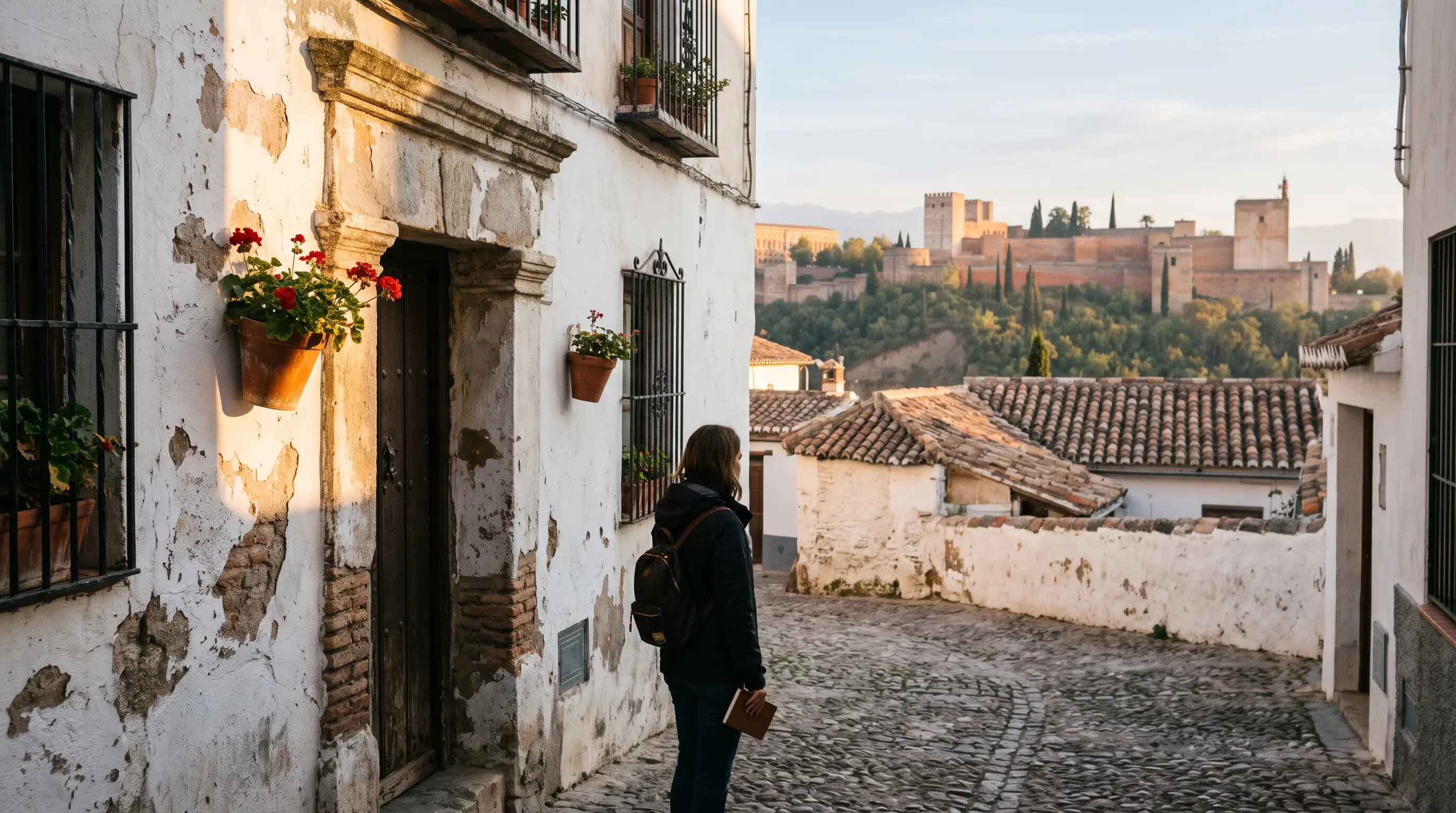
Visitor with a notebook in a Realejo lane, on the Moses ibn Ezra Granada poet trail, Alhambra towers beyond the roofs

Moses ibn Ezra: Granada's Exiled Hebrew Poet

Moses ibn Ezra, the Hebrew poet born in Granada around 1055-1060, lost his city to the Almoravids in 1090 and wrote of it from exile in Christian Spain.

Portrait of James Walker
Written by

Seven years resident in Granada. Specialist in Nasrid architecture, Al-Andalus history, and Andalusian walking routes.

Published
Early Islamic, Zirid & Almohad711–1238
Moses ibn Ezra was born in Granada and spent the later part of his life shut out of the city he yearned for,[4] and he is not the better-known Abraham ibn Ezra, a different and later poet. Ranked among the finest poets of the golden age of Spanish Jewry,[5] he wrote sacred verse that entered the Sephardi liturgy and secular verse that is startlingly sensual. The dates are loose (born around 1055–1060, died after 1138) and the reason he left is still argued, so treat any tidy biography with caution.
Almoravid conquest
1090
Granada's Jewish community destroyed, Ibn Ezra family dispersed[1]
Sacred compositions
220
Mostly penitential poems for New Year and Atonement[2]
Verses in Tarshish
1,210
The Hebrew letters of the title encode the verse count[3]

Born into Granada's Hebrew and Arabic elite

No document fixes the day, and reference works disagree on the year: Moses ibn Ezra was born in Granada between roughly 1055 and 1070, with most settling on 1055–1060. Treat any single year as a convention. What is firmer is the schooling, Jewish learning at home and Arabic literature and theology beyond it[6], a double education that shows in everything he wrote.
He studied under Isaac ibn Ghiyyat in Lucena, nicknamed the "city of poetry"[7], and went on to hold an administrative post in his home province under the Arabic title sahib al-shurta[8], an office Encyclopaedia Judaica renders as "head of the police"[38] and the scholar Matthew Warshawsky as "chief of markets"[39]. Poet and official in one man was an old pattern in Granada.
Family tied him to the circle around Samuel ha-Nagid, the vizier-poet who had run Zirid Granada's government. Moses had three brothers, Isaac, Joseph and Zerahiah, all distinguished scholars[9], and the eldest, Isaac, married one of the Nagid's daughters[10].

1090: Granada falls and the family scatters

The 1066 massacre had not ended Jewish Granada. The community recovered quickly, only to fall again in 1090, this time to the Almoravids[11]. In that conquest the Jewish community was destroyed and the members of the Ibn Ezra family dispersed[1].
Ibn Ezra himself did not leave at once. He was married with many children, and only later, after some threat to his life, did he flee, leaving his family behind and spending the rest of his life in the Christian north[12]. Accounts differ on the timing: most say only that he stayed in Granada for a while after the conquest[37], while Matthew Warshawsky dates his departure to 1095, five years on, and has him leaving without his wife and children[36].
Why he went is argued over, and the explanations compete:
  • A failed courtship. A thwarted love for his niece, an episode said to have estranged him from his brothers, driven him from Granada and coloured the verse he wrote afterwards[13].
  • A rescue. A more prosaic motive: getting his niece out of the Almoravids' reach[14].
  • Plain danger. The conquest and a threat to his own life, which needs no romance to explain it.
The courtship story rests on an assumption that has been disputed[15], so read it as tradition rather than biography. The outcome is not in doubt: he fled to Christian Spain and remained in exile from his native city for the rest of his life[16].

Judah Halevi and a friendship written in verse
The friendship that defined his private life was with the younger poet Judah Halevi, who dedicated many poems to him, and whose correspondence with Ibn Ezra is where scholars first read of the great disappointment he suffered[17]. Ibn Ezra supported the junior man, and the two formed a lasting friendship[18]. He was also an important influence on Halevi's early poetic work[19].
Their lives bent in opposite directions. Where Ibn Ezra was pushed out of Granada and wanted nothing but to go back, Halevi chose his own departure: he left his only daughter, his family, friends and possessions for a pilgrimage to Jerusalem[20].
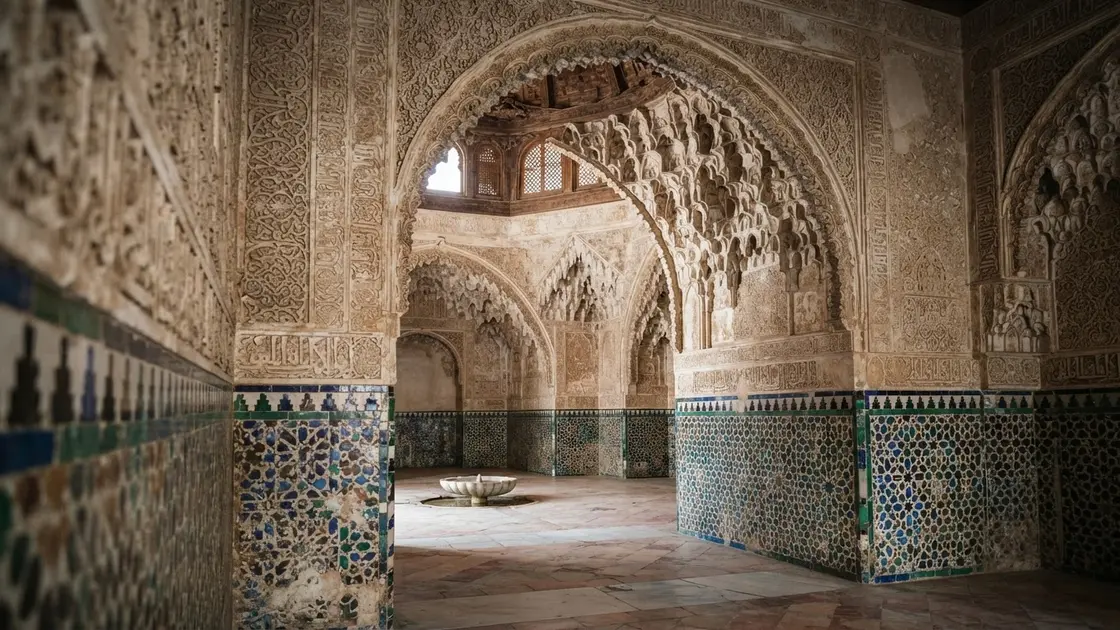
Interior of the Cuarto Real de Santo Domingo qubba in Granada, showing the muqarnas arch and blue-green glazed tile dado, 13th-century Nasrid architecture

Explore nearby · Monument

Cuarto Real de Santo Domingo

13th-century Nasrid throne room in the Realejo. A 7m qubba with muqarnas, Kufic inscriptions and glazed tiles — built 60 years before the Alhambra. €2 entry.

One poet lost a city against his will; the other gave up a household for a holy one. Both ended their lives far from the streets that made them.

Exile in the north: patrons, loneliness and penitential verse

In Christian Spain he wandered, unable to adapt to the manners of the local Jewish communities or to what he judged their low cultural standard[21]. Poverty exacted its own price: he had to seek out munificent patrons and sing their praise in return[22].
The poems he made of that loneliness are plain-spoken. His loneliness in exile and his yearning for his native city are at times set down with warmth and great simplicity[23]. In "The flight from Granada", in Matthew Warshawsky's English (made from the Spanish version of Sáenz-Badillos and Targarona Borrás), leaving arrives as a command: ‘flight shouted to me, “Arise, carefree one!”’[42]
His religious output is the larger part of what survives. Most of his 220 sacred compositions are penitential poems[2], which earned him the surname Ha-Sallah, writer of penitential prayers[24], and many entered the Sephardi liturgy for the New Year and the Day of Atonement[25]. An exile's words became part of the synagogue calendar.
The secular side is another poet entirely. The collection called Tarshish holds 1,210 verses[3], is the first example of homonymic rhyme in Hebrew and a model for later medieval poets[26], and celebrates love, wine and birdsong while mourning faithlessness and the onset of old age[27]. It is the most sensual verse in the Spanish Jewish school[28], written by the same man who composed the penitential prayers.
“Moses ibn Ezra draws pearls from the well of thought[29]”
Judah al-Harizi

The Arabic treatise of his old age

His last great work looks back. The Kitab al-Muhadara wal-Mudhakara, usually rendered Conversations and Recollections, took shape after 1135, when a friend's eight questions on Hebrew poetry gave the old exile eight chapters to fill[30]. Encyclopaedia Judaica calls it an early study of Hebrew poetics and unique in medieval Hebrew literature[31]. A Hebrew poet wrote it in Arabic because the adab form, an informal essay style, drew its definitions and metrical rules from scholars of Arabic literature[43].
Dealing with Arabic, Castilian and Jewish poetry, it is an important Spanish literary history[32]. Its lasting value is as a source for Spanish Hebrew poetry in general and for biographical data on individual authors[33], a record kept by a man who could no longer walk the streets where those poets had lived.
B.Z. Halper translated it into Hebrew in 1924 as Shirat Yisrael[34].
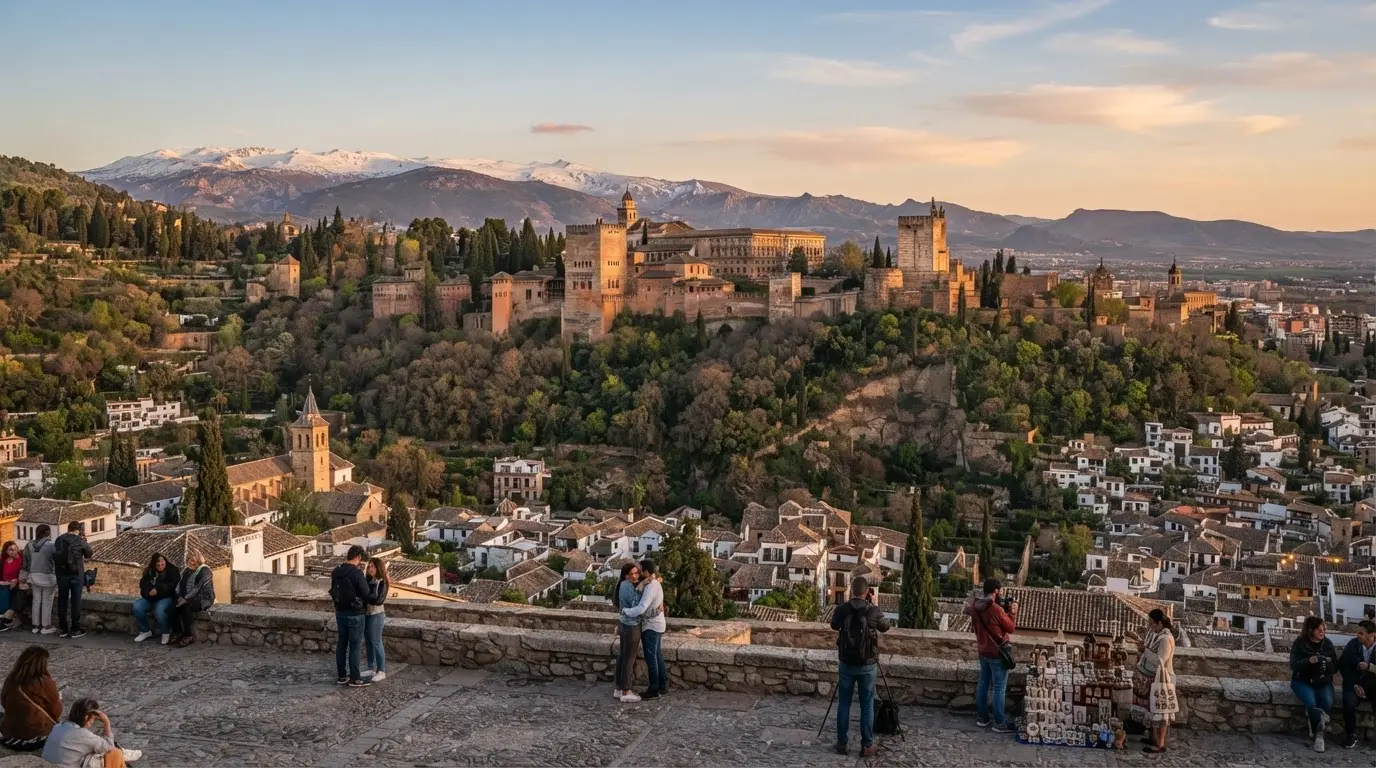
Wide-angle panoramic view of Granada Spain from Mirador de San Nicolás showing the Alhambra palace complex and Generalife gardens against the snow-capped Sierra Nevada mountains at golden hour, illustrating the interesting facts about Granada Spain

Deep dive · Article

20 Interesting Facts About Granada, Spain

Interesting facts about Granada Spain that guidebooks skip: disputed etymologies, the soldier who saved the Alhambra, and a river buried under Plaza Nueva.

His philosophy was also written in Arabic. The Maqala bi-l-hadiqa, part of which was anonymously translated into Hebrew as Arugat ha-Bosem ("Bed of Spices"), deals with man's place in the universe, the unknowability of God and the intellect[40]. Encyclopaedia Judaica judges his philosophic attainments minor and his leaning neoplatonic[41].

Following Moses ibn Ezra through Granada today

Little visible trace of the medieval Jewish quarter remains for a visitor to find. The Jewish quarter of the Realejo was rebuilt as a Christian neighbourhood, and the Alhambra Decree of 1492 finished what 1090 began. Even in Muslim times the quarter was never fixed in one spot[35], so a medieval street plan would not tell you where he walked.
What you can see is the setting. The Cuarto Real de Santo Domingo, a Nasrid palace room built long after his flight, is an Andalusi interior in the Realejo, and it tells you nothing about Ibn Ezra but a good deal about the world that replaced his.
If you want something to carry down the slope, take the poems rather than a building. The penitential verse outlasted the quarter he lost, and it is the nearest thing Granada has to his voice.

Frequently asked questions

Who was Moses ibn Ezra, the Granada poet?

Moses ibn Ezra was a Hebrew poet and philosopher born in Granada, also known as Abu Harun. He is counted among the finest poets of the golden age of Spanish Jewry and spent the later part of his life in exile in Christian Spain.

When was Moses ibn Ezra born and when did he die?

Sources disagree. His birth in Granada falls between about 1055 and 1070, most often given as 1055–1060, and his death is placed after 1135 or 1138, with some reference works giving about 1139. No single exact year is secure.

Why did Moses ibn Ezra leave Granada?

The conquest of Granada by the Almoravids in 1090 dispersed his family, and he later fled after a threat to his life. An older tradition adds a thwarted love for his niece, but that assumption has been disputed, and some scholars think a more prosaic motive, such as getting her to safety, is likelier.

Did Moses ibn Ezra ever return to Granada?

No. He remained in exile from his native city for the rest of his life and was not allowed to return to the place he yearned for.

How were Moses ibn Ezra and Judah Halevi connected?

Halevi was the younger poet and a close friend. He dedicated many poems to Ibn Ezra, who supported him and influenced his early work. Where the two first met is disputed, so it is safest to speak only of a lasting friendship.

What did Moses ibn Ezra write?

About 220 sacred compositions, mostly penitential poems, many in Sephardi liturgy; the secular collection Tarshish of 1,210 verses on love, wine and nature; and the Arabic treatise Kitab al-Muhadara wal-Mudhakara, a literary history written in old age.

Is Moses ibn Ezra the same person as Abraham ibn Ezra?

No. Abraham ibn Ezra was a different, later poet. Some reference works call the two related while others find no evidence of it, so do not treat them as one figure.

Can I see anything of Jewish Granada today?

Walk the Realejo, the former Jewish quarter below the Alhambra, but expect little visible trace of the medieval quarter and nothing tied to Ibn Ezra himself. The nearby Cuarto Real de Santo Domingo gives you a Nasrid interior, if not his own world.

Sources

43 references Show
  1. robbins.digitalscholar.rochester.edu (opens in a new tab)

    “Granada was captured by the Almoravides, its Jewish community was destroyed, and the members of the Ibn Ezra family dispersed.”

  2. jewishencyclopedia.com (opens in a new tab)

    “The greater part of Ibn Ezra's 220 sacred compositions, which are scattered in nearly all the Maḥzorim (that of the Ashkenazim excepted) and in the "Diwan," are penitential poems”

  3. jewishvirtuallibrary.org — Ibn ezra moses ben jacob (opens in a new tab)

    “(the Hebrew letters standing for the numerical value of its 1,210 verses)”

  4. jewishvirtuallibrary.org — Ibn ezra moses ben jacob (opens in a new tab)

    “but he was not allowed to return to his native city for which he yearned all his life.”

  5. Britannica (opens in a new tab)

    “was a Hebrew poet and critic, one of the finest poets of the golden age of Spanish Jewry (900–1200).”

  6. poetryfoundation.org (opens in a new tab)

    “Born in Granada, he was educated in both Jewish and Arabic literature and theology.”

  7. Wikipedia (opens in a new tab)

    “While living in Lucena, the "city of poetry", Ibn Ezra was a student of Isaac ibn Ghiyyat.”

  8. Wikipedia (opens in a new tab)

    “He held a crucial administrative office in his home province, evidenced by his Arabic title of sahib al-shurta.”

  9. jewishencyclopedia.com (opens in a new tab)

    “he had three brothers, Isaac, Joseph, and Zerahiah, all of whom were distinguished scholars.”

  10. Wikipedia (opens in a new tab)

    “His elder brother, Isaac Abū Ibrāhīm, was married to one of the Nagid's daughters.”

  11. jewishvirtuallibrary.org — Granada spain jewish history tour (opens in a new tab)

    “Incredibly, the community quickly recovered, only to fall again, this time at the hands of the Almoravids in 1090.”

  12. Wikipedia (opens in a new tab)

    “Moses was married and had many children, but later on he also fled because of some threat to his life, leaving his family behind and spending the rest of his life in the Christian north.”

  13. Britannica (opens in a new tab)

    “This episode affected Ibn Ezra deeply, not only estranging him from his brothers and driving him from Granada but also influencing his subsequent poetry.”

  14. Wikipedia (opens in a new tab)

    “However, it appears more likely that he had more prosaic reasons, such as perhaps saving his niece from the Almoravides.”

  15. jewishvirtuallibrary.org — Ibn ezra moses ben jacob (opens in a new tab)

    “(an assumption which has, however, been disputed)”

  16. poetryfoundation.org (opens in a new tab)

    “ibn Ezra eventually fled to Christian Spain and remained in exile from his native city for the rest of his life.”

  17. jewishencyclopedia.com (opens in a new tab)

    “From his correspondence with his junior and friend Judah ha-Levi, who dedicated to him many poems, it is known that Ibn Ezra suffered a great disappointment”

  18. jewishvirtuallibrary.org — Ibn ezra moses ben jacob (opens in a new tab)

    “invited him to come to Granada where he supported him, and the two formed a lasting friendship.”

  19. Wikipedia (opens in a new tab)

    “He also developed a strong friendship with the poet Judah Halevi, and was an important influence in Halevi's early poetic works.”

  20. encyclopedia.com — Judah halevi (opens in a new tab)

    “Halevi therefore left his only daughter and grandchild, his family, friends, and possessions, to make a pilgrimage to Jerusalem.”

  21. jewishvirtuallibrary.org — Ibn ezra moses ben jacob (opens in a new tab)

    “Ibn Ezra wandered through Christian Spain but could neither adapt himself to the manners of its Jewish population nor to their low cultural standard.”

  22. jewishvirtuallibrary.org — Ibn ezra moses ben jacob (opens in a new tab)

    “He was obliged to seek the aid of munificent patrons in return for which he had to sing their praise.”

  23. jewishvirtuallibrary.org — Ibn ezra moses ben jacob (opens in a new tab)

    “His loneliness in “the exile of Edom” and his yearning for his native city are at times expressed with warmth and great simplicity.”

  24. Wikipedia (opens in a new tab)

    “known as Ha-Sallaḥ ("writer of penitential prayers")”

  25. Britannica (opens in a new tab)

    “many of them are included in the liturgy of the Sefardim (Jews of Spanish or Portuguese descent) for the New Year and the Day of Atonement.”

  26. poetryfoundation.org (opens in a new tab)

    “is the first example of homonymic rhyme and was a model for other medieval poets.”

  27. Britannica (opens in a new tab)

    “In it, he celebrates love, the pleasures of wine, and the beauty of birdsong and bemoans faithlessness and the onset of old age.”

  28. jewishvirtuallibrary.org — Ibn ezra moses ben jacob (opens in a new tab)

    “Ibn Ezra’s secular poetry is the most sensual in the Jewish Spanish school.”

  29. jewishencyclopedia.com (opens in a new tab)

    “of whom Judah al-Ḥarizi said: "Moses ibn Ezra draws pearls from the well of thought"”

  30. jewishvirtuallibrary.org — Ibn ezra moses ben jacob (opens in a new tab)

    “It was written in his old age (after 1135) in answer to eight questions on Hebrew poetry posed by a friend and is thus correspondingly divided into eight chapters.”

  31. encyclopedia.com — Ibn ezra moses ben jacob (opens in a new tab)

    “is one of the earliest works on Hebrew poetics and as such is unique in medieval Hebrew literature.”

  32. Britannica (opens in a new tab)

    “Dealing with Arabic, Castilian, and Jewish poetry, the work is an important Spanish literary history.”

  33. jewishvirtuallibrary.org — Ibn ezra moses ben jacob (opens in a new tab)

    “A valuable historical source for Spanish Hebrew poetry in general and for biographical data on individual authors”

  34. encyclopedia.com — Ibn ezra moses ben jacob (opens in a new tab)

    “B.Z. Halper translated it into Hebrew under the title Shirat Yisrael (Leipzig, 1924).”

  35. jewishvirtuallibrary.org — Granada spain jewish history tour (opens in a new tab)

    “The Juderia in Granada was never located in one specific spot during Moslem rule.”

  36. sephardichorizons.org (opens in a new tab)

    “A greater mystery is why Moses remained in Granada for five more years and then, when he did leave, in 1095, why he did so without his wife and children.”

  37. jewishvirtuallibrary.org — Ibn ezra moses ben jacob (opens in a new tab)

    “It is not known why Ibn Ezra remained in Granada for a while.”

  38. encyclopedia.com — Ibn ezra moses ben jacob (opens in a new tab)

    “(lit. "head of the police", but also "his excellency")”

  39. sephardichorizons.org (opens in a new tab)

    “Ibn Ezra also served as șaḥib al-šurṭa, or chief of markets, in the court of Abd Allah ibn Buluggin, the last king of the Zirid dynasty in the taifa of Granada.”

  40. encyclopedia.com — Ibn ezra moses ben jacob (opens in a new tab)

    “It deals with the position of man in the universe, the unknowability of God, and the intellect.”

  41. encyclopedia.com — Ibn ezra moses ben jacob (opens in a new tab)

    “Although Ibn Ezra was an accomplished poet and literary critic, his philosophic attainments were minor.”

  42. sephardichorizons.org (opens in a new tab)

    “flight shouted to me, “Arise, carefree one!””

  43. encyclopedia.com — Ibn ezra moses ben jacob (opens in a new tab)

    “Definitions of terms and linguistic and poetical (metrical) rules set down by scholars of Arabic literature form the basis of the work which is written in the Arabic adab form, an informal casual style.”