Mariana Pineda: Granada's Liberal Heroine Executed for Freedom
Mariana Pineda, Granada's liberal heroine, was executed by garrote vil in 1831 for a flag found in her house. Her story shaped Lorca's play and Granada's Plaza.
Seven years resident in Granada. Specialist in Nasrid architecture, Al-Andalus history, and Andalusian walking routes.
Updated Published
Mariana Pineda was a Granada embroiderer garrotted at twenty-six for possessing a flag stitched with the words "Equality, Freedom and Law." She refused to name the fellow liberals who plotted with her, so Ferdinand VII's absolutist government made an example of her instead. Two centuries on, Granada still marks the anniversary with a public holiday, and Federico García Lorca called her one of the defining emotions of his childhood.
Mariana Pineda was born in Granada on 1 September 1804, into a city still shaped by its Moorish quarter and its Catholic monarchy in equal measure. Her family trade was the needle: she grew up a bordadora, an embroiderer, skilled with silk and gold thread on the kind of fine linen that dressed Granada's churches and its wealthier households. That craft would matter more than anyone could have guessed.
In October 1819, at fifteen, she married Manuel Peralta Valte, a liberal army officer eleven years her senior. The marriage lasted less than three years: he died in August 1822, leaving her a widow at eighteen with two young children and a household to run alone[4]. Widowhood in provincial Spain usually meant retreat into domestic obscurity. It did the opposite for Mariana Pineda.
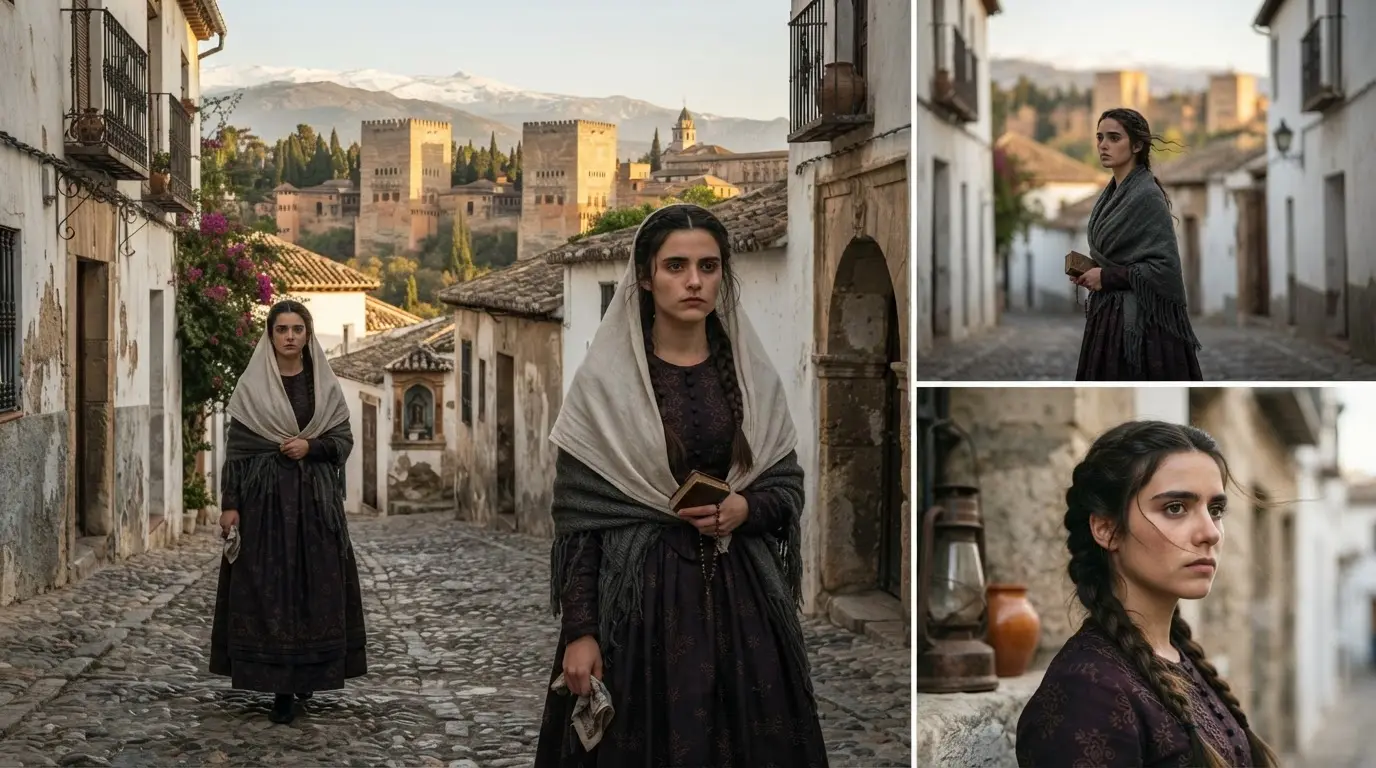
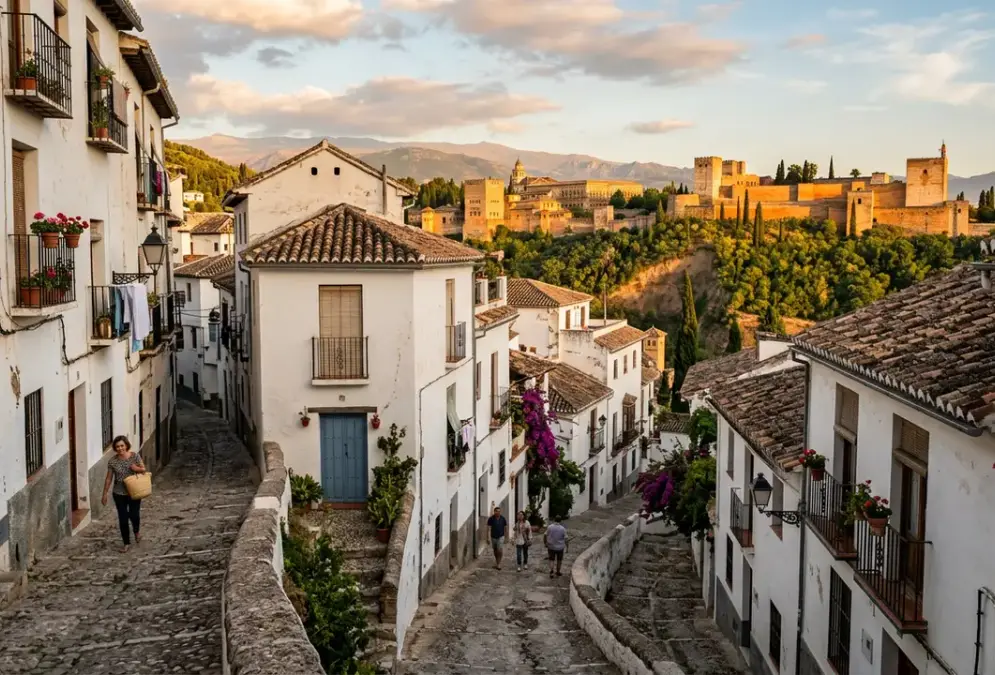
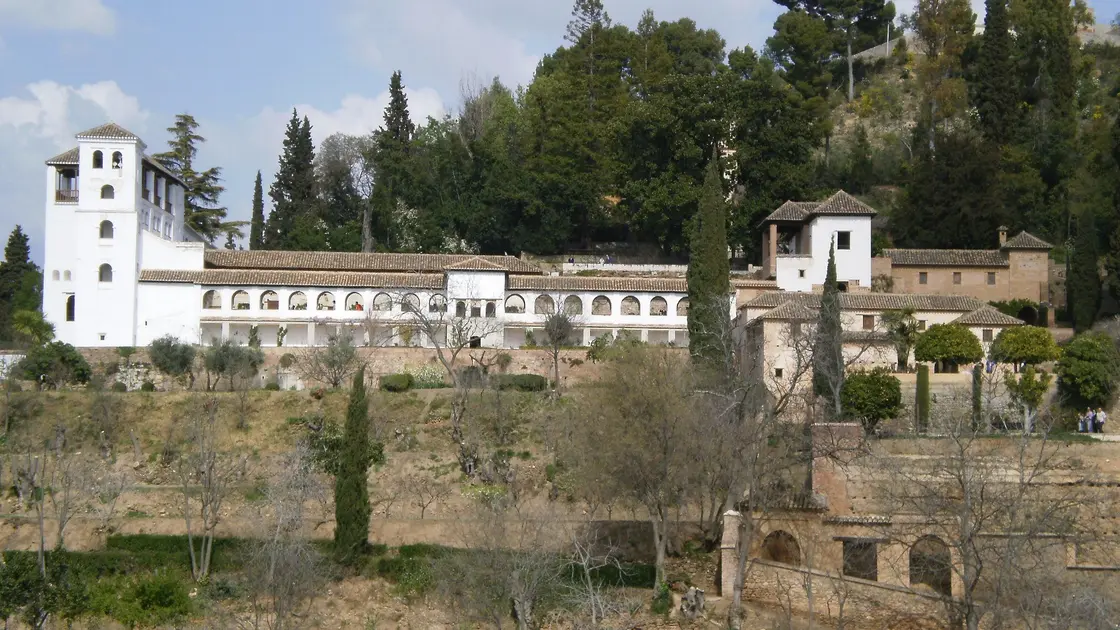
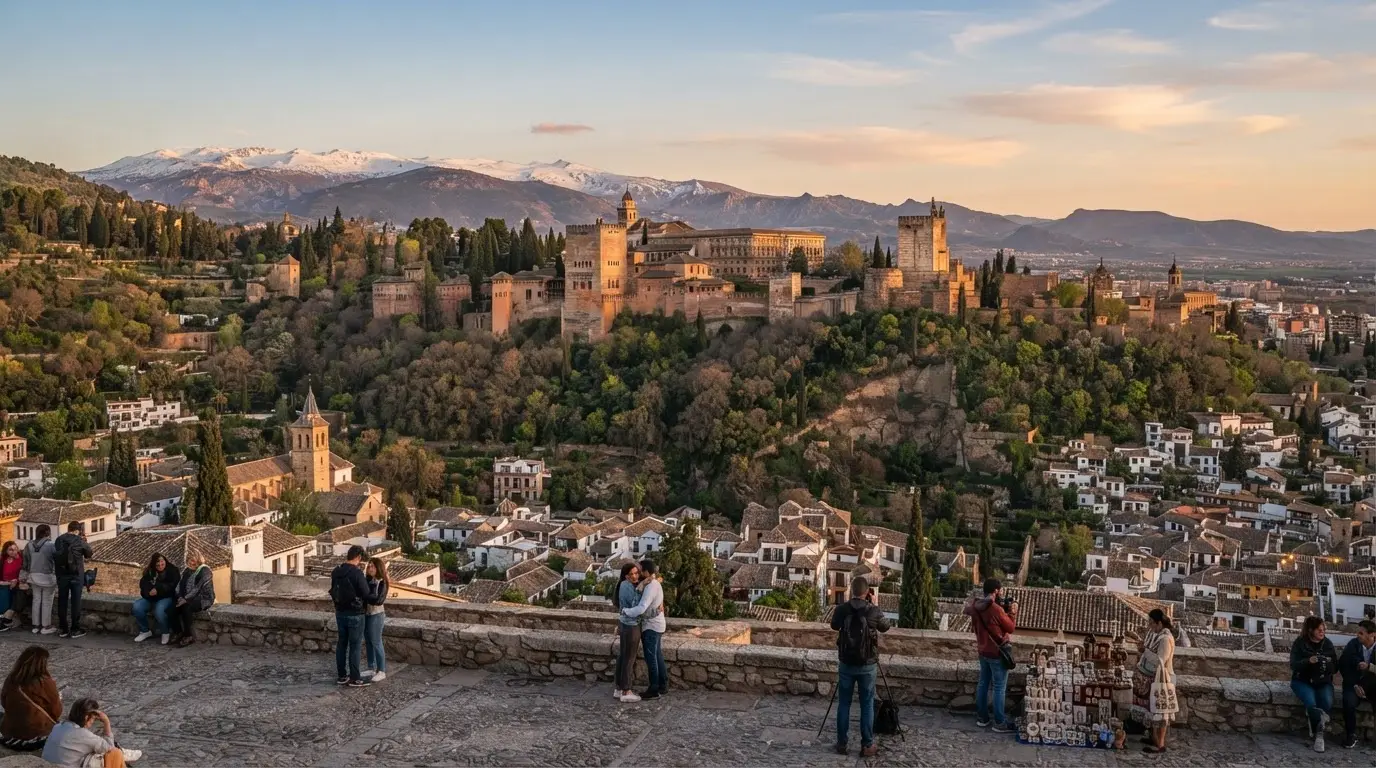
She stayed in the world she knew, the tangle of steep lanes and walled gardens climbing the hill above the Darro, home to some of the finest Cármenes of the Albaicín in the city. It was a neighbourhood built for privacy, courtyards hidden behind blank walls and heavy wooden doors, and that geography suited a household that had begun, quietly, to shelter people the state was looking for.
From Trienio Liberal to the Ominous Decade
To understand why an embroiderer ended up on trial for her life, you need the fifteen years of Spanish politics that came before it — a pendulum swing between constitutional government and absolute monarchy that Granada, like the rest of the country, lived through at close range.
The Trienio Liberal (1820–1823)
In January 1820, the army officer Rafael del Riego led an uprising against Ferdinand VII, forcing the king to reinstate the Constitution of 1812 he had abolished six years earlier[5]. What followed, the Trienio Liberal, was three years of constitutional government: a free press, an elected Cortes, and the beginnings of liberal civil society in cities like Granada. It ended in 1823, when a French army, backed by the other crowned heads of Europe, invaded Spain and restored Ferdinand's absolute power by force[5].
The Ominous Decade begins
Historians call what came next the Década Ominosa, the Ominous Decade: ten years running from the abolition of the Constitution in October 1823 to Ferdinand's death in September 1833[3]. The name is not exaggeration. The restored king purged the army and the civil service, revived in all but name the Inquisition's machinery for hunting dissent, and many liberals went into exile[6]. Granada, a garrison city with a history of liberal sympathy, was watched closely, and Mariana Pineda's Albaicín household, with its connections to officers who had served through the Trienio Liberal, sat squarely inside that surveillance.
For the fuller arc — the Moorish city, the 1492 conquest, the centuries after — the history of Granada guide traces it from Roman Iliberis through to Lorca's century.
A friar's robe and a prison break, 1828
By 1828, Mariana Pineda was no longer a passive sympathiser. That year she helped Captain Fernando Álvarez de Sotomayor escape from prison, smuggling him out disguised in a friar's habit, a plan arranged with the help of her cousin[7]. Sotomayor had been jailed for his own liberal activities, and the escape was audacious enough that it should have drawn the authorities' attention on its own.
It is worth pausing on what this tells you about her, because the later trial made her sound almost passive, a woman caught out by a flag she may not even have known was dangerous. The 1828 escape says otherwise. She was an organiser inside Granada's liberal underground years before the flag was found, moving people and information through a network of Albaicín houses the state was only slowly learning to map.
The end came in March 1831. A search of Mariana Pineda's house turned up a flag embroidered with the words "Equality, Freedom and Law," the emblem of a liberal rising being planned in the city. She was arrested and charged with conspiracy, attempted to escape before she could be brought to trial, failed, and was jailed to await proceedings in the Santa María Egipciaca convent[8].
The flag itself is the detail every account returns to, and for good reason: it fused her trade and her politics into a single incriminating object. A bordadora's skill, put to work for the crown's churches for most of her life, had produced instead a piece of sedition the state could hold up in court. Whether she embroidered every stitch of it herself or commissioned the work is a question the surviving record does not fully settle. What is documented is that the flag was found in her house, in her name, and that was enough.
Timeline
1819
Marries Manuel Peralta Valte
A liberal army officer eleven years her senior; the marriage lasts under three years.
1822
Widowed at eighteen
Left with two children and an Albaicín household of her own.
1828
Helps Sotomayor escape prison
Arranges a friar's-robe disguise with her cousin's help.
1831
Flag found, arrested for conspiracy
A search of her house turns up the embroidered flag that will condemn her.
Garrote vil: the trial and the execution
At trial, the presiding judge offered Mariana Pineda a way out: name her fellow conspirators, and she could expect leniency. She refused[9]. It is the single fact about her that every later account, monument, and play returns to, because it is the one moment where the historical record and the legend agree completely — whatever pressure was applied, she did not give up the network she had helped build.
On 26 May 1831, at twenty-six years old, she was executed by garrote vil in public, and her flag was burned in front of her before the sentence was carried out[9]. Garrote vil was Spain's standard method of judicial execution at the time: a seated iron collar tightened by a screw mechanism at the back of the neck, distinct from the guillotine used in France and sometimes confused with it in secondary accounts of her death. The confusion is understandable but wrong: every primary account of Mariana Pineda's execution describes the garrote, not the blade.
She was twenty-six. The Ominous Decade had two more years to run.
Lorca's Mariana Pineda and Granada's living memory
Nearly a century later, a ten-year-old boy in Granada was told her story and never let it go. Federico García Lorca wrote a play named after her in 1925, and said of the figure who inspired it: "Mariana Pineda was one of the greatest emotions of my childhood."[10] His Mariana Pineda premiered in 1927 with sets designed by Salvador Dalí, turning a local execution into national theatre. Anyone tracing Federico García Lorca through Granada eventually arrives back at this earlier, unrelated tragedy that shaped his imagination before he had written a word of his own major work.
The square built in her name took longer to arrive than the play did. The Cortes approved an esplanade in 1836, the first stone was laid in 1839, and it was not inaugurated until 1873, four decades after her death. A marble statue by Miguel Marín and Francisco Morales stands there now: Mariana in classical dress, her right hand resting on a column inscribed "Homeland / Law / Liberty," her left holding a cross to her chest.
Granada keeps returning to her in small, concrete ways:
26 May is still observed as a local public holiday in the city[11]
PSOE's Francisco Cuenca once proposed replacing Granada's other, far more disputed January holiday — Día de la Toma — with a Mariana Pineda commemoration, though he dropped the idea once he became mayor
The statue and square sit a short walk from the Realejo, easy to combine with a Cathedral visit
Lorca's play is still staged periodically by Granada's theatre companies
None of it required her to have been a saint or a mastermind. She was a widow who ran a needle through a piece of cloth and would not give up a name. Granada decided, eventually, that this was enough to remember.
Frequently asked questions
Who was Mariana Pineda and why is she famous in Granada?
Mariana Pineda (1804–1831) was a Granada bordadora and widow who supported the liberal cause during Ferdinand VII's absolutist restoration. She helped a fellow liberal escape prison in 1828, then was arrested in 1831 after a flag embroidered with the words "Equality, Freedom and Law" was found in her house. She refused to name her co-conspirators and was executed for it, becoming Granada's most enduring symbol of resistance to the Ominous Decade.
Why was Mariana Pineda executed?
She was executed for conspiracy against Ferdinand VII's absolutist government after a liberal flag was discovered in a search of her house in 1831. At trial, the judge offered leniency if she named her fellow conspirators. She refused, and on 26 May 1831 she was garrotted in public at the age of twenty-six, her flag burned in front of her.
What is the garrote vil execution method?
Garrote vil was Spain's standard method of judicial execution in the 19th century: the condemned was seated and an iron collar around the neck was tightened by a screw mechanism, causing death by strangulation or cervical fracture. It is often confused with the guillotine in secondary sources, but every primary account of Mariana Pineda's death describes the garrote.
How did Federico García Lorca write about Mariana Pineda?
Lorca wrote a play titled Mariana Pineda in 1925, calling her story one of the greatest emotions of his childhood. It premiered in 1927 with stage designs by Salvador Dalí and dramatised her refusal to betray her fellow conspirators, cementing her place in 20th-century Spanish culture well beyond Granada.
What was the Ominous Decade (Década Ominosa) in Spain?
The Ominous Decade was the last ten years of Ferdinand VII's reign, from the abolition of the Constitution of 1812 in October 1823 to his death in September 1833. It was marked by the systematic suppression of liberal opponents, purges of the army and civil service, and mass exile of liberal leaders — the political climate that made an example of Mariana Pineda.
What is the Trienio Liberal?
The Trienio Liberal was a three-year period, 1820 to 1823, when Spain was governed under the Constitution of 1812 after Rafael del Riego's military uprising forced Ferdinand VII to accept constitutional rule. It ended when a French army invaded and restored the king's absolute power, beginning the Ominous Decade that would later condemn Mariana Pineda.
Where in Granada can you learn about Mariana Pineda today?
Start at the Plaza de Mariana Pineda, where a 19th-century marble statue marks the square built in her name. Her remains rest in Granada Cathedral, a short walk away. Granada still observes 26 May as a local holiday in her memory, and her story is told in the Albaicín, the neighbourhood where she lived and organised.
“The Década Ominosa is a traditional term for the last ten years of the reign of King Ferdinand VII of Spain, dating from the abolition of the Spanish Constitution of 1812, on 1 October 1823, to his death on 29 September 1833.”
“The Trienio Liberal was a period of three years in Spain between 1820 and 1823 when a liberal government ruled Spain after a military uprising in January 1820 by lieutenant-colonel Rafael del Riego against the absolutist rule of Ferdinand VII. It ended in 1823 when, with the approval of the crowned heads of Europe, a French army invaded Spain and reinstated the King's absolute power.”
“The Trienio Liberal was a period of three years in Spain between 1820 and 1823 when a liberal government ruled Spain after a military uprising in January 1820 by lieutenant-colonel Rafael del Riego against the absolutist rule of Ferdinand VII. It ended in 1823 when, with the approval of the crowned heads of Europe, a French army invaded Spain and reinstated the King's absolute power.”
“In a search of her house in 1831, a flag was discovered with the embroidered slogan "Equality, Freedom and Law" and Mariana was arrested and accused of conspiracy.”