
The myth versus the record
Guidebooks and 19th-century travel writers gave the Alhambra a harem in the Ottoman sense: veiled women behind lattice screens, existing for a sultan's pleasure. That image comes from Romantic-era painting and fiction, not from the archives of Nasrid Granada. The household that actually lived inside the palace walls was governed by specific categories of Islamic law, and those categories mattered enormously to the women living under them: whether a child was born free or enslaved, whether a mother could be sold, whether she inherited anything at all.
The Nasrid dynasty of Granada that built the Alhambra ruled the city from the 13th century until its surrender in 1492[3]. Its women fall into a small number of legal tiers: free wives married under nikah contract, slave-concubines known as jariya, and a distinct third category, the umm al-walad, a concubine whose status changed the moment her child was acknowledged by the sultan as his own. None of these tiers map onto the harem fantasy. All of them map onto specific legal consequences that determined a woman's freedom, her property, and her children's legitimacy.
Two women broke through this structural anonymity by force of circumstance rather than romance: Aisha al-Hurra, who deposed her own husband, and Fatima bint al-Ahmar, who governed as regent-tutor a century earlier. A third, Isabel de Solís, entered the record not through political manoeuvring but through capture, a Christian girl taken in a border raid who ended up, by most accounts, at the centre of the rivalry that split the Nasrid succession. Their names survive in the chronicles. Most others in the record do not, and that asymmetry is the actual subject of this article.
Free wives, concubines, and the umm al-walad
The vocabulary matters, because English translations collapse three distinct legal categories into one vague word: wife. A Nasrid sultan could have free wives, contracted under nikah marriage, whose children inherited by default. He could also have slave-concubines, jariya, who carried no such guarantee. And he could have women who moved between those categories mid-life, which is where the umm al-walad status comes in.
- Free wife (nikah marriage): children legitimate and inheriting by default
- Jariya (slave-concubine): no guaranteed freedom or inheritance, for her or her children
- Umm al-walad: a concubine reclassified once her child was acknowledged; freed on the master's death, her children fully legitimate
The umm al-walad: mother of the child
Under classical Islamic law, the title umm al-walad, literally 'mother of the child', was given to a slave-concubine whose child was acknowledged by her master as his own[4]. That single act of acknowledgment reclassified her: she could no longer be sold. Under the dominant Sunni legal position, followed across the Islamicate world, an umm al-walad was freed automatically on her master's death[5]. Her children, meanwhile, counted as freeborn and legitimate, treated the same as children born to a sultan's free wives[6], which is exactly how a concubine's son could become a Nasrid sultan.
Sultanas: property, guardianship, and the limits of power
Free wives who reached the rank of sultana (malika) had real legal standing. They could own and administer property in their own name, though always under male guardianship[7]. What they could not do, according to the Alhambra's own heritage authority, was rule Granada in their own right: the title malika never came with independent executive power[8]. Legal personhood without sovereign authority is the actual shape of women's power in the Nasrid court, and it explains exactly how a woman like Aisha al-Hurra had to work: through a son, through faction, never through a throne of her own.
Aisha al-Hurra: the sultana who deposed a sultan
Of all Nasrid women, Aisha al-Hurra (Aixa) left the deepest mark on the documentary record, and it was not because of any harem intrigue. She was a free wife of Sultan Abu al-Hasan Ali, married under nikah, and by the early 1480s she had become the central political actor in a succession crisis that would decide who ruled Granada in its final decade.
“«Mujer de fuerte carácter, inteligente y decidida», a woman of strong character, intelligent and decisive.”
Recommended tours
Tours are selected for quality, not commission. We earn a small fee if you book — at no extra cost to you.

From wife to kingmaker
In 1482, Aisha allied with the powerful Abencerrajes faction and had her husband deposed in favour of their son, who took the throne as Muhammad XI, remembered by history as Boabdil, last Moorish king[2]. It was a coup executed through faction politics, not romance, precisely the mechanism available to a sultana who could never rule in her own name. The alliance connects directly to the wider Nasrid civil war that split the kingdom into three competing courts through most of the 1480s.
The coup did not end her involvement. In 1483, after Boabdil was captured at the Battle of Lucena, Aisha personally handled the negotiations for his release from Castilian captivity[9], a mother acting as her son's chief diplomat at a moment when the kingdom's survival depended on the outcome.
The legend of the last sigh
The most quoted line attributed to Aisha never appears in a contemporary source. According to a legend recorded only in later chronicles, she is said to have told the departing Boabdil to weep like a woman for what he could not defend like a man, as he looked back at Granada for the last time in 1492. There is no earlier documented attestation of the line, and the English-language scholarship on her explicitly labels it a legend rather than a recorded statement. Whatever Aisha actually said in that moment, if she said anything at all, is lost. What survives instead is the documented record: a woman who deposed a sultan and negotiated a captive prince's release, which required considerably more than the ability to shame a son.
Isabel de Solís: a captive who became a sultan's favourite
Not every Nasrid court woman entered the palace as a wife or a contracted concubine. Isabel de Solís arrived as a captive. On a raid toward Aguilar, in Castilian territory, on 29 September 1471, she was taken prisoner[1], by most accounts a young girl from a Christian noble family. She was brought to the Alhambra and sold as a slave to Sultan Abu al-Hasan Ali, Boabdil's father[10].
What happened next moved her, in the terms set out above, from jariya toward umm al-walad. She had two sons with the sultan, Nasr and Said, both named royal princes[11], full acknowledgment, with the legal consequences that acknowledgment carried. Renamed Zoraya, she became Abu al-Hasan's favourite, and her sons' claim to the succession is exactly what Aisha al-Hurra's 1482 coup was fighting to block. The rivalry between the two women, a free sultana defending her son's inheritance against a converted concubine defending hers, is as close as the Nasrid court comes to the harem-intrigue cliché, except that both were fighting over something entirely unromantic: succession law, not affection. The Abencerrajes faction that backed Aisha's side of that fight had its own long and violent history at court, separate from this rivalry but entangled with it at every turn.
Granada fell in 1492, and Isabel's story did not end with the Nasrid dynasty. She is last documented alive in Seville in 1510[12], having reconverted to Catholicism at the urging of her sons and, eventually, of Ferdinand and Isabella themselves, reclaiming the name Isabel[13]. A captive girl from a border raid ended her life as a Christian noblewoman in Castile, having spent the middle decades of it as a legally acknowledged mother inside the Alhambra. Neither end of that life fits comfortably into a single story about power, romance, or captivity alone.
Explore nearby · Monument
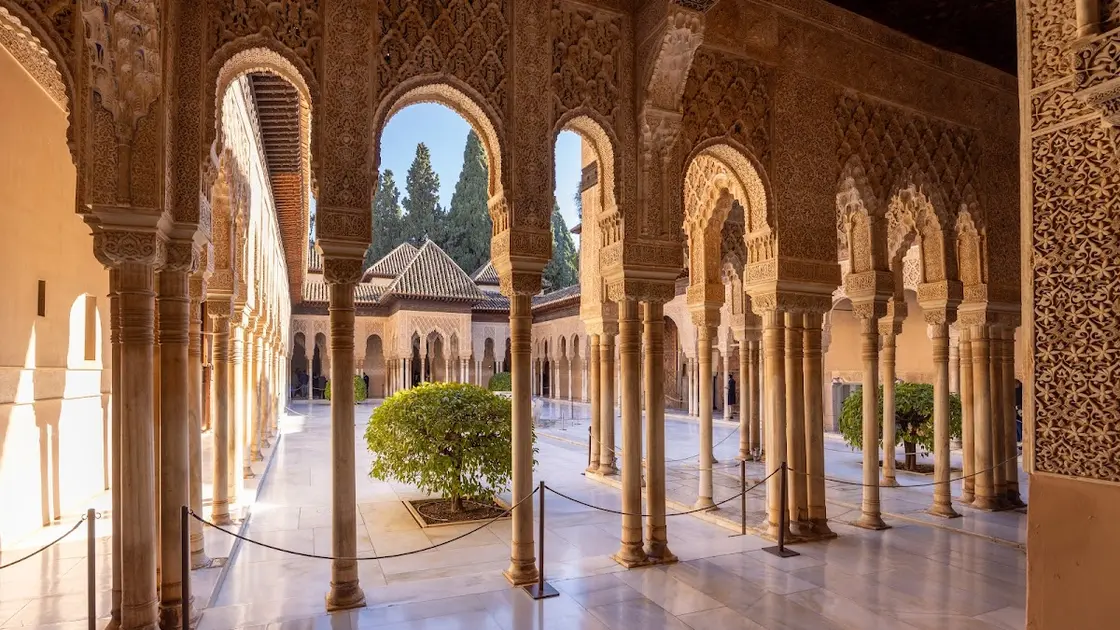
Nasrid Palaces
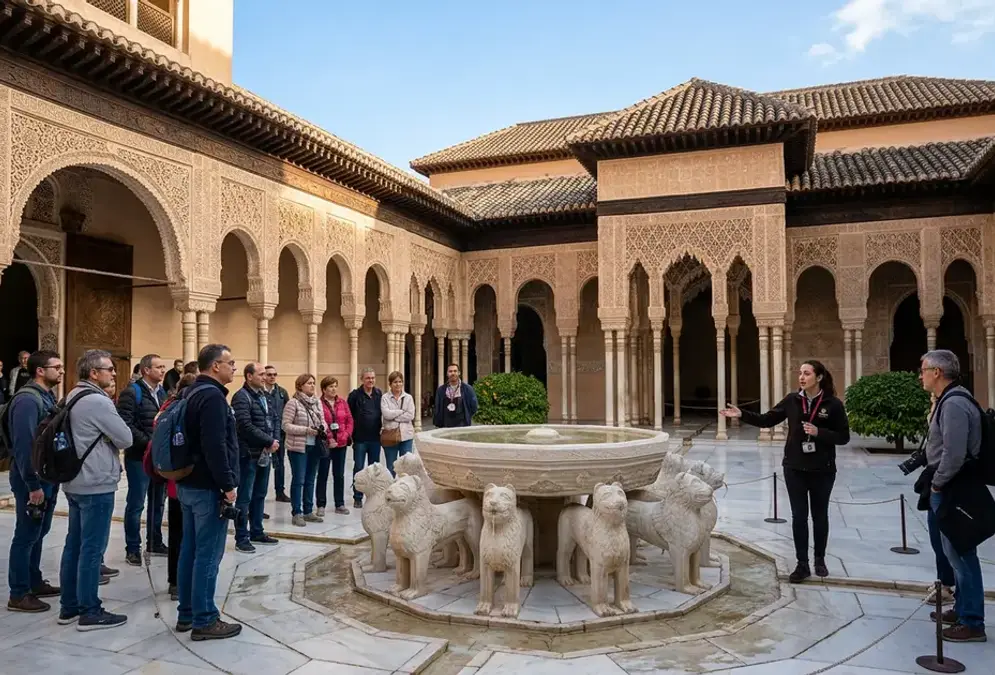
Three royal Nasrid palaces inside the Alhambra, including the Patio de los Leones and Hall of the Ambassadors. Entry is timed: arrive within your booked slot.
Fatima bint al-Ahmar and the women history didn't name
A century before Aisha al-Hurra, another Nasrid woman held power without ever contesting a throne. Fatima bint al-Ahmar, known to Granada's own heritage authority as Sultana Fatima, served as regent-tutor for two underage grandsons in succession and directed the kingdom's politics across several generations[14], an institutional, unglamorous kind of power, exercised through guardianship rather than intrigue, that predates the harem cliché by roughly a century and a half.
Fatima and Aisha are the exceptions the record allows us to see clearly, and that visibility is itself worth interrogating. Granada's Patronato de la Alhambra y Generalife has stated plainly that chroniclers deliberately limited what they recorded about the sultanas[15], which is the specific, documented reason so many Nasrid court women exist in the archive only as an unnamed wife, an unnamed mother, an unnamed daughter. That is not an accident of survival. It reads more like an editorial decision made centuries ago, one the Alhambra's own custodians are now trying to work around through initiatives like Alhambra en Femenino, a research programme explicitly aimed at recovering the women the chronicles left out.
Deep dive · Article
20 Interesting Facts About Granada, Spain
Interesting facts about Granada Spain that guidebooks skip: disputed etymologies, the soldier who saved the Alhambra, and a river buried under Plaza Nueva.
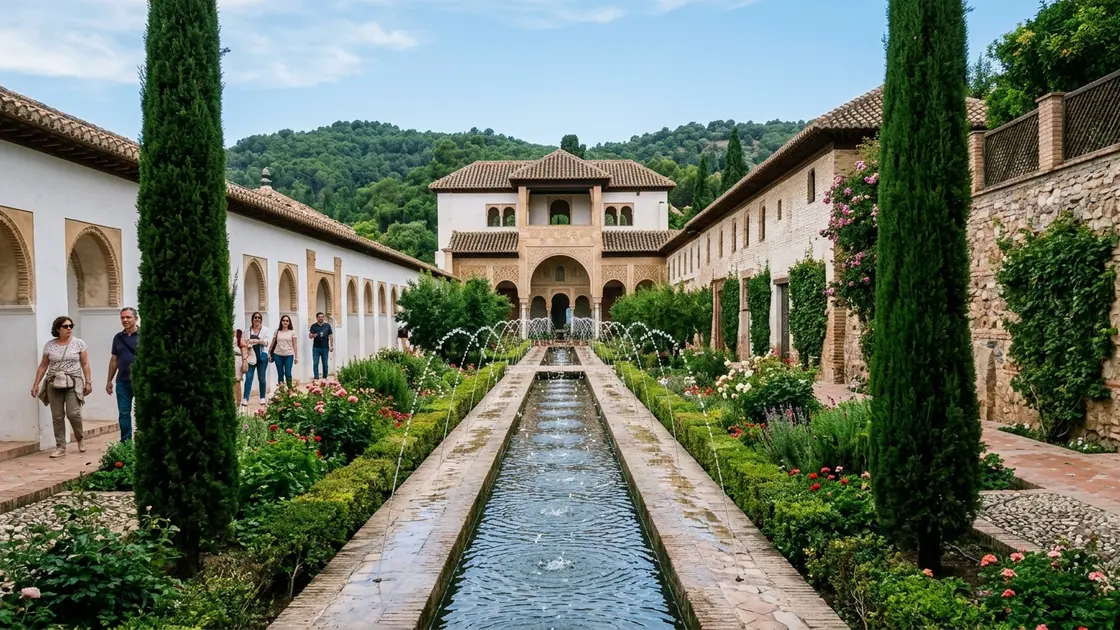
Some architectural claims about where these women actually lived deserve more caution than they usually get. The term dar al-nisa, house of the women, appears in scholarship on the Nasrid court, but assigning it to specific surviving rooms in the Alhambra remains contested academic ground, not settled fact. The Generalife gardens, often described to visitors as a women's retreat, lack the documentary evidence to support that framing as anything more than an inference. The honest position is the one the Patronato itself takes: the women were there, the walls and gardens they moved through mostly survive, and their names, for the most part, did not.