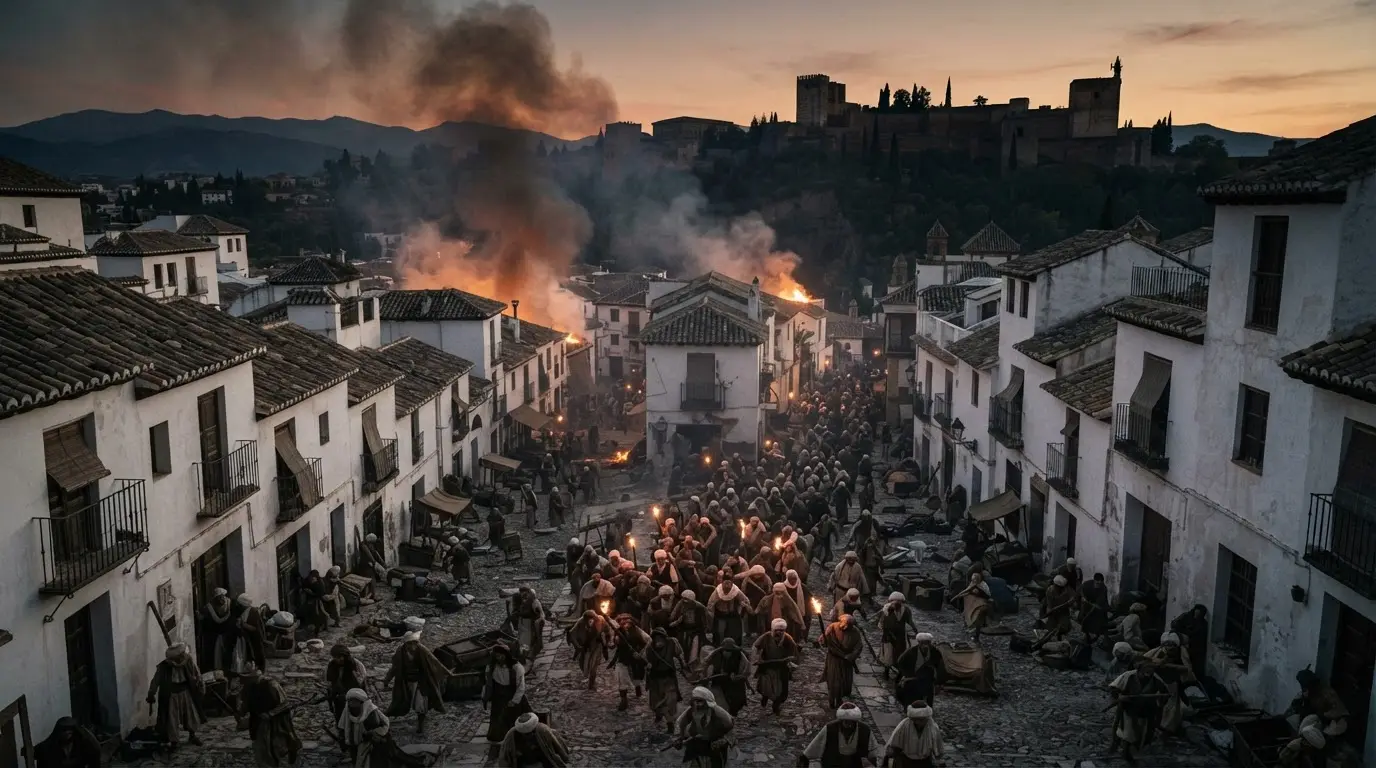

Samuel ha-Nagid: from refugee to the most powerful Jew in al-Andalus
Samuel ha-Nagid was born in Córdoba in 993[4], into a city that would not survive his childhood intact. When Berber forces sacked Córdoba in 1013, Samuel fled south to Málaga, then part of the Muslim kingdom of Granada[5].
By 1027, at the age of 34, Samuel had been granted the title Nagid ("Prince" or "Leader") — the first person in al-Andalus to hold it[2]. He went on to serve as vizier and military commander of the Taifa of Granada under two Zirid rulers, Habbus al-Muzaffar and then his son Badis ibn Habus, a tenure that ran from 1038 until his death around 1056[6].
What made this extraordinary was not the title itself but what it let him do. Islamic law's Pact of Umar barred dhimmis, protected non-Muslim subjects such as Jews and Christians, from holding public office in Islamic states. Samuel's position as commander of a Muslim army was, by his biographers' account, "an astonishing feat"[7]. He led Granada's Zirid forces into the field himself, most notably to a victory at Ronda on 8 September 1047[3] against a coalition of rival taifa armies.
He used the position to fund Jewish scholarship far beyond Granada, and he wrote. His three Hebrew poetry collections, Ben Tehillim, Ben Mishlei, and Ben Qohelet, pioneered a new style of Hebrew verse that borrowed the metrical forms of Arabic poetry and applied them to biblical Hebrew[8]. He was, by any measure, the most powerful and most visible Jew in eleventh-century Islamic Spain. That visibility is exactly what his son would fail to manage.
For his full career as vizier, general, and Hebrew poet, see the dedicated profile of Samuel HaNagid.
Garnata al-Yahud: the quarter Samuel governed from
Samuel's power was based in Granada's Jewish quarter, the neighbourhood now known as the Realejo, on the hillside opposite the Alhambra. The community there was large enough that later Arabic usage is sometimes said to have called the city Garnata al-Yahud, "Granada of the Jews," though that name survives mostly in popular retellings rather than a source solid enough to state as settled fact here — take it as colour, not confirmed history.
What is not in doubt is the density of institutions the quarter supported:
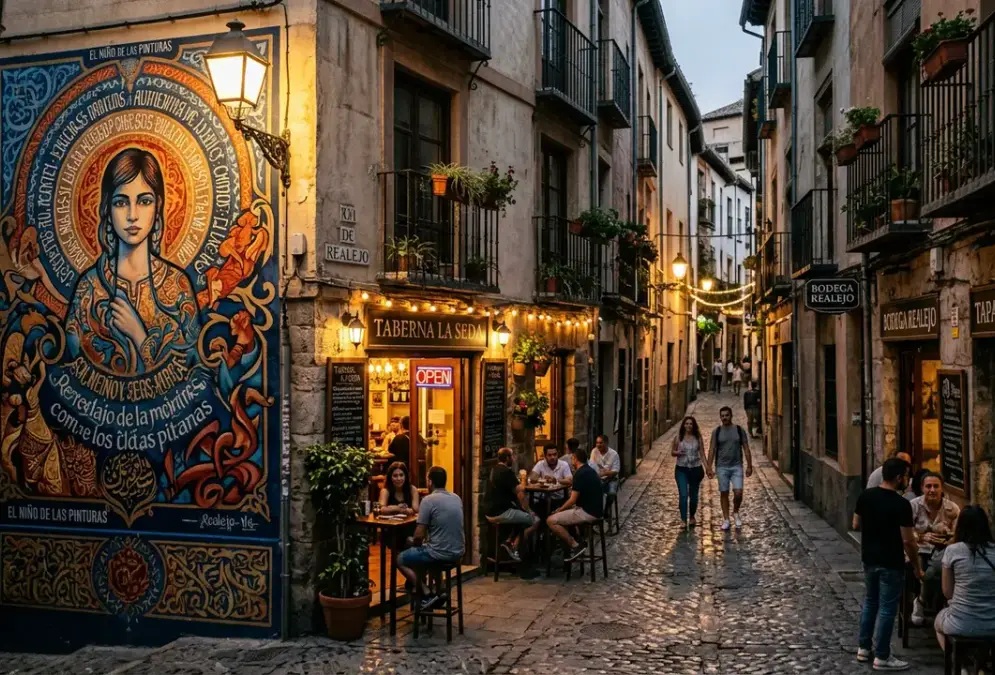
Explore · Neighbourhood
Realejo / Jewish Quarter
Medieval Granada's Jewish quarter, now a neighbourhood of historic palaces, street art, and the city's finest tapas bars — all at the foot of the Alhambra.
- Synagogues and its own courts for matters of Jewish law
- A professional class of physicians and astronomers
- Translators and merchants the Zirid court depended on
For a full account of what the quarter looked like day to day and what survives of it, see the piece on the Realejo Jewish quarter. This article's job is narrower: what happened to the family that ran the quarter's politics, and why it ended the way it did.
Joseph ha-Nagid's fatal miscalculation
Samuel died around 1056, reportedly worn out by decades of campaigning, and his eldest son Joseph ibn Naghrela succeeded him as vizier — but Joseph lacked his father's political finesse[9]. Where Samuel had spent thirty years managing exactly how much visibility a Jewish minister could carry before it became a provocation, Joseph inherited the position and, by most accounts, not the instinct that went with it.
The precipitating act was a secret negotiation. Joseph contacted Al-Mutasim ibn Sumadih, ruler of the neighbouring Taifa of Almería, and offered to open Granada's gates to him in exchange for being installed as a subordinate ruler under Almería's protection[10] — trading Zirid Granada's independence for his own political survival. The plot became public only because Al-Mutasim withdrew at the last moment, and word of what Joseph had offered leaked into the city.
Historians read the reaction that followed less as a spontaneous religious riot than as the collapse of a specific political bargain. Bernard Lewis, whose account remains the standard framing, ascribes the massacre to "a reaction among the Muslim population against a powerful and ostentatious Jewish vizier," and notes that massacres of this kind were rare in Islamic history generally[11] — part of why 1066 gets treated as an exception worth explaining rather than a pattern. Popular tradition also attaches an accusation that Joseph poisoned a member of the ruling family shortly before the violence broke out; that detail circulates widely in secondary retellings but isn't pinned to a source solid enough to state as established fact here, so treat it as attributed tradition rather than a confirmed cause.
What is clear is the shape of the failure: a position built on being useful without being threatening, held by a man who miscalculated exactly how much threat the city would tolerate.
30 December 1066: the massacre
The violence broke on 30 December 1066, 9 Tevet 4827 on the Hebrew calendar[1], and moved fast. Joseph was found hiding in a coal-pit, having blackened his face in an attempt to pass unrecognised. He was discovered, killed, and his body was hanged on a cross at the city gate[12].
The mob did not stop with him. The house-to-house killing that followed is the part of the story hardest to pin to a precise number: the 1906 Jewish Encyclopedia put the toll at more than 1,500 Jewish families, around 4,000 people, killed in a single day[13], a figure still repeated in most popular accounts of 1066. Later editions of the Encyclopaedia Judaica quietly dropped that precise count, a sign that modern scholarship treats it as a traditional estimate rather than a confirmed modern consensus. What both the old figure and the newer caution agree on is the order of magnitude: this was not a riot that killed a handful of people close to Joseph. It was the destruction, in a single day, of the leadership and much of the population of the community Samuel had spent thirty years building.
Why 1066 marks the end, not just an event
Joseph's wife and their son Azariah survived by fleeing to Lucena, near Córdoba, where the Jewish community there took them in; Azariah died young[14]. That is the scale of what 1066 ended: not just two men's careers, but a family line that had run Granada's Jewish community for two generations, scattered to another city's charity within a day.
Historians treat 1066 as the hinge that closes al-Andalus's Jewish Golden Age for a specific reason: it showed that the dhimmi arrangement's protections were conditional on political restraint the minority community did not control. Samuel had managed that restraint for thirty years through skill and caution. Joseph broke it in roughly a decade, and the community paid for both men's tenure in a single afternoon. No Jewish vizier held equivalent power in al-Andalus again.
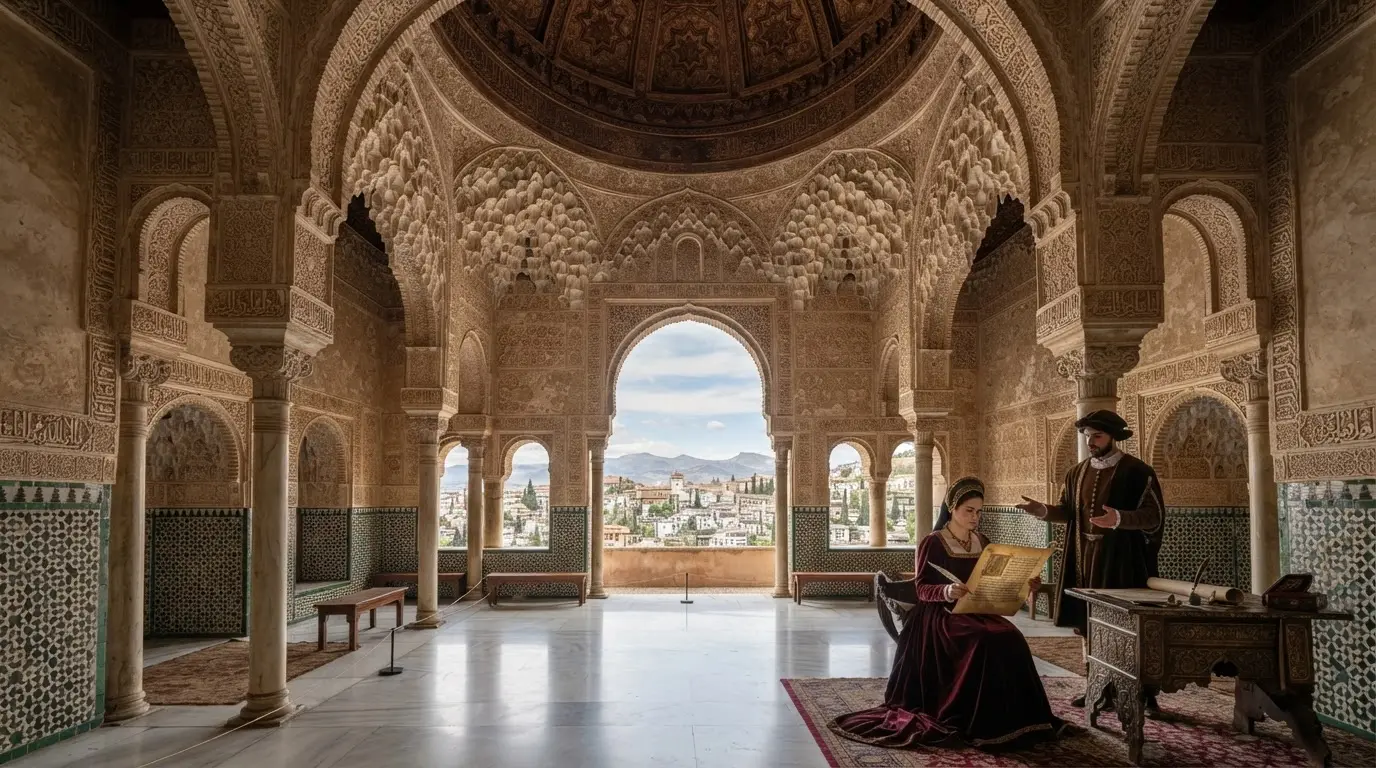
Deep dive · Article
Alhambra Decree 1492: Granada's Jewish Expulsion Explained
The Alhambra Decree (Edicto de Granada) expelled Spain's Jews in 1492. Learn why it happened, what else happened in Spain that year, and where exiles went.
This article has deliberately stayed narrow: one family, one plot, one massacre. For how that fits into the longer, messier three-century relationship between Granada's Muslims, Christians, and Jews, including what came after 1066 and what finally ended it in 1492, the convivencia in Granada article covers the fuller picture. What 1066 shows on its own is narrower and starker: how quickly a position built on royal favour rather than legal right can be reversed, and how completely.