Isabella I and the Flemish Masterpieces of Granada's Royal Chapel
Inside the Royal Chapel sacristy, Isabella I's Flemish paintings wait: Van der Weyden, Memling, Bouts, and a lone Botticelli. Most visitors never enter.
Seven years resident in Granada. Specialist in Nasrid architecture, Al-Andalus history, and Andalusian walking routes.
Updated Published
The tombs get all the attention, but the paintings are why Isabella built the place. In the sacristy museum of Granada's Capilla Real, Spain's most underrated small art collection holds the works she personally chose, owned, and bequeathed: Flemish masters, a solitary Botticelli, her crown and sceptre, all of it ten metres from the royal sarcophagi where most visitors turn around.
In this article
Jump to a section
⌄
The sacristy nobody enters
The Capilla Real in Granada is one of the most visited monuments in Andalusia, and it is almost always visited wrong. Visitors queue for the main door on Calle Oficios, walk the central nave, stand before the carved marble screen, look down at the lead coffins in the crypt, and read the names on the plaque: Isabella I of Castile, Ferdinand II of Aragon, Joanna I, Philip I. They photograph the sarcophagi. Then they leave.
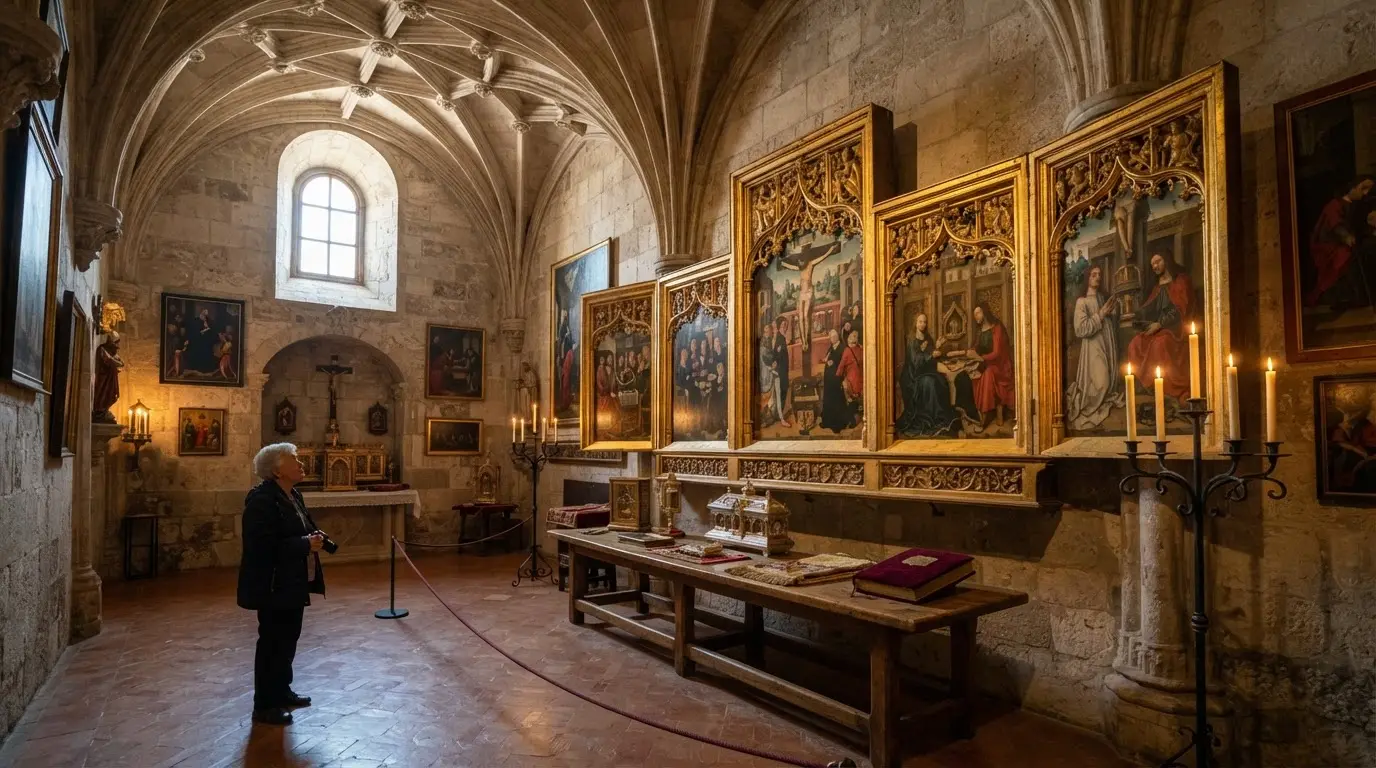
Physically separated from the main chapel and accessible through a different door[1], the sacristy museum holds what Isabella actually considered most important: her private art collection, the devotional paintings she lived with, chose personally, and left here in her will. A 2024 visit on a Tuesday afternoon found the nave holding perhaps sixty people at any given moment. The sacristy had four.
The collection is not hidden. It is not poorly signed. It is simply in the second room, and second rooms in Iberian monuments suffer a reliable fate: visitors reach the primary attraction, feel that they have seen the thing, and move on. In this case, the thing they are moving on from is a concentration of late 15th-century Flemish painting that would be a headline exhibit in any European city gallery.
Isabella's royal charter for the chapel was issued in September 1504[1], less than three months before her death. The building itself was completed in 1517[1] and inaugurated in 1521. The sacristy received her personal bequest: the paintings she had accumulated across thirty years of rule, sent from Flanders by diplomatic agents, painted at her court by artists she employed. Rogier van der Weyden, Hans Memling, Dieric Bouts: these names belong in a paragraph about the Prado or the Ghent altarpiece, not a sacristy on a side street in the centre of Granada. That is precisely the point.
A queen who collected like no other
Isabella I of Castile had particular taste in painting, and particular reasons for it. She was, by any reading of her documented preferences, drawn to the emotional directness of Northern European devotional work over the composed idealism of the Italian Renaissance. Flemish painting in the late 15th century was devotional in a specific way: figures with real physical weight, grief that read as genuine rather than decorative, the texture of cloth and skin rendered with a precision that made the sacred feel immediate. For a woman whose religious life was reported as intense even by the standards of 15th-century Castilian piety, this mattered[6].
The political context made the collecting possible. Castile and Flanders were commercial partners of long standing, the wool trade connecting the two regions through Bruges and Antwerp, and the Habsburg marriage alliance that brought Philip of Burgundy into the Castilian royal family created direct dynastic connections to the heartland of Flemish art production[5]. Isabella did not need to travel to Flanders to acquire its paintings; the trade routes and diplomatic missions brought them to her.
Isabella's network of diplomatic agents used these established routes to acquire art on her behalf, purchasing Flemish works through channels that ranged from direct commissions to market acquisitions[5]. The resulting acquisitions formed the core of what ended up in the sacristy.
At the same time, Isabella had a Flemish painter at her court. Juan de Flandes (c.1460-1519) arrived in Castile around 1496[5] and remained as court painter until Isabella died in 1504. His work synthesised Northern technique, the luminous glazing and precise detail of the Flemish tradition, with the subjects and formats that the Castilian court required. He is the most direct expression of what the queen was building: a court aesthetic that was neither purely Spanish nor purely Flemish but something that emerged from sustained contact between the two[5].
Van der Weyden and Memling: the masters she chose
The two painters most heavily represented in the sacristy collection are Rogier van der Weyden and Hans Memling, and their presence together is not a coincidence. Memling trained in Van der Weyden's workshop in Brussels before the older master died in 1464[4]; the continuity of technique between them is direct rather than merely stylistic.
Van der Weyden's contribution to the sacristy includes an altarpiece with panels depicting the Nativity and a Descent from the Cross, oils on oak, the characteristic Flemish support[2]. Van der Weyden was, by 1504, already a figure of historical importance rather than a working artist; he had died forty years earlier. Isabella was not collecting contemporary work. She was collecting what she judged to be the greatest devotional painting available, and in the Flemish tradition Van der Weyden set the standard against which other painters measured themselves[4]. His Descent from the Cross, in any version, is one of the formal achievements of 15th-century Northern painting: the body of Christ and the figure of the Virgin mirroring each other in the diagonal sweep of the composition, grief made structural.
The Memling works are numerous. The sacristy holds a Pietà (53×38 cm)[2], a diptych of the Descent from the Cross and the Weeping of the Holy Women, a Virgin with Child Enthroned (75×60 cm)[2], and a Nativity panel. Memling worked at a scale suited to private devotion: these are not altarpieces for large churches but objects meant for a small room, for one person looking closely. The Virgin with Child Enthroned shows the formal influence of Van der Weyden's compositional approach, with the throne canopy, the shallow pictorial space, and the figures frozen in a stillness that reads as reverence rather than stiffness. The surface treatment is softer, the light more diffuse, the emotional register slightly less austere than his master's work.
Recommended tours
Tours are selected for quality, not commission. We earn a small fee if you book — at no extra cost to you.
What Isabella saw in these paintings was probably what she could not find in Spanish work of the same period: emotional intensity rendered through technique rather than through scale. The Flemish painters' ability to make suffering visible at small scale, through the precise observation of a tear-stained face or a hand gripping cloth, served her devotional needs more directly than the monumental altarpieces of Castilian churches.
53 × 38 cm
The dimensions of Memling's Pietà in the sacristy — smaller than a standard sheet of paper. Flemish devotional panels were made for private contemplation, not public display. Most of the sacristy's works were painted at this intimate scale.
The supporting cast: Bouts, Provost, and a surprise Botticelli
Beyond Van der Weyden and Memling, the sacristy holds works by Dieric Bouts and Jan Provost, among others. Bouts's contribution is a Passion Triptych covering the Crucifixion, Descent, and Resurrection, and a separate panel of the Virgin with Child and Four Angels[2]. Bouts worked in Leuven rather than Brussels, slightly outside the direct Van der Weyden circle, and his figure types are distinctive: elongated, with a formal gravity that reads differently from Memling's warmth or Van der Weyden's emotional tension. The triptych format was the standard vehicle for devotional painting in this period, and Bouts's example in the sacristy gives the collection a liturgical structure that the individual panels of Memling and Van der Weyden lack.
Jan Provost and the Master of the Legend of St. Catherine are also present, with a triptych that includes a scene of St. Gregory's Mass — a subject with particular resonance for Isabella's Eucharistic piety, depicting the vision said to have appeared to Pope Gregory I during Mass as proof of the Real Presence.
Then there is the Botticelli. Sandro Botticelli'sAgony in the Garden (c.1500)[3] is the most unexpected object in the sacristy: Italian, not Flemish, from a painter associated with the Neo-Platonic aesthetics of Medici Florence rather than the devotional realism of the Low Countries. Its presence reflects the breadth of Isabella's network of agents and the ambition of her collecting programme, which was not doctrinaire. If a work served devotional purposes and was of sufficient quality, its origin mattered less than its function. The Botticelli occupies the collection slightly awkwardly, which is part of what makes it interesting.
Alongside the paintings, the sacristy holds Isabella's personal crown and sceptre[1] — the crown, likely used for her effigy rather than her living head, is made of gilded silver and is visibly modest by royal standards. The sceptre is similarly plain. Together they give the sacristy a material dimension that extends beyond the paintings: this is not a gallery but a reliquary of royal life, the objects and images that belonged to one specific person who happened to rule Castile.
The Hispano-Flemish revolution Isabella started
Isabella's collecting was not simply acquisition. It shaped what Spanish painters saw, absorbed, and produced for the next two generations. The presence of Flemish panels at the Castilian court, and the employment of Juan de Flandes as court painter from 1496, created a sustained conversation between Northern technique and Spanish patronage that produced a distinct aesthetic: the Hispano-Flemish style[5].
The style is characterised by the adoption of Flemish technical methods, oil on panel, precise optical rendering of surfaces, deep spatial recession through atmospheric perspective, applied to Spanish religious subjects and Spanish architectural settings. It appears in altarpieces across Castile and Aragon in the late 15th and early 16th centuries, in the work of painters such as Fernando Gallego and Bartolomé Bermejo, who had independently absorbed Flemish influence, and in the more direct production of Juan de Flandes himself[5].
Timeline
1496
Juan de Flandes hired as court painter
Juan de Flandes (c.1460-1519) arrives at the Castilian court as Isabella's official court painter, beginning the direct synthesis of Flemish technique with Spanish royal patronage[5].
1499
Fonseca's buying mission to Flanders
Bishop Juan Rodríguez de Fonseca departs for Flanders on behalf of Isabella to acquire tapestries and paintings. His mission will produce many of the works now in the sacristy[2].
1504
Isabella dies; collection bequeathed
Isabella I dies on 26 November. Her will explicitly bequeaths her personal art collection to the Capilla Real sacristy in Granada[1].
1505–1517
Chapel constructed
Construction of the Capilla Real proceeds under royal commission. The building is completed in 1517[1].
1521
Chapel inaugurated
The Capilla Real is formally inaugurated, with the royal tombs and the sacristy collection installed[1].
Juan de Flandes' court work for Isabella included a series of small panels depicting episodes from the life of Christ and the Virgin, known as the Retablo of Queen Isabella, now dispersed across several collections. The panels are in the sacristy tradition: small scale, oil on oak, intended for private contemplation rather than public display. They read as Flemish in technique and Spanish in their devotional register, which is what Isabella wanted them to be.
The broader significance is that Isabella's taste was not passive consumption. She did not simply buy what was available; she employed a painter who fused two traditions, sent agents to acquire works that met specific criteria, and created an environment in which the Flemish and the Iberian interacted at the highest level of patronage. The result fed Spanish painting for half a century after her death in 1504. When you look at a Castilian altarpiece from the early 16th century and see the precise rendering of cloth or the low horizon and wide sky of a Flemish landscape in the background, you are seeing an inheritance that traces, in part, back to the collection in the sacristy on Calle Oficios. The Granada Cathedral, directly adjacent to the Capilla Real, was under construction through most of the same period and holds its own layer of this dynastic programme in stone — Diego de Siloé's Renaissance conversion of what began as a Gothic church commissioned by the same monarchs whose paintings hang in the sacristy next door.
How to see the collection today
The Capilla Real is open six days a week, closed on Sunday mornings during Mass, and admission covers both the main chapel and the sacristy. The standard advice is to arrive early, before tour groups form, which applies here as everywhere in central Granada. A morning visit from Tuesday to Friday is quieter than any visit on a weekend.
Once inside, go left before you go right. Most visitors turn right along the nave towards the sarcophagi and then circle back; the sacristy door is to the left of the high altar area. Go there first while the room is empty, or return there after the sarcophagi if you prefer to follow the conventional sequence. Either way, give the sacristy at least 40 minutes. The paintings are small and require closeness. The wall lighting in the sacristy is reasonable by Spanish museum standards, but bring reading glasses if you use them — the panel inscriptions and some of the smaller figures reward close reading.
For the Flemish panels, start with the Van der Weyden altarpiece and work outward. The connection to Memling becomes visible once you have looked at Van der Weyden first: the shared compositional logic, the approach to drapery folds, the way both painters construct their figures to fill the picture plane without crowding it. The Bouts triptych gives you a point of comparison with a slightly different Flemish tradition.
The Botticelli is in a distinct bay and easy to miss if you are moving quickly. Slow down when you reach it. After the Flemish panels, the different handling of light, the Italian landscape background, the almost agitated quality of the garden scene, reads like a deliberate counterpoint.
Isabella's crown and sceptre are in a case near the entrance to the sacristy. They are worth pausing over for reasons that have nothing to do with their material value, which is modest. A queen who ruled Castile at the moment of the Reconquista's completion, who funded Columbus's first voyage, who commissioned the building that holds you, wore this small gilded crown. The plainness is the point.
The Royal Chapel monument page has current ticket prices, opening hours, and practical logistics. The Royal Chapel planning guide covers how to combine the visit with the Cathedral next door. Allow two hours for both buildings, and save the sacristy for the end, when you are ready to stand still.
Frequently asked questions
What paintings are in the Royal Chapel of Granada?
The sacristy museum of the Capilla Real holds Isabella I's personal collection of late 15th-century Flemish painting, including works by Rogier van der Weyden (an altarpiece with Nativity and Descent from the Cross panels), Hans Memling (a Pietà, a diptych of the Descent from the Cross and Weeping of the Holy Women, a Virgin with Child Enthroned, and a Nativity panel), and Dieric Bouts (a Passion Triptych and Virgin with Child and Four Angels). Jan Provost and the Master of the Legend of St. Catherine are also represented, along with a Botticelli Agony in the Garden (c.1500) — a rare Italian work in an otherwise Flemish-dominated collection.
What is in the Royal Chapel sacristy museum?
The sacristy museum holds Isabella I's personal art collection, bequeathed to the chapel in her will of 1504. It includes Flemish panel paintings by Van der Weyden, Memling, Bouts, and others, a Botticelli, and Isabella's personal crown and sceptre. The sacristy is physically separate from the main chapel nave and requires a different door, which is why many visitors miss it. Entry is included in the standard chapel admission.
Where is Isabella of Castile buried?
Isabella I of Castile is buried in the crypt of the Capilla Real (Royal Chapel) in Granada, in the city she chose as her final resting place after the Reconquista was completed with the fall of Granada in 1492. Her lead coffin rests in the crypt directly below the chapel floor, alongside Ferdinand II of Aragon, Joanna I, and Philip I. The carved marble sarcophagi above, visible in the main nave, are cenotaphs rather than actual burial containers.
Who is the Flemish artist who worked at Isabella's court?
Juan de Flandes (c.1460-1519) was the Flemish painter employed at Isabella's court from approximately 1496 until her death in 1504. He is the primary figure of the Hispano-Flemish style, fusing Northern panel-painting technique with the devotional subjects required by the Castilian court. His most significant court project was a series of small oil-on-panel scenes from the life of Christ and the Virgin, the so-called Retablo of Queen Isabella, now dispersed across several European and American collections.
Is there a Botticelli in Granada?
Yes. Sandro Botticelli's Agony in the Garden (c.1500) is permanently held in the sacristy museum of the Capilla Real in Granada. It is one of very few Italian Renaissance works in Isabella I's otherwise Flemish-dominated personal collection, and its presence suggests her collecting programme prioritised devotional quality and function over national origin. The painting dates from Botticelli's late religious phase, after the influence of the Florentine preacher Savonarola.
What is the Hispano-Flemish style?
The Hispano-Flemish style is a 15th- and early 16th-century Spanish painting tradition that adopted Flemish technical methods, oil on wood panel, detailed optical rendering of surfaces, atmospheric perspective, while applying them to Spanish religious subjects and patronage contexts. It emerged from the sustained contact between Castilian court patronage and Flemish art production. Isabella I's employment of Juan de Flandes as court painter and her systematic acquisition of Flemish works through agents like Juan Rodríguez de Fonseca were central to its development.
Is the Royal Chapel sacristy worth visiting?
Yes, and it is arguably more worth visiting than the main chapel nave. The tombs are historically significant but visually modest. The sacristy holds a genuine concentration of late 15th-century Flemish masterworks in a small space, including panels by Rogier van der Weyden and Hans Memling that would be headline exhibits in any major European gallery. Admission to the sacristy is included in the standard Capilla Real entry price. Allow at least 40 minutes in the sacristy alone.
Why is the Royal Chapel Granada paintings collection so underrated?
The collection's obscurity has a structural explanation: the sacristy is physically separate from the main chapel, accessible through a side door, and positioned past the primary attraction. Most visitors reach the royal tombs and leave without walking the extra ten metres. The collection is also not associated with a famous museum context; it exists in a working religious building rather than a dedicated gallery. Finally, the painters it holds, Van der Weyden, Memling, and Bouts, are less immediately famous to non-specialist visitors than Italian contemporaries such as Raphael or Leonardo, despite being equally significant within 15th-century European painting.