Richard Ford handbook for travellers in Spain Granada scene: an 1830s English traveller in a frock coat sketching beneath the carved stucco arcades of the Court of the Lions at golden hour, a woman beside him with a drawing board

Richard Ford and the Romantic Travellers in Granada

Richard Ford summered in the Alhambra in 1831 and 1833, then wrote the 1845 Handbook for Travellers in Spain. Meet him, Harriet and Gautier in Granada.

Portrait of James Walker
Written by

Seven years resident in Granada. Specialist in Nasrid architecture, Al-Andalus history, and Andalusian walking routes.

Published
Modern Granada1808–today
Richard Ford was the English connoisseur who lived in the half-ruined Alhambra in the early 1830s and then wrote the Handbook for Travellers in Spain, which makes him the best eyewitness to the palace before restoration. On 7 June 1831 he reported that he had installed himself there,[1] nine years before Théophile Gautier lodged for four days with Eugène Piot[2] and fourteen years before the Handbook sold 1,800 of its first 2,000 copies by the end of its publication year.[3] You can still stand where his staircase led, because the Hall of the Ambassadors is on the Nasrid Palaces route.
Ford moves into the palace
7 June 1831
His letter announcing he had installed himself in the Alhambra[1]
Gautier's Nasrid stay
4 days
Gautier and Eugène Piot lodged in the Nasrid palace for four days[2]
Handbook first-year sales
1,800 copies
Of 2,000 printed, the first edition sold 1,800 by the end of 1845[3]

Moving into a half-ruined palace, 1831

Ford did not go to Spain to write a guidebook. He and his wife Harriet stayed from October 1830 to October 1833, with Seville as their base and the summers of 1831 and 1833 in the Alhambra, where the climate was cooler.[4] Anyone who has climbed the Cuesta de Gomérez in July understands the logic.
The palace they moved into bore little resemblance to the monument you queue for today. Rowland Prothero, who edited Ford's letters in 1905, described a place that had served as a debtors' asylum, a prison for galley-slaves and a French barrack. His own summary of the livestock is hard to improve on: "A donkey was stabled in the chapel, sheep were folded in the courtyards, poultry penned in the halls."[5]
Ford summered in it anyway, and the contrast is the point. The Alhambra you walk today is a managed circuit of restored stucco; the one he knew was half barracks and half farmyard, with a British couple spending their summers inside it. Everything he wrote about the place, and everything Harriet drew, comes from that unmanaged version.

Harriet's drawings and the painters around Ford
Harriet Ford is the traveller readers of the Handbook never meet. She drew the Alhambra's azulejo tile patterns during those summers, and Ford's letters tie the work to her health: he wished she "got on as well as the Alhambra azulejo drawings".[6]
The household was a magnet for painters. From late 1832 Ford housed and patronised the British artist John Frederick Lewis,[7] who was another painter at the Alhambra around the same time.[8]
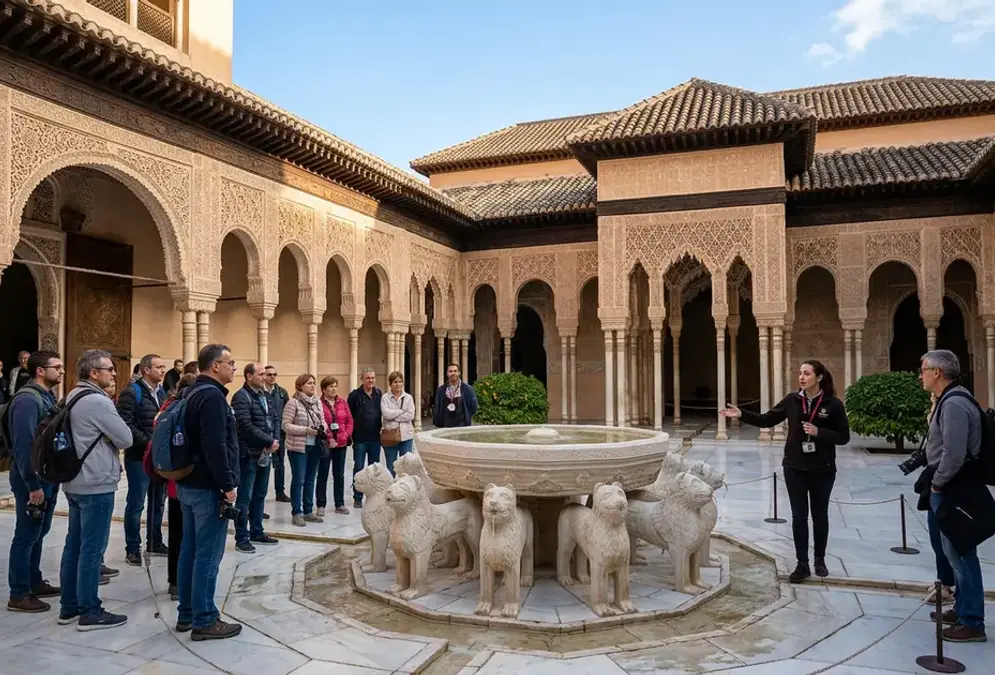
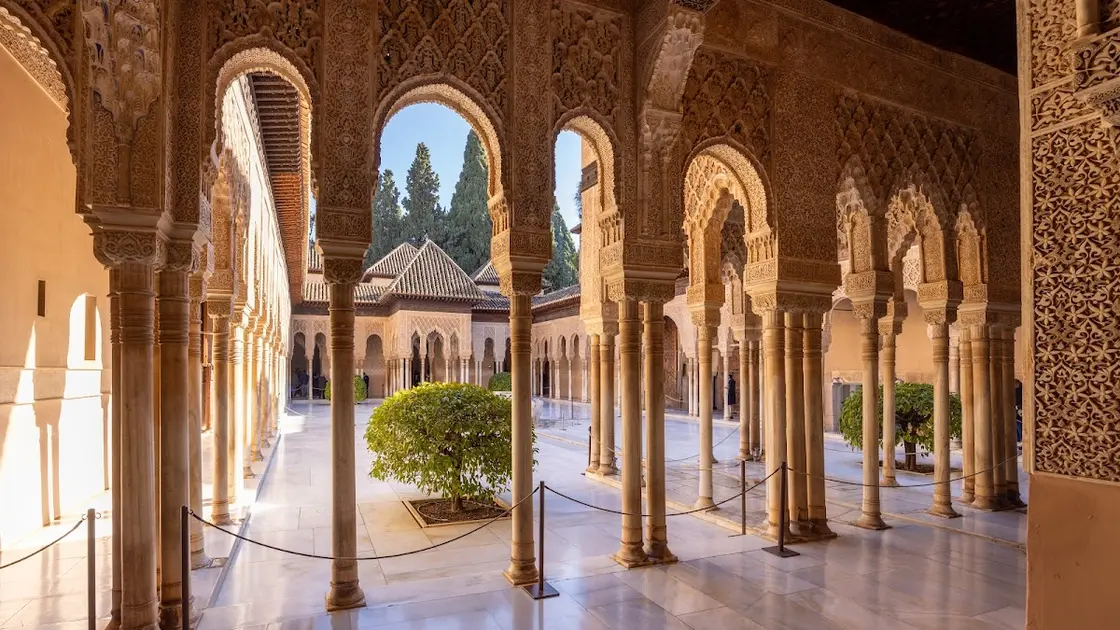
The Patio de los Leones in the Nasrid Palaces, with its central alabaster fountain supported by twelve lions

Explore nearby · Monument

Nasrid Palaces

Three royal Nasrid palaces inside the Alhambra, including the Patio de los Leones and Hall of the Ambassadors. Entry is timed: arrive within your booked slot.

Others came with different tools. David Roberts painted a dramatic view of the Alhambra in 1833, reproduced as a lithograph in his Sketches of Spain in 1837.[9] Owen Jones and Jules Goury spent six months at the Alhambra in 1834, and Goury died of cholera there.[10]
None of these men went home and wrote a guidebook. Ford did, though it took him twelve years from his last Alhambra summer.

Gautier, nine years later

Gautier came as a different kind of visitor. The poet and critic made his Spanish journey in 1840 with Eugène Piot, and the book that came out of it, Voyage en Espagne, was published in 1843.[11]
He arrived already knowing the story of the place. Lodging in the palace, Gautier recalled the popular legends that Washington Irving had gathered for his Tales from the Alhambra,[12] so Irving's book was already the lens through which a Frenchman read the rooms.
Set the two men side by side and the difference is plain. Ford wrote as a resident with a landlord's grievance, complaining that "what with time, the French, and the barbarous Spaniards" the whole enchanted spot was going the way of everything in Spain.[13] Gautier wrote as a guest with four days and a head full of legends.
Gautier's book travelled. It reached English readers as Wanderings in Spain, translated by Thomas Robert McQuoid, which put a French view of the Alhambra on the same shelf as Ford's English one.[14]

The 1845 Handbook gives the Alhambra only 15 pages

Ford's Handbook gives the Alhambra, the Palace of Charles V, the Generalife and their surroundings just 15 pages, 369 to 383 in the Alhambra library's copy of the 1845 edition.[15] That is a short allowance for a place he had lived in for two summers, which is why his letters of 1831 are the better place to meet the Ford who lived there.
The book did not arrive in one piece. What reached the shops that July was the second attempt: the first draft, partly printed in 1844, had been abandoned in early 1845 for its hostility to the Spanish government, to Marian devotion and to French misconduct, and the replacement was a toned-down but still harsh book in two volumes, published in July 1845.[16]
Timeline
  1. October 1830

    The Fords reach Spain

    Seville becomes their base.

  2. 7 June 1831

    Ford writes from the Alhambra

    His letter says he has installed himself in the palace.

  3. Late 1832

    Lewis joins Ford's household

    Ford begins to house and patronise the painter.

  4. October 1833

    The Fords leave Spain

  5. 1834

    Jones and Goury at the Alhambra

    Their stay lasts six months and ends in Goury's death from cholera.

  6. 1840

    Gautier and Piot lodge in the palace

  7. 1843

    Voyage en Espagne is published

  8. July 1845

    Ford's Handbook appears in two volumes

Ford had no patience for armchair authorship. He dismissed James Cavanah Murphy's Arabian Antiquities as "a mere book-making job" and found it "difficult to believe that Murphy was even ever on the spot".[17]
By the third edition of 1855 his pecking order of Alhambra books was plain: he listed Girault de Prangey's Paris volume of 1837 among the works that "fade before the English publication by Owen Jones".[18]
His own century's verdict came in an obituary commonly attributed to Sir William Stirling-Maxwell: "so great a literary achievement had never before been performed under so humble a title."[19] The Handbook survives as an odd object, a work of reference that readers keep for its voice rather than its opening hours.

Seeing Ford's Alhambra today

Start with the Governor's suite. General O'Lawlor, Ford wrote, had procured him the Governor's apartments, one staircase of which led into the Sala de los Embajadores.[20] Ford's exact rooms cannot be confirmed as open to visitors today. The Hall of the Ambassadors itself is on the Nasrid Palaces route, so a ticket for the palaces takes you into the room that staircase opened onto.
Ford is best read before you go, at the pace of a guidebook rather than a novel. Three books frame the Alhambra as these travellers saw it:
  • Ford's Handbook for Travellers in Spain (1845), for the grievances and the Alhambra pages
  • Gautier's Voyage en Espagne (1843), in English as Wanderings in Spain, for a four-day guest's first impressions
  • Irving's Tales of the Alhambra, for the legends Gautier had in his head
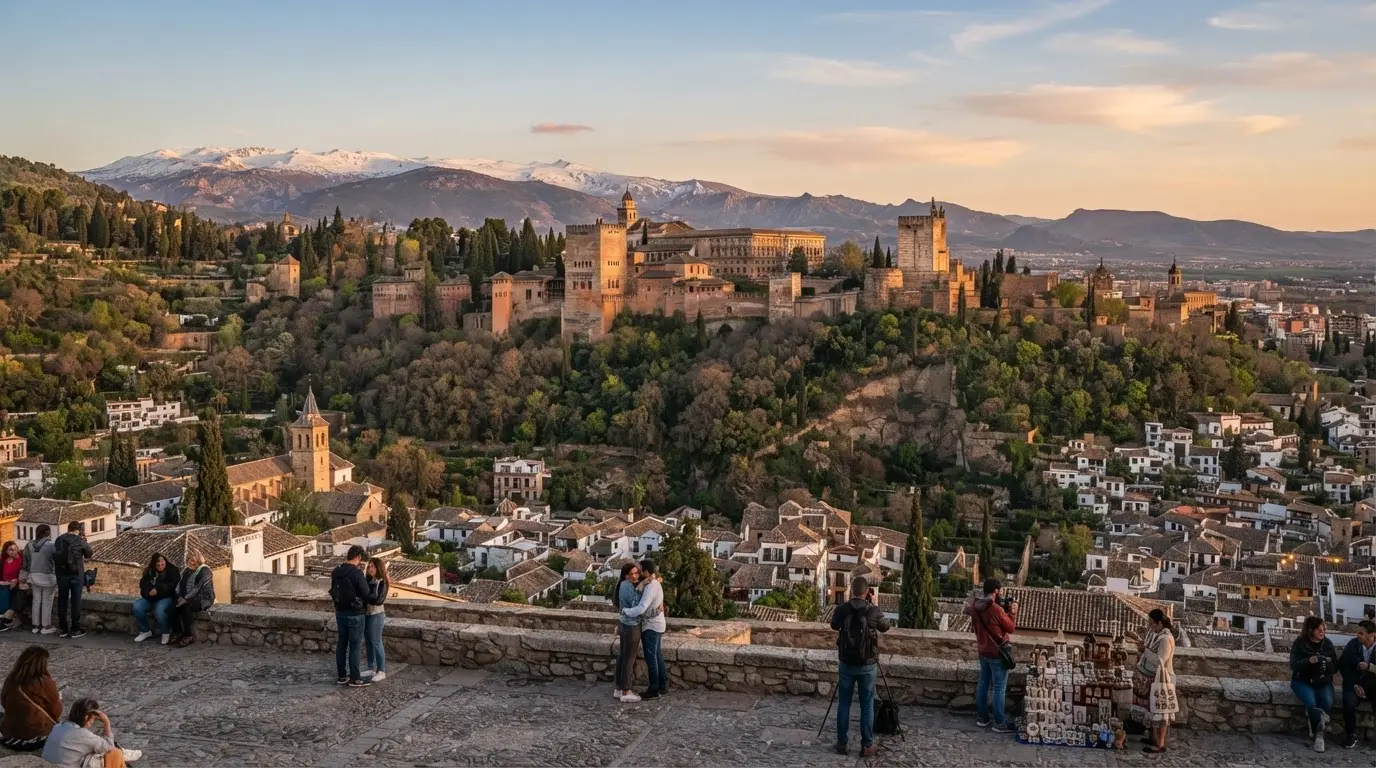
Wide-angle panoramic view of Granada Spain from Mirador de San Nicolás showing the Alhambra palace complex and Generalife gardens against the snow-capped Sierra Nevada mountains at golden hour, illustrating the interesting facts about Granada Spain

Deep dive · Article

20 Interesting Facts About Granada, Spain

Interesting facts about Granada Spain that guidebooks skip: disputed etymologies, the soldier who saved the Alhambra, and a river buried under Plaza Nueva.

The Alhambra's own reading recommendations point to Guardians of the Alhambra for the world of the Romantic travellers and the arrival of David Roberts.[21] It is a useful companion for anyone who wants the wider cast.
Then look at the walls. Gautier's blunt discovery was that all this magnificence is executed "neither in marble nor alabaster, nor even stone, but simply in plaster".[22] Stand in the Court of the Lions with that sentence in mind and the stucco, close enough to read, looks both more fragile and more remarkable.

Frequently asked questions

Who was Richard Ford and why does he matter to Granada?

Richard Ford (1796-1858) was an English connoisseur who spent October 1830 to October 1833 in Spain, summering in the Alhambra in 1831 and 1833. His 1845 Handbook for Travellers in Spain is regarded as a classic of travel literature in its own right, and his letters are an eyewitness account of the palace before restoration. He should not be confused with the American novelist of the same name.

When did Richard Ford live in the Alhambra?

Ford and his wife Harriet spent the summers of 1831 and 1833 in the Alhambra, using Seville as their base for the rest of their Spanish stay. By 7 June 1831 he had installed himself in the palace, in the Governor's suite of apartments.

What does Richard Ford's Handbook for Travellers in Spain say about Granada?

The Handbook appeared in two volumes in July 1845. In the Alhambra library's copy, the account of the Alhambra, the Palace of Charles V, the Generalife and the surroundings runs on pages 369 to 383. Ford's tone is critical throughout; in the 1855 edition he ranks Owen Jones's English publication above Girault de Prangey's Paris volume.

Did Théophile Gautier visit the Alhambra?

Yes. Gautier made his Spanish journey in 1840 with Eugène Piot and lodged inside the Nasrid palace for four days and nights. He published Voyage en Espagne in 1843, and it reached English readers as Wanderings in Spain, translated by Thomas Robert McQuoid.

Who else rediscovered the Alhambra in the 1830s?

John Frederick Lewis, whom Ford housed from late 1832, drew the palace. David Roberts painted it in 1833, and Owen Jones and Jules Goury stayed six months in 1834, when Goury died of cholera. Girault de Prangey visited in 1832-33 and lithographed his plans and drawings in his 1837 Souvenirs de Grenade et de l'Alhambra.

Did Ford meet Washington Irving or David Roberts?

Ford wrote that Irving had told him he could lodge in the Alhambra as Irving had, which tempted him to spend the next summer there. He befriended Roberts in England but apparently never met him in Spain, although both were there in 1832-33.

What did Gautier think of the Alhambra?

He warned readers that the palace-fortress does not match the imagination: massive brick-coloured towers outside, delicate rooms inside, and decoration in plaster rather than marble. He still called his four days and nights there the most delightful moments of his life.

Further reading

Sources

22 references Show
  1. gutenberg.org — Pg60992 images (opens in a new tab)

    “His letter of June 7th, 1831, announces that he had installed himself in the palace.”

  2. Patronato de la Alhambra — S4.pdf (opens in a new tab)

    “They stayed in the Nasrid palace for four days”

  3. Wikipedia — Richard Ford (English writer) (opens in a new tab)

    “Of the 2,000 copies of this first published edition 1,800 were sold by the end of the year.”

  4. Wikipedia — Richard Ford (English writer) (opens in a new tab)

    “Their stay lasted from October 1830 to October 1833, Seville being their base, except for the summers of 1831 and 1833, which they spent in the Alhambra at Granada where the climate was cooler.”

  5. gutenberg.org — Pg60992 images (opens in a new tab)

    “A donkey was stabled in the chapel, sheep were folded in the courtyards, poultry penned in the halls.”

  6. gutenberg.org — Pg60992 images (opens in a new tab)

    “I wish she got on as well as the Alhambra azulejo drawings.”

  7. Wikipedia — Richard Ford (English writer) (opens in a new tab)

    “From late 1832 Ford was also to house and patronise the British artist, John Frederick Lewis (1804/5–1876).”

  8. languagecollections-blog.lib.cam.ac.uk (opens in a new tab)

    “Another visitor to the Alhambra at around the same time was the painter, John Frederick Lewis.”

  9. artmuseum.princeton.edu (opens in a new tab)

    “This dramatic view of the Alhambra was reproduced as a lithograph in the artist’s portfolio _Sketches of Spain_ in 1837.”

  10. languagecollections-blog.lib.cam.ac.uk (opens in a new tab)

    “They stayed at the Alhambra for six months but sadly Jules Goury died of cholera there.”

  11. Patronato de la Alhambra — S4.pdf (opens in a new tab)

    “Gautier published his Voyage en Espagne in 1843”

  12. poetryintranslation.com (opens in a new tab)

    “I recalled to mind the popular legends Washington Irving gathered to form his Tales from the Alhambra.”

  13. gutenberg.org — Pg60992 images (opens in a new tab)

    “what with time, the French, and the barbarous Spaniards, all this enchanted spot is going the way of everything in Spain.”

  14. gutenberg.org — 52763 (opens in a new tab)

    “Translator | McQuoid, Thomas Robert, 1820-1912”

  15. Patronato de la Alhambra — 6057 (opens in a new tab)

    “descripción de la Alhambra, Palacio de Carlos V, Generalife y contornos en las páginas 369-383”

  16. Wikipedia — Richard Ford (English writer) (opens in a new tab)

    “A revised edition, still highly critical, if somewhat toned down, appeared in two volumes in July 1845.”

  17. languagecollections-blog.lib.cam.ac.uk (opens in a new tab)

    “a mere book-making job, and it is difficult to believe that Murphy was even ever on the spot.”

  18. archive.org (opens in a new tab)

    “fade before the English publication by Owen Jones”

  19. Wikipedia — A Handbook for Travellers in Spain (opens in a new tab)

    “so great a literary achievement had never before been performed under so humble a title.”

  20. gutenberg.org — Pg60992 images (opens in a new tab)

    “General O’Lawlor, very civil, has procured me the Governor’s suite of apartments in the Alhambra, one staircase of which leads into the Sala de los Embajadores (as aforesaid)”

  21. Patronato de la Alhambra — Guardians of the alhambra (opens in a new tab)

    “The writer describes the world of the Romantic travellers, the arrival of David Roberts, the Scottish painter and creator of the paintings of the monument which are most reproduced.”

  22. poetryintranslation.com (opens in a new tab)

    “all this magnificence is executed neither in marble nor alabaster, nor even stone, but simply in plaster!”