
Why Charles V built a palace inside the Alhambra
In the spring of 1526, Charles V (Holy Roman Emperor and King of Spain as Carlos I) brought his new bride Isabella of Portugal to Granada for their honeymoon. The couple stayed in the royal apartments, and Charles, by several accounts, was genuinely overcome by what he found there. The problem was political as much as aesthetic.
The Alhambra was the most celebrated palace complex in his kingdom and, thanks to its Nasrid builders, the most obviously Islamic. Ferdinand and Isabella, his grandparents, had taken Granada in 1492 and completed the Reconquista, but the palace they occupied sat inside a building programme begun by sultans, surrounded by stucco calligraphy in Arabic and fountains arranged according to Islamic garden principles. For an emperor who held the most powerful Christian throne in Europe, the symbolism was uncomfortable.
111 years
The decision to build a new palace within the Alhambra grounds served a precise imperial purpose[1]: to place a monument of Christian, Roman, classicising architecture at the heart of the Islamic complex. The site chosen was no accident. Several Nasrid palace buildings were demolished to make way for it, a literal erasure of what came before — though the older military fortress at the hill's western end, the Alcazaba, survived; its own construction history predates even the demolished Nasrid palaces, as told in Alcazaba Granada: a fortress history older than the Alhambra.
The man who shaped the project was not the emperor but his governor at the Alhambra, Luis Hurtado de Mendoza, Marquis of Mondéjar. He was the patron who hired the architect, controlled the budget, and pushed the Italian Renaissance aesthetic that would make the building remarkable. Without Mondéjar's ambition, the palace that rose on the Sabika hill might have been a more conventional Spanish court building. Instead, Mondéjar gave the commission to a painter freshly returned from Rome.
Pedro Machuca and the architecture that shocked Spain
Pedro Machuca was born in Toledo around 1490 and spent his early career in Italy, training in the artistic circles of Raphael and moving in a world shaped by Michelangelo's buildings and sculptures. He returned to Spain not as a painter who dabbled in architecture, but as someone who had absorbed the intellectual foundations of High Renaissance design at the source. The palace he designed for Charles V is proof of that.
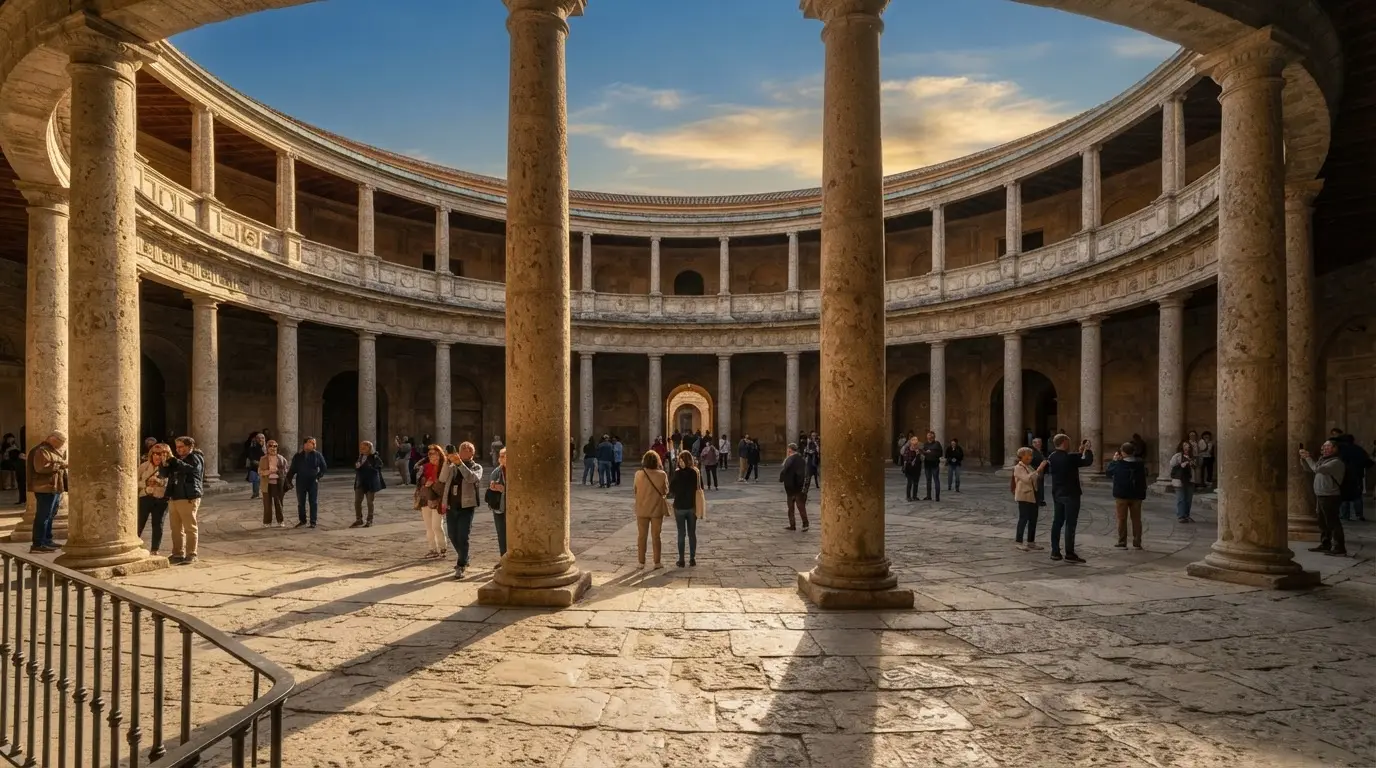
The plan is a 63-metre square (one of the largest Renaissance buildings in Spain) with a 30-metre circular courtyard at its centre. That combination, a perfect circle inscribed inside a square, was without precedent in Renaissance architecture anywhere in Europe.[2] Other architects had proposed circular courtyards theoretically; Machuca built one.
The courtyard is ringed on the ground floor by 32 Doric columns in the Tuscan order, austere and precisely spaced. Above them, the upper storey carries a stylised Ionic colonnade. The ordering follows the canonical Renaissance hierarchy: the heavier Doric below, the lighter Ionic above. The geometry they enclose belongs to a different register entirely. Standing at ground level and looking up at the open sky through the circular opening, you understand what made the building avant-garde. It feels more like a statement about geometry than a room.
The exterior facades tell a different story. The west and south facades mix Plateresque decorative medallions (the Spanish decorative idiom Machuca grew up with) with the heavier rusticated ashlar masonry he preferred from his Italian studies. Two large bronze rings on the south facade were designed for tethering horses during ceremonial arrivals. The building was designed from the outside as an imperial threshold and from the inside as a philosophical proposition.
Explore nearby · Museum
Museo de Bellas Artes de Granada
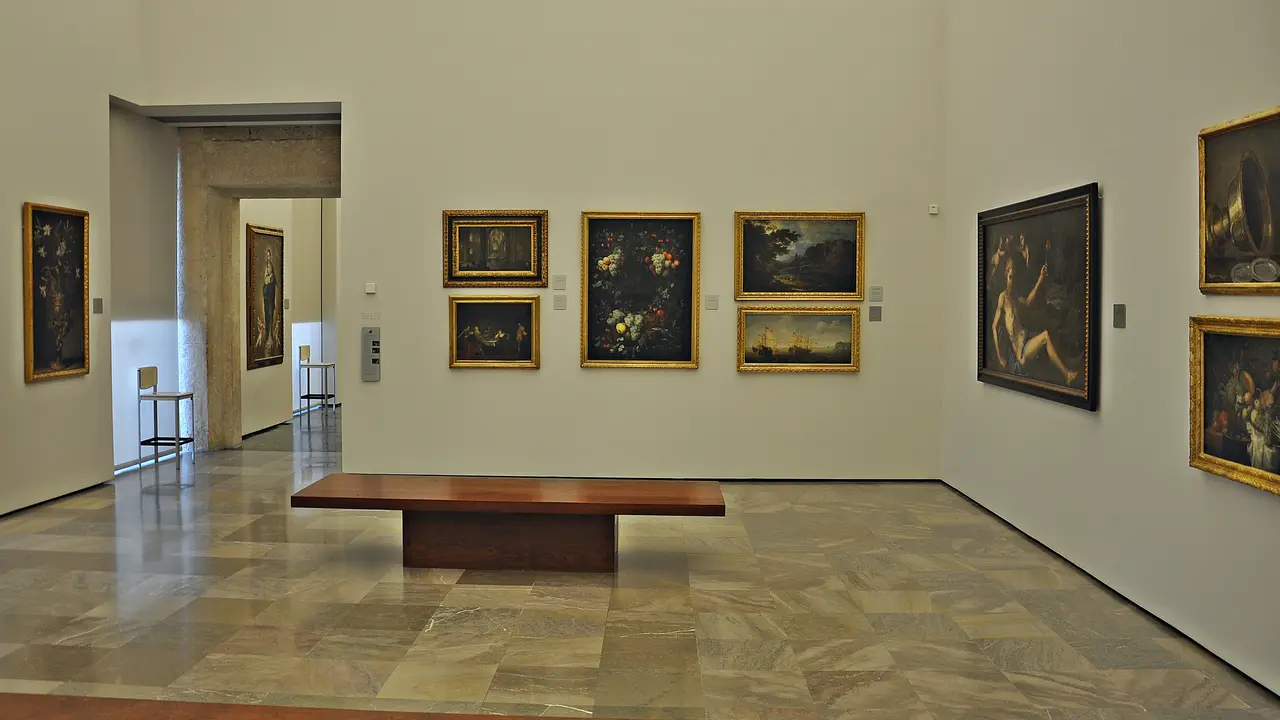
Spain's oldest public museum (1839), upper floor of the Palace of Charles V. Free for EU visitors. Alonso Cano's Granada School paintings and sculptures.
Machuca died in 1550, thirteen years after construction began, having seen the basic structure take shape but never seeing it anything close to finished. His son Luis Machuca took over and continued the work, completing the facades and developing the circular courtyard further. Finishing the roofing of the upper galleries, the project that would have made the palace habitable, was beyond either of them.
The square and the circle: Neoplatonic geometry as imperial language
Machuca did not invent the square-and-circle combination arbitrarily. The pairing carries specific meaning in Renaissance Neoplatonism, the philosophical framework that educated Italian humanists and Spanish courtiers shared by the 1520s.
The square represents the earthly domain: the four cardinal directions, material stability, the foundations of human order. The circle represents the divine: perfection without beginning or end, eternity, the cosmos. Together they encode a claim: that the empire Charles V ruled aligned the earthly with the divine, the human with the transcendent. For an emperor who held that his power derived ultimately from God, this was not abstract decoration. It was the philosophical argument made in stone.
Architectural historians note that Machuca's solution was unprecedented.[3] The circular courtyard within a square plan, known architecturally as annular plan or central-plan architecture, had been theorised by Vitruvius and appeared in Early Christian baptisteries and mausolea. No architect had applied it to a secular palace on this scale. The Pantheon in Rome (which Machuca certainly knew) had inspired its dome, but no residential building had applied the compositional logic to a palace courtyard.
Recommended tours
Tours are selected for quality, not commission. We earn a small fee if you book — at no extra cost to you.
The coffered ceiling of the two staircases that flank the patio is a further Neoplatonic signal: coffering in the Roman manner, as Machuca would have studied at the Pantheon and the Baths of Diocletian. An octagonal chapel embedded in the northeast corner of the building continued the sacred geometry: the octagon, in Christian symbolism, represents the eighth day, the day of resurrection and eternity.
For all the philosophical sophistication, the building conveyed a blunter message to anyone walking through the Alhambra: here, after the intricate stucco and Arabic calligraphy, is a building that speaks Latin. Heavy, Roman, unambiguous in its proportions. Whether that contrast reads as conquest or as dialogue depends on where you are standing.
330 years roofless: the abandoned palace and its unlikely rescue
The history of what did not happen to the Palacio de Carlos V is almost as long as the history of what did.
Work stopped for the first serious interruption in 1568, when the Morisco Rebellion broke out across Granada and the Alpujarras. The uprising of the moriscos (the converted descendants of the Nasrid population) shut down construction for 15 years. Labour, materials, and political attention all moved elsewhere. When work resumed in 1583, the palace was structurally advanced but nowhere near complete.
In 1628, Philip IV visited Granada and inspected the palace. Court records describe it as not inhabitable after 90 years of works. Nine years later, in 1637, the project was definitively abandoned.[4] The upper galleries had no roof. Rain ran freely through the circular courtyard. The building designed to project imperial permanence stood open to the Andalusian sky.
During the Peninsular War (1810–1812), French troops occupied the Alhambra. They stripped the wooden internal fittings from the palace for fuel. What stone remained was untouched; what timber had been fitted was gone.
For perhaps 150 years after that, accounts suggest the circular courtyard served as an informal bullring, the humanist geometry repurposed as an arena. The circle, designed to embody divine perfection, became a place to watch fights. There is something genuinely strange about that arc: from emperor's vanity project to philosophical monument to ruined arena.
Restoration came late and slowly. In 1923, the architect Leopoldo Torres Balbás was appointed architect-conservator of the Alhambra, a position that made him responsible for the entire complex. Torres Balbás is now regarded as one of the founders of rigorous architectural conservation in Spain: his approach was to stabilise and preserve, not to reconstruct speculatively. He began systematic work on the palace, reinforcing the structure and assessing what could be saved.
The roof was not completed until 1967: 330 years after the building was abandoned, 44 years after restoration began. The delay reflects both the scale of the work and the consistent underfunding of the project. The two museums now inside the building opened only after the roof was in place: the Fine Arts Museum in 1958 (in the roofed sections) and the Alhambra Museum in 1995.
The stone paradox: two museums inside the conqueror's palace
The most satisfying irony of the Palacio de Carlos V is not architectural. It is curatorial.
The Alhambra Museum occupies the ground floor, in seven rooms arranged around the circular courtyard. Established in 1995, its permanent collection holds 312 pieces of Hispano-Islamic and Nasrid art from the 13th through 15th centuries.[5] The collection includes bronze lamps, carved woodwork, domestic ceramics, and marble architectural fragments pulled from the Alhambra complex itself. The centrepiece is the Vase of the Gazelles, a 14th-century Nasrid luxury ceramic of extraordinary quality: about 1.3 metres tall, painted in cobalt blue and gold lustre, with two gazelles painted in the upper register. It is one of perhaps 30 surviving examples of the large Nasrid vase form, and among the finest.
Admission to the Alhambra Museum is free for EU citizens, €1.50 for non-EU visitors.[2] Crucially, you do not need the main Nasrid Palaces timed ticket to enter. The museum has independent access within the Alhambra grounds. If you couldn't secure one of the timed slots (they sell out weeks ahead in high season), the palace and its museums are available to anyone with a general Alhambra grounds ticket.
Deep dive · Article
Alhambra 19th Century Restoration: What Contreras Changed
Rafael Contreras renewed parts of the Alhambra in the 1800s. See how Leopoldo Torres Balbás later changed the method through conservation and restraint.
The Museum of Fine Arts of Granada occupies the upper floor, its six rooms holding an extensive collection of 16th–20th century painting and sculpture from Granada and Andalusia. The collection includes key works by Alonso Cano (the 17th-century Granada-born painter and architect who also designed the facade of Granada Cathedral) and by José de Mora. There is also, in one of the smaller rooms, a telling detail: paintings by Pedro Machuca himself. The palace's architect was also a significant Renaissance painter, and his works hang on the walls of the building he designed. The building that was supposed to erase Islamic culture now holds the finest collection of Nasrid art in existence. The architect who designed it is represented upstairs as a painter. The emperor who commissioned it never came back after 1526.
Hours for both museums vary seasonally. In summer (mid-March to mid-October), the ground-floor Alhambra Museum opens Wednesday through Saturday 08:30–20:00 and Sunday through Tuesday 08:30–14:30, closed Mondays. In winter the afternoon hours shorten. Verify current times on the Patronato's website before visiting, as hours can shift.
Practical guide: visiting the Palacio de Carlos V today
The Palacio de Carlos V stands at the heart of the Alhambra complex, a few minutes' walk from the Nasrid Palaces entrance. Getting here requires purchasing an Alhambra grounds ticket at minimum; the palace and both museums are included.
For most visitors, the palace fits naturally into the main Alhambra visit. If you have the full ticket covering the Nasrid Palaces, the Alcazaba, and the Generalife, budget 30–45 minutes for the palace and Alhambra Museum, more if you plan to work through the Fine Arts collection upstairs. The museums are rarely as crowded as the Nasrid Palaces, so you can take your time with the 14th-century ceramics without being moved along by the group behind you.
If you did not get a Nasrid Palaces ticket (and in summer this is a real possibility, since they sell out 60 to 90 days ahead) the grounds ticket still gives access to the:
| Museum | Floor | Collection | Admission (EU / non-EU) |
|---|---|---|---|
| Alhambra Museum | Ground floor | 312 pieces, Nasrid art, 13th–15th c. | Free / €1.50 |
| Museum of Fine Arts | Upper floor | Extensive collection, 16th–20th c. | Free / check current |
- Alcazaba fortress at the western end of the hill
- Generalife terraced gardens
- Palacio de Carlos V with both museums
- The various garden areas connecting them
This is a legitimate half-day in its own right. The neighbouring Generalife is underrated as a standalone destination. The terraced water gardens above the Nasrid Palaces, with views across the Albaicín, reward the walk regardless of whether you entered the palace rooms.
For photography, the circular courtyard is most interesting in morning light, when the low sun catches the Doric capitals of the ground floor columns and throws long shadows across the paving. By midday the courtyard fills with uniform overhead light that flattens the architecture. The exterior south facade is best in afternoon, when the rusticated stonework reads clearly against the shadow.
The nearest entrance is the Puerta de la Justicia, the 14th-century Nasrid gateway on the south approach, reached by the Cuesta de Gomérez from the city centre. The walk up takes about 15 minutes at a steady pace from Plaza Nueva.