
The Nasrid Palaces, Alhambra
alhambra nasrid palace

The Nasrid Palaces, Alhambra

Three royal Nasrid palaces inside the Alhambra, including the Patio de los Leones and Hall of the Ambassadors. Entry is timed: arrive within your booked slot.

Daily 8:30–20:00 (Oct 15–Mar 31: until 18:00). Entry strictly within booked 30-min slot. Night visits Tue–Sat 22:00–23:30 (Apr–Oct); Fri–Sat 20:00–21:30 (Oct–Mar).
€22.27 included in general Alhambra day tour / €12.73 night visit ticket. Free under 12 (ticket required).
Directions

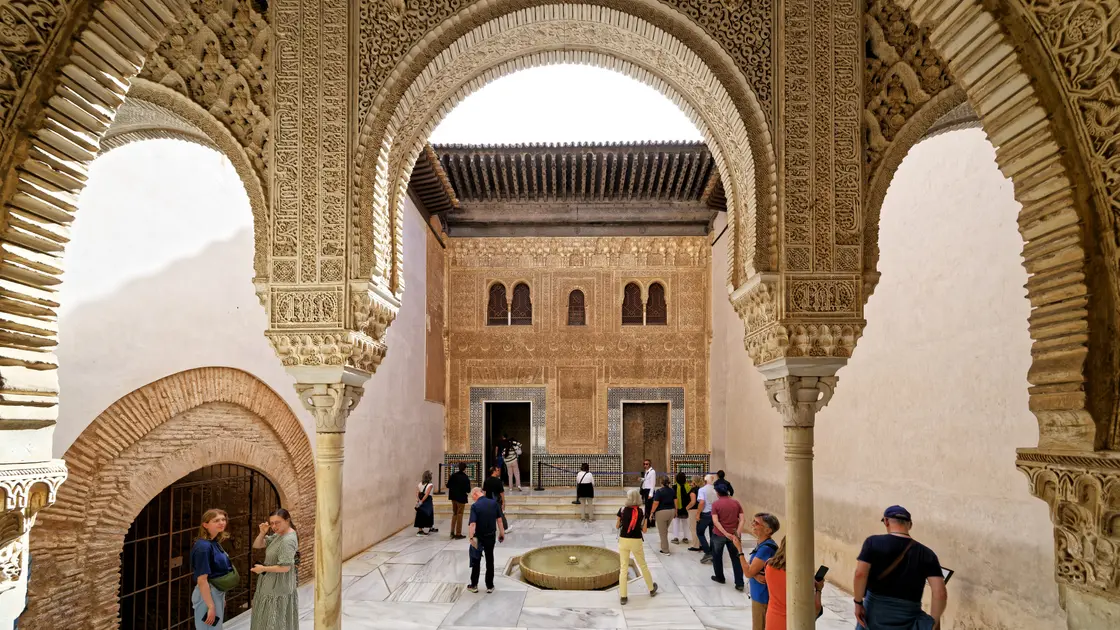
The Nasrid Palaces are the centrepiece of the Alhambra: three linked royal houses built between the mid-13th and late 14th centuries, each commissioned by a different sultan. They are among the most elaborately decorated interiors in the medieval world, with walls covered floor to ceiling in carved stucco arabesques and epigraphic bands, muqarnas vaulting in the domes, and tile dados whose visual complexity comes from simple geometric repetition. The most repeated of the carved texts is the dynastic motto, explained in Alhambra inscriptions meaning: the Nasrid motto.

The overall effect is one of contained richness rather than ostentation: each room feels intimate despite the grandeur. These palaces rose beside a fortress that had already stood on the hill for roughly a century; see the Alcazaba's long history.

When to Visit

Best season

March to May and October to November

Quietest hours

First entry at 8:30 or night visit

Visit duration

45 to 90 minutes

Inside the three palaces

The circuit runs through three palaces in sequence. The Mexuar, the oldest surviving section, served as the council chamber where the sultan received petitions; the tile dado and carved frieze are from the 14th century, though the room was substantially altered after the Reconquest.

The Comares Palace, built under Yusuf I (1333–1354), is centred on the Patio de los Arrayanes, a long reflecting pool of green water flanked by myrtle hedges. At one end rises the Torre de Comares, whose Hall of the Ambassadors served as the throne room: its cedar ceiling is inlaid with a cosmological star pattern, and its three walls are each pierced by arched windows looking out over the city. At 11.3 metres square and 18 metres high, it is the largest room in the Alhambra.

The Sala de la Barca, the antechamber connecting the Patio de los Arrayanes to the Torre de Comares, is not as fortunate in its fabric: fire gutted its carved dome in 1890, and the pine lattice ceiling standing there now is a 1965 reconstruction; see the story of the Alhambra fire of 1890.

Position yourself at the back of the Patio de los Leones early in your session

Tour groups stop at the fountain and photograph from there. Walk to the north or south portico first — the perspective along the columned arcade with the fountain in the distance is a stronger composition and usually clear of crowds for a few minutes.

The Palace of the Lions

The Palace of the Lions, built under Muhammad V (1362–1391), is the most celebrated section. The Court of the Lions centres on a twelve-lion marble fountain whose basin carries a poem by the court poet Ibn Zamrak, surrounded by 124 slender columns whose spacing follows square-root geometric proportions. Four water channels radiate outward as a built representation of the Quranic paradise garden.

The flanking halls demonstrate techniques that remain poorly understood even today, combining structural ingenuity with decorative effect at a scale that later Islamic architecture rarely attempted. The Hall of the Abencerrajes' muqarnas dome generates a honeycomb of light, while the Hall of the Two Sisters' dome contains over 5,000 individual muqarnas cells.

Tours & tickets for Nasrid Palaces

Skip-the-line tickets and guided visits.

Tours are selected for quality, not commission. We earn a small fee if you book — at no extra cost to you.

Visiting the palaces

Entry to the Nasrid Palaces is governed by a strict timed-slot system: visitors must arrive within their designated 30-minute window or forfeit entry. Slots are the first to sell out in the general day tour ticket. That strict system traces back to a 1998 capacity study that capped these rooms at 535 people at once; see the history behind the Alhambra's visitor caps.

The visit itself takes around 45 to 75 minutes depending on pace. Photography is permitted throughout, but tripods and flash are not allowed. The palaces connect directly to the Generalife path, making a combined visit straightforward.

Reporter notebook

Insider tips

Practical observations gathered the way a local journalist would keep them: short, specific, and more useful than brochure copy.

Crowd tip

Move through the Mexuar quickly — most people slow down there

The Mexuar is the first hall you enter and tour groups bunch up. Pass through it at a normal pace and you will arrive at the Comares Palace ahead of the crowd, giving you a few minutes alone at the Patio de los Arrayanes.

Best time

The night visit transforms the palaces entirely

The timed night entry (€12.73, small group numbers) lets you see the carved plasterwork under artificial light rather than daylight. The contrast in texture and shadow is dramatic and the atmosphere completely different from the daytime circuit.

Practical information

Opening hours
Daily 8:30–20:00 (Oct 15–Mar 31: until 18:00). Entry strictly within booked 30-min slot. Night visits Tue–Sat 22:00–23:30 (Apr–Oct); Fri–Sat 20:00–21:30 (Oct–Mar).
Admission
€22.27 included in general Alhambra day tour / €12.73 night visit ticket. Free under 12 (ticket required).
Address
C/ Real de la Alhambra, s/n, 18009 Granada, Spain View on Google Maps
Interactive map — loads as you scroll (requires JavaScript)

Tags

alhambra nasrid palace islamic art muqarnas patio de los leones medieval must see architecture timed entry

Frequently asked questions

What is the Patio de los Leones?

The Patio de los Leones is the central courtyard of the Palace of the Lions, built under Muhammad V around 1362–1391. Its alabaster fountain rests on twelve marble lions and is one of the best-known images of Andalusian Islamic art.

What is a muqarnas ceiling?

Muqarnas is a form of Islamic decorative vaulting made up of small prismatic cells stacked into a three-dimensional honeycomb. The Nasrid Palaces contain two of the finest examples: the Hall of the Abencerrajes and the Hall of the Two Sisters.

How long should I allow for the Nasrid Palaces?

Allow 45 to 75 minutes for a thorough visit. If you linger to read the epigraphic bands (poetry from Ibn Zamrak inscribed in the plaster) or photograph the domes, budget 90 minutes.

Can I enter the Nasrid Palaces outside my time slot?

No. The slot is enforced at the entrance. Arriving late means losing access. Exit is unrestricted, so you can stay as long as you like once inside.