Written by James Walker
Modern Granada · 1808–today
  • 5 min
  • 26 sources

The Duke of Wellington's Granada Estate and Why Spain Gave It

Spain's Cortes gave the Duke of Wellington Soto de Roma, a royal estate in Granada's Vega. How it reached him, Lorca's village, and what the family keeps.
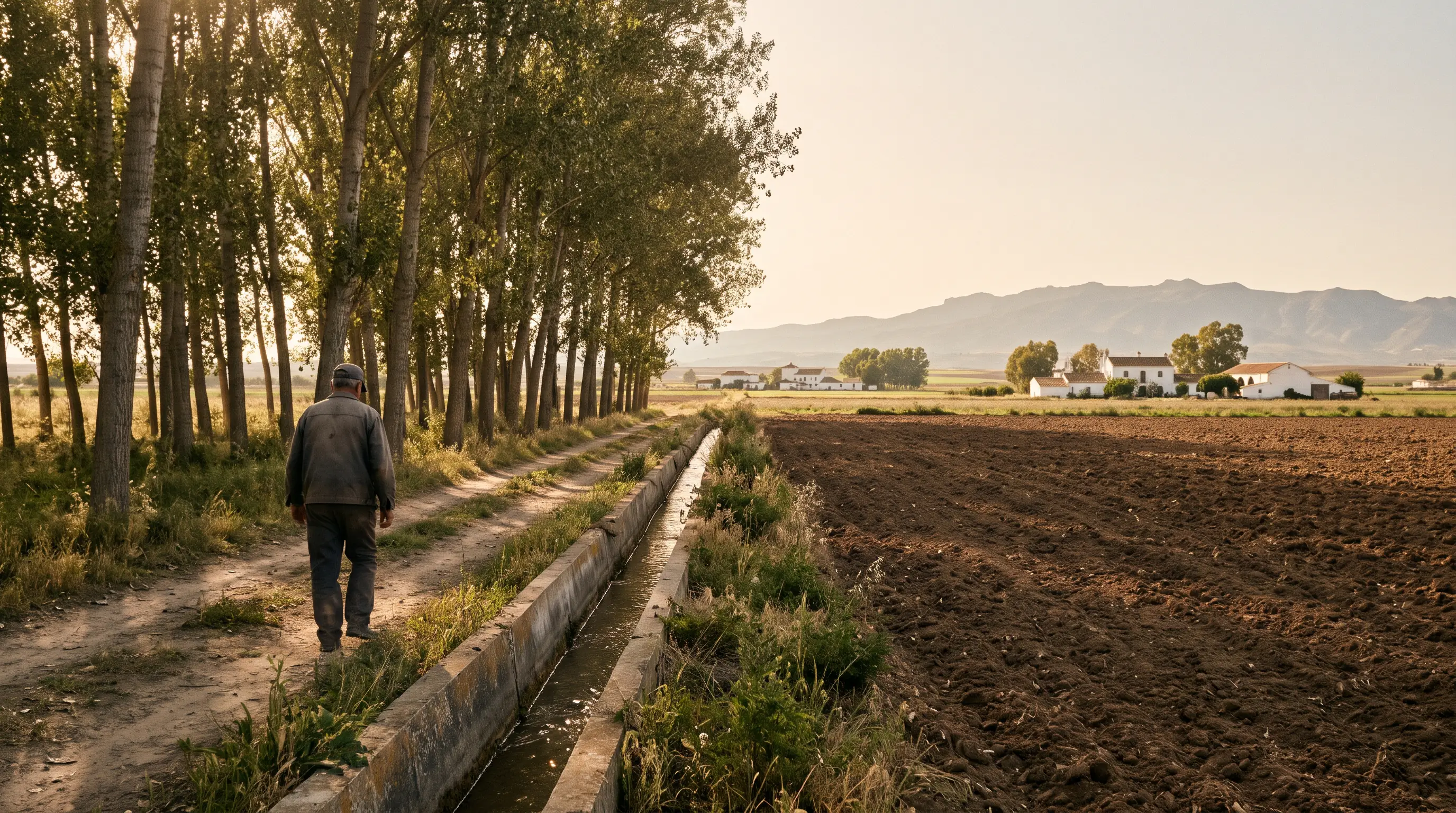
Farmland of the Vega de Granada near Fuente Vaqueros at golden hour, poplar-lined irrigation channels and fields, Sierra Elvira on the horizon, the Duke of Wellington estate Granada countryside

Soto de Roma, which Eye on Spain puts at about 4,000 acres and roughly 16 km from Granada, is the estate Spain granted to Wellington.

Spain's Cortes paid its debt to Arthur Wellesley in land: Soto de Roma, a royal estate that Eye on Spain puts at 4,000 acres in the Vega de Granada, sixteen kilometres from the city[1]. A good part of the land of Fuente Vaqueros, the village where Federico García Lorca was born, stayed tied to the Duke of Wellington until about 1940[2], and the family still keeps a Spanish dukedom and an estate near Illora[3][4]. The estate itself is best read in the villages of the Vega, not in any single building: you can follow its story today in Fuente Vaqueros, Valderrubio and Illora, where the sections below place Lorca's birth, his childhood and the family's La Torre estate.
Soto de Roma estate
4,000 acres
Eye on Spain's figure; 16 km from Granada[1]
Duke's hold on the village
c. 1940
A good part of Fuente Vaqueros' land stayed tied to him[2]
Family estate near Illora
~1,000 ha
The Olive Press: La Torre covers almost 1,000 hectares[4]

A royal estate in the Vega, centuries before Wellington
Soto de Roma was Crown land for most of its history before any Wellesley saw it. The Catholic Monarchs incorporated it into the Royal Patrimony on 11 November 1491[5], while the siege of Granada was still running, and it stayed royal property from the Reconquest until 1765, when Charles III gave it to Richard Wall[6]. Wall's tenure ended with his death, and the estate reverted to the Crown.
It was working farmland, not empty parkland. The cadastre drawn up for the Marquis of La Ensenada shows the estate in watercolour, with its six cortijos and the spring of the Romilla marked[7]. Eye on Spain puts the estate 16 km out from the city, at about 4,000 acres[1], with the Sierra Elvira on its edge. Six farmsteads and a named spring mean hands were working this ground long before it had a foreign owner.
The covered lanes of the Alcaicería market in Granada, with hanging lanterns and arched doorways

Explore nearby · Monument

Alcaicería

Granada's historic silk market, rebuilt after 1843 in Neo-Moorish style. Small shops sell ceramics, taracea woodwork, spices, and leather goods. Free to enter.

A royal gift made by the Crown tended to return to it. Wall's did, and so did the next one. Wellington was the third private owner since 1765[6], and a good part of Fuente Vaqueros stayed tied to the Dukes of Wellington into the twentieth century[2].

From Godoy to Wellington: the Cortes decree of 22 July 1813

The decree of the Cortes ceding Soto de Roma to Arthur Wellesley is dated 22 July 1813[8]. The date goes back to Madoz's nineteenth-century geographical dictionary, and the decree text itself was not consulted for this article.
The Cortes ceded the estate in gratitude for Wellington's part in driving Napoleon's troops out of Spain[9]. By then it had been royal, Wall's, royal again, Manuel Godoy's under Charles IV, and royal once more after the Prince of Peace fell from favour[10].
The war that earned him the land had already brought a French occupation of Granada and a botched attempt to blow up the Alhambra. Spain's thanks arrived in two forms: the Spanish dukedom of Ciudad Rodrigo, conferred by Ferdinand VII in 1812[11], and the Vega estate by decree of the Cortes Generales y Extraordinarias, the parliament sitting in Cadiz.
The two acts are separate. The 1812 usually attached to Wellington's Spanish honours is the dukedom, and the land followed with the 1813 decree. The provincial archive's Documento del Mes reproduces the decree's inscription naming Wellington but prints no date for the decree[12], and Eye on Spain's quotation of Madoz misprints the year as 1913[13]. Anyone repeating a single year for the whole package is merging the two.

What the decree actually granted

The grant was a bundle of places, not a single parcel. The decree names the Vega land called Soto de Roma, with the Chauchinas and the Dehesa of Yllora included[14], and a later description spells out the Fuente Vaqueros side of it[15]. In plain terms the Duke received:
  • Soto de Roma itself, the royal tract in the Vega
  • The Chauchinas, named in the decree
  • The Dehesa of Illora, spelled Yllora in the decree
  • The area of Fuente Vaqueros, its annex La Paz, and the farmhouses Casa Real and Martinete
A grant described by village and farmhouse names, rather than by a surveyed line, was bound to cause trouble. Eye on Spain reports that the boundaries of Soto de Roma were never made clear, and that owners of neighbouring estates went to court over them many times[16].
The consequence is worth holding on to when you read the estate's usual acreage[1]. On that account the estate's edges were never fixed and neighbours kept going to court over them, so the figure is an estimate of something that was never clearly bounded. The names in the decree and the later description (the Chauchinas, the Dehesa, Fuente Vaqueros and its annex) were the real description, and the villages that carry some of those names today are the nearest thing to a map of the grant.

Lorca's village on a duke's land

Federico García Lorca was born in Fuente Vaqueros on 5 June 1898[17], inside the Wellington grant. His family later moved to neighbouring Asqueroso, now Valderrubio, where, on Eye on Spain's account, the poet spent his childhood and adolescence on the Duke of Wellington's land[18].
A good part of the land of Fuente Vaqueros stayed tied to the Duke until about 1940[2], and Eye on Spain goes further, saying the municipality itself belonged to him and its land was rented out to tenant farmers[19]. The Vega that Lorca wrote about was, in that sense, a landscape of rented farms on a grandee's property, which is a better frame for the poems than the postcard version.
A duke who sells his village leaves marks on the map. Once the Duke began selling plots to settlers, people came to live in Fuente Vaqueros from other places[20], so part of the village exists because the estate broke up.
Lorca did not stay. His last day and assassination at Víznar in 1936 belong to another corner of the province, but the childhood landscape behind them was this tenanted plain.

What the Wellington family keeps today

The family keeps the Spanish dukedom and an estate near Illora. The title of Duke of Ciudad Rodrigo, with Grandeza de España, passed to Lord Charles Wellesley in 2010 by cession from his father, Lord Valerian Wellesley[3]. Charles, born in 1945, is the 9th Duke of Wellington[21] and succeeded to that title in 2014[22]. A Spanish title that outlives the land it was first paired with is an odd inheritance: the honour of 1812 is still in the family[11], while the Vega land was sold off over time, with parcels going progressively to the colonists who worked them[23] and some segregated estates to the counts of Casa Valencia[24].
The Olive Press reports that the Granada property, La Torre, covers almost 1,000 hectares near Illora[4]. The previous duke, who died in 2014, went there often to hunt[25].
Not everyone has accepted such holdings quietly. Eye on Spain reports that on 31 July 2008 about 20 trade unionists made a symbolic occupation of the Dukes of Wellington's estate in Alomartes[26]. A grant from the era of the Cortes of Cadiz was still a political subject nearly two centuries later.
For a visitor, the trail is in the villages rather than at a gate. Three places carry it:
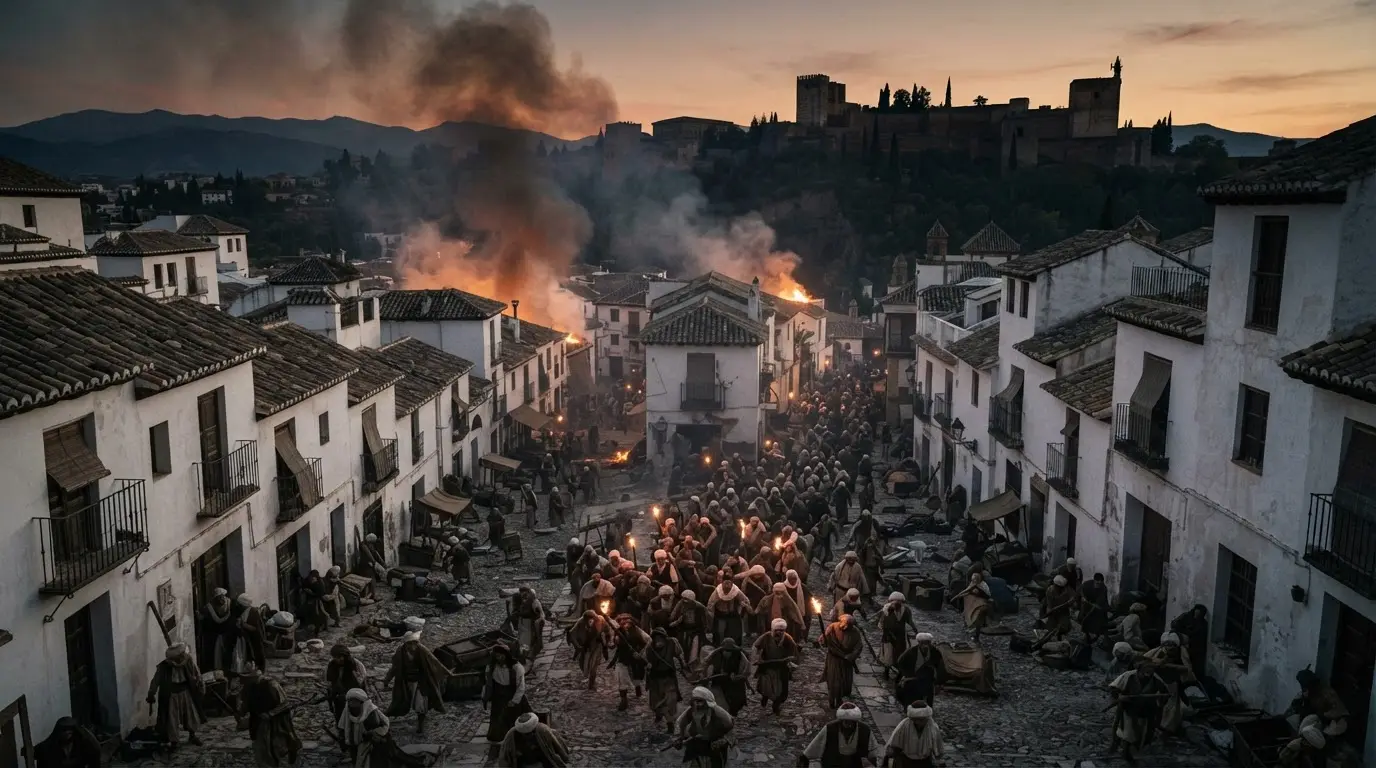
1066 Granada massacre scene in Jewish history: a mob attacking the Jewish quarter of Nasrid-era Granada at dusk, the Alhambra hill silhouetted in the background, smoke rising over whitewashed rooftops, sombre red and amber tones

Deep dive · Article

1066 Granada Massacre: When the Jewish Golden Age Ended in a Day

The 1066 Granada massacre killed Joseph ha-Nagid and thousands of the city's Jews in a single day, ending three decades of Jewish power under Samuel ha-Nagid.

  • Fuente Vaqueros, where Lorca was born in 1898[17] and where settlers arrived once the Duke began selling plots[20]
  • Valderrubio, the former Asqueroso, where the young Lorca grew up, on land Eye on Spain ties to the Duke[18]
  • Illora, the town near the family's La Torre estate[4]

Frequently asked questions

Did the Duke of Wellington own an estate in Granada?

Yes. Spain's Cortes ceded the royal estate of Soto de Roma, which Eye on Spain puts at about 4,000 acres of the Vega de Granada, to Arthur Wellesley in gratitude for his service in the War of Independence. The grant took in Fuente Vaqueros, a good part of whose land stayed tied to the Duke until about 1940.

Why did Spain give Wellington Soto de Roma?

The Cortes ceded the estate by decree in gratitude for his services in expelling Napoleon's troops from Spain. The Spanish dukedom of Ciudad Rodrigo, conferred by Ferdinand VII in 1812, was a separate honour.

Is there a Duke of Wellington now?

Yes. Charles Wellesley, born in 1945, is the 9th Duke of Wellington. The Spanish dukedom of Ciudad Rodrigo passed to him in 2010 by cession from his father, and he succeeded to the Wellington title in 2014.

Is Federico García Lorca's birthplace on Wellington's land?

Fuente Vaqueros, where Lorca was born in 1898, was part of the grant, and a good part of its land stayed tied to the Duke until about 1940. The family later moved to Asqueroso, now Valderrubio, which Eye on Spain also places on Wellington land.

Who owns Soto de Roma today?

Fuente Vaqueros passed out of the Duke's hands gradually: parcels were sold progressively to the colonists who worked them, while a good part of the land stayed tied to the Duke until about 1940. Some of the segregated Soto de Roma estates were bought by the counts of Casa Valencia. What the family is documented to hold today is the Spanish dukedom and La Torre, which the Olive Press puts at almost 1,000 hectares near Illora.

When was Soto de Roma granted to Wellington?

The decree of the Cortes of Cadiz is dated 22 July 1813, a date that goes back to Madoz's dictionary; the decree text itself was not consulted for this article. The provincial archive page prints no date for the decree, Eye on Spain's quotation of Madoz misprints the year as 1913, and the 1812 date belongs to the dukedom of Ciudad Rodrigo, not the land.

How big was the Soto de Roma estate?

Eye on Spain gives about 4,000 acres, sixteen kilometres from Granada. It also reports that the boundaries were never clearly defined, which led to many lawsuits with neighbouring landowners.

Sources

26 references Show
  1. eyeonspain.com (opens in a new tab)

    “Encompassing 4000 acres of land, bordered by the Sierra Elivra, Soto de Roma, 16km from Granada, was granted to the first Duke of Wellington by the Spanish Government”

  2. Wikipedia — Fuente Vaqueros (opens in a new tab)

    “Hasta aproximadamente 1940, buena parte de las tierras de Fuente Vaqueros permaneció vinculada a la propiedad del duque de Wellington.”

  3. boe.es (opens in a new tab)

    “Real Carta de Sucesión en el título de Duque de Ciudad Rodrigo, con Grandeza de España, a favor de Lord Charles Wellesley, por cesión de su padre, Lord Valerian Wellesley”

  4. theolivepress.es (opens in a new tab)

    “La Torre sprawls over almost 1,000 hectares of land near the Andalucian town of Illora.”

  5. revistas.usal.es (opens in a new tab)

    “El 11 de noviembre de 1491 los Reyes Católicos incorporaron el Soto de Roma al Patrimonio Real”

  6. Junta de Andalucía (opens in a new tab)

    “propiedad real desde la Reconquista has-ta que en 1765 Carlos III lo regaló a Ri-chard Wall, revirtiendo a la Corona tras la muerte de este.”

  7. artsandculture.google.com (opens in a new tab)

    “In the watercolor drawn in the Cadastre the six cortijos of the place and the source of the Romilla appear.”

  8. Wikipedia — Soto de Roma (opens in a new tab)

    “mediante «Real» Decreto de las Cortes de Cádiz del 22 de julio de 1813”

  9. Junta de Andalucía (opens in a new tab)

    “La cesión se hizo en agradecimiento a sus servicios prestados durante la Gue-rra de la Independencia para expulsar de España a las tropas napoleónicas.”

  10. Junta de Andalucía (opens in a new tab)

    “En el reinado de Car-los IV, fue donado a su ministro Manuel Godoy, para volver de nuevo al patrimo-nio real al caer en desgracia el Príncipe de la Paz.”

  11. Wikipedia — Duke of Ciudad Rodrigo (opens in a new tab)

    “It was conferred by King Ferdinand VII on the British General Arthur Wellesley, then 1st Viscount Wellington, later 1st Duke of Wellington, in 1812”

  12. Junta de Andalucía (opens in a new tab)

    “en concreto la inscripción donde se recoge la cesión ordenada por el decreto de S.M. y las Cor-tes Generales y Extraordinarias, del Soto de Roma a Arthur Wellesley, Duque de Wellington”

  13. eyeonspain.com (opens in a new tab)

    “as per the decree of 22nd July, 1913”

  14. Junta de Andalucía (opens in a new tab)

    “terreno en la Vega de esta ciu-dad con la denominación del Soto de Roma inclusas las Chauchinas y la Dehesa llamada de Yllora”

  15. eyeonspain.com (opens in a new tab)

    “In the donation was included “the area of Fuente Vaqueros, its annex of La Paz, and the farmhouses named Casa Real and Martinete””

  16. eyeonspain.com (opens in a new tab)

    “although it was never made clear what the boundaries of Soto de Roma were and therefore has been the source of many lawsuits from owners of nearby estates.”

  17. eyeonspain.com (opens in a new tab)

    “In the former was born Federíco García Lorca on the 5th June, 1898.”

  18. eyeonspain.com (opens in a new tab)

    “Here, in the lands of the Duke of Wellington, the poet lived his childhood and adolescent years.”

  19. eyeonspain.com (opens in a new tab)

    “Until 1940 the municipality of Fuente Vaqueros itself belonged to the Duke of Wellington and the land was rented out to tenant farmers”

  20. fuente-vaqueros.com (opens in a new tab)

    “Cuando el Duque de Wellington comienza a vender los terrenos a los colonos, la gente empieza a venir a vivir aquí desde otros”

  21. Wikipedia — Charles Wellesley, 9th Duke of Wellington (opens in a new tab)

    “Arthur Charles Valerian Wellesley, 9th Duke of Wellington, Baron Wellington of Stratfield Saye (born 19 August 1945)”

  22. Wikipedia — Duke of Ciudad Rodrigo (opens in a new tab)

    “The new Duke of Ciudad Rodrigo succeeded his father as Duke of Wellington in 2014.”

  23. Wikipedia — Fuente Vaqueros (opens in a new tab)

    “La progresiva venta de las parcelas a los colonos que las habían trabajado durante generaciones”

  24. Wikipedia — Soto de Roma (opens in a new tab)

    “Algunas de las fincas segregadas fueron compradas por los condes de Casa Valencia”

  25. theolivepress.es (opens in a new tab)

    “The last Duke [who died in 2014] went there a lot because he loved to hunt.”

  26. eyeonspain.com (opens in a new tab)

    “on the 31st July, 2008, around 20 militant trade-unionists made a symbolic gesture of occupying the estate of the Dukes of Wellington in Alomartes (Granada).”