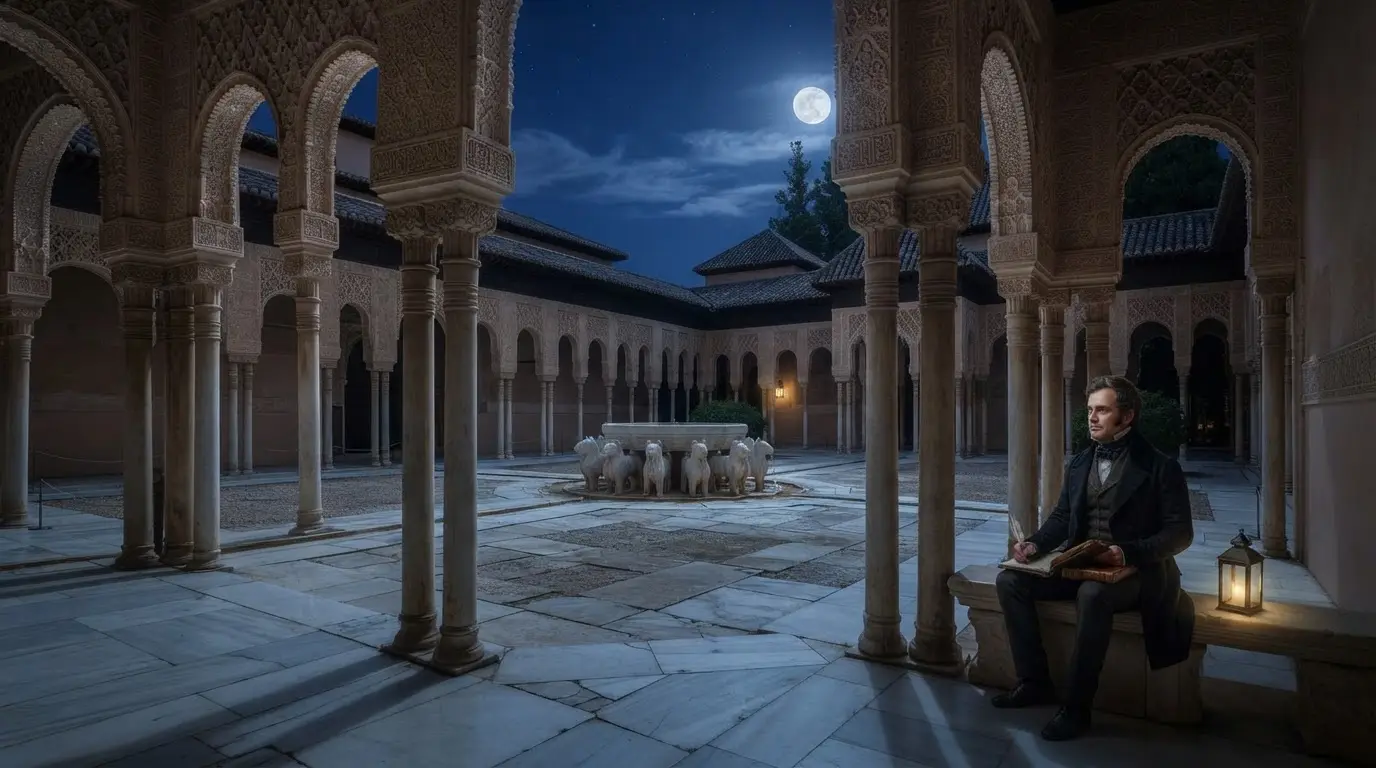

Irving before Granada: fame, Spain, and the Columbus years
By the time Washington Irving reached Granada, he was already the most celebrated American writer alive. His Sketch Book of Geoffrey Crayon, Gent. (1819-1820) had introduced Rip Van Winkle and The Legend of Sleepy Hollow to readers on both sides of the Atlantic. No American author had achieved that kind of European recognition before him.[1]
He had been living in Spain since 1826, attached to the American Legation in Madrid, working through the archives on a biography of Christopher Columbus. He moved through Seville's Archivo General de Indias, where the documents from the first voyages were kept, and began a companion project: a dramatized chronicle of the fall of Granada in 1492. That work, published as Chronicle of the Conquest of Granada in 1829, gave the Tales their historical depth. Irving was not arriving at the Alhambra cold.
His first visit to Granada came in 1828, while he was travelling for research. He saw the Alhambra, but this was a passing visit, not a residence. He had no rooms there, no extended stay, no accumulated nights in the palace listening to the fountains. Several later accounts conflate this 1828 trip with the extended stay that followed, but the two are distinct events separated by a year.
Explore nearby · Monument
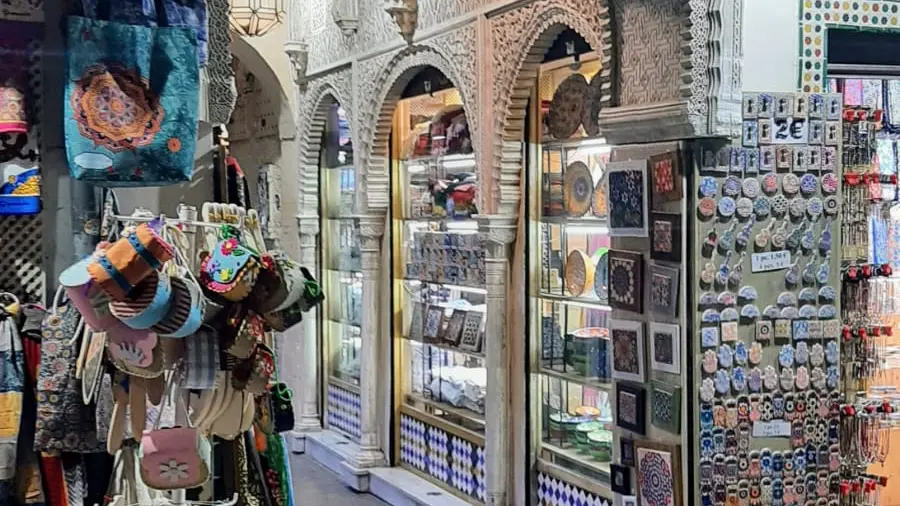
Alcaicería
Granada's historic silk market, rebuilt after 1843 in Neo-Moorish style. Small shops sell ceramics, taracea woodwork, spices, and leather goods. Free to enter.
His Geoffrey Crayon pen name, used for both the Sketch Book and the Tales, evoked an artist sketching from life: observation blended with imagination, fact dissolved into atmosphere. It was exactly the register he would need for the Alhambra.
Moving into the palace: 4 May to 29 July 1829
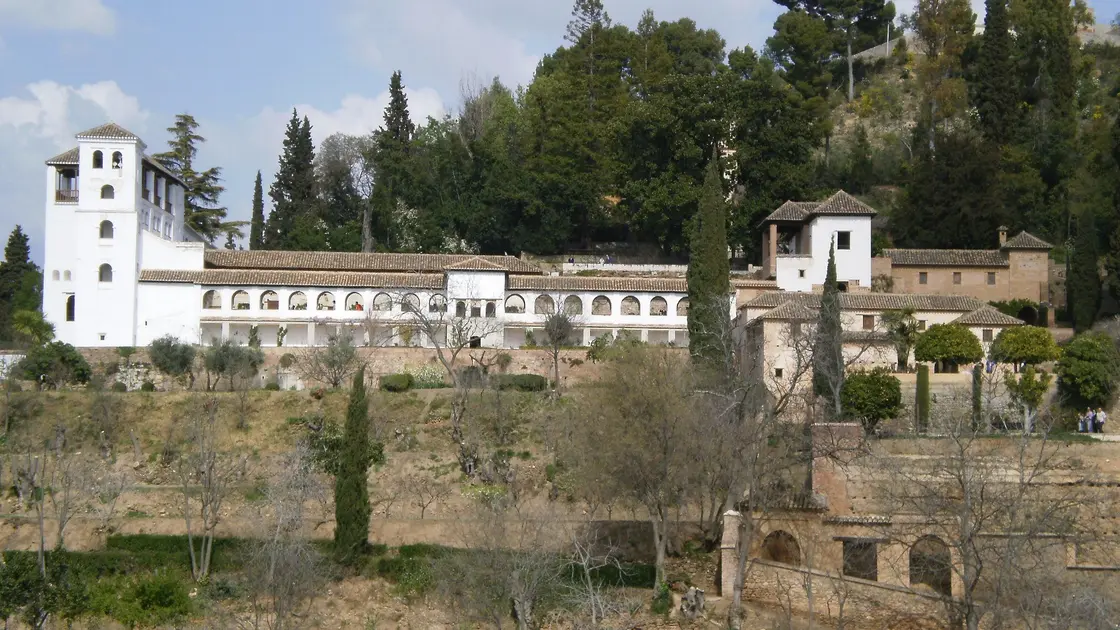
Irving arrived at the Alhambra on 4 May 1829. He had used his celebrity to secure something genuinely unusual: permission to reside inside the palace itself. The governor of the Alhambra and the Archbishop of Granada both granted it. At the time, the complex was not a tourist attraction — it was a half-abandoned ruin, occupied by a small community of impoverished caretaker families who had carved makeshift apartments out of the ancient rooms. Gypsies had settled in some of the towers. The walls were covered in names scratched by visitors. The gardens were tangled. Major restoration would not begin for decades.
Irving first took rooms in the Palace of Charles V (Palacio de Carlos V), the heavy Renaissance block that sits incongruously within the Alhambra's Moorish fabric. He soon moved to a better situation: the Salas de las Frutas (Halls of the Fruits), the suite of rooms built for Emperor Charles V from 1528, also called the Habitaciones del Emperador — the Emperor's Chambers.[2] The ceiling decorations, a painted frieze of fruits completed by Julio Aquiles and Alejandro Mayner in 1537, give the rooms their popular name. A wooden coffered ceiling was designed by Pedro Machuca in 1532.
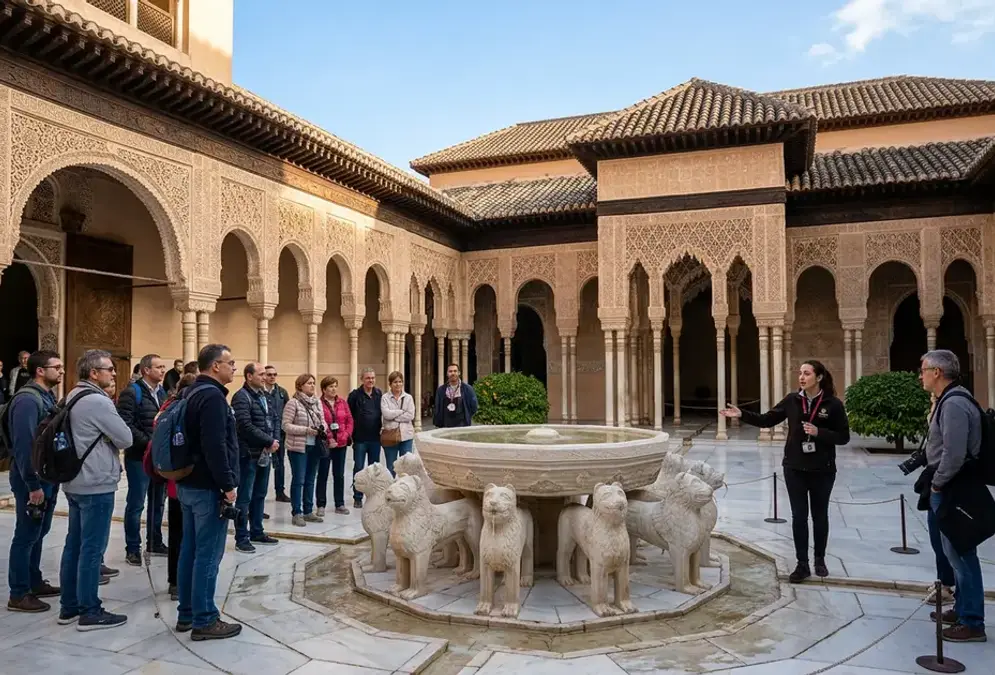
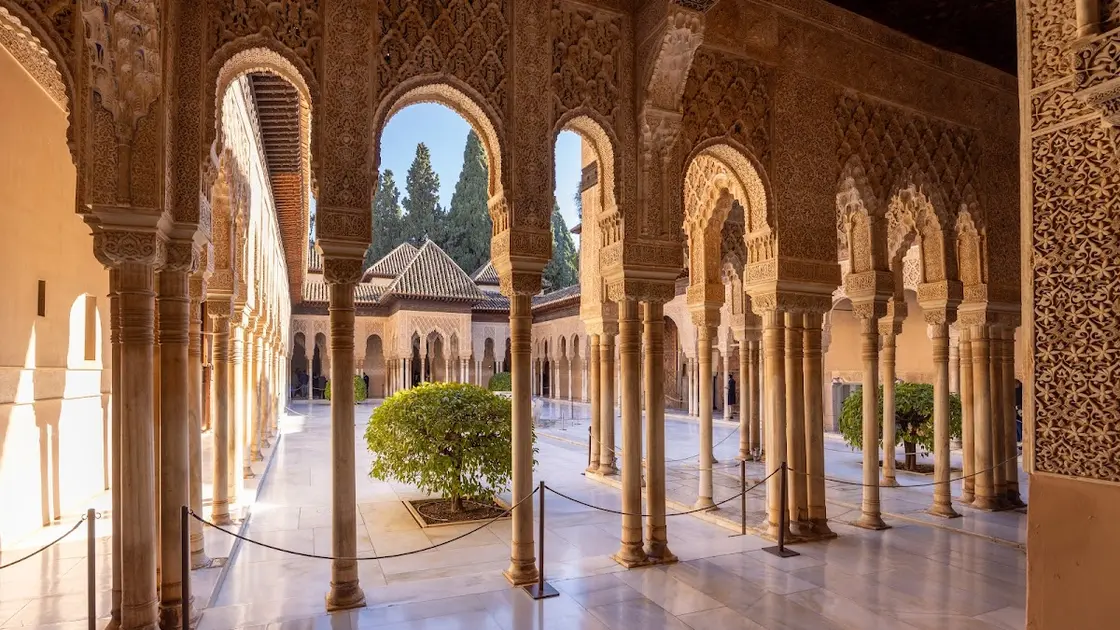
He stayed until 29 July 1829: about three months. His companion during part of this period was a Russian acquaintance, Prince Dolgorouki. Together they sometimes had breakfast in the Court of the Lions. Irving wrote in the mornings and explored the palace in the evenings, walking the moonlit arcades, sitting by fountains, wandering through the towers.
He and Dolgorouki were appalled by the names carved into every ancient surface. Their response was practical: they created a guest book where visitors could sign their names instead of scratching them into the walls. That ledger, one of the first documented moves toward heritage protection at the site, still exists.[3]
3 million
The people Irving met: Mateo, Dolores, and the caretaker families
The Tales of the Alhambra would have been a thinner book without Mateo Ximenes. Irving encountered him in the palace precincts shortly after arriving and hired him immediately as guide, companion, and self-appointed valet. Mateo wore, by Irving's account, a tattered garb but carried himself with dignified pride. His sales pitch was definitive: "Ninguno mas; pues, Señor, soy hijo de la Alhambra" — "Nobody better; I am a son of the Alhambra." He claimed descent from an old family that had lived in the complex for generations.
Mateo was Irving's primary source for the legends that give the book its spine. He knew the ghost stories and the tales of buried treasure, the Moorish knights said to sleep under the towers, the enchanted chambers nobody had found yet. He knew which walls had ears and which fountains had names. Irving was doing fieldwork as much as writing, and Mateo was his informant.
The domestic side of palace life ran through Dolores, the niece of Tía Antonia, one of the caretaker women who maintained the occupied sections. She served as Irving's housekeeper. Irving describes her as bright-eyed and cheerful, an ordinary young woman living in an extraordinary address. Her presence in the narrative grounds the book: behind the Romantic atmosphere and the Moorish legends, there were people doing laundry and cooking meals and sweeping floors.
Recommended tours
Tours are selected for quality, not commission. We earn a small fee if you book — at no extra cost to you.
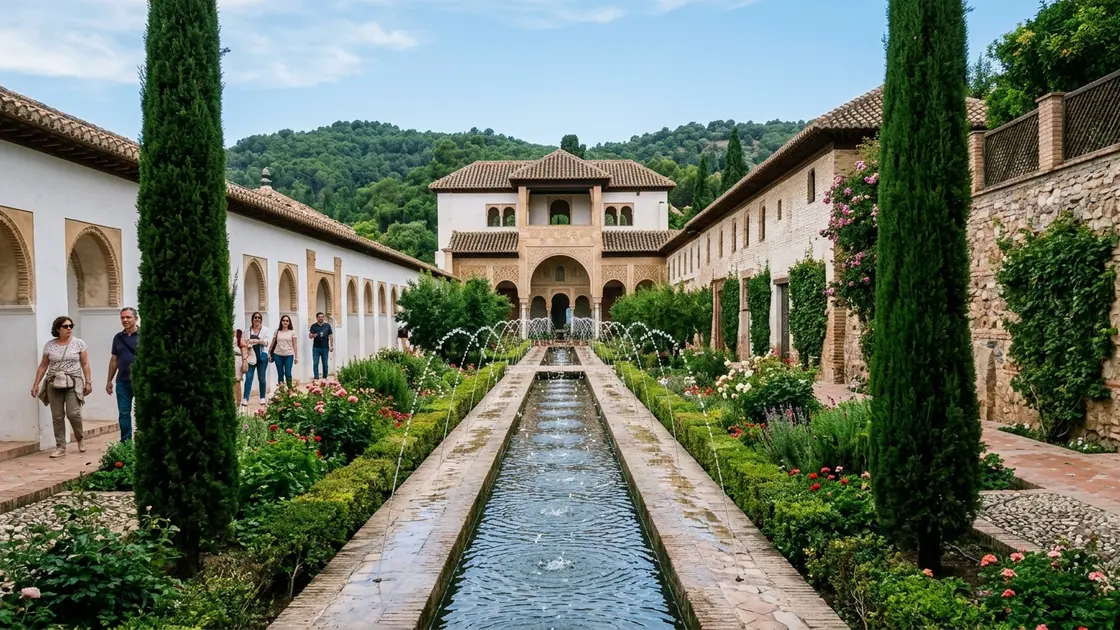
Tía Antonia herself appears in the background, representative of the small community that kept the Alhambra from total dereliction during the decades when the Spanish state had effectively abandoned it. Irving wrote articles during his stay urging the proper recognition and restoration of the palace, arguing, with some irritation, that Granada was failing to value what it had. He was right about that.
Nine legends and what they tell
The Tales of the Alhambra published in May 1832 mixes travel memoir, architectural description, historical essay, and fiction across 41 sections. The legends are the part readers remember. Irving gathered nine major ones, drawing on Mateo Ximenes and his own wanderings through the Albaicín neighbourhood, where the Moorish population had retreated after 1492.[4]
The densest cluster concerns the fall of the Nasrid kingdom. The Sigh of the Moor retells the moment when Boabdil (Muhammad XII), the last sultan of Granada, stopped on a hill south of the city as he rode into exile and wept at his final sight of the Alhambra. His mother reportedly told him: "You weep like a woman for what you could not defend as a man." The hill is still called El Puerto del Suspiro del Moro.
The Abencerrajes is the darkest legend in the book. The noble Abencerraje family was destroyed by court rivals who fabricated a romance between a sultana and an Abencerraje lord. The sultan ordered 37 Abencerraje knights beheaded at the fountain in the Hall of the Abencerrages. Irving notes that the reddish mineral stains at the fountain's base were said to be their dried blood. Visitors to the royal chambers can stand at that fountain today.
The other seven legends include:
- The Three Beautiful Princesses (Zayda, Zorayda, Zorahayda, imprisoned in a tower; the two elder ones elope with Christian knights; the youngest dies of a broken heart)
- The Arabian Astrologer (a bronze horseman atop a tower protects a Moorish king's palace from attack)
- The Rose of the Alhambra (a girl finds a magic lute that breaks an enchantment on a prince)
- The Enchanted Soldier (a Salamanca student finds a soldier cursed to guard Boabdil's treasure for 300 years; a botched ritual fails when greed interrupts the ceremony)
- Prince Ahmed Al Kamel (a Moorish prince raised in ignorance of love falls for a Christian princess)
- The Moor's Legacy (a dying stranger gives a water carrier a treasure map; greed and treachery prevent him from ever using it)
- The Gate of Justice (the sculpted hand and key on the Puerta de la Justicia will come together only at the end of the world)
None of these are pure invention. Irving worked from local oral tradition, from histories of the Nasrid dynasty, and from the landscape itself. The Gate of Justice legend, for instance, is grounded in the actual carved symbols above the gate's horseshoe arch: a hand (Islamic symbol for the five pillars) and a key (for the city). He documented what was already there.
The book: publication, reception, and what it actually is
Irving left the Alhambra on 29 July 1829 with notebooks full of sketches, legends, and observations. He worked on the manuscript over the next two years. The book was published simultaneously in the United States and England in May 1832: by Lea & Carey in Philadelphia and by Henry Colburn in London, under his pen name Geoffrey Crayon.[5] The full title was The Alhambra: A Series of Tales and Sketches of the Moors and Spaniards; the shorter Tales of the Alhambra became the common usage almost immediately.
Classifying the book is harder than it looks. The 41 sections move between modes: some are travel sketches describing the journey from Seville to Granada through Andalusian villages; some are architectural essays on the Hall of Ambassadors or the Generalife; some are personal memoir; some are legends presented as fiction; some are hybrid things that don't fit any of these categories cleanly. Irving revised the book substantially in 1851 for the Author's Revised Edition, reworking the structure and cutting some material.
“The very next day we took up our abode in the palace, and never did sovereigns share a divided throne with more perfect harmony.”
The book's critical reception was immediate and enthusiastic on both sides of the Atlantic. It sold steadily and has remained continuously in print since 1832 — approaching 200 years, an extraordinary run for travel writing. The Gutenberg Project makes the full 1832 text available online if you want to read the source rather than summaries of it.
Irving returned to Spain from 1842 to 1846 as U.S. Minister (Ambassador), cementing a connection to the country that lasted his entire adult life. He died at Sunnyside, New York, in November 1859, by then acknowledged as the patriarch of American literature.
How to visit Irving's rooms today
The Emperor's Chambers, where Irving lived from May to July 1829, are open to visitors on Tuesdays through Sundays, 8:30am to 6:00pm, with a maximum of 30 visitors at a time.[2] Entry is included in the general Alhambra ticket. You do not need a separate booking for the chambers, but verifying current hours on the official patronato.es site before your visit is sensible, as they can change seasonally.
In the antechamber, a marble plaque installed in 1914 reads: "Washington Irving wrote his Tales of the Alhambra in these rooms in 1829." The ceiling decoration of painted fruits (the Salas de las Frutas) is original 16th-century work by Julio Aquiles and Alejandro Mayner, completed in 1537. The rooms are not staged as a period recreation — they are presented as architectural heritage, with the plaque as the primary Irving reference.
The Alhambra visit itself requires timed-entry tickets booked on the official website (alhambra-patronato.es), ideally 60 to 90 days ahead for summer. The Nasrid Palaces timed entry is the scarcest ticket, a scarcity that is the direct legacy of the pilgrimage Irving's book set off two centuries ago — see how the Alhambra learned to ration it. If you want to read Irving's own description of the rooms before you go, the chapter The Journey and the section Palace of the Alhambra in the 1832 text are the best starting points.
Deep dive · Article
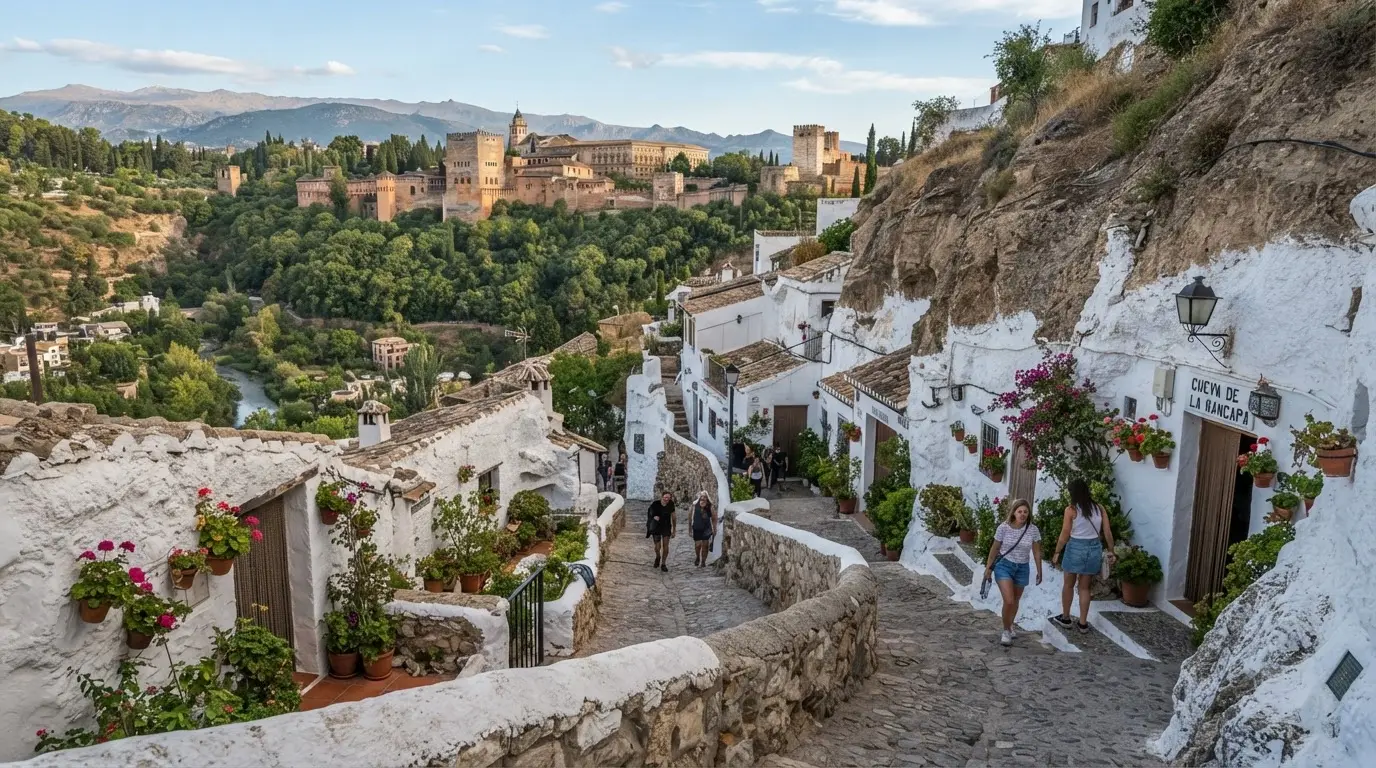
Cave houses of Sacromonte: how Granada carved its hillside
Sacromonte's caves were dug from Alhambra conglomerate: Romani history, the 1963 flood evacuation, the €5 ethnographic museum, and the abbey's Santas Cuevas.
Beyond the rooms, the modern Ruta de Washington Irving traces his 1829 journey from Seville to Granada through Andalusian villages, including Montefrío. The route was created to recognize Irving's role in the region's literary and tourism history. It runs roughly 200 kilometres through the olive groves and hill towns of eastern Andalusia.