Is Orce Man Europe's First Human? What the Record Says
Orce Man is a disputed 8 cm skull fragment from northern Granada province. A 2024 study dated the Orce sediments, about 1.3 million years old, not the fossil.
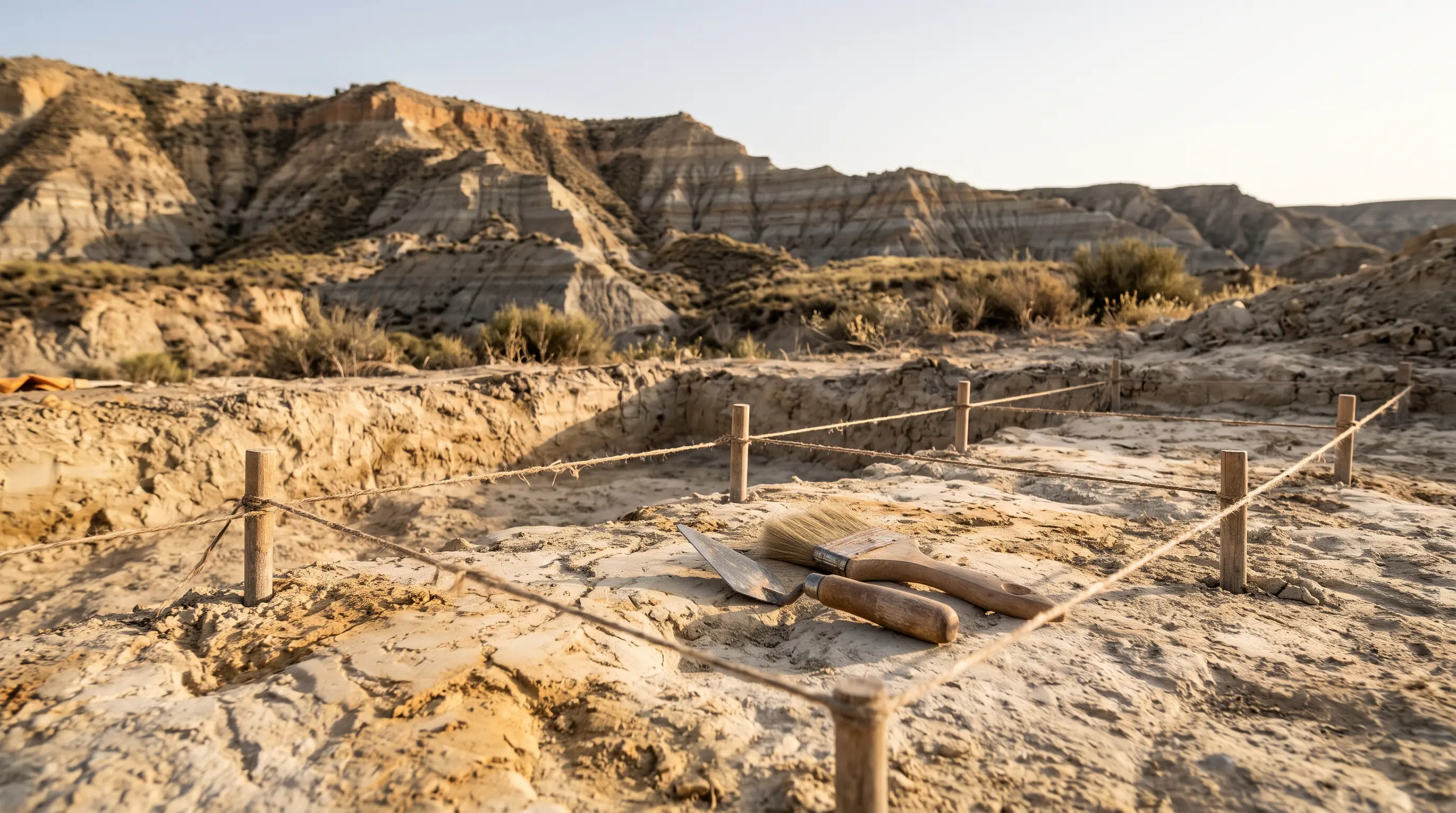
Venta Micena, where an 8 cm cranial fragment was found in 1982; a 2024 model dates its sediments to 1.32 ± 0.07 Ma.
In this article
Jump to a section
Where the claim comes from: a fragment found in 1982
What the record says: two fossils, one dating study
- The Venta Micena fragment, an 8 cm cranial piece found in 1982 and attributed by its finders to a hominin.[1][4]
- A hominin tooth from Barranco León, described in a 2013 study with an ESR range of 1.02 to 1.73 Ma and an estimate of close to 1.4 Ma.[5]
- The 2024 ages: Venta Micena at 1.32 ± 0.07 Ma, Barranco León-5 at 1.28 ± 0.07 Ma and Fuente Nueva-3 at 1.23 ± 0.06 Ma, dates for sediments rather than for any bone.[6]
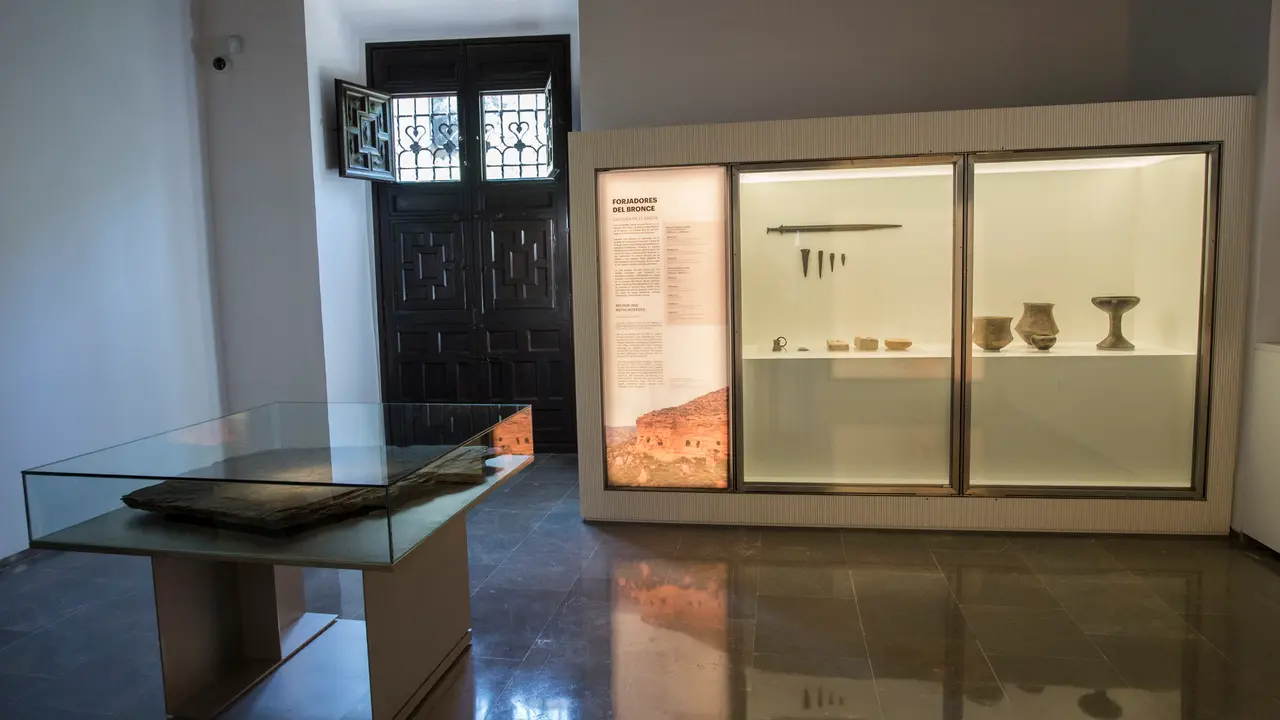
Explore nearby · Museum
Museo Arqueológico de Granada
Inside the 1539 Casa de Castril on the Darro. Paleolithic to Nasrid-era finds: Phoenician objects, Roman bronzes, Arab ceramics. €1.50; free for EU citizens.
What the record does not support
What to check before you go
Deep dive · Article
Corral del Veleta Glacier: Europe's Southernmost Ice
Corral del Veleta held Europe's southernmost glacier — active until 1913 at 37°N. Relict ice and permafrost still cling on in Sierra Nevada, shrinking fast.
Before setting out, check:
- whether the museum is open on your day and what it charges
- whether guided visits to the Barranco León and Fuente Nueva excavations are running
- how you will get there, since Orce is a separate trip from Granada city
Recommended tours
Tours are selected for quality, not commission. We earn a small fee if you book — at no extra cost to you.
Frequently asked questions
What is Orce Man?
Was the Orce Man fragment human or a horse?
Is the Barranco León tooth the same fossil as Orce Man?
How old is Orce Man, and what did the 2024 study date?
Are the Orce Man fossils the oldest humans in Europe?
Can you visit the Orce Man museum from Granada city?
Sources
23 references Show Hide
- produccioncientifica.ucm.es (opens in a new tab)
“The Orce Man is a 8 centimetres cranial fragment attributed to a hominid and discovered in the Venta Micena site, in Orce, Granada, Andalusia, southern Spain.”
- riuma.uma.es — 3c256fd7 b126 43c5 911a b62fb6562fb8 (opens in a new tab)
“It is situated in the northeastern sector of the intramontane Guadix-Baza Basin (Granada, Andalusia, southern Spain).”
- diposit.ub.edu (opens in a new tab)
“Here we provide a new Early Pleistocene magnetostratigraphy, recording four paleomagnetic boundaries within 80 m of a fluvio-lacustrine sedimentary succession in Orce, southeastern Spain.”
- produccioncientifica.ucm.es (opens in a new tab)
“The fossil was unearthed in 1982 by three young Catalan palaeontologists, Josep Gibert, Salvador Moyà-Solà i Jordi Agustí, from the Institut de Paleontologia de Sabadell.”
- riuma.uma.es — 3c256fd7 b126 43c5 911a b62fb6562fb8 (opens in a new tab)
“dated between 1.02 and 1.73 Ma (millions of years ago) by Electron Spin Resonance (ESR), which, in combination with paleomagnetic and biochronologic data, is estimated to be close to 1.4 Ma.”
- diposit.ub.edu (opens in a new tab)
“Three sites higher in the stratigraphy, which contain evidence of hominids, occur at 1.32 ± 0.07 Ma (Venta Micena), 1.28 ± 0.07 Ma (Barranco León-5), and 1.23 ± 0.06 Ma (Fuente Nueva-3).”
- eurekalert.org (opens in a new tab)
“These changes do not have a specific periodicity, but they are recorded in the minerals and make it possible to establish time periods from the different magnetic events.”
- produccioncientifica.ucm.es (opens in a new tab)
“The crest seemed to indicate that the fragment was not from a hominid but that it belonged to an ancient equine.”
- produccioncientifica.ucm.es (opens in a new tab)
“This dispute lasted for at least 23 years until 2007 when Gibert died.”
- diposit.ub.edu (opens in a new tab)
“The specific age for each fossil quarry is estimated using a Bayesian age-stratigraphic model with 95% confidence intervals.”
- eurekalert.org (opens in a new tab)
“The subsequent discovery at the nearby sites of Barranco León and Fuente Nueva 3 of two human molar teeth and thousands of Olduvayan lithic tools — one of the first human lithic industries”
- eurekalert.org (opens in a new tab)
“We also defend the hypothesis — adds the researcher — that they arrived from Gibraltar because no older evidence has been found at any other site along the alternative route”
- nature.com (opens in a new tab)
“Here we present most of the midface of a hominin found at the TE7 level of the Sima del Elefante site (Sierra de Atapuerca, Spain), dated to between 1.4 million and 1.1 million years ago.”
- geoparquedegranada.com (opens in a new tab)
“Created in 1985, it houses a complete collection of pieces from the Sites of Geological Interest found in the municipality (Venta Micena, Barranco León and Fuente Nueva).”
- geoparquedegranada.com (opens in a new tab)
“There are guided tours for tourists and school groups, as well as general scientific dissemination activities (“Science in Your Town”).”
- en.andalucia.org (opens in a new tab)
“This circular route goes through six municipalities in the Granada region of Huéscar: Puebla de Don Fadrique, Huéscar, Castril, Castilléjar, Galera and Orce.”
- en.andalucia.org (opens in a new tab)
“Others prefer to do it by mountain bike (in some parts the route will take you on the road) and, finally, you can drive.”
- riuma.uma.es — Download (opens in a new tab)
“a site dated by biochronology and paleomagnetism to 1.6–1.5 Ma with no conclusive evidence on hominin presence”
- riuma.uma.es — Download (opens in a new tab)
“The age of BL-D ( Figures 2C,E ) and FN3 ( Figures 2C,D ) was estimated in 1.43 ± 0.38 and 1.19 ± 0.21 Ma, respectively”
- riuma.uma.es — Download (opens in a new tab)
“a deciduous tooth of Homo sp. in the case of BL.”
- riuma.uma.es — Download (opens in a new tab)
“This species is first recorded in level TE9 (Atapuerca), dated at 1.22 ± 0.16 Ma by cosmogenic nuclides”
- riuma.uma.es — Download (opens in a new tab)
“The oldest settlements in Eurasia (e.g., Dmanisi, ∼1.8 Ma) suggest a scenario in which the Caucasus and southern Asia were occupied ∼0.4 Ma before the first peopling of Europe.”
- diposit.ub.edu (opens in a new tab)
“| dc.relation.ispartof | Earth-Science Reviews, 2024, vol. 256 | |”