Seven years resident in Granada. Specialist in Nasrid architecture, Al-Andalus history, and Andalusian walking routes.
Updated Published
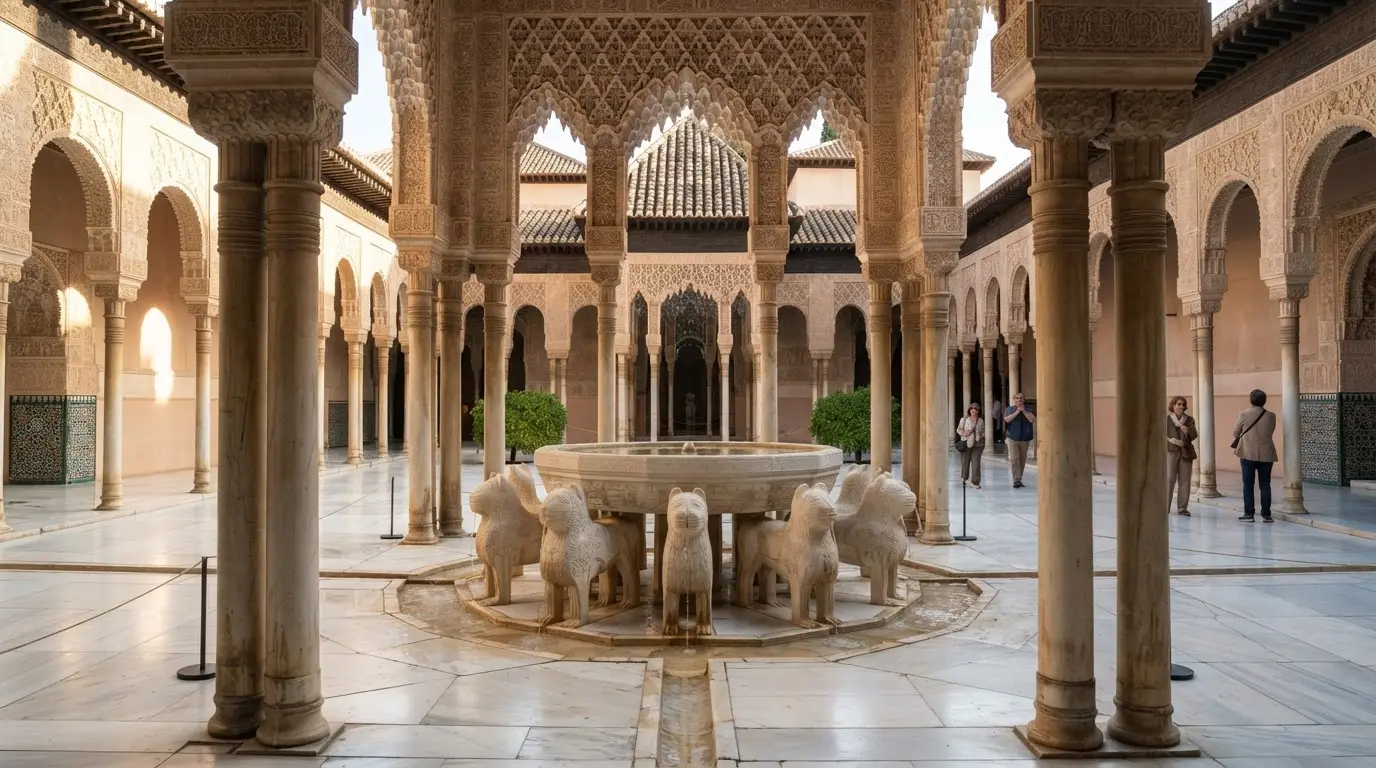
The Court of the Lions is the private royal quarter Muhammad V built between 1362 and 1391 — not for ambassadors, but for himself and his household. Twelve white marble lions hold up a fountain basin inscribed with poetry about restrained tears; 124 slender columns surround them on all sides. Most visitors have twenty minutes here; the ones who read the basin's poem and look up at the muqarnas domes of the flanking halls get considerably more out of it.
In this article
Jump to a section
⌄
Who built it and why: Muhammad V and the private palace
The Court of the Lions belongs to the Palace of the Lions, the second main cluster of the Nasrid Palaces at the Alhambra palace complex. It was built by Muhammad V, who ruled twice: first from 1354 to 1359, then — after exile in Fez and Castile — from 1362 to 1391[1]. The courtyard was constructed during his second reign, when he returned with diplomatic connections spanning Christian and Islamic courts.
This matters for understanding what the courtyard is. The Comares Palace, built by Muhammad V's father Yusuf I, was the formal public palace: throne room, ambassador reception, the great reflecting pool of the Comares Tower facing outward. The Palace of the Lions was entirely different in function. It was the haram quarter — private apartments, the sultan's living space, the intimate reception rooms for people the sultan actually trusted. For a full account of what each of these spaces was designed to say about power — from the Mexuar's council functions under earlier sultans to the Hall of the Two Sisters as a statement of Muhammad V's restored authority — see the political biography of each room in the Alhambra. Visitors from Castile and Aragon came here; court poets performed here; the scholars Muhammad V gathered around him argued here.
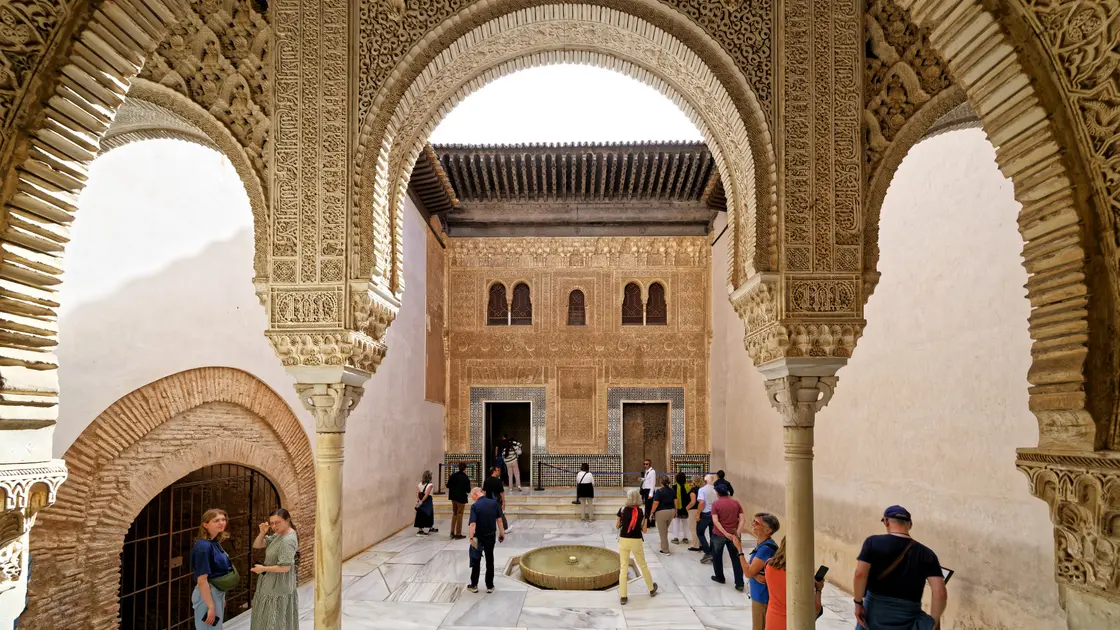
The multicultural character of his court is embedded in the architecture. The porticoed gallery that runs around all four sides of the courtyard echoes a Christian cloister form — rectangular plan, colonnade on all sides, a fountain at the centre — yet the ornament is entirely Islamic in vocabulary. The blending was deliberate. Muhammad V had diplomatic relations with Peter I of Castile, who funded the construction of several chambers in the Alcázar of Seville in the same decade, using Nasrid craftsmen working in an almost identical style. Some of the same workshops almost certainly worked on both sites.
Timeline
1354
Muhammad V's first reign begins
Muhammad V takes the throne of the Nasrid Sultanate of Granada at age 15. Court construction continues in the Comares Palace tradition of his father Yusuf I.
1359
Exile and return
A coup forces Muhammad V into exile, first in Guadix, then at the courts of Peter I of Castile and Muhammad V of Morocco in Fez. He lives among Christian and Islamic scholarship simultaneously.
1362
Second reign and construction begins
Muhammad V regains the throne with Castilian military support. Construction of the Palace of the Lions begins, drawing on craftsmen and design ideas from both Fez and Castile.
~1380
Court of the Lions completed
The central courtyard, fountain, and flanking domed halls reach their current form. The court poet Ibn Zamrak inscribes his qasida verses on the fountain basin.
1391
Muhammad V dies
Muhammad V dies having completed the most ambitious private palace in Nasrid Granada. The Palace of the Lions remains intact through the Reconquista of 1492.
The courtyard's rectangular plan measures roughly 29 by 16 metres[2]. The longer east-west axis terminates in two shallow garden pavilions, each with a fountain pool in its floor fed by channels from the central fountain. The shorter north-south axis leads to the two great domed halls: the Hall of Two Sisters to the north, the Hall of the Abencerrajes to the south.
The 124 columns: geometry, marble, and muqarnas capitals
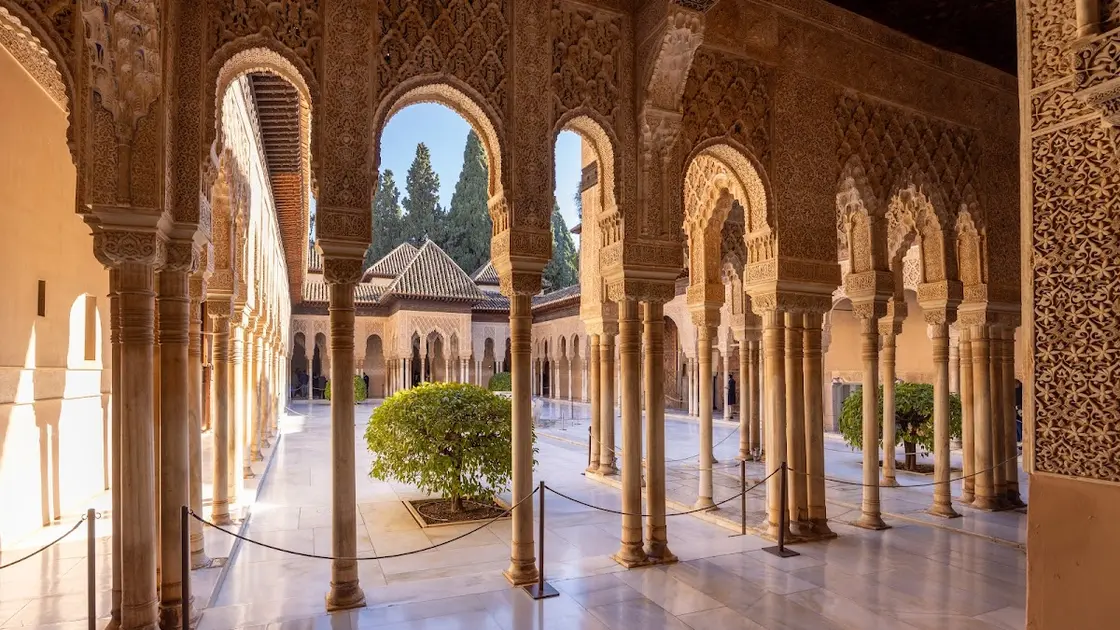
124 white marble columns stand in the courtyard, varying in arrangement from double rows at the pavilion entrances to single files along the longer sides[3]. They are slender to a degree that looks structurally implausible until you understand the engineering: the visible columns carry very little load. The arches they support transfer weight to embedded stone piers at intervals through the arcade, while the colonnade itself provides visual rhythm and frames the cross-shaped axis of the courtyard.
Art historian Antonio Fernández-Puertas established that the spacing between columns follows a geometric sequence based on square root proportions — specifically √2, √3, and √5 — rather than a uniform module. The columns are not equally spaced. The wider bays occur at the pavilion centres and at the fountain axis crossing points; narrower bays fill in between. The result, when you stand at either pavilion entrance and look down the long axis, is a controlled recession that makes the courtyard appear larger than it is. These same proportion systems — the √2 rectangle, the golden ratio, and the bayt modular grid — are examined in detail in the geometry deep dive, which traces them room by room across the Nasrid Palaces.
124 columns
The Court of the Lions has 124 white marble columns arranged around its perimeter and pavilions. Their spacing follows square-root proportions (√2, √3, √5), a mathematical sequence identified by art historian Antonio Fernández-Puertas.
Each capital carries muqarnas carving — small stalactite cells stacked in tiers, the same vocabulary deployed at larger scale in the domed halls of the Nasrid Palaces on either side. Many capitals were installed rotated 45 degrees relative to their columns, which distributes the visual weight of the arcade differently depending on where you stand. Whether this was a design preference or a pragmatic reuse of capitals cut for a different plan is still discussed. Traces of original polychrome survive in sheltered spots: the capitals were once painted in blue, red, and gold. The white marble you see now is the bare substrate.
The lion fountain: twelve lions, water mechanics, and Ibn Zamrak's poem
The twelve lions at the centre of the courtyard carry a large marble basin on their backs. Water flows from a smaller basin at the top, down through the lion spouts, and outward along four stone channels that cross the courtyard floor toward the pavilion pools. The geometry is the chahar bagh — the Persian four-part garden divided by water channels representing the four rivers of paradise described in Surah 47:15 of the Quran: water, milk, wine, and honey.
The origin of the twelve lions is contested. Three theories circulate:
Zodiac hours: the twelve figures represent the twelve zodiac signs or the twelve hours of the day, with the water flow cycling from lion to lion over a twelve-hour period
Solomonic Temple: the arrangement echoes the bronze "molten sea" of Solomon's Temple, which stood on twelve oxen, placing the Nasrid sultan in a lineage of ancient kingship
Bargebuhr's thesis (1956): art historian Friedrich Bargebuhr argued the lions came from an 11th-century palace of Jewish vizier Yusuf ibn Nagrela and represent the twelve Tribes of Israel; later scholarship dating the lions' style firmly to the 14th century has largely set this theory aside[4]
Recommended tours
Tours are selected for quality, not commission. We earn a small fee if you book — at no extra cost to you.
The basin inscription is a 12-verse extract from a 146-verse qasida by court poet Ibn Zamrak, composed to celebrate the circumcision of Muhammad V's son. One passage compares the fountain's behaviour to a lover restraining tears: "Can't you see how the water runs through its bowl, but the bowl itself stops its flow — just as a lover whose tears are on the brink keeps them in for fear that they might betray him." Elsewhere water becomes pearls, then liquid silver, then a jet rising toward stars.
In 1884, when the basin was raised during a survey, workers discovered a cylindrical marble block with a perforated top beneath the fountain. In 1890, archaeologist Francisco de Paula Valladar proposed this was the original water-distribution device — designed to maintain a steady water level and prevent turbulence, producing laminar flow: water that brimmed quietly over the basin edge rather than jetting upward[5]. During the 2012 restoration, a replica of this block was installed, restoring the calm overflow the 14th-century engineers had intended. Previous 20th-century modifications had introduced pressurised jets contrary to the original design.
The Hall of Two Sisters and the Hall of the Abencerrajes
The two great domed halls that open off the north and south ends of the courtyard contain the most technically ambitious muqarnas work in the Alhambra. Both were built as part of the same construction campaign under Muhammad V, and both follow the same compositional logic: a square chamber beneath a muqarnas dome, with light entering through a band of pierced windows just below the dome.
The Hall of Two Sisters (Sala de Dos Hermanas) to the north gets its name from two large white marble slabs set into the floor — the two sisters. The dome above holds approximately 5,000 individually carved stucco cells radiating from a central eight-pointed star[1]. Sixteen subsidiary miniature domes surround the main dome's perimeter. The cells were originally painted in blue, red, and gold; the pale uniformity you see now came from weathering and cleaning. A mirador to the north of the hall — the Mirador de Lindaraja — extends the room toward a view window overlooking the lower Alhambra gardens, its carved plaster screen filtering light into the chamber in shifting patterns through the day.
The Hall of the Abencerrajes (Sala de los Abencerrajes) to the south has a dome of comparable scale but different geometry: its summit is a sixteen-pointed star rather than an eight-pointed one, with corner squinches resolving the transition from square room to star plan. A small fountain pool at floor level would originally have reflected light upward onto the dome. A rust-coloured stain at the base of the fountain is invariably described in tour guides as the blood of the Abencerraje clan, massacred by the last Nasrid sultan. Chemically it is iron oxide from the marble. The massacre story is a legend with no contemporary source, but the legend is old enough to be part of the site's texture. For a full account of who the Abencerrajes actually were — their role in Nasrid court factions, the documented 1462 executions, and how their name became attached to this room through literary tradition — the history is considerably more interesting than the stain.
For visitors with limited time, the practical recommendation is straightforward: stand at the entrance to each hall and look up before stepping inside. The dome's geometry is clearer from the doorway threshold than from directly beneath it. The full effect requires letting your eyes adjust to the change from courtyard daylight to interior shadow.
The four water channels and the paradise garden theology
The four stone channels radiating from the central fountain are not decorative. They are the structural argument of the whole courtyard.
The chahar bagh (literally "four gardens" in Persian) is a garden design concept in which a space is divided into four quadrants by two perpendicular water channels meeting at a central pool or fountain. The concept appears in the Quran in descriptions of paradise (Surah 47:15 names four rivers: of water that does not stagnate, of milk that does not curdle, of wine pleasant to drink, and of purified honey), and in pre-Islamic Persian royal garden design. By the time the Nasrids built the Court of the Lions, the chahar bagh had been a central feature of Islamic garden and palace design for five centuries.
What the Nasrids achieved in the Court of the Lions was a chahar bagh transposed indoors. The courtyard has no sky above it on the fountain axis — the pavilions close off both ends under ceilings. The four channels still carry their symbolic cargo, but the paradise garden is now an enclosed architectural space rather than an open garden. The sound of water in an enclosed marble courtyard behaves differently from water in a garden. The Nasrid designers chose the acoustic effect deliberately: the water sound filled the space without echoing excessively, because the pierced screens and column spacing dispersed the sound.
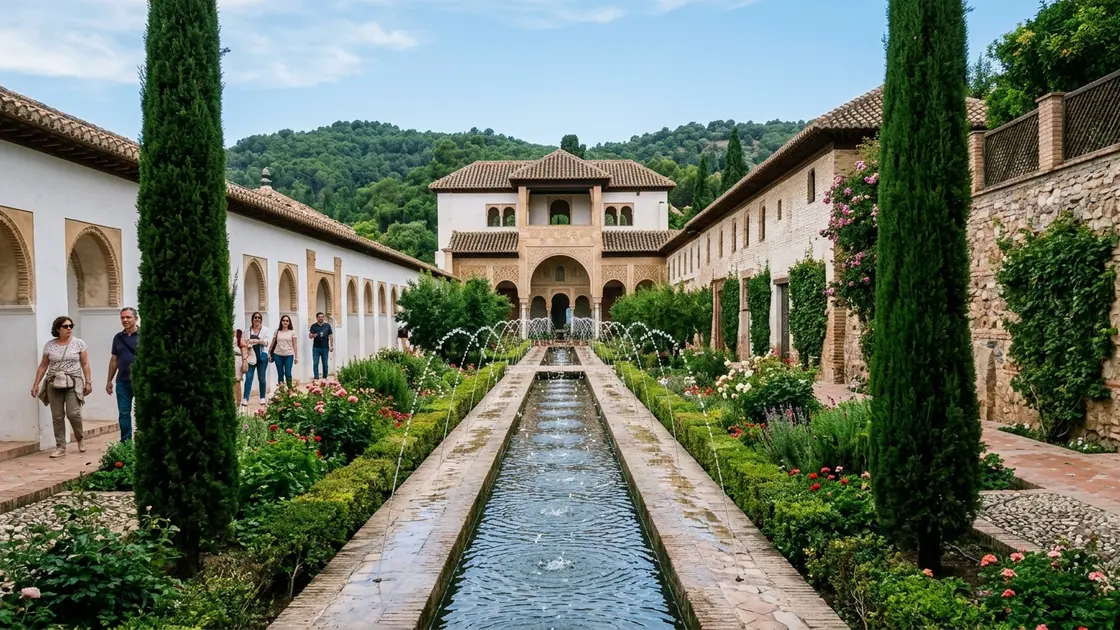
The orange trees and myrtle hedges now planted between the channels and the courtyard walls are post-medieval additions. The original Nasrid courtyard floor was at a higher level, with the channels recessed into it. During the 2012 restoration, the courtyard floor level was adjusted to recover part of the original geometry. The planting is attractive but historically approximate: the Nasrid courtyard would have had a more open, marble-paved floor that let the water channels read as geometric lines across a pale ground.
When to visit and how to make the most of limited time
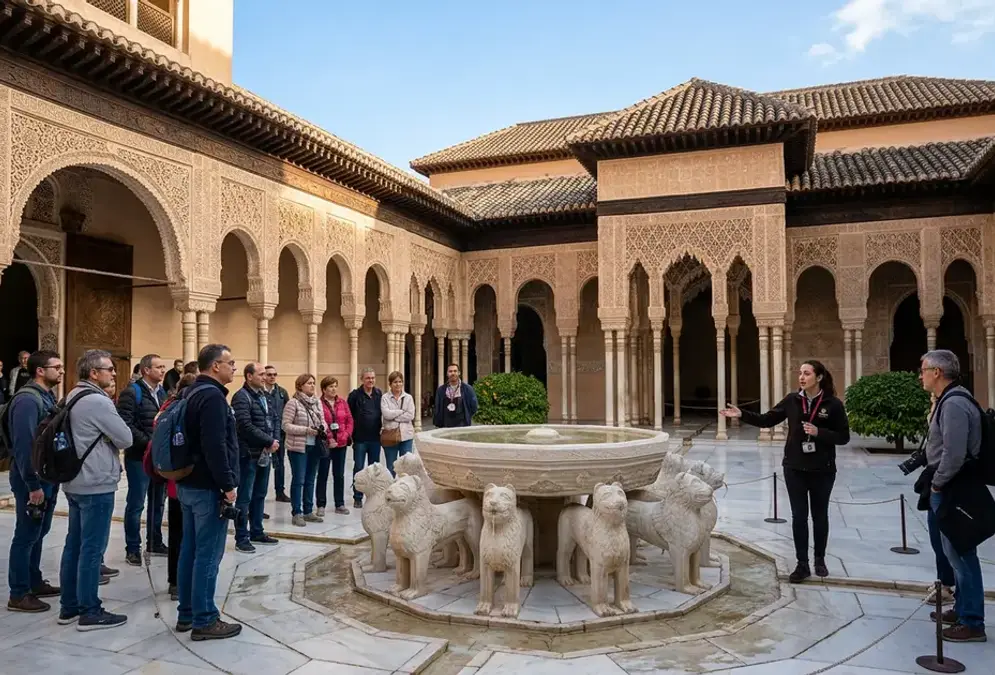
The Court of the Lions is included in the Nasrid Palaces ticket, which must be booked in advance with a specific entry time slot. Once inside the Nasrid Palaces, visitors move at their own pace, but entry to the palaces themselves is controlled to a 30-minute window. Most organised tour groups spend 15 to 20 minutes in the Court of the Lions before moving on.
The early morning slot (8:30am entry to the Nasrid Palaces) gives the least crowded access. The courtyard faces east-west: morning light enters through the eastern colonnade and reaches the marble lions at a low angle between roughly 9am and 11am, sharpening the shadows on the muqarnas capitals. After 11am the light is overhead and less dramatic. Afternoon light (3pm to 5pm) suits the Hall of Two Sisters entrance better, where the dome catches raking light from the west through the mirador window.
For photography, the best single viewpoint is from either the east or west pavilion entrance, shooting along the courtyard's central long axis with the fountain and colonnade in frame. A longer lens compresses the column spacing and makes the arcade recession visible. After a guided tour group clears the two domed halls (they spend about three minutes in each), you typically get two to four minutes alone in each hall before the next group arrives.
The rust stain in the Hall of the Abencerrajes is on the north side of the fountain base, near floor level. If you want to see it, crouch down at the fountain edge.
The Ibn Zamrak inscription runs around the outside of the lion fountain basin in thuluth Arabic script. Reading it requires crouching and rotating around the fountain; most tour groups don't stop for it. The full 12-verse text is reproduced in the Alhambra's printed guide, available at the ticket desk.
Frequently asked questions
What do the 12 lions represent in the Alhambra?
Three theories persist. The most widely cited connects them to the zodiac or the 12 hours of the day, with the fountain's water flow cycling symbolically through each lion. A second theory links the twelve lions to the bronze "molten sea" of Solomon's Temple, which stood on twelve oxen, placing the Nasrid sultan in a lineage of ancient kingship. A third theory, proposed by Friedrich Bargebuhr in 1956, suggested the lions came from an 11th-century palace of Jewish vizier Yusuf ibn Nagrela and represented the twelve Tribes of Israel. Most current scholarship has set this last theory aside because the sculptural style dates the lions to the 14th century, not the 11th.
Who built the Court of the Lions at the Alhambra?
Muhammad V, sultan of the Nasrid Sultanate of Granada, built the Court of the Lions between approximately 1362 and 1391 during his second reign. He had spent time in exile in Fez and at the court of Peter I of Castile before returning to power, and his court drew scholars and craftsmen from both Islamic and Christian traditions. The courtyard was his private royal quarter, separate from the formal public reception palace of his father Yusuf I.
What do the four water channels in the Court of the Lions mean?
The four channels represent the four rivers of paradise described in Surah 47:15 of the Quran: rivers of water, milk, wine, and honey. This four-part garden design, known in Persian as the chahar bagh, was a central tradition in Islamic garden and palace architecture across the medieval Islamic world. By bringing the chahar bagh indoors in the Court of the Lions, the Nasrid architects made the courtyard itself a physical representation of the Quranic paradise.
Was the Alhambra lion fountain restored?
Yes. The cylindrical marble block that originally controlled the fountain's water flow was first discovered in 1884, when the basin was raised during a survey. In 2012, a major restoration campaign installed a replica of this block to restore the laminar flow — water brimming quietly over the basin edge rather than jetting upward — that the 14th-century engineers had intended. Previous 20th-century modifications had introduced pressurised jets contrary to the original design.
How many columns are in the Court of the Lions?
124 white marble columns stand in the Court of the Lions, arranged in single and double rows around the porticoed gallery. Their spacing is not uniform: it follows a geometric sequence based on square-root proportions (√2, √3, √5), which creates a controlled visual recession when viewed from the pavilion entrances. The columns themselves carry relatively little structural load; the arches transfer weight to embedded stone piers within the arcade.