Ibn al-Khatib ran Nasrid Granada for 30 years, wrote 60+ works, and argued contagion theory 500 years before Pasteur. His poetry lines the Alhambra walls.
Seven years resident in Granada. Specialist in Nasrid architecture, Al-Andalus history, and Andalusian walking routes.
Updated Published
Ibn al-Khatib was the most powerful mind in 14th-century Granada: chief vizier, court poet, physician, and historian, all at once. He ran the foreign policy of a kingdom under existential pressure and still produced more than sixty works, including a plague treatise that identified contagion as the mechanism of disease roughly five centuries before germ theory reached European medicine. His story ends badly. He was arrested in Fez, strangled in a prison cell, his body burned. The man who helped bring him down was his own student.
Ibn al-Khatib was born on 16 November 1313 in Loja, a walled garrison town about 55 kilometres southwest of Granada that guarded the emirate's western approaches.[1] His full name, Lisan al-Din Muhammad ibn Abd Allah ibn Said ibn Ali ibn Ahmad al-Salmani al-Khatib, carried the honorific Lisan al-Din, meaning "Tongue of Religion," a title that described what he would become. His family was already embedded in the Nasrid court bureaucracy, which explains the trajectory that followed.
That trajectory nearly ended before it started. At the Battle of Río Salado in 1340, a Castilian-Portuguese force defeated a combined Nasrid-Marinid army on the Andalusian coast. Ibn al-Khatib's father and elder brother died in the fighting. He was twenty-six years old, his family's senior male, and now entirely dependent on the court for his position.
What saved him was talent and the mentorship of Ibn al-Jayyab, vizier and court poet to Emir Yusuf I, who took the young al-Khatib on as secretary and apprentice. The arrangement defined the rest of his life: he learned court administration and Arabic poetry simultaneously, from a man who treated both as equally serious disciplines. When Ibn al-Jayyab died in the Black Death of 1349 (the same plague that killed a third of Europe's population), Ibn al-Khatib inherited his master's position. He was thirty-five.
Timeline
1313
Born in Loja
16 November 1313, in the Nasrid garrison town of Loja.
1340
Battle of Río Salado
Father and elder brother killed fighting alongside the Marinids and Nasrids against Castile-Portugal.
1349
Appointed chief vizier
Inherits the position of Ibn al-Jayyab after his mentor dies in the Black Death.
1360
First exile
Flees to North Africa when Muhammad V is temporarily deposed.
1362
Returns with Muhammad V
Restored to office when the sultan retakes power.
1369
Completes al-Ihata
Finishes his encyclopaedic history of Granada, still the key primary source for the Nasrid period.
1371
Second exile — permanent
Flees to Fez as Ibn Zamrak and the Grand Qadi al-Nubahi move against him.
1374
Executed in Fez
Strangled in prison; body burned and buried at Bab Mahruq.
Running a kingdom: thirty years as Nasrid chief vizier
The title was wazir, but the job was closer to what we would now call prime minister and foreign secretary combined. Ibn al-Khatib headed the royal chancery, drafted diplomatic correspondence, received foreign envoys, and ran Granada's diplomatic balancing act between the Marinids and Castile that kept the emirate alive.[1] He served two successive sultans: Yusuf I until 1354, and then Muhammad V.
The relationship with Muhammad V was the central relationship of his career. The sultan came to power at nineteen, was deposed in 1360 by a rival claimant (Muhammad VI, later murdered), and spent two years in exile in Morocco, where Ibn al-Khatib accompanied him. When Muhammad V was restored in 1362, with Marinid military support, both men returned together. The shared exile cemented what was already a close working relationship.
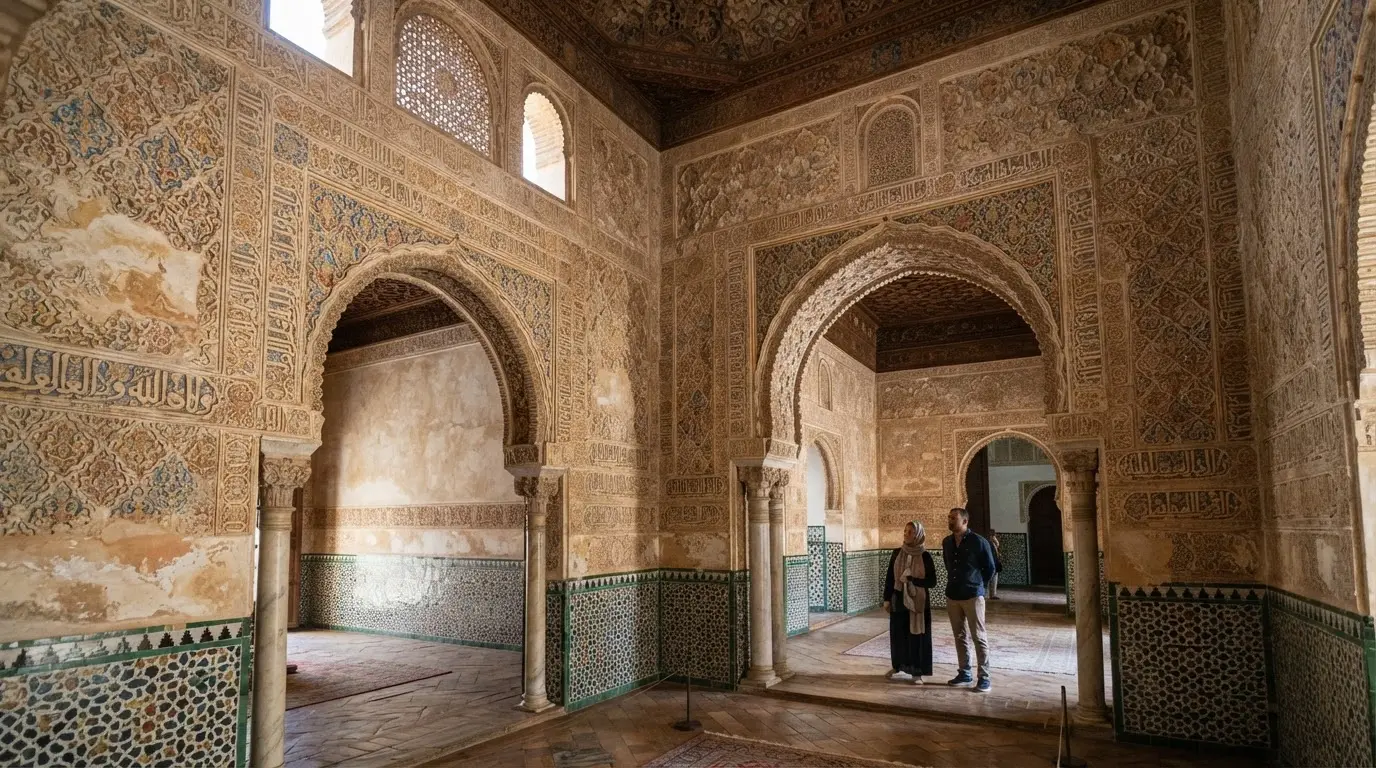
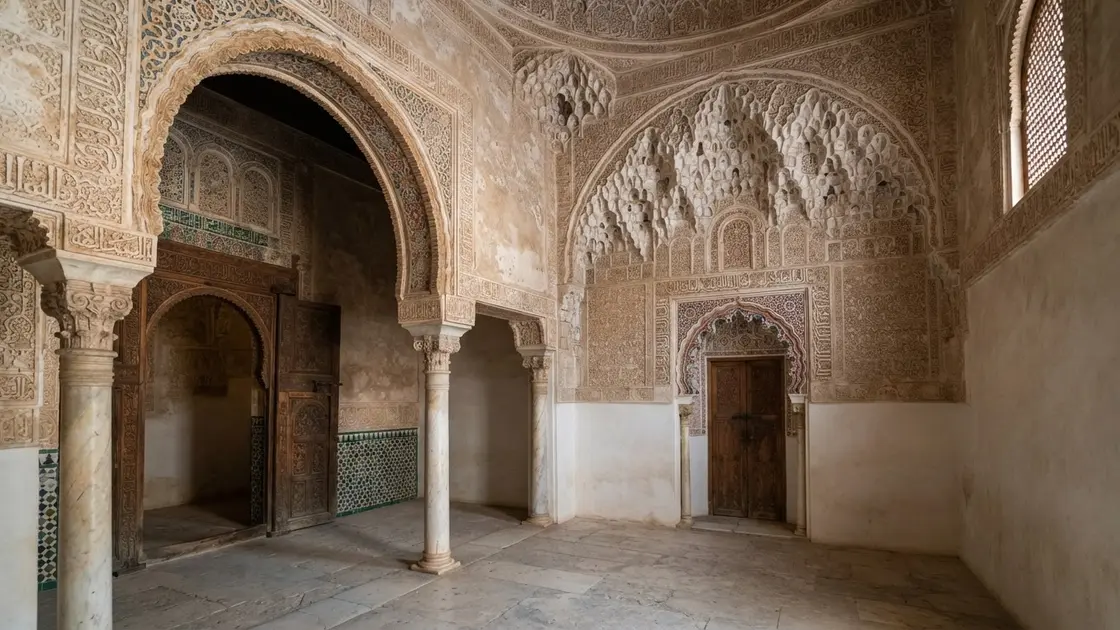
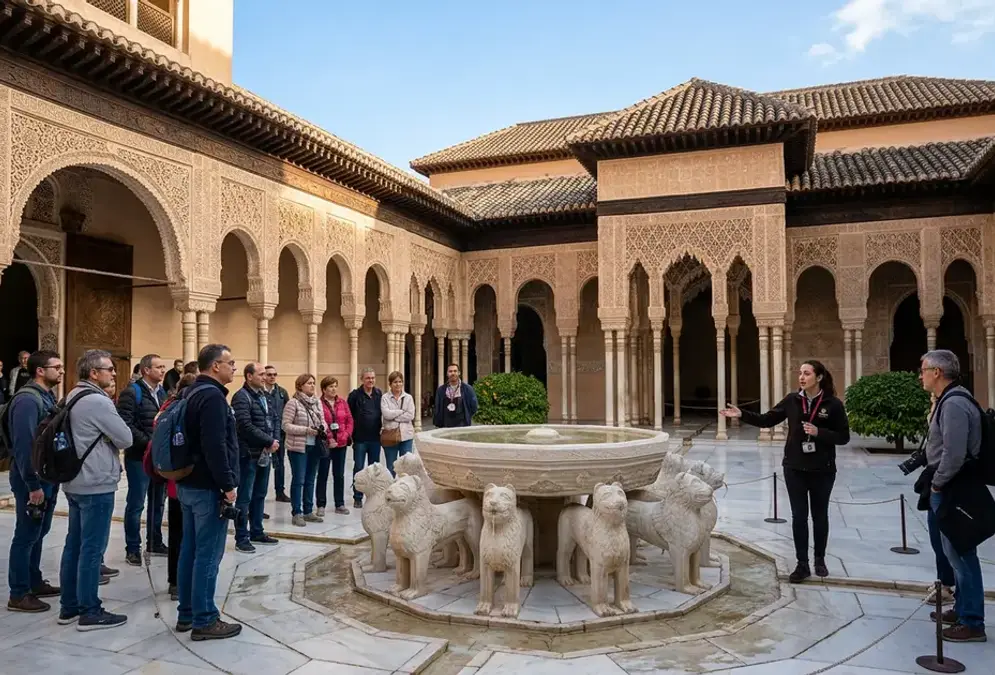
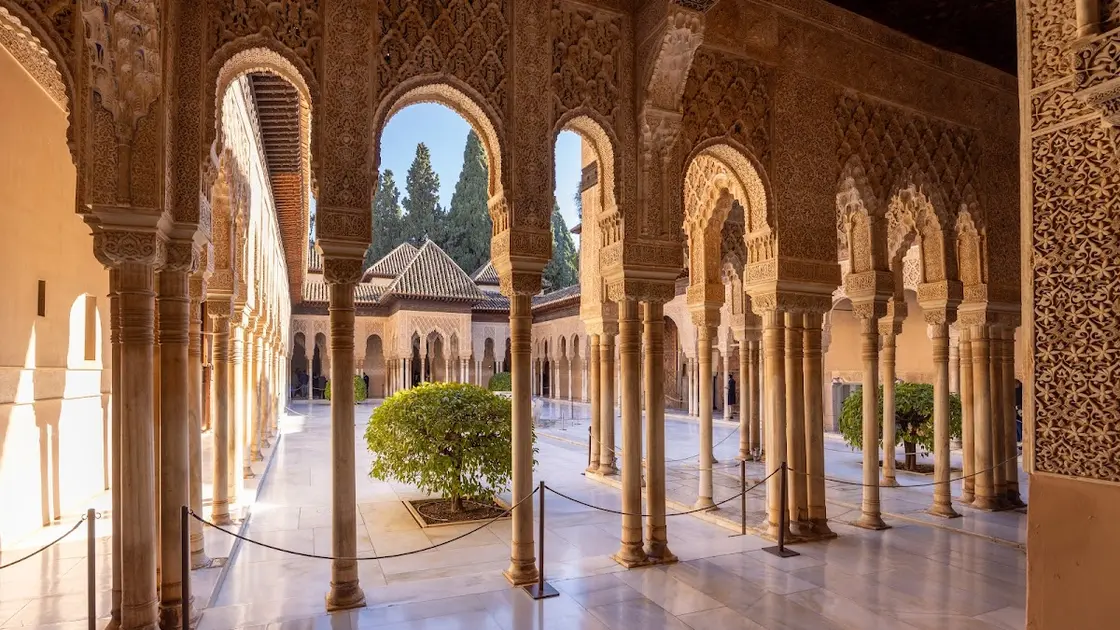
The cultural peak of Nasrid Granada falls precisely in this period. Muhammad V expanded the Alhambra on a scale no previous sultan had attempted: the Court of the Lions, the Hall of the Two Sisters, the Hall of the Abencerrajes. These were not just building projects. They were political statements about legitimacy, projections of power through geometry and calligraphy. Ibn al-Khatib was the intellectual frame around which that programme ran. He ran the administration that funded it, wrote the history that contextualised it, and composed the poetry that was carved into its walls. His medical expertise — grounded in the works of al-Razi and Ibn Sina — also informed Muhammad V's decision to build Islamic Spain's first public hospital, which opened in 1367 in the lower Albaicín a few steps from El Bañuelo.
Power at the Nasrid court had a texture that guidebooks rarely capture. It required constant management of factions, religious scholars, and military commanders, all competing for influence over the sultan. Ibn al-Khatib managed this for thirty years. That he eventually failed does not diminish the achievement; it confirms that the environment was as dangerous as his trajectory suggested.
The plague treatise: contagion before germ theory
In 1349, the Black Death reached Granada. Ibn al-Khatib watched it kill his mentor and large numbers of the city's population. His response was to write a medical treatise: Muqni'at al-Sa'il 'an al-Marad al-Ha'il ("The Satisfying Answer on the Terrible Disease").[2] The clinical grounding for that treatise came from the same medical circles that, a generation later, staffed the Maristan of Granada, the public hospital his patron Muhammad V built.
The treatise's argument was heterodox by the standards of the time. Most 14th-century Islamic physicians attributed plague to corrupted air (the miasma theory) or to divine punishment, which was not really a medical argument at all. Ibn al-Khatib argued differently. The disease spread through direct contact: through garments, vessels, earrings, through people moving between houses, through the arrival of ships from infected ports into healthy ones. He cited the evidence of observation: communities that isolated themselves avoided infection; isolated individuals who had no contact with the sick remained healthy. He used hadith (prophetic sayings about plague and quarantine) to defend the argument within Islamic legal discourse, pre-empting the theological objection that denying divine causation was impious.
His most striking claim, unique among all 14th-century plague writers, was that the pandemic had originated in China and spread westward along trade routes. This is now understood to be historically correct.
Recommended tours
Tours are selected for quality, not commission. We earn a small fee if you book — at no extra cost to you.
The gap between Ibn al-Khatib's argument and Louis Pasteur's germ theory (formally established in the 1860s) is roughly 500 years. Western scholarship caught up with his plague treatise relatively recently: a 1982 paper in a US medical history journal brought his work to wider attention in English. He was not proposing a microorganism theory; he lacked the conceptual and technological framework for that. But his insistence that the mechanism was physical transmission rather than miasmic atmosphere put him, in practical terms, five centuries ahead of mainstream European medicine.
Al-Ihata and the other sixty works
The plague treatise is the work that gets cited in histories of medicine. But Ibn al-Khatib's own ambition was historical and literary.
Al-Iḥāṭa fī akhbār Gharnāṭa ("The Complete Source on the History of Granada"), completed in 1369, is his masterpiece.[1] A vast biographical dictionary of scholars, poets, jurists, and officials connected to Granada across its history, it remains the single most important primary source for Nasrid Granada. It also contains an autobiography: his own entry in a dictionary of notable Granadans, written in the third person with characteristic precision. As of 2026, it has not been translated into English in full.
Beyond these two works, he produced:
Rawḍat al-taʿrīf bi-al-ḥubb al-sharīf ("The Garden of Acquaintance with Noble Love"): a treatise on Sufi mysticism and sacred love, written in a Neoplatonic register. The heterodox content of this text was later used as evidence of heresy (zandaqa) in his posthumous trial.
Khaṭrat al-Ṭayf ("The Appearance of a Ghost During a Trip"): a prose travelogue of a 21-day journey, which demonstrates the range of his literary ambitions.
Poetry: court verse inscribed on the walls of the Alhambra as part of the Nasrid epigraphy programme. He was one of three principal court poets, alongside his mentor Ibn al-Jayyab and his student Ibn Zamrak.
80 titles
Over 60 works across history, medicine, philosophy, poetry, geography, and jurisprudence: Ibn al-Khatib wrote more than virtually any other individual in 14th-century al-Andalus, in more disciplines. Some medieval bibliographies credit him with as many as 80 titles.
The total count is over sixty works, with some bibliographies listing as many as eighty, covering history, medicine, philosophy, poetry, geography, and jurisprudence. The medieval Islamic tradition of the adib (the cultivated man of letters who commanded multiple disciplines) had few practitioners at this level.
The student who destroyed him: Ibn Zamrak and the fall
The most unsettling part of the story is the instrument of his destruction.
Ibn Zamrak (1333–1393/1395) was Ibn al-Khatib's student, protégé, and the man he had trained and promoted within the Nasrid chancery. The older vizier described the relationship in terms that were paternal. Ibn Zamrak is today the better-known Alhambra poet: his verse fills the Court of the Lions, the Hall of the Two Sisters, and the Torre de la Cautiva, the most celebrated and clearly attributed inscriptions in the palace complex.[3]
But by 1371, Ibn Zamrak had allied with the Grand Qadi al-Nubahi against his teacher. The precise dynamics are murky. Political ambition, religious factionalism, and personal rivalry all appear in the sources. What is clear is the outcome: Ibn al-Khatib was driven into his second exile, this time permanent, and fled to Fez under the protection of the Marinid sultan.
A trial was convened in Granada in absentia. The charges were zandaqa (heresy), supported in part by the Sufi mystical content of his Rawḍat al-taʿrīf. The theological reading of that text may have been sincere or it may have been a pretext. Either way, the verdict was predictable.
In 1374 (some sources give 1375), Ibn al-Khatib was arrested in Fez before the formal verdict was even delivered. He was strangled in his prison cell and his body was burned, then buried near the Bab Mahruq gate of the city. He was sixty years old.
The irony that retrospective readers tend to note is this: Ibn Zamrak, who engineered his teacher's fall and took his place, died the same way. He was killed by order of Sultan Muhammad VII around 1393–1395, probably also the result of court intrigue. The Nasrid court consumed its poets.
What survives in Granada today
Ibn al-Khatib is not commemorated in Granada the way Boabdil is, or Washington Irving, or even García Lorca. There is no major monument to him in the city. What he left behind is more diffuse and, in its way, more permanent.
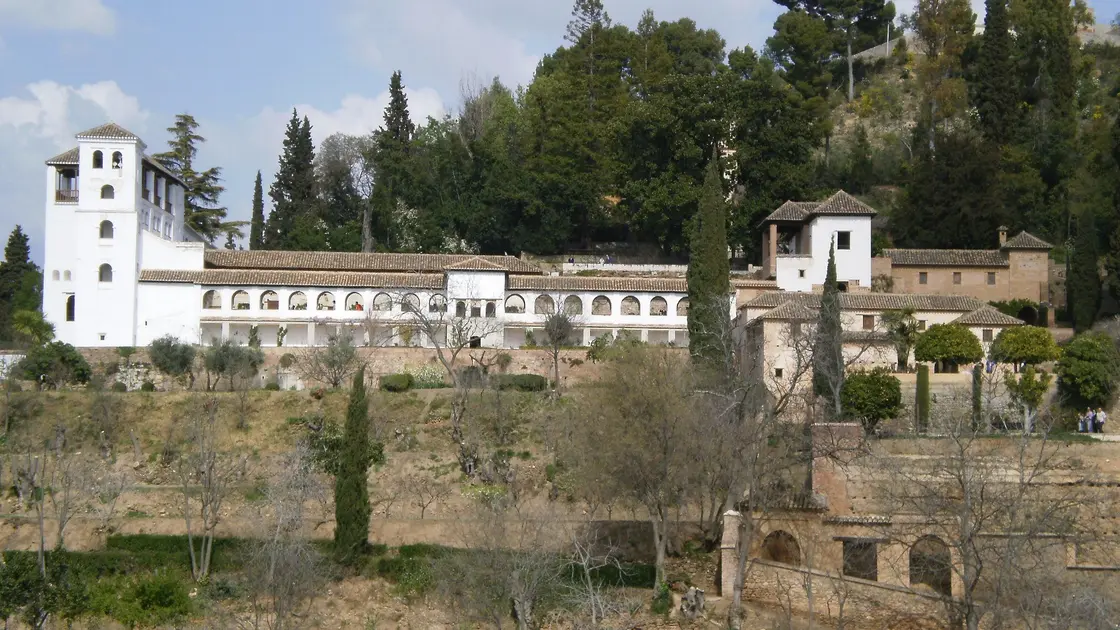
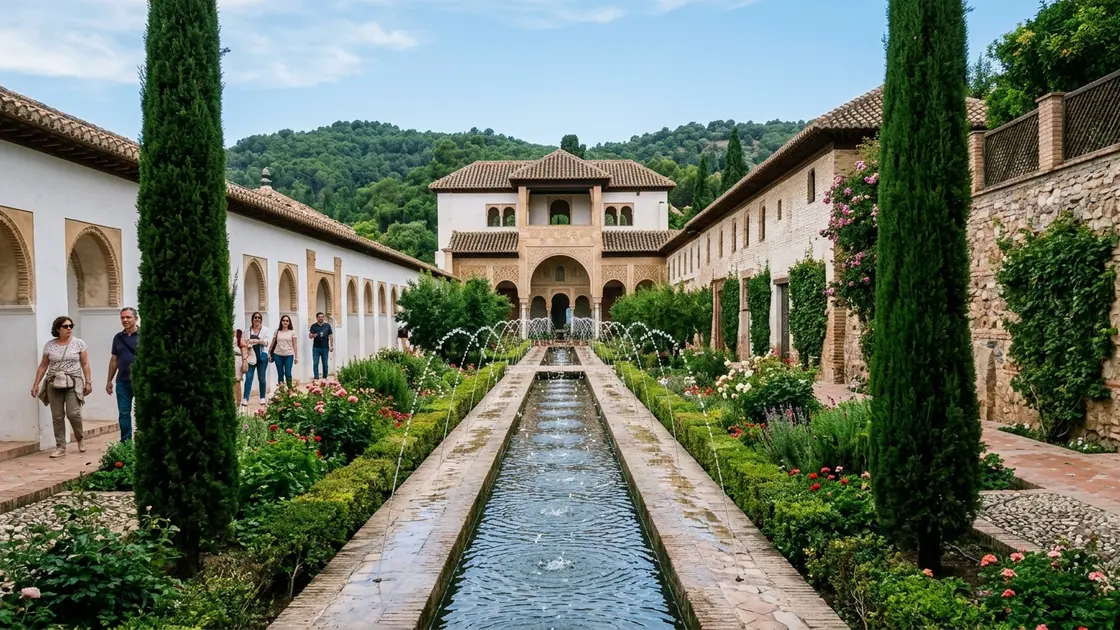
The Alhambra itself is partly his. Not architecturally (the buildings were commissioned by the sultans) but intellectually. He was the cultural director of the Muhammad V court that produced the Court of the Lions and the Generalife's gardens. His poetry is inscribed on the palace walls as part of the Nasrid epigraphy programme, alongside the work of Ibn al-Jayyab and the more extensively attributed verse of Ibn Zamrak. When you trace the Arabic calligraphy on the stucco panels with your eye, you are in contact with a tradition he shaped, even if the specific couplets you cannot read were probably carved from Ibn Zamrak's pen.
The Albaicín, the medieval Islamic quarter on the hill facing the Alhambra, was the city Ibn al-Khatib described and administered. The street pattern he would have known (the narrow lanes, the whitewashed carmen houses, the fountains fed by Nasrid aqueducts) is substantially intact. Walking it is closer to a historical encounter than visiting most dedicated museums.
His books survive in manuscript. Al-Ihata has been partially published in Arabic critical editions; scholars of medieval Islam consider it indispensable for understanding Nasrid Granada. The plague treatise circulates in academic medicine as a landmark in the history of epidemiology. Neither has been fully translated into English.
The the Generalife and the Nasrid Palaces carry the cultural programme he helped frame. The Court of the Lions was almost certainly conceptualised during the period of his peak influence over Muhammad V's court, and it remains one of the most precisely engineered spaces in medieval architecture. None of that would look the same without him. He just doesn't get the plaque.
Frequently asked questions
Who was Ibn al-Khatib?
Ibn al-Khatib (1313–1374) was the chief vizier of Nasrid Granada and one of the most prolific scholars of medieval Islam. Born in Loja, he served sultans Yusuf I and Muhammad V as head of the royal chancery and ran the emirate's foreign policy for roughly thirty years. He wrote over sixty works covering history, medicine, poetry, philosophy, and geography, and is considered the greatest Arabic prose writer of al-Andalus.
What did Ibn al-Khatib argue in his plague treatise?
Written around 1349, his treatise Muqni'at al-Sa'il 'an al-Marad al-Ha'il argued that plague spreads through physical contagion (via garments, vessels, and direct contact with infected people) rather than through miasma or divine punishment alone. He cited quarantine evidence and identified China as the pandemic's point of origin. This put him roughly 500 years ahead of mainstream European acceptance of contagion theory. He is the only 14th-century author known to have identified China as the origin of the Black Death.
Can you see Ibn al-Khatib's poetry in the Alhambra?
Ibn al-Khatib was one of three principal Nasrid court poets (alongside his mentor Ibn al-Jayyab and his student Ibn Zamrak) whose verse was inscribed on the Alhambra walls. The most celebrated and clearly attributed inscriptions belong to Ibn Zamrak, found in the Court of the Lions, the Hall of the Two Sisters, and the Torre de la Cautiva. Ibn al-Khatib's verse also survives in the complex as part of the same epigraphy tradition, though specific panels are not as clearly labelled in published official sources.
How did Ibn al-Khatib die?
After his former student Ibn Zamrak and the Grand Qadi al-Nubahi orchestrated his downfall, Ibn al-Khatib fled to Fez, Morocco. He was tried in absentia in Granada on charges of heresy (zandaqa), with his Sufi mystical writings used as evidence. In 1374 (some sources say 1375), he was imprisoned in Fez and strangled in his cell before the formal verdict was delivered. His body was burned and buried near the Bab Mahruq gate.
What is the relationship between Ibn al-Khatib and Ibn Zamrak?
Ibn Zamrak (1333–1393/1395) was Ibn al-Khatib's student and protégé, trained within the Nasrid chancery. Ibn al-Khatib described the relationship in paternal terms. Despite this, Ibn Zamrak allied with the Grand Qadi al-Nubahi against his teacher and helped engineer his exile and eventual execution. Ibn Zamrak is now better known as the Alhambra's principal poet, his verse filling the Court of the Lions. Ironically, he was himself murdered around 1393–1395, probably through similar court intrigue.
What is al-Ihata and why does it matter?
Al-Iḥāṭa fī akhbār Gharnāṭa ("The Complete Source on the History of Granada"), completed in 1369, is a biographical dictionary of scholars, poets, jurists, and officials connected to Granada. It remains the single most important primary source for Nasrid Granada's history and contains Ibn al-Khatib's own autobiography. Scholars of medieval Islam consider it indispensable. As of 2026, it has not been translated into English in full.
Where was Ibn al-Khatib born?
He was born on 16 November 1313 in Loja, a garrison town roughly 55 kilometres southwest of Granada that guarded the emirate's western approaches. Loja is today a small agricultural city in the province of Granada, on the A-92 motorway between Granada and Antequera.
What role did Ibn al-Khatib play in the Alhambra's development?
Ibn al-Khatib did not design the Alhambra, but he was the intellectual and administrative engine behind the court of Muhammad V, during whose reign the palace reached its artistic peak. The Court of the Lions and the Hall of the Two Sisters were built during this period. He also contributed poetry to the Nasrid epigraphy programme, the tradition of inscribing court verse on the palace walls, that makes the Alhambra as much a literary monument as an architectural one.