
Five centuries of academic history in one building
The physical starting point for understanding Granada's university is the Hospital Real, on Calle Hospital Real at the northern edge of the main campus. The Catholic Monarchs — Ferdinand and Isabella — founded it in 1504 to treat soldiers wounded in the Granada Wars. Over the following two centuries, successive architects added Gothic arches, Mudéjar timber ceilings, Plateresque window frames, and a Baroque façade until the building absorbed almost every style in Spanish Christian architecture into a single structure. In 1978 it became the rectorate and main library of the Universidad de Granada.
The interior is closed to general visitors, but the exterior rewards twenty minutes of close attention. Stand on Calle Hospital Real thirty metres from the main entrance and work through the facade from base to cornice — the architectural registers shift noticeably as you move up, each layer reflecting a different period of construction and patronage.
The university's origins go back further than 1531. The institution traces its intellectual lineage to the Madrasah Yusufiyya, founded in 1349 by Sultan Yusuf I of the Nasrid dynasty to teach medicine, astronomy, geometry, and logic. When Charles V established the studium generale via a papal bull from Clement VII in 1531, granting it the same status as Bologna, Paris, Salamanca, and Alcalá, he was effectively formalising a centuries-old tradition of organised learning in the city. Federico García Lorca enrolled at the Faculty of Law here in 1916 and spent nine years completing a degree he treated primarily as an opportunity to practise piano.
Today the university runs five campuses across Granada: Centro, Cartuja, Fuentenueva, Aynadamar, and Ciencias de la Salud, plus outposts in the Spanish territories of Ceuta and Melilla. Campus Fuentenueva, in the western part of the city, groups the science and engineering faculties. Campus Cartuja, slightly further out, handles humanities and social sciences. The practical effect is that the university is not a self-contained precinct — it is woven through the city, which means student life is woven through it too.
Realejo: the former Jewish quarter that became student territory
El Realejo sits immediately south-west of the Cathedral, in the low ground between the Alhambra hill and the city centre. Before the Reconquista, it was the Jewish quarter of Moorish Granada — the medina's inhabitants called it Garnata al-Yahud, Granada of the Jews. After 1492 the community dispersed, and the neighbourhood went through successive reinventions: merchant quarter, working-class district, and eventually what it is now — one of the most student-heavy areas in the city.
The draw is geographic. Realejo sits between the Cathedral and the university faculties, close enough to walk to either and far enough from the Alhambra ticket queues to feel like a functioning neighbourhood. Rents run lower than the centro, cobbled streets rise steeply toward the palace hill, and the squares are full of terraces that stay open late during term.
Read next · Neighborhood
Realejo / Jewish Quarter
Medieval Granada's Jewish quarter, now a neighbourhood of historic palaces, street art, and the city's finest tapas bars — all at the foot of the Alhambra.
Campo del Príncipe is the neighbourhood's main square, and it behaves differently from the tourist plazas on the other side of the Cathedral. In the evening it fills with students and young professionals rather than tour groups — terraces around the square fill up around nine, stay active until midnight, and the bars tend toward proper tapas over tourist menus. The bars here attract a slightly older student crowd than Pedro Antonio de Alarcón, less concerned with volume and more with staying out late at a table.
The Centro de Lenguas Modernas — the UGR's language school — has two sites in the Realejo, which partly explains the international density of the quarter. Students arriving on Erasmus placements or direct-enrolment programmes take their language courses here before dispersing across the city's faculties. The school's schedule runs throughout most of the year, meaning there is a near-constant flow of new arrivals who need to find somewhere to live, somewhere to eat, and someone to practise Spanish with.
Calle Pedro Antonio de Alarcón: the student bar strip
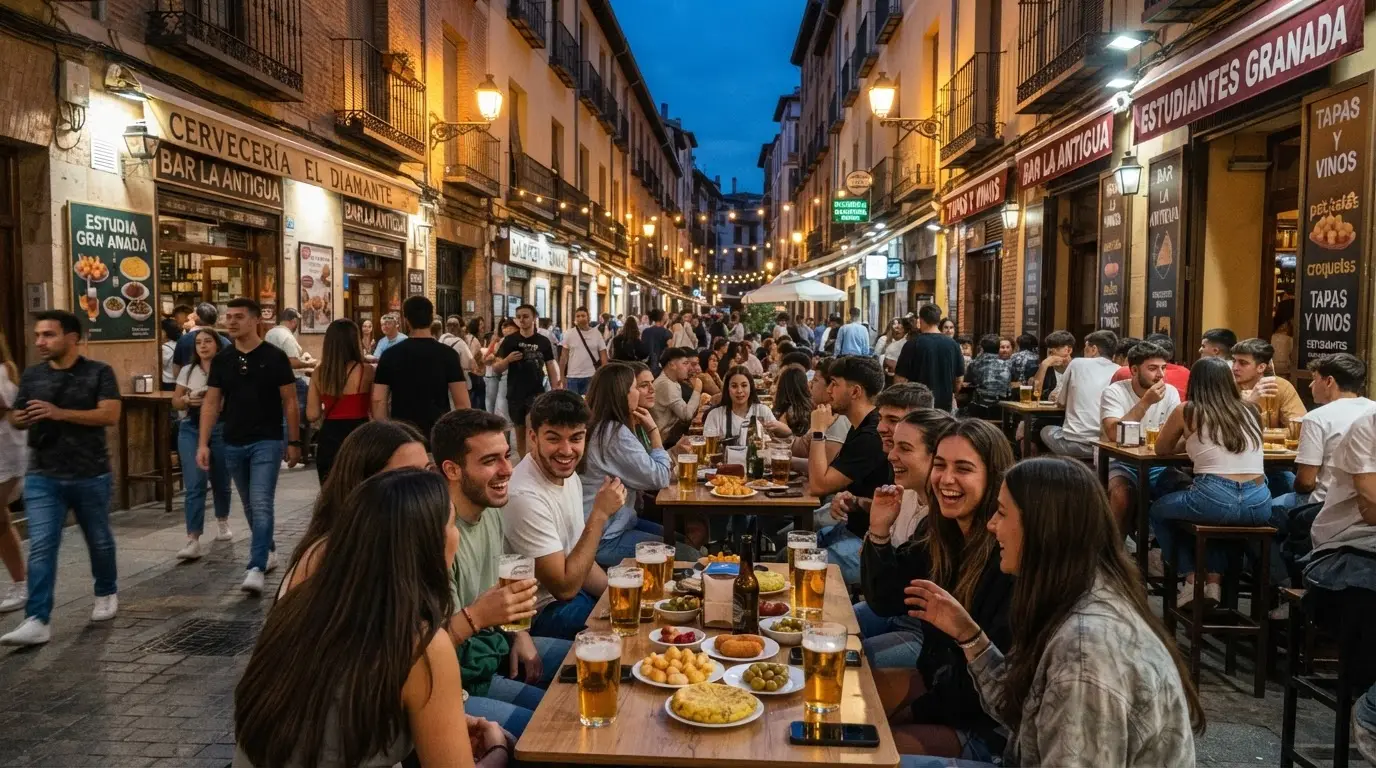
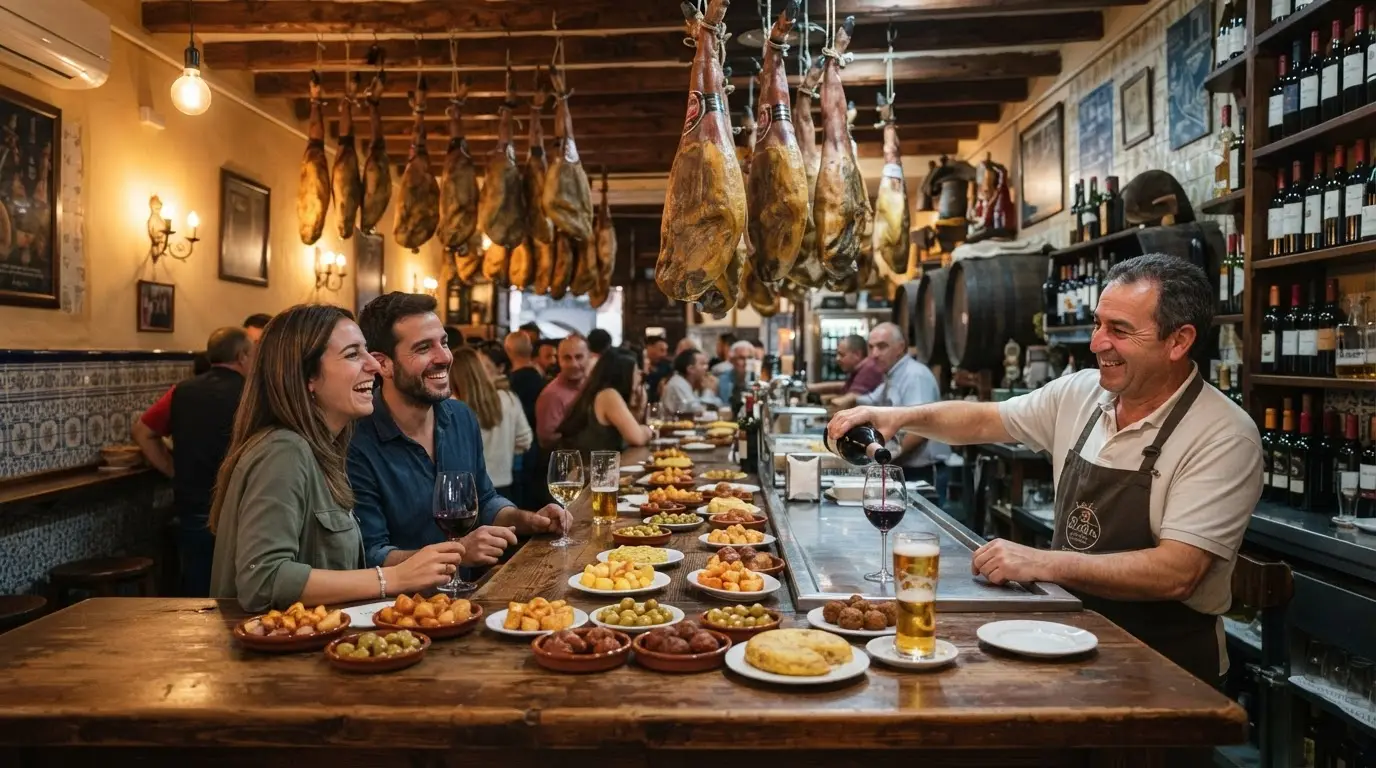
Every Spanish university city has a street like this. Granada's is Calle Pedro Antonio de Alarcón — PAA in shorthand — running roughly north to south through the western part of the Universidad quarter, from Plaza Albert Einstein down toward the newer residential areas. The local description is the three Bs: bueno, barato, bonito — good enough, cheap, and comfortable. A beer on Pedro Antonio comes with a free tapa and costs less than almost anywhere else in the city.
The northern end of the street, around Plaza Albert Einstein, is the louder section: karaoke bars, chupiterías where shots cost well under a euro each, and venues that run music loud enough that conversation requires effort. Pub Babel at number 54 has table football and billiards and attracts a mixed crowd. Bar La Guarida del Lobo has an arcade section and plays rock. Chupitería 69 is the shot bar of record for Erasmus students, with over a hundred options.
The southern end is quieter. Bars have terraces. The food is more considered. The crowd tends toward groups of students who have found a regular haunt rather than first-year arrivals trying every option in sequence. Both ends serve the same function: a place to eat and drink without the price pressure of the tourist circuit.
Recommended tours
Tours are selected for quality, not commission. We earn a small fee if you book — at no extra cost to you.
Wednesdays and Thursdays are the Erasmus nights, when international students from the university's exchange programmes have made a tradition of taking over these bars. Granada has received Erasmus students since the programme launched in the late 1980s, and the social infrastructure has adapted accordingly: some bars staff bilingual servers, a few post drink menus in English and German, and the language in the street on those evenings shifts noticeably away from Spanish. For visitors arriving outside the Erasmus schedule, weekday evenings from 8pm onward during semester — October to November or February to April — are when the street operates at full capacity. In July and August, the students leave and Pedro Antonio goes quiet in a way that makes it feel like a different city.
Language exchanges and the Erasmus effect
Granada's student population includes a significant international component. The UGR's Center for Modern Languages draws over 10,000 students a year through Erasmus and bilateral agreements with North American and Asian institutions.[3] In 2014 the university was voted the best Spanish university by international students — a ranking driven partly by the city's quality of life and partly by the volume of language and integration support on offer.
The result is a city with a structured culture around language exchange. Intercambios — organised language exchange meetups — run throughout the academic year in bars across the university quarter and Realejo. The format is standard: Spanish speakers who want to practise English pair with English speakers who want to practise Spanish, and they switch every thirty or forty minutes. Wanderlust Café Pub hosts sessions on Tuesdays and Thursdays from 8pm. The Escuela Montalbán offers a more structured programme through its Tandem language exchange system, pairing participants at least twice a week.
For students arriving on exchange programmes, the intercambio circuit is often the fastest route to actual friendships with Granadinos. The bars that host these sessions tend to be on the boundary between the university quarter and the tourist centre — accessible to both populations, which is partly the point. The sessions are free, require no advance booking, and produce the kind of mixed Spanish-international social dynamic that is otherwise difficult to create organically.
Deep dive · Article
Why Granada Tapas Are Free: The History Behind the Tradition
Granada is one of the last cities in Spain where every drink comes with a free tapa. The real history, the unwritten rules, and the best bars to find it.
For visitors passing through rather than studying, these events are worth knowing about. Arriving at an intercambio as a tourist rather than a student is not unusual — the sessions are genuinely open — and the conversation that results tends to be more honest about what Granada is actually like to live in than anything available on a guided tour.
Working from Granada: cafes, coworking, and the student economy
Granada's university population has created an infrastructure that suits remote workers as well as students. The city has fibre broadband across the centre, free WiFi hotspots at key public points, and a café culture built around tables that stay occupied for hours at a stretch without pressure to order more.
Café 4 Gatos is one of the consistently recommended study spots — good views over the city, strong coffee, and a tolerance for laptop workers that some of Granada's more tourist-facing cafes have abandoned. La Finca Coffee is quieter and closer to the university faculties, with enough plug sockets to serve a table of simultaneous workers. Atypica Coffee, near the centre, draws a mixed Spanish and international crowd and runs on the Arabic-influenced café culture that occasionally surfaces in Granada's food scene.
For structured coworking, ANDA Cowork is the most established option, located near the main station with fast WiFi and a membership model aimed at freelancers and remote workers. Gran Vía Coworking occupies an attic space with a panoramic terrace on the city's main boulevard. TRISKELE Café offers a hybrid format — café menu plus coworking desks — for those who want food alongside work.
The student economy keeps prices low in ways that benefit anyone on a tight budget. The menú del día at restaurants near campus faculties — three courses with bread and a drink — costs noticeably less than the tourist-zone equivalent. Bar prices on Pedro Antonio de Alarcón and in Realejo are 30 to 40 percent lower than the tourist zones around the Cathedral and Alhambra approach. Student accommodation pressure has kept a large stock of affordable short-let rooms available through platforms like Idealista and pisoengranada.es, which makes Granada unusually accessible as an extended base.
Read next · Activity
Granada Tapas Tour
Guided 2.5-3 hour walk through Granada's authentic tapas bars. 10-12 tapas samples and 4-5 local drinks per person. Small groups, max 8 people. From €60.
Practical guide to the university quarter
The universidad quarter is ten minutes on foot from the Cathedral heading west, and the change in atmosphere happens fast. Cross Gran Vía de Colón and the souvenir shops disappear. By the time you reach Calle Rector López Argüeta the street is running on students, academics, and local residents — not tour groups.
The UGR Botanical Garden on the south side of the Faculty of Law is free to enter, open from 10am to 2:30pm on weekdays, and rarely crowded. It holds seventy mature tree specimens, sections for medicinal herbs and aquatic plants, and a ginkgo biloba among the first planted in the Iberian Peninsula. Forty minutes there is enough to see it properly and provides a quiet interval between the Hospital Real exterior and Pedro Antonio de Alarcón in the evening.
For the bar strip, the practical window is 7pm to 10pm on weekday evenings during semester. Arrive before the rush, choose a bar on the southern end of Pedro Antonio if you want a table rather than a standing spot, and plan on two or three stops rather than settling at one bar for the evening. The free tapa changes with each round at good bars — a full evening of four rounds is a complete dinner as well as a night out.
Academic-year timing matters. October to November and February to April are the peak periods when the quarter operates at full energy. The August school holiday period is noticeably quieter — the bars are still open, but the density that makes Pedro Antonio de Alarcón work as an experience is not there. June and September are intermediate: some international students remain but the local student population has thinned.