A teenage sultan and a murdered father
Muhammad V was born on 4 January 1339, son of Yusuf I, the seventh Nasrid sultan of Granada. He came to the throne at sixteen, still legally a minor, after his father was stabbed to death while at prayer in Granada's main mosque on the last day of Ramadan 1354, killed by a slave later described in court records as deranged[4].
Too young to govern alone, Muhammad V relied on the hajib Ridwan and the vizier Ibn al-Khatib, a historian and poet who would stay loyal to him through exile and restoration alike. It set the pattern for his whole career: his real strength lay less in his own sword-arm than in his ability to keep capable men close.
The kingdom he inherited was already a reduced one, a mountain state wedged between Castile and the Mediterranean, its independence resting more on tribute payments, fortified geography, and the rivalries of its Christian neighbours than on military strength. Muhammad V would spend the rest of his reign working that narrow margin, a relationship with Castile that swung between alliance and wariness, always with fewer options than his palace architecture suggests.
Coup and exile: three years in Fez
The regency held for five years, but on 21 August 1359 a palace coup drove Muhammad V from the Alhambra. He fled first to Guadix, which sheltered him, then crossed into Morocco that November while a rival, Ismail II, took the throne in Granada[5].
The coup scattered the court along with the sultan. Princes, scholars, and literary men fled with him, among them Ibn al-Khatib himself and the young poet Ibn Zamrak, both bound for the Marinid capital[6]. In Fez, Muhammad V and Ibn al-Khatib crossed paths with the historian Ibn Khaldun, who backed their claim to Granada[7].
- 1339
Birth of the future sultan
- 1354
Accession
Becomes sultan at sixteen after Yusuf I's murder
- 1359
Deposed
Palace coup exiles him to Fez
- 1362
Restored
Returns with Castilian military support
- 1391
Dies
Succeeded by his son, Yusuf II
Restoration: the Castilian alliance that brought him home
Three years of exile ended in 1362, when Muhammad V returned to the peninsula backed by an alliance with Castile under Pedro I. Together their forces took Málaga. His rival Muhammad VI, sensing defeat, surrendered to Pedro and asked for mercy; Pedro executed him instead, clearing the way for Muhammad V's second reign[8].
Explore nearby · Monument
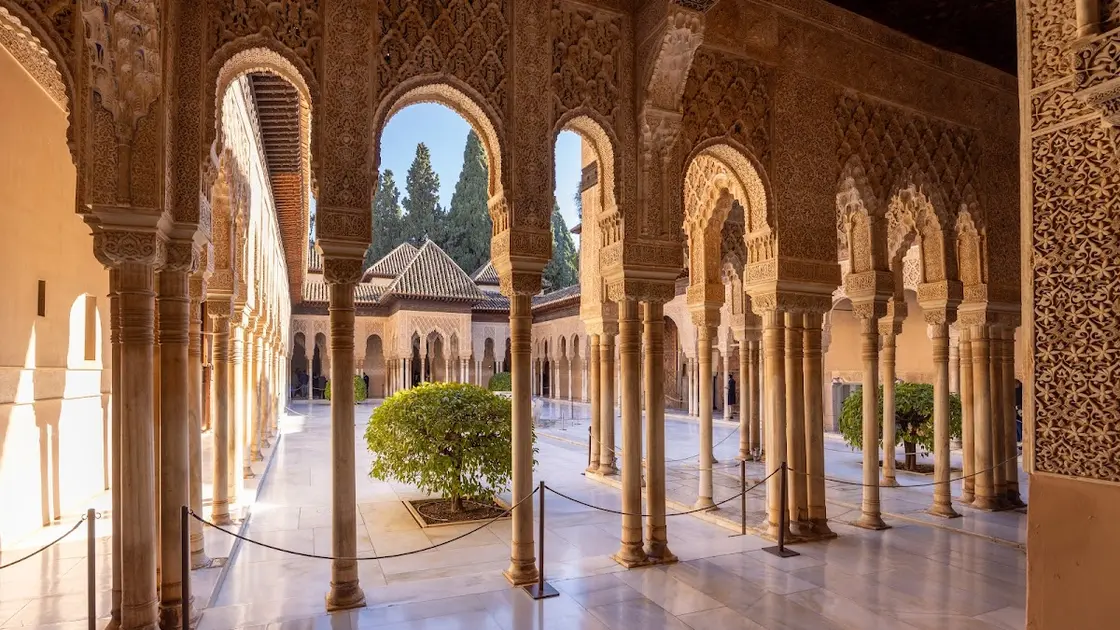
Nasrid Palaces
Three royal Nasrid palaces inside the Alhambra, including the Patio de los Leones and Hall of the Ambassadors. Entry is timed: arrive within your booked slot.
The alliance cut both ways. When Pedro was assassinated in 1369, Muhammad V used the chaos in Castile to retake Algeciras, a port his family had lost decades earlier, and had it demolished so it could never again anchor an enemy garrison[9].
Domestically, he also reorganised command of the frontier troops, the Zenata mercenaries known as the Ghazis, eliminating the office of their independent chief in 1370 and bringing them for the first time under direct Nasrid family authority[13]. It was a quiet consolidation of power, the kind that rarely makes the chronicles but matters more than a captured city.
The golden age: peace, poets, and the Palace of the Lions
Muhammad V's second reign lasted twenty-nine years, and Nasrid Granada spent most of them at relative peace. The court that gathered around him became a centre of the western Islamic world's intellectual life: Ibn al-Khatib remained vizier for the better part of a decade after the restoration, serving until 1371 before court intrigue drove him to flee to Fez, and Ibn Zamrak succeeded him as the court's leading poet.
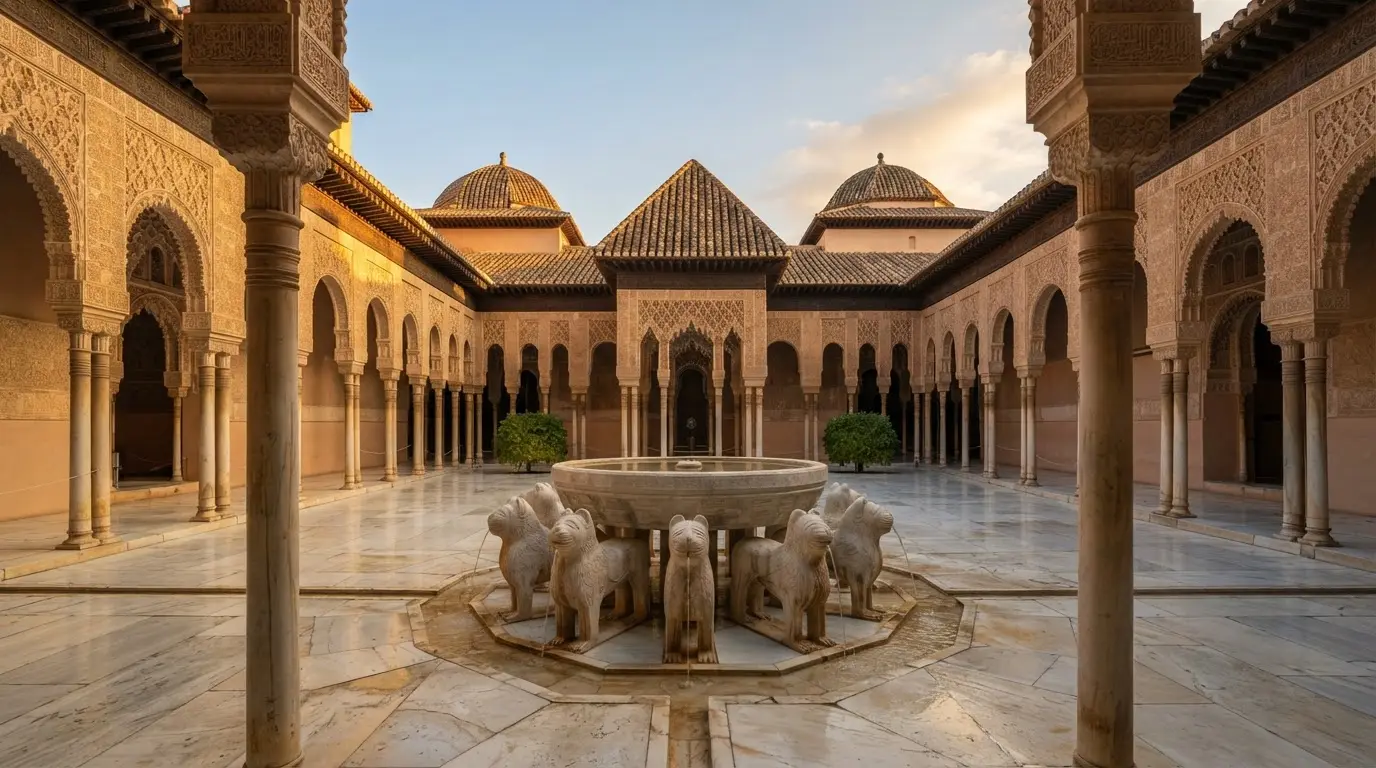
Almost everything visitors recognise in the Alhambra today dates from this period. Muhammad V rebuilt the Mexuar council hall, refurbished the Comares Palace and raised its ornate entrance façade in the Patio del Cuarto Dorado, and finished the baths before turning to an entirely new palace of his own design: the Palace of the Lions, whose fountain and courtyard draw together the whole Nasrid decorative tradition[10].
How each of these spaces functioned politically, room by room, from the earlier Comares core through Muhammad V's additions to what Boabdil eventually surrendered in 1492, is covered in the political history of the Alhambra's rooms. What matters here is simpler: the Palace of the Lions and most of his distinctive additions date from after 1362.
The Maristan: a sultan's hospital in the Albaicín
Muhammad V's building projects were not confined to the hilltop palace. In 1365 he founded the Maristan, Granada's first hospital, on a site in the Axares quarter of the Albaicín, reusing the line of an older fortification wall as its foundation[11]. It served the sick and the mentally ill together, an unusual combination for a fourteenth-century hospital, for well over a century before later civic uses, and eventual ruin, took it over.
The building's foundational inscription, an unusually detailed stone tablet, records the exact dates of construction, 1365 to 1367, alongside the sultan's genealogy and the patients the hospital was meant to serve[3]. It is one of the few Nasrid monuments whose builder left, quite literally, a signed and dated plaque.
Deep dive · Article
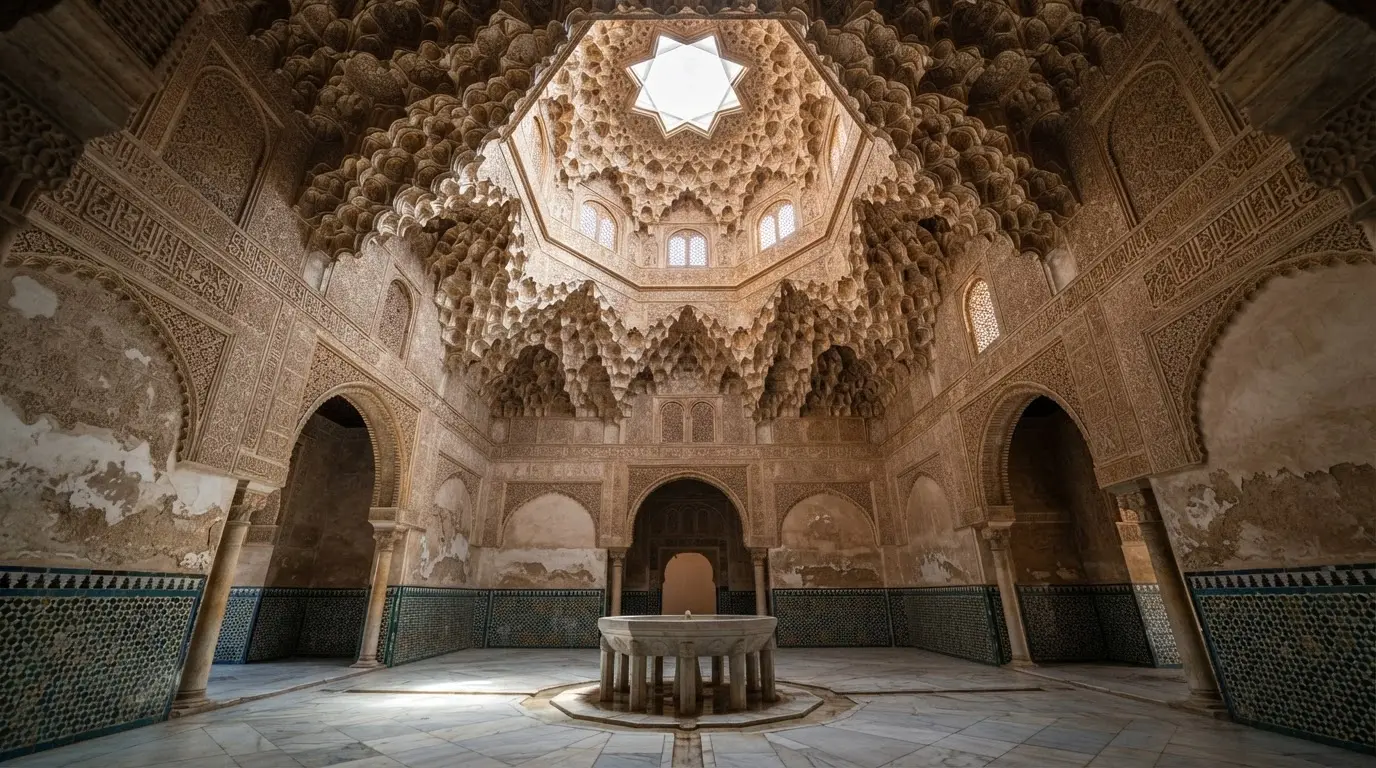
Abencerrajes of Granada: the noble clan behind the legend
Abencerrajes of Granada: the noble clan who shaped Nasrid court politics for a century and became legend through a massacre story set in the Alhambra.
Death and the measure of the man
Muhammad V died on 16 January 1391[1], having just turned fifty-two, and was succeeded by his son Yusuf II. His death is usually treated as the effective end of the golden years his reign and his father's had built together, and the century that followed brought renewed succession crises that would weaken the dynasty for good.
Contemporary description of him, from courtiers who knew him, is unusually consistent: a handsome man, generous, sensitive to others' misfortune, a devout Muslim who dressed correctly rather than lavishly and did not surround himself with a large retinue. Those qualities, more than military brilliance, are credited with winning him the loyalty of subjects who had already watched him lose the throne once[12].
None of this required a legendary reputation. Muhammad V is not the sultan visitors ask about by name, the way they ask about Boabdil. But almost every photograph taken inside the Alhambra's Nasrid Palaces is, in some sense, a photograph of his work, commissioned by a man who spent three years in exile and then very nearly three decades building.