Ibn Zamrak: the poet whose words are carved into the Alhambra
Ibn Zamrak (1333–1393), pupil of Ibn al-Khatib, was the Nasrid court poet whose Arabic verses were carved into the Alhambra's Court of the Lions and stucco.
Seven years resident in Granada. Specialist in Nasrid architecture, Al-Andalus history, and Andalusian walking routes.
Updated Published
Most visitors to the Alhambra look up at the muqarnas vaulting of the Hall of the Two Sisters or down at the twelve stone lions and have no idea they are standing inside a poem. The Arabic inscriptions that run along every frieze, every arch intrados, and every fountain basin in the Nasrid palaces are not decoration; they are verses, composed by a specific man, carved into plaster on his instructions. That man was Ibn Zamrak, court poet and vizier of Granada, born 1333, assassinated 1393, and in some ways still present in every room he ever wrote about.
In this article
Jump to a section
⌄
A poet inside the machine of Nasrid power
Ibn Zamrak was born in Granada in 1333, most likely in or near the city itself, though some sources suggest family connections to the Guadix area to the east.[1] His full name was Muhammad ibn Yusuf ibn Ahmad ibn Zamrak al-Andalusi. By the time he was a young man, Granada was the last surviving Muslim emirate on the Iberian Peninsula, its territory squeezed between Castile and the Mediterranean, its court producing some of the most refined Arabic poetry anywhere in the western Islamic world.
He came to the attention of Ibn al-Khatib, the most powerful intellectual figure in 14th-century Granada: poet, historian, physician, and chief vizier under Sultan Muhammad V.[3] Ibn al-Khatib ran the chancery, shaped Nasrid foreign policy, and wrote prolifically; his Ihata fi akhbar Gharnata is the first systematic history of Granada. He also collected and mentored talent, and in Ibn Zamrak he found a student worth cultivating. The younger man became his secretary and principal apprentice, learning not just poetic technique but the politics that came with it.
Timeline
1333
Ibn Zamrak born in Granada
Born in Granada during the reign of Yusuf I, into a period when the Nasrid emirate was consolidating its position as the last Muslim state in Iberia.
c. 1360s
Studies under Ibn al-Khatib
Becomes secretary and apprentice to the vizier-poet Ibn al-Khatib, learning chancery writing and court poetry under Muhammad V.
c. 1362–1391
Alhambra inscriptions composed
Ibn Zamrak composes the casidas carved into the Court of the Lions, Hall of the Two Sisters, and Hall of the Abencerrajes during Muhammad V's great building programme.
c. 1375
Trial and death of Ibn al-Khatib
Ibn Zamrak participates in the political proceedings against his mentor in Fes. Ibn al-Khatib is condemned and killed there. Ibn Zamrak rises to chief vizier.
1391–1393
Chief vizier under Muhammad VII
Serves as chief minister of the emirate under the new sultan. Political circumstances deteriorate rapidly.
Summer 1393
Assassinated
Killed on the orders of Muhammad VII. The exact charge is murky: possibly heresy, possibly political conspiracy. His words survive him by over six centuries.
Court poetry in the Nasrid emirate was not an ornamental profession. The kātib, the royal secretary-poet, drafted diplomatic correspondence, composed panegyric casidas for state occasions, and supplied the texts that would be carved into palace walls. A court poet was a propagandist, a diplomat, and an architect of royal reputation simultaneously. Ibn Zamrak was good at all three.
The falling-out with Ibn al-Khatib
The relationship between Ibn Zamrak and his mentor did not end well, and the circumstances illuminate the brutal logic of Nasrid court politics.
Ibn al-Khatib fell from favour under Muhammad V around 1371 and fled Granada for the Marinid court in Morocco, taking refuge in Fes.[3] The reasons were partly factional (new courtiers had the sultan's ear) and partly the result of Ibn al-Khatib's own outspokenness on questions of mystical philosophy that some considered heresy. What happened next is less edifying. Around 1375, Ibn Zamrak was among the Granadan figures who participated in the proceedings against his former teacher.[1] Ibn al-Khatib was tried on charges including heresy, found guilty, and killed in his prison cell in Fes before sentence could be formally executed. The sources say he was strangled, possibly by agents working for Granadan interests.
Ibn Zamrak did not kill his mentor personally, and the exact nature of his role in the proceedings is not fully documented.[1] But he participated, and he benefited. He became chief vizier in the years after al-Khatib's death, the most senior administrative position in the emirate. The same structure that had elevated Ibn al-Khatib swallowed him, and Ibn Zamrak stepped into the vacancy.
The irony is that Ibn al-Khatib had described his student's poetic gifts in warm terms in the Ihata.[3] The two men's verses were apparently compared favourably during their lifetimes. What the mentor made of his student's behaviour at the end, nobody recorded. Eighteen years after al-Khatib's death, Ibn Zamrak was himself killed by the court that employed him. The machine of Nasrid power processed its poets consistently.
Writing poems into stone: inscriptions in the Nasrid palaces
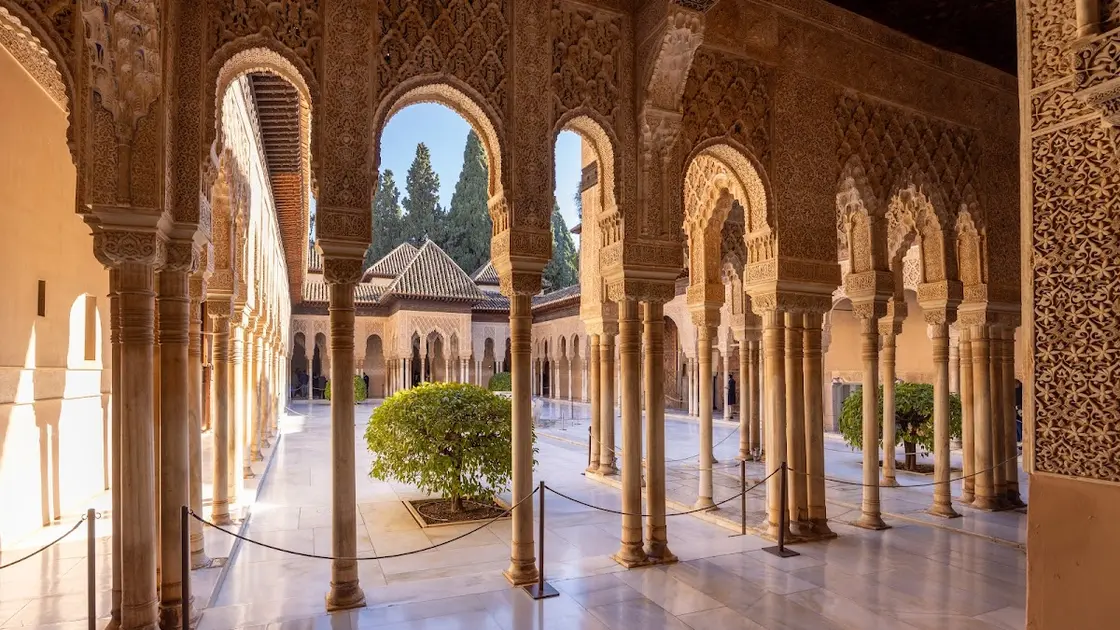
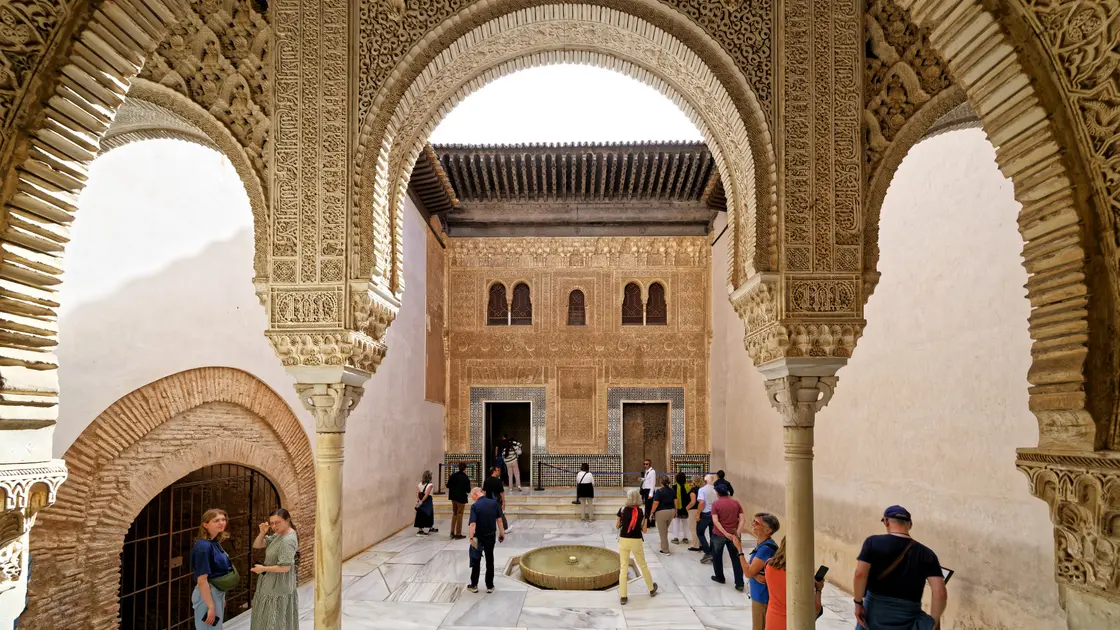
Muhammad V's building programme at the Alhambra in the 1360s–1390s produced the most celebrated rooms in the palace complex: the Court of the Lions, the Hall of the Two Sisters, and the Hall of the Abencerrajes.[4] All three carry extensive Arabic verse inscriptions, and the majority of those verses are Ibn Zamrak's.[1]
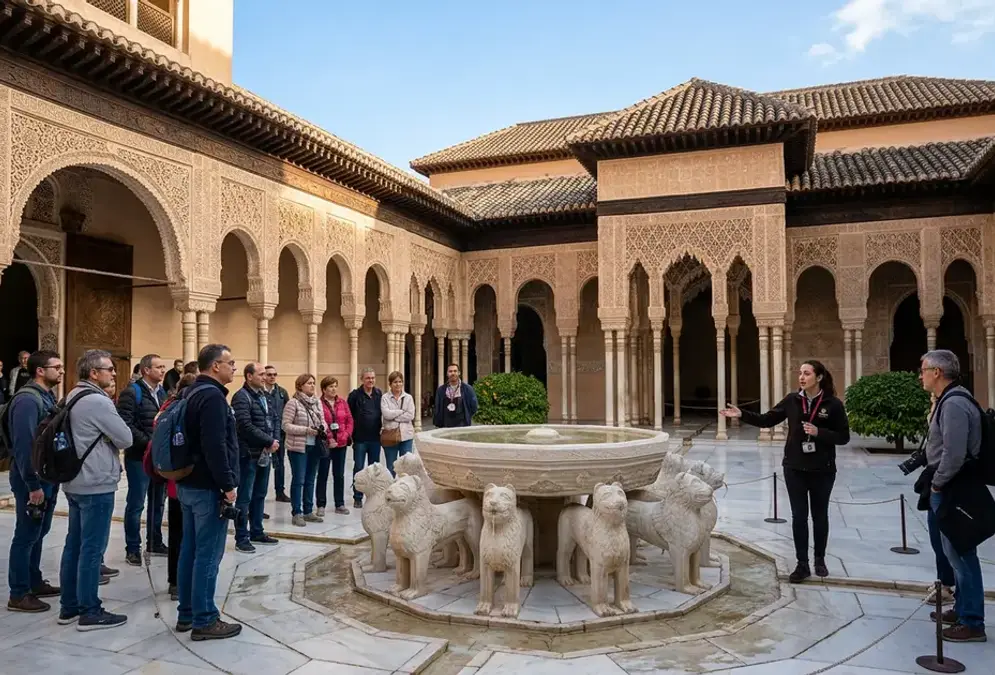
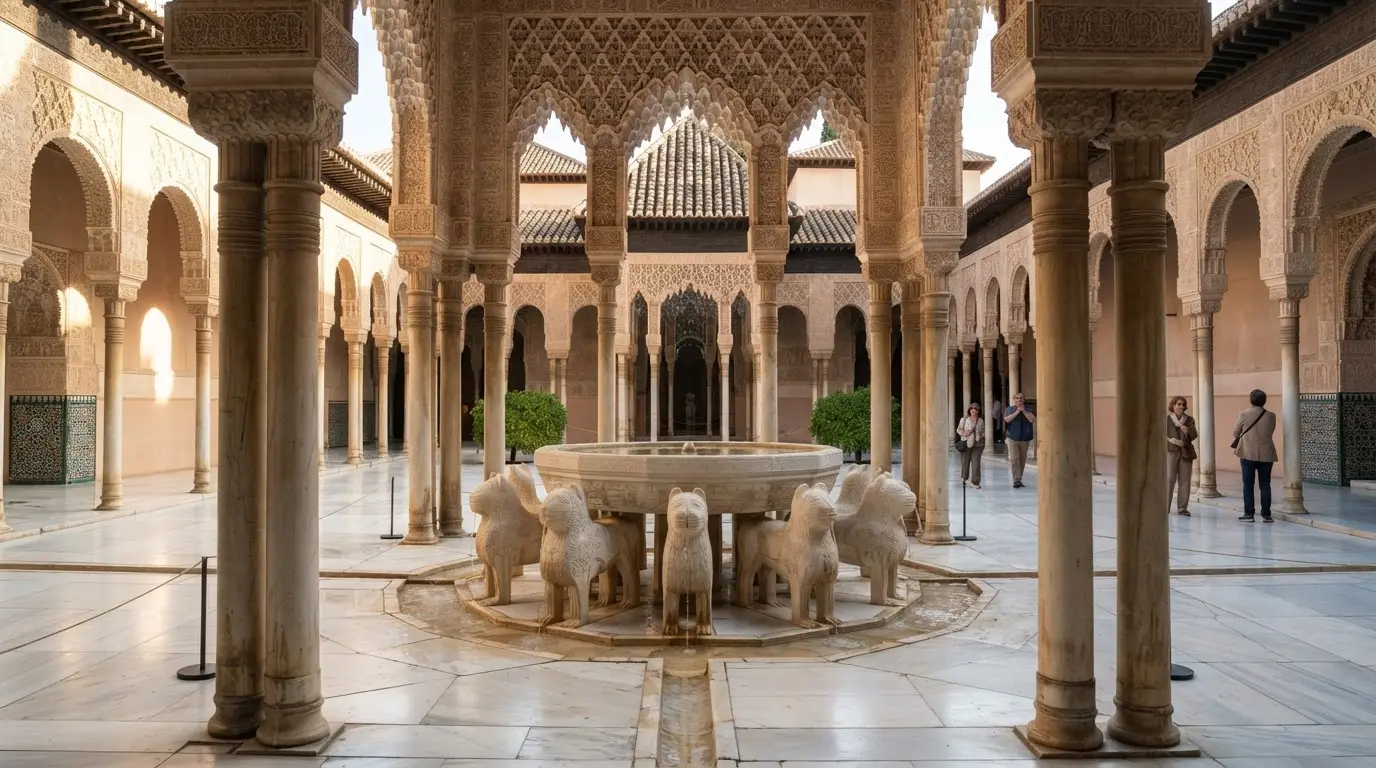
The system was deliberate. A Nasrid palace room was not finished when the plasterwork was smooth and the tiles were laid. It was finished when the words were in place. The inscriptions ran along the walls in continuous bands, framing arches, circling fountain basins, climbing into the muqarnas vaulting. Thuluth script was carved by craftsmen into still-damp stucco, with the text composed in advance and cut to fit each available register. In the Court of the Lions, the inscription on the fountain basin is a casida of 24 lines in which Ibn Zamrak addresses the water directly, describing the lions as guards whose mouths release a stream that functions as a sword, a river, and a gift from the sultan's generosity.[2]
The poem says something more interesting than standard royal flattery. Ibn Zamrak addresses the basin in the second person: it is the thing being spoken to. The lions are described as an army waiting in formation, mouths open, releasing water rather than roaring. The water runs in channels from the central basin to the four surrounding galleries, and Ibn Zamrak describes the hydraulic system in terms mixing military imagery with theological imagery. The water is a sword that does not cut. It is a gift distributed from the centre to the edges. It mirrors the sultan's rule: power flows outward from a single source and reaches every point equally.
Recommended tours
Tours are selected for quality, not commission. We earn a small fee if you book — at no extra cost to you.
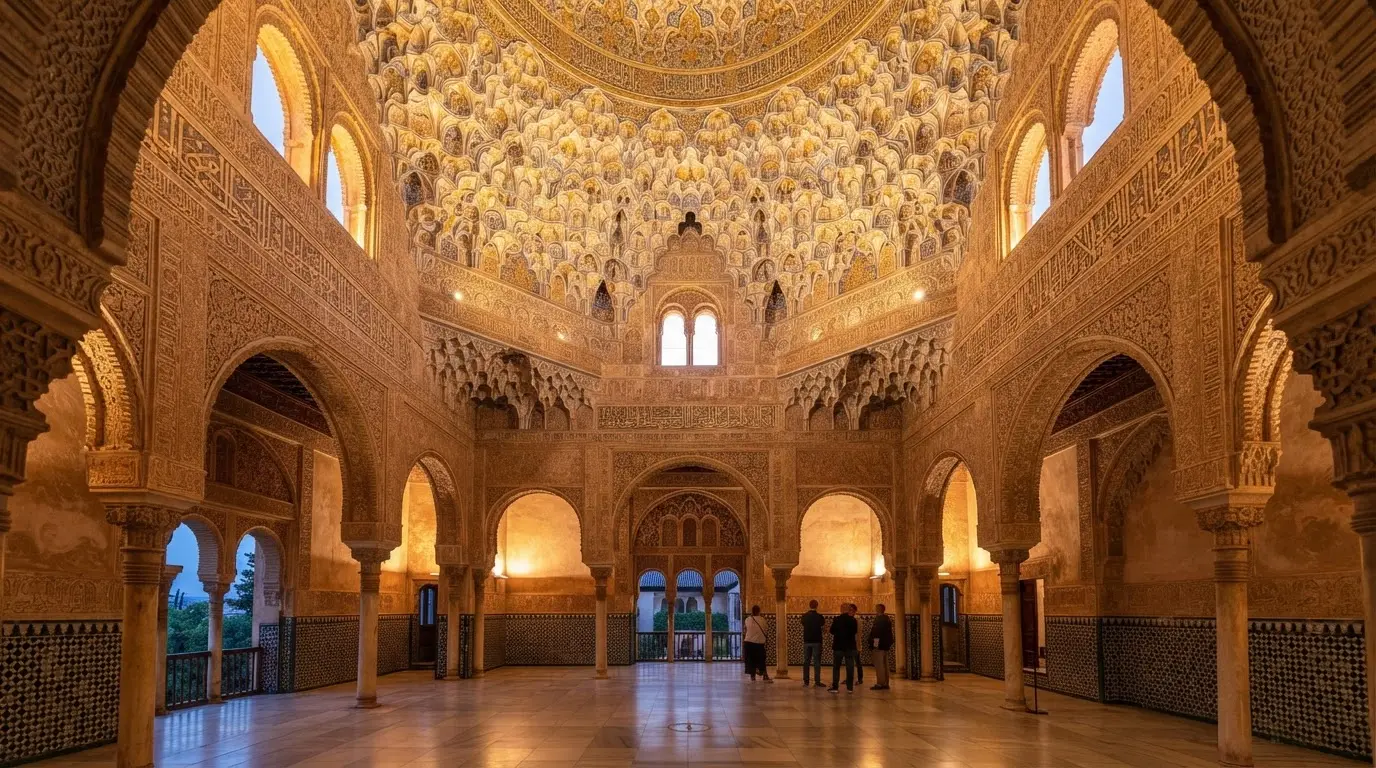
The Hall of the Two Sisters carries what may be the most accomplished of all his surviving palace poems. The muqarnas dome above (more than 5,000 individual plaster cells arranged into a honeycomb that seems to rotate if you stare at it long enough — a three-dimensional projection of the same girih geometry governing the tile floors below, as the architecture-lovers' geometry guide explains) is encircled by lines in which Ibn Zamrak compares the hall to a garden, to the sky, to paradise itself.[2] One passage, translated by Emilio García Gómez, the 20th-century Spanish scholar who spent decades on Andalusian poetry, runs: Moreover we do not know of any other garden / more pleasant in its freshness, more fragrant in its surroundings, / or sweeter in the gathering of its fruits.[7]
These were not modest claims. The poem argues that the hall surpasses anything comparable in the world, that the sultan who built it produced something without precedent. That is conventional panegyric hyperbole; every court poet wrote it. What distinguishes Ibn Zamrak's version is the precision with which the poem maps onto the architecture. The lines about the dome describe the dome. The lines about the fountain describe what the fountain actually does. He was not composing generic praise-poetry to be filed in a divan; he was writing to a specific physical space, measuring his lines against its proportions.
The Diwan and what survives
Ibn Zamrak's Diwan, his collected poetry, survives in manuscript form, which makes him unusual among medieval Granadan poets.[1] Much Andalusian Arabic verse was lost: manuscripts dispersed after the Reconquista, libraries were destroyed or transported to North Africa, and the chain of transmission for Arabic literary texts from the Iberian Peninsula was broken in ways it was never fully broken for Latin or Hebrew texts from the same region.
The Diwan was studied seriously in the 20th century primarily through the work of García Gómez, whose translations and commentaries in the 1940s–1960s brought Ibn Zamrak to the attention of scholars outside the Arabic literary tradition.[7] Before García Gómez, Ibn Zamrak was a name that appeared in medieval Arabic biographical dictionaries and in the margins of studies of the Alhambra; after him, there was a body of translated work that non-Arabic readers could assess. James Monroe, an American scholar of Andalusian literature, extended this work in subsequent decades.[6]
The palace inscriptions themselves are the most widely read of his poems in a literal sense: millions of visitors walk past them every year. Whether any of those visitors read Arabic is another question. For those who do not, the inscriptions function as pattern — beautiful, clearly intentional, obviously important, but opaque. Audio guides available at the Alhambra provide translations of selected passages, and some panels near the inscriptions carry transliterations or translated excerpts. The full texts are in specialist publications.
The Hall of the Abencerrajes, the room to the south of the Court of the Lions whose star-vaulted ceiling has been photographed perhaps more than any other single architectural detail in Spain, also carries Ibn Zamrak inscriptions, though they are less studied than those in the Hall of the Two Sisters.[5] The room takes its name from a legend about a massacre of the Abencerrajes clan whose blood supposedly stained the central fountain basin red. The staining is iron oxide in the marble, not blood, but the story has proven durable.
Death, legacy, and the half-life of a court poet
Ibn Zamrak was killed in summer 1393, on the orders of Sultan Muhammad VII, who had taken the throne in 1392.[1] The exact charge is unclear from the sources. Some mention heresy, some mention political conspiracy, some suggest the elimination was simply precautionary: a new sultan removing a powerful figure whose loyalty was to the previous regime. He was over sixty years old.
The parallel with Ibn al-Khatib is too obvious to ignore. Both men were poet-viziers of the highest rank. Both were killed by the state they served, on charges that were at least partly fabricated, in circumstances that benefited their immediate successors. Ibn Zamrak had seen this happen to his own mentor and had participated in the process. He cannot have been surprised that the same structure eventually turned on him. Whether he had time to reflect on the irony is not recorded.
His Diwan circulated in North Africa after 1492 alongside other manuscripts that left the peninsula with the last Andalusians. His palace inscriptions survived because they were built into walls that proved too useful to demolish: the Christian monarchs who took Granada in 1492 chose to live in the Nasrid palaces rather than replace them, and later Habsburg builders added a new Renaissance palace alongside but did not gut the older rooms.[5] The Arabic inscriptions remained because the architecture remained.
Where does this leave Ibn Zamrak for a visitor to the Alhambra today? He is the author of much of what you are looking at. The Court of the Lions fountain inscription, the great dome poem in the Hall of the Two Sisters, several passages in the Hall of the Abencerrajes: all of it was composed for specific rooms in a specific political context in the 1360s–1390s, during the reign of a sultan whose rule he supported and whose propaganda he manufactured.[1] The poems outlasted the sultan, the emirate, and the poet himself by more than six hundred years. That is a reasonable definition of literary survival, and it happened entirely by accident.
Visiting the inscriptions: what to look for
The Alhambra ticket system requires advance booking; same-day admission is rarely available from spring through early autumn, and the timed entry slots for the Nasrid Palaces fill weeks ahead in high season.[5] The inscriptions are in the Nasrid Palaces section, which has a specific timed slot separate from the gardens and the Alcazaba.
In the Court of the Lions, the inscription you want is on the fountain basin itself, a low circular basin of white marble surrounded by the twelve carved lions. The Arabic text runs around the rim in a continuous band. You need to crouch or lean in to read it at close range; most visitors photograph the lions from a standing distance and miss the inscription entirely. The courtyard gets crowded quickly during a slot, so arriving at the start of your timed window gives you three to five minutes at the fountain before the next group fills in.
Over 600 years
The span between Ibn Zamrak's death in 1393 and today. His verses carved into the stucco of the Alhambra have survived the fall of the Nasrid emirate, the Spanish Reconquista, and five centuries of restoration work, making them among the oldest surviving in-situ court poetry anywhere in Europe.[1]
The Hall of the Two Sisters is through the archway to the north of the courtyard. Look up immediately on entering. The muqarnas dome is above you, and the inscriptions run in bands at the base of the dome and around the walls below. The room is deliberately dim; the light filters in from the sides, not from a central opening, and the carved text seems to disappear into the surface when the light is low. Late morning, when direct light enters the lateral windows, is the best time to see the inscriptions clearly.
For translations, the Alhambra's official audio guide includes selected passages from the Court of the Lions casida. The most accessible scholarly source in English remains the translations in Robert Hillenbrand's Islamic Architecture and in various papers by James Monroe, available through JSTOR.[7] García Gómez's Spanish translations, published in the 1940s–60s, are the definitive scholarly versions but require reading Spanish.
Spend at least 90 minutes in the Nasrid Palaces if the inscriptions interest you. Most visitors allocate the minimum and walk through the Hall of the Two Sisters in under five minutes. The architecture rewards stillness: standing in one place and reading the walls, rather than moving between rooms, is how Ibn Zamrak intended the poems to be experienced.
Frequently asked questions
Who was Ibn Zamrak?
Ibn Zamrak (1333–1393) was the chief court poet and vizier of the Nasrid emirate of Granada. He studied under Ibn al-Khatib, the great 14th-century polymath, and became the principal literary voice of Sultan Muhammad V's court. His casidas are carved into the stucco of the Alhambra's Nasrid Palaces — in the Court of the Lions, the Hall of the Two Sisters, and the Hall of the Abencerrajes. He was assassinated in 1393 on the orders of Sultan Muhammad VII.
Where can I see Ibn Zamrak's poems in the Alhambra?
The main inscriptions are in three locations within the Nasrid Palaces: the fountain basin of the Court of the Lions (a 24-line casida running around the marble rim), the walls and muqarnas dome of the Hall of the Two Sisters, and passages in the Hall of the Abencerrajes. All three are in the timed Nasrid Palaces section of the Alhambra ticket. The Court of the Lions inscription is visible at close range around the fountain basin; you need to lean in to read it.
What do the Alhambra's Arabic inscriptions say?
The inscriptions by Ibn Zamrak combine praise of the sultan, descriptions of the architecture, and theological imagery. In the Court of the Lions, the poem addresses the fountain basin directly, describes the lions as guards whose mouths release water like a sword, and presents the hydraulic system as a metaphor for royal generosity. In the Hall of the Two Sisters, the verse compares the room to a garden, the Pleiades, and paradise. The Alhambra's audio guide includes translated excerpts of selected passages.
Did Ibn Zamrak betray his teacher Ibn al-Khatib?
Ibn Zamrak participated in the political proceedings against his mentor Ibn al-Khatib around 1375, when the older man was in exile in Fes and faced charges including heresy. Ibn al-Khatib died in prison there. Ibn Zamrak's exact role in those proceedings is not fully documented in surviving sources, but he did benefit from his teacher's fall, becoming chief vizier afterwards. Eighteen years later, Ibn Zamrak was himself killed by the Nasrid court in similar circumstances.
How should I book the Alhambra to see the inscriptions?
Book the Nasrid Palaces timed entry slot well in advance — at least three to four weeks ahead from late March through October, and often longer in July and August. Tickets sell out on the official Alhambra booking site (alhambratickets.com) and through the Patronato de la Alhambra. The Nasrid Palaces slot is separate from the gardens and Alcazaba admission. Plan to arrive at your slot start time to have a few minutes at the Court of the Lions fountain before crowds fill in.
What happened to Ibn Zamrak's poetry after 1492?
Ibn Zamrak's Diwan (collected poems) circulated in manuscript form after the fall of Granada in 1492, partly carried to North Africa with the last Andalusians. The palace inscriptions survived because the Nasrid Palaces themselves survived — the Catholic Monarchs chose to preserve the buildings, and later Habsburg rulers added a new palace alongside rather than demolishing the old rooms. The inscriptions were studied seriously in the 20th century by Spanish scholar Emilio Garcia Gomez, whose translations brought Ibn Zamrak's work to wider academic attention.