The Maristan of Granada: Islamic Hospital That Vanished
Granada's 14th-century Maristan was Islamic Spain's first hospital, built by Nasrid sultan Muhammad V in 1367. Its remains quietly reopened to visitors in 2023.
Seven years resident in Granada. Specialist in Nasrid architecture, Al-Andalus history, and Andalusian walking routes.
Updated Published
In 1367, Nasrid sultan Muhammad V opened the first Islamic hospital on the Iberian Peninsula: the Maristan of Granada, a free clinic funded by a charitable endowment that treated anyone who walked through its doors, regardless of religion. Patients recovered to the sound of running water from two marble lion fountains flanking a therapeutic bathing pool, alongside music, poetry recitation, and carefully prescribed diets. Almost entirely demolished in 1843 and forgotten for nearly two centuries, the surviving fragments reopened to visitors in January 2023 after a 1.3 million euro restoration.[1]
In this article
Jump to a section
⌄
The hospital Muhammad V built
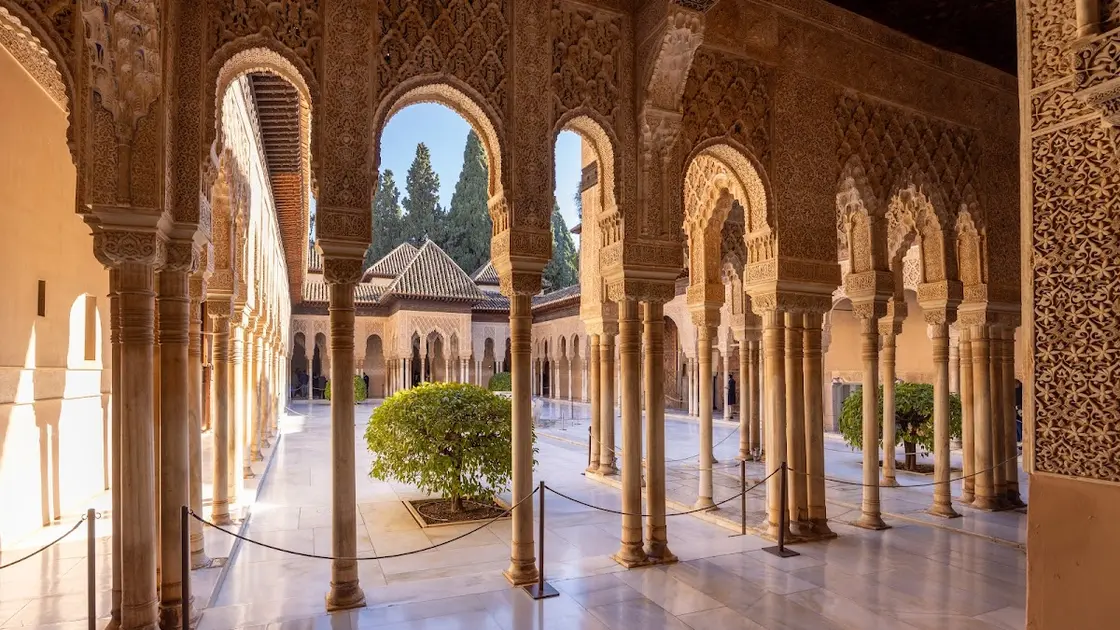
Muhammad V was the most prolific builder of the Nasrid dynasty: he gave Granada the Court of the Lions at the Alhambra, the great muqarnas domes, and the inscription programme that turned palace walls into poetry. But while the Alhambra works were still underway, he directed substantial funds toward something entirely different: a hospital for the city below the hill.[1]
The Maristan, from the Persian bimaristan (meaning "place of the sick"), was constructed between 1365 and 1367 on the north bank of the Darro River in the lower Albaicín quarter, a few steps from the surviving Arab baths of El Bañuelo.[2] The building measured 38 metres by 26.5 metres, organised around a central courtyard of 26 by 15 metres with a therapeutic bathing pool at its centre.[3] Steps descended into the pool. Patients did not merely look at the water; they entered it.
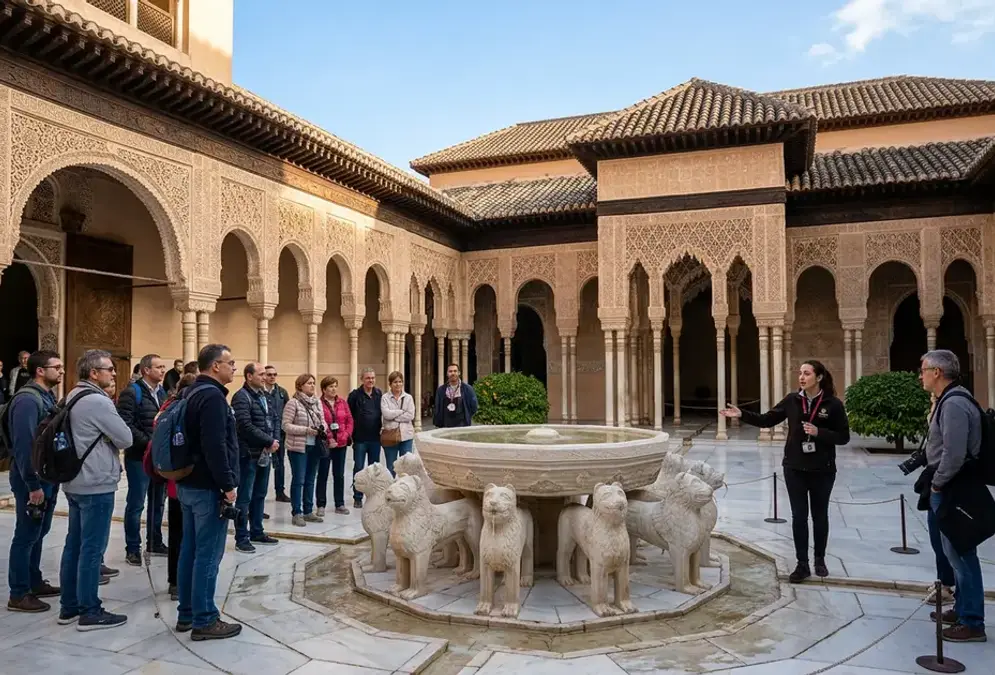
Flanking the pool stood two marble lion fountains, carved from the same Macael marble that supplied the Alhambra's Court of the Lions a decade later. One lion measures 159 centimetres high, the other 149 centimetres.[4] In Islamic hospital architecture, the sound and sight of running water were considered part of the treatment, a sensory intervention as deliberate as any medicine dispensed in the wards.
38 × 26.5 metres
The Maristan was larger than most private residences of the Nasrid nobility. Its 26 × 15 metre courtyard alone exceeded the footprint of many contemporary houses in the lower Albaicín. The building was a statement: a ruler's wealth channelled into public health, not another palace.
The entire operation was funded by a waqf, a charitable endowment under Islamic law that made treatment free for all patients regardless of religion, race, or ability to pay.[5] Muhammad V had spent his exile in Fez between 1359 and 1362, where he saw the Marinid dynasty's sophisticated bimaristans firsthand. The Granada Maristan was almost certainly modelled on what he encountered there.[6] His vizier, Ibn al-Khatib, the polymath who wrote one of the earliest known treatises on plague transmission, would have shaped the medical thinking behind the project.
How the Maristan treated its patients
The Maristan began as a general hospital but gradually specialised in the treatment of mental illness, making it one of Europe's earliest known psychiatric hospitals.[7] The first institution dedicated purely to psychiatric care, the Hospital de los Inocentes in Valencia, did not appear until the early 15th century, several decades after the Granada Maristan had already been treating patients with mental disorders.
The treatment approach was holistic in a sense that would not reappear in European medicine for centuries. Patients received:
Music therapy: musicians performed in the courtyard and wards, their melodies carrying through the building alongside the sound of the fountains
Hydrotherapy: the central pool was not ornamental; patients bathed in it, the temperature and flow of water calibrated as part of their regimen
Prescribed diets: each patient's meals were tailored to their condition, a practice that required a kitchen staffed with cooks who understood the medical rationale behind their work
Poetry and storytelling: the sound of spoken verse, already central to Nasrid court culture, was directed at patients as a form of mental stimulation and comfort
Compassionate care: the waqf charter that funded the Maristan specified kind treatment as an obligation, not a recommendation
This was not folk medicine dressed up in architecture. It rested on the Islamic medical tradition of physicians like al-Razi (Rhazes) and Ibn Sina (Avicenna), whose works on mental health, dietary therapy, and the use of music in treatment circulated throughout the Islamic world and were available in Granada's libraries. Ibn al-Khatib, Muhammad V's vizier, had studied these texts, and his own writings on contagion — notably his assertion during the Black Death that plague spread through contact and not divine will — show a mind working well outside medieval conventions.[8]
The surviving artefacts: lions and inscription
Three objects from the Maristan survive, all now housed at the Alhambra Museum on the Sabika hill.[7] Together they are the only direct physical evidence of what the hospital looked like and what its founder intended.
The two marble lions, one 159 centimetres high and the other 149 centimetres, stood on either side of the therapeutic pool in the central courtyard.[4] They were carved in the same Nasrid workshop tradition that produced the 12 lions of the Court of the Lions at the Alhambra, completed around 1380. The Maristan lions are slightly rougher in finish than their more famous counterparts. They were made for a working hospital, not a royal reception hall. But the shared workshop, shared marble source, and shared design vocabulary make the connection unmistakable. If you want to see what Nasrid craftsmanship looked like when it was applied to a public institution rather than a palace, these lions are the answer.
The foundation inscription is a rectangular marble slab measuring 179.5 by 95.5 centimetres, carved with 26 lines of angular Kufic script.[8] The text is remarkable not only for its content but for its frankness. It describes the Maristan as "a great work, never before accomplished since the Muslims have been in this country" and states that Muhammad V built it "as proof of his great mercy for the weakest and sickliest of Muslims."[7] This is not the language of standard Nasrid court flattery, which tended toward the elliptical and the poetic. It is declarative, even political. Muhammad V was telling Granada that he had done something no previous ruler had managed, and that his legitimacy rested partly on how he treated the vulnerable.
The inscription also confirms the date of foundation: the month of Safar in the year 767 of the Hijri calendar, which corresponds to October–November 1365 in the Gregorian calendar. That places the start of construction two years before its completion in 1367.
After 1492: four centuries of repurposing
When Granada fell to Ferdinand and Isabella in January 1492, the Maristan did not disappear overnight. Its decline was slow, pragmatic, and almost total, a process of erasure by repurposing that left almost nothing standing.
The timeline runs like this:
Timeline
1365–1367
Construction
Muhammad V builds the Maristan as a waqf-funded hospital in the lower Albaicín.
1502
Royal mint
The Catholic Monarchs convert the building to a Casa de la Moneda.
16th century
Mercedarian friary
The site becomes a religious house, erasing its Islamic character.
1843
First demolition
Almost the entire complex is demolished. Only a southern gallery survives.
1984
Second demolition
Further structures removed. The site is largely forgotten.
2022–2023
Restoration and reopening
A 1.3 million euro EU-funded restoration is completed. The site opens to visitors in January 2023.
1502: the Catholic Monarchs converted the Maristan into a royal mint (Casa de la Moneda), stripping its medical function entirely. The therapeutic pool was filled in, the wards repurposed for coin production.[1]
Later 16th century: the building passed to the Mercedarian order, who used it as a friary. Religious use saved the structure from demolition but erased its Islamic character: chapels replaced wards, altars replaced fountains.
18th–19th centuries: the site became a winery, then tenement housing. Each conversion removed more of the original fabric. By the early 19th century, the Maristan was unrecognisable: a crowded residential block built inside the shell of a hospital that had itself been built inside an earlier building.
1843: almost the entire complex was demolished. What remained was a single southern gallery and fragments of the courtyard foundations, buried under later construction.
1984: a second wave of demolition removed more of the surviving structure. By this point, most Granadinos walking past the site on their way to El Bañuelo had no idea a hospital had ever stood there.
The pace of destruction was not the work of vandals. It was the result of a city growing over its own past, repurposing buildings until the original form was unreadable, then clearing them to make way for something newer. In most cities, that is how history disappears.
The 2022 restoration and what you see today
In 2022, a 1.3 million euro restoration funded by European Union structural funds was completed, and in January 2023 the Maristan site opened to the public for the first time.[1] The restoration is archaeological rather than reconstructive. It does not attempt to rebuild what was lost. Instead, it makes the surviving fragments legible.
What you see when you visit:
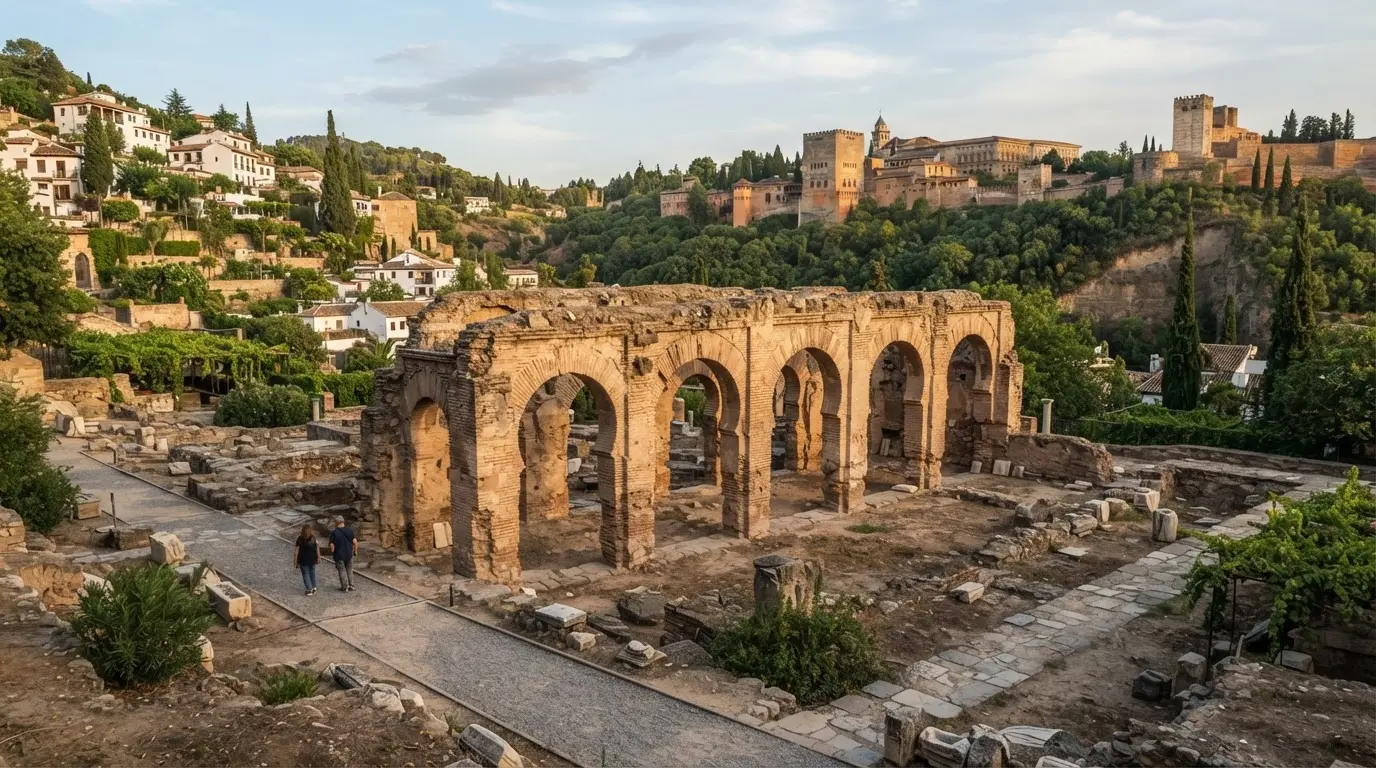
The southern gallery, a row of brick arches that is the only substantial piece of Nasrid-era architecture still standing on the site. These arches once opened onto the central courtyard. Today they face a quiet excavation.
The foundations of the therapeutic pool, including the recess for the stairs that patients descended into the water. You can stand at the edge of what was once a working hydrotherapy basin.
An 11th-century well, discovered during the restoration works and predating the Maristan itself. It confirms that the site was in use long before Muhammad V chose it for his hospital.
The mint-era furnaces, brick structures that date from the building's 16th-century conversion into a royal mint. They are the most visible trace of the post-1492 repurposing.
The site is small; you can walk its full extent in ten minutes. But what you are walking through is the sole surviving Nasrid-era hospital site in Spain, and one of the very few Islamic medical institutions in Europe whose physical footprint can still be traced. The El Bañuelo Arab baths sit a two-minute walk down the street. Together, the two sites tell a story about water and healing in Nasrid Granada that neither can tell alone.
Why the Maristan matters now
The Maristan is easy to overlook. It has no dome, no tilework, no inscription visible in situ. It does not photograph well compared to the Alhambra's muqarnas ceilings or the Generalife's water channels. For most of its recent history, it was not even visible at all.
But the Maristan represents something the Nasrid dynasty rarely gets credit for: public infrastructure. The Alhambra and the Generalife are palaces, monuments to a ruling family's wealth and power. The Maristan was the opposite. It was a building designed for the sick, the poor, and the mentally ill, funded by a waqf that required its doors to stay open regardless of who walked through them.
This was not charity in the modern sense. The waqf system was a legal and financial mechanism that made hospitals self-sustaining. A waqf endowment typically consisted of revenue-generating property (agricultural land, commercial buildings, bathhouses) whose income paid for the institution's operations in perpetuity. The Maristan did not depend on the sultan's goodwill year after year. Its funding was structural.
The contrast with European hospitals of the same period is instructive. In 14th-century Christendom, hospitals were almost always religious foundations: monasteries or convents that treated the sick as an act of mercy, with medical care often secondary to spiritual preparation for death. The Maristan was different: it was a secular institution (in the sense that its funding came from property endowments, not clerical budgets), staffed by paid physicians and surgeons, and organised around medical treatment rather than pastoral care.
The Maristan also forces a rethinking of what the Nasrid period produced. The Nasrid dynasty is remembered for the Alhambra, rightly, because it is the finest Islamic palace complex in the Western world. But Muhammad V also funded Granada's Albaicín cisterns, the network of underground reservoirs that still supply the neighbourhood, and built a hospital at the same time he was building the Court of the Lions. The same ruler, the same treasury, the same decade. A hospital that treated mental illness and charged no fees is not the work of a ruler who was only interested in his own pleasure.
The tragedy is that almost none of it survived. Demolition in 1843 and 1984 removed all but traces. But the traces are there now, visible for the first time in nearly two centuries, a few streets down from the baths at El Bañuelo and a ten-minute walk from the Darro. You can stand at the edge of the pool foundations and hear the river below, just as patients did in 1367.
Frequently asked questions
What was the Maristan of Granada?
The Maristan of Granada was the first Islamic hospital on the Iberian Peninsula, built between 1365 and 1367 by Nasrid sultan Muhammad V in the lower Albaicín quarter. It was a bimaristan, a hospital funded by a charitable endowment (waqf) that provided free medical care to all patients regardless of religion or wealth. It began as a general hospital and gradually specialised in the treatment of mental illness, making it one of Europe's earliest known psychiatric hospitals.
Who built the Maristan and why did he build it?
The Maristan was built by Muhammad V, the Nasrid sultan who also commissioned the Court of the Lions at the Alhambra. He founded it during a period of intense construction activity, likely inspired by the Marinid bimaristans he had seen during his exile in Fez (1359–1362). The hospital was funded by a waqf, an Islamic charitable endowment that made healthcare free and self-sustaining. The foundation inscription states he built it "as proof of his great mercy for the weakest and sickliest of Muslims."
What happened to the Maristan after 1492?
After Granada fell to the Catholic Monarchs, the Maristan was converted into a royal mint in 1502. It later became a Mercedarian friary, then a winery, then tenement housing. The building was almost entirely demolished in 1843, with a second wave of demolition in 1984. Only a single southern gallery and fragments of the courtyard foundations survived. A 1.3 million euro EU-funded restoration completed in 2022, and the site opened to visitors in January 2023.
What treatments did the Maristan offer?
The Maristan offered a holistic treatment programme that included music therapy (musicians performed in the courtyard and wards), hydrotherapy (patients bathed in the therapeutic courtyard pool), individually prescribed diets, poetry recitation and storytelling, and compassionate care mandated by the waqf charter. This approach drew on the medical writings of physicians like al-Razi and Ibn Sina, whose works on mental health, dietary therapy, and music in treatment were well known in Nasrid Granada.
Was the Maristan really Europe's first psychiatric hospital?
The Maristan was one of Europe's earliest known psychiatric hospitals, though it began as a general hospital before gradually specialising in mental illness treatment. The first institution in Europe dedicated purely to psychiatric care, the Hospital de los Inocentes in Valencia, opened in the early 15th century, several decades after the Maristan was already treating patients with mental disorders. The Maristan's approach to mental illness, which emphasised sensory environment and compassionate care rather than restraint, was notably advanced for its time.
Where are the Maristan lion fountains now?
The two marble lion fountains that flanked the Maristan's therapeutic pool are now housed in the Alhambra Museum, on the Sabika hill. One measures 159 centimetres high, the other 149 centimetres. They were carved from Macael marble in the same Nasrid workshop tradition that produced the 12 lions of the Court of the Lions. The foundation inscription, a 179.5 by 95.5 centimetre marble slab with 26 lines of Kufic script, is also displayed at the Alhambra Museum.
Can you visit the Maristan site today?
Yes. The Maristan site reopened to visitors in January 2023 after a 1.3 million euro restoration. What you can see includes the surviving southern gallery with its original brick arches, the foundations of the therapeutic bathing pool, an 11th-century well discovered during restoration, and the mint-era furnaces from the building's 16th-century conversion. The site is small; you can walk it in about ten minutes. It sits in the lower Albaicín, a two-minute walk from the El Bañuelo Arab baths.
Where was the Maristan located in Granada?
The Maristan stood in the lower Albaicín quarter of Granada, on the north bank of the Darro River, very close to the surviving El Bañuelo Arab baths. The location was deliberately chosen: the Albaicín was Granada's most densely populated district in the 14th century, and proximity to the river made water supply for the therapeutic pool practical. The site is roughly a ten-minute walk downhill from the Plaza Nueva, following Calle del Bañuelo toward the river.
What is the foundation inscription and what does it say?
The foundation inscription is a marble slab measuring 179.5 by 95.5 centimetres, carved with 26 lines of Kufic script, now displayed at the Alhambra Museum. The text describes the Maristan as "a great work, never before accomplished since the Muslims have been in this country" and states that Muhammad V built it "as proof of his great mercy for the weakest and sickliest of Muslims." It also confirms the construction date: the month of Safar in the year 767 of the Hijri calendar (October–November 1365).