Sabika Hill first, then a garden behind the palace
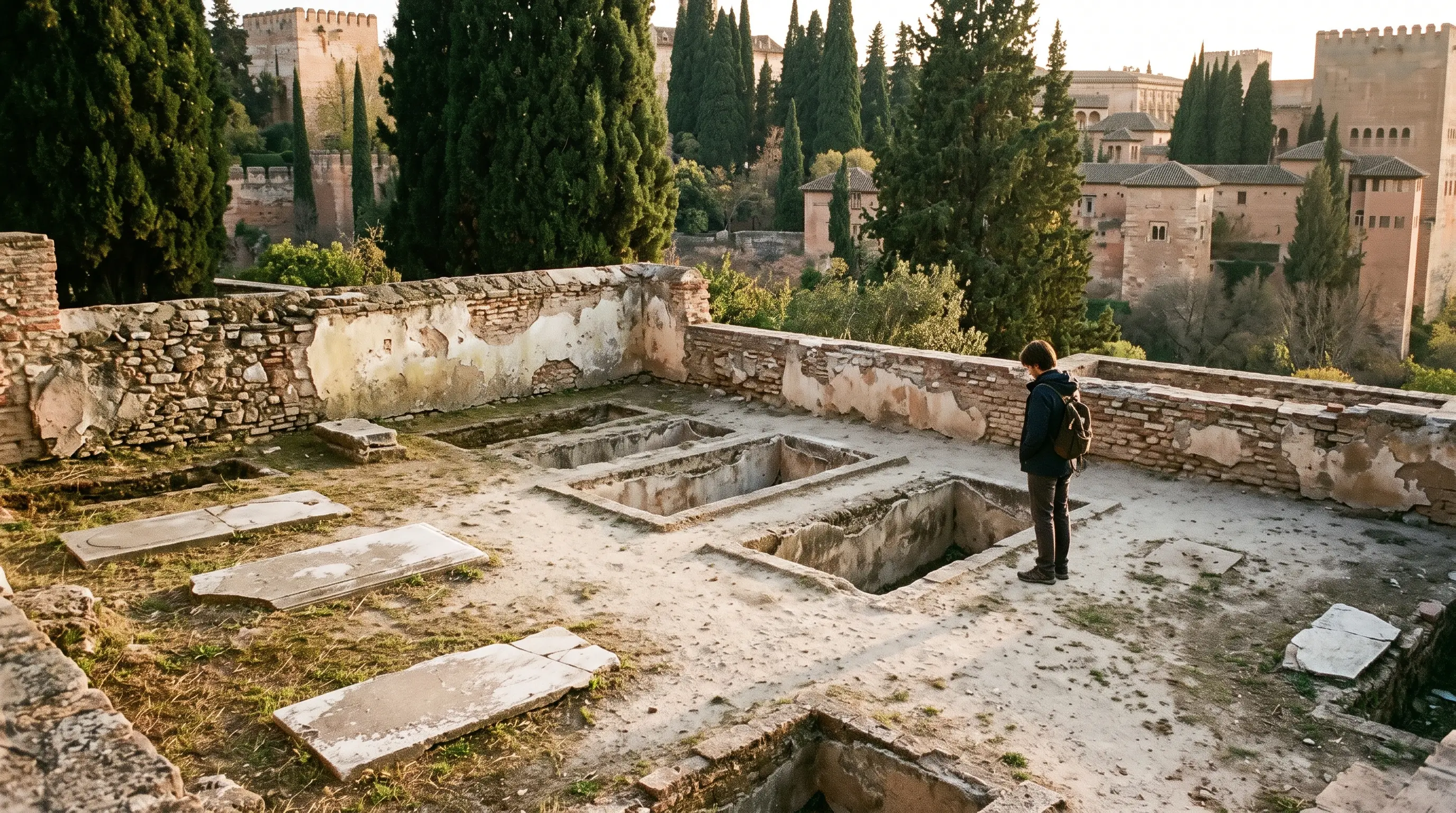
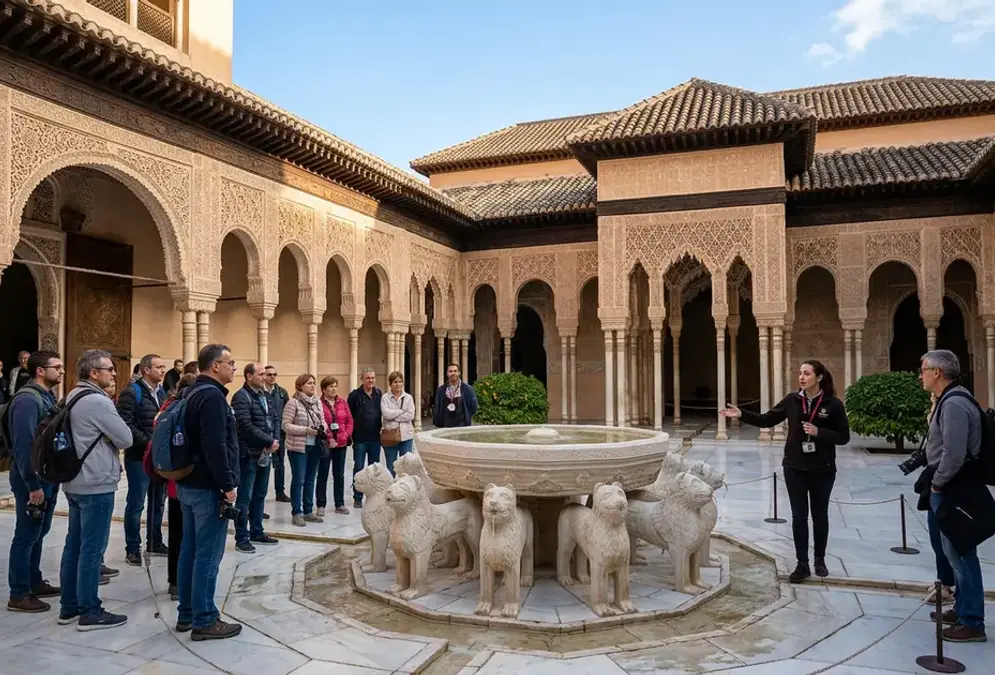
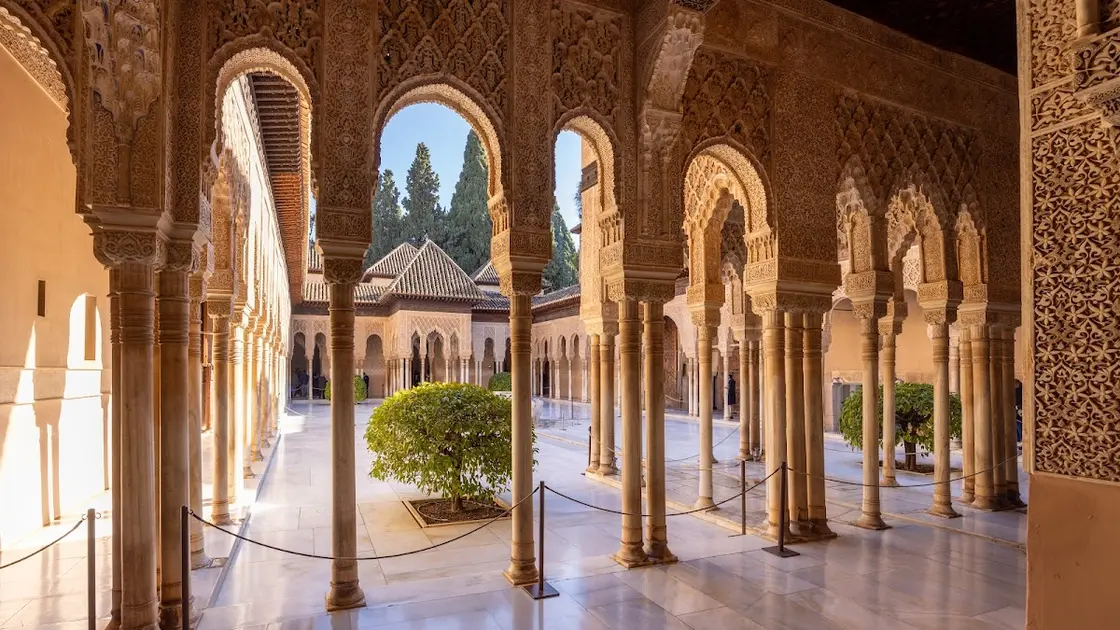
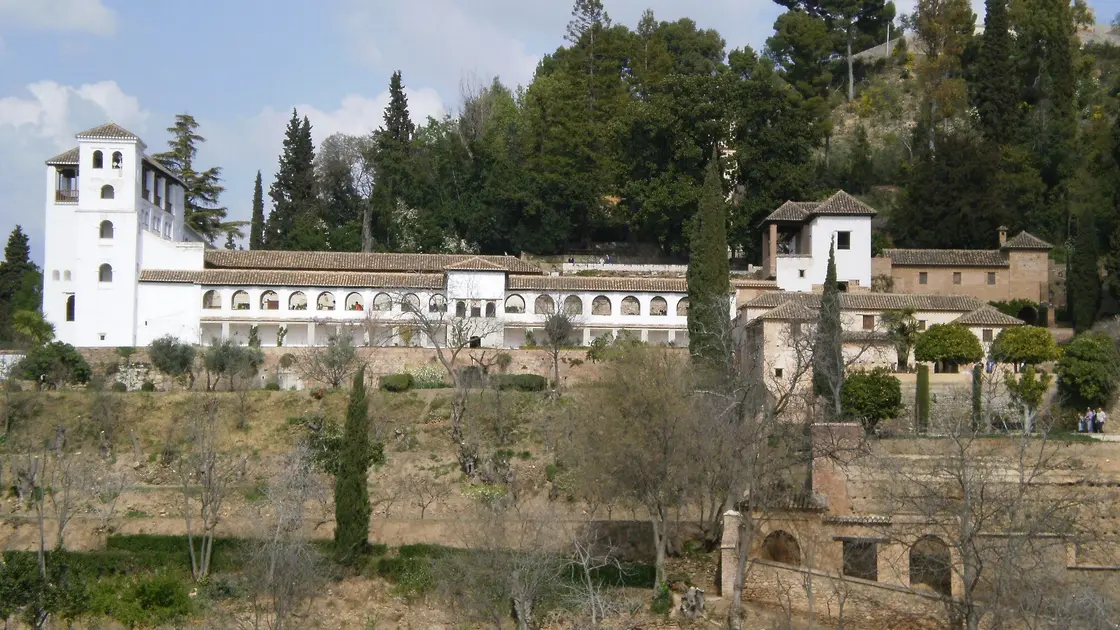
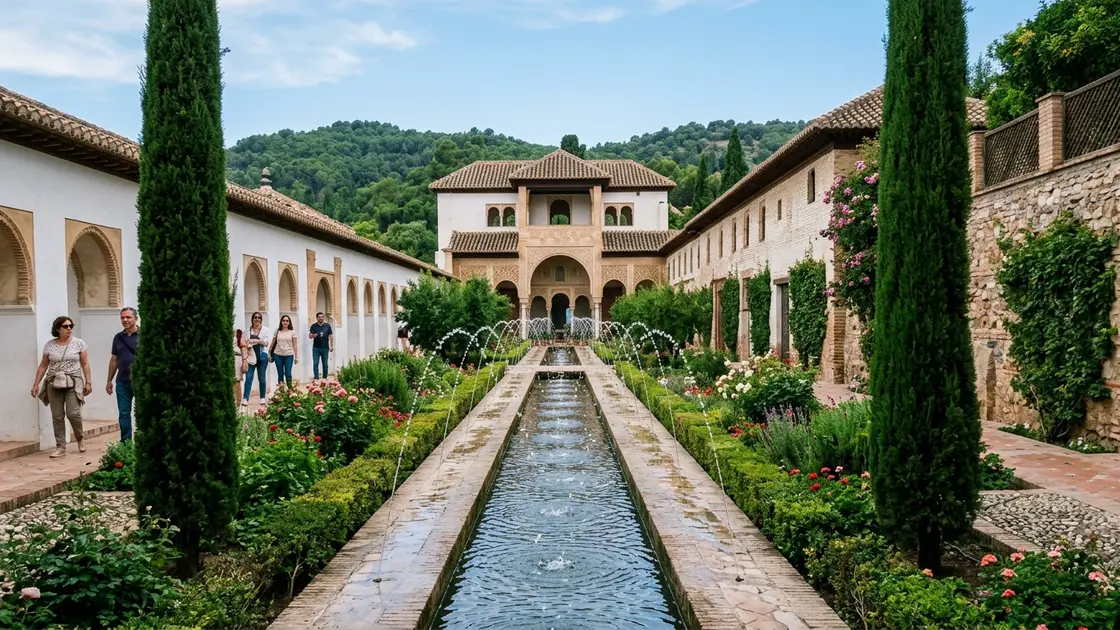
Before the Rawda there was a family cemetery on a platform of Sabika Hill, south of the Alhambra and outside its walls.[33] The Rawda came later, and it is easy to look for in the wrong place. It is not part of the Partal gardens; Calle Real Baja runs between them. A few vestiges survive just behind the Palace of the Lions, the building around the Court of the Lions.[5]
Earlier writers got it wrong too. Until the late nineteenth century, a ribbed dome in the passage between the Court of the Lions and the Partal was taken for the royal burial chapel.[6] The real cemetery lay forgotten close by.
The word itself is a clue. Rawda means garden, yet it was stretched to cover an enclosed burial ground with buildings of its own, set among planted areas.[20] That suits what the excavators later met: less a churchyard than a royal garden with a pantheon among the planting.
Which sultans lay in the Rawda
The order of burials is the argument, and it starts with a disputed founding. Some attribute the Rawda to Ismail I, at the start of the fourteenth century, and others to Muhammad V.[21]
Muhammad II is the knot. Ibn al-Khatib has him, dead in 1302, in an isolated tomb east of the Royal Mosque, in the gardens beside the Royal House,[22] and calls him the first emir buried in the Rawda.[32] Yet Muhammad III, assassinated in January 1314, lay on Sabika Hill in the family pantheon beside al-Ghalib bi-llah, his grandfather.[4][34]
The Patronato suggests why Muhammad II broke the pattern. His burial here, rather than on Sabika Hill, relates to Ismail I's wish to secure his legitimacy on the throne, perhaps by moving the grave into a new pantheon, which would make Ismail the founder.[31]
After Ismail I, it appears, every following sultan was buried in the Rawda rather than on Sabika Hill.[7] The Alhambra's own researchers are careful with names, and the safest ones are these:
- Muhammad IV
- Yusuf I
- Yusuf III
- Muhammad V, possibly
The caution is the point. The Nasrid sultans proclaim themselves on every wall of the palaces, yet for their burials the record is a short list with a "possibly" in it.
Explore nearby · Museum
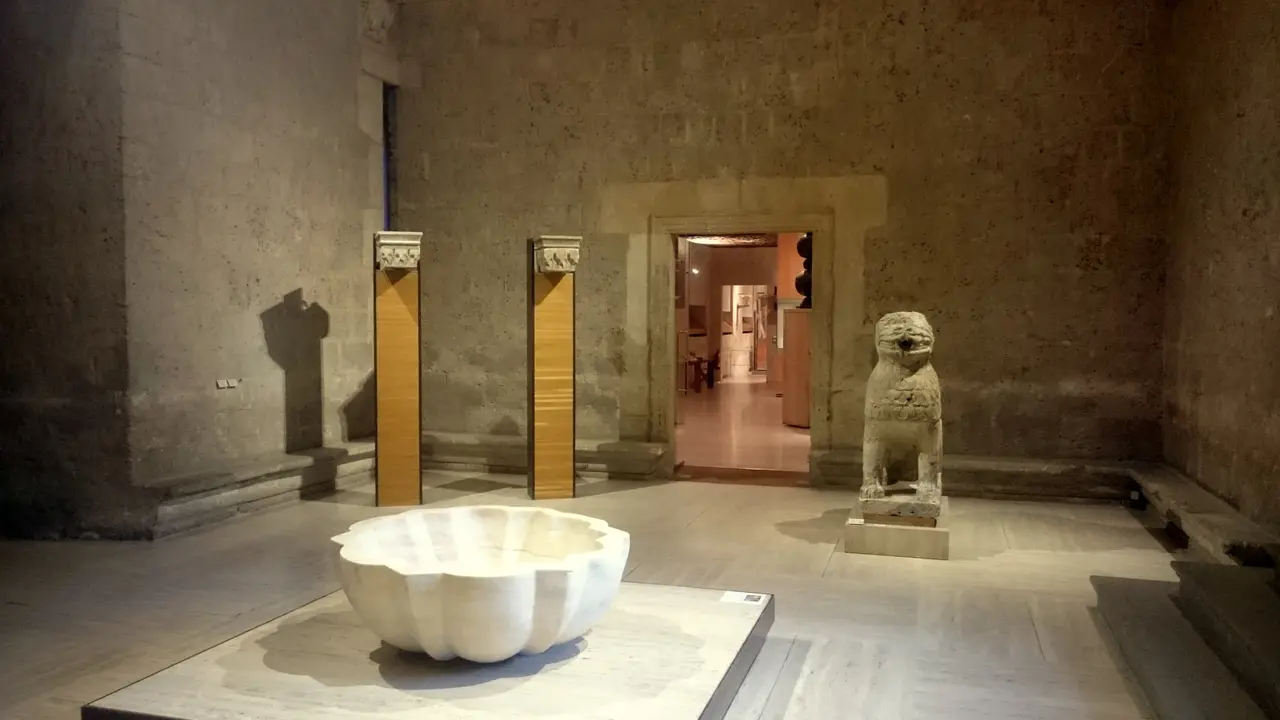
Museo de la Alhambra
Free Islamic art museum inside the Palacio de Carlos V, with Nasrid ceramics, carved stucco, and the Blue Amphora. Essential context for the Alhambra visit.
The plan: one chamber, many pits
At the centre of the Rawda stood a square qubba, the funerary chamber proper, with three tombs below ground level.[24] Around it, in the garden, the excavators later counted about seventy trapezoid pits.[15] Three tombs in the chamber and seventy pits outside is not the picture the word mausoleum suggests.
The contrast with the palaces is sharp. Across the street, the Nasrids covered every surface with poetry and plaster lace for visitors and rivals to read. Here the dynasty's dead left a chamber, a few tombs and rows of pits in the earth, and their names survive on only a handful of slabs.
After the conquest: bones carried off, a cemetery built over
On leaving Granada, Boabdil is said to have exhumed the remains of his ancestors and taken them into exile, to a rauda that his wife, Morayma, owned at Mondújar.[8][40]
Mondújar: where the trail goes cold
The trail ends there, and the paper behind it is thin. Gómez Moreno's 1942 publication of the documents remains the basis for the idea that the remains were moved to Mondújar at all.[30] When a motorway came through, the excavations of 1998 and 1999 found the cemetery already partly destroyed by the old road,[29] along with numerous graves that contained no human remains.[42] Nothing like piles of bones corroborated the idea that the Alhambra's dead lay there.[43] Morayma herself was buried at Mondújar Castle, in the Valle de Lecrín.[41]
Whether the remains were destroyed when the first road was built at Mondújar, or Boabdil went back for them before sailing for Fez, will never be known.[3] He left from the port of Adra in 1493, a year after reaching the Alpujarra.[44] What became of Boabdil's own tomb in Fez is a separate puzzle.
Apartments, ruin and the Palace of Charles V
At home the Rawda met a quieter end. In Castilian times the cemetery served as an apartment building and fell into ruin with the passing of time.[23] Among the works that altered it was, without doubt, the Palace of Charles V.[9] The stretch of the Rawda nearest the palace is the part most affected by its building works,[35] and when Contreras's demolition opened the site, four pits lay exposed in that sector.[36] Four tombstones turned up in 1574, and three of them survive.[10]
That is a strange fate for a dynastic cemetery: emptied by a defeated heir, trimmed by the victors' building works, then forgotten. What the excavators later uncovered was a cemetery that had been lived in, built over and left to decay.
Contreras, Torres Balbás and a second dig
The cemetery came back into view in the late nineteenth century, by demolition. Mariano Contreras, the Alhambra's conservation architect, pulled down a house behind the Palace of the Lions and uncovered structures that were soon attributed to the Rawda.[11]
The date is contested. The Alhambra's guardians place Contreras's rediscovery in 1887 and credit Leopoldo Torres Balbás with excavating and restoring the pantheon in 1925,[12] but a study in the Alhambra's own journal puts the find nearer 1892.[13] Either way, the cemetery waited decades between being found and being dug.
The archaeologists' work was not the last word. Between 1999 and 2000 the site was excavated again, this time to support restoration work.[14]
Deep dive · Article
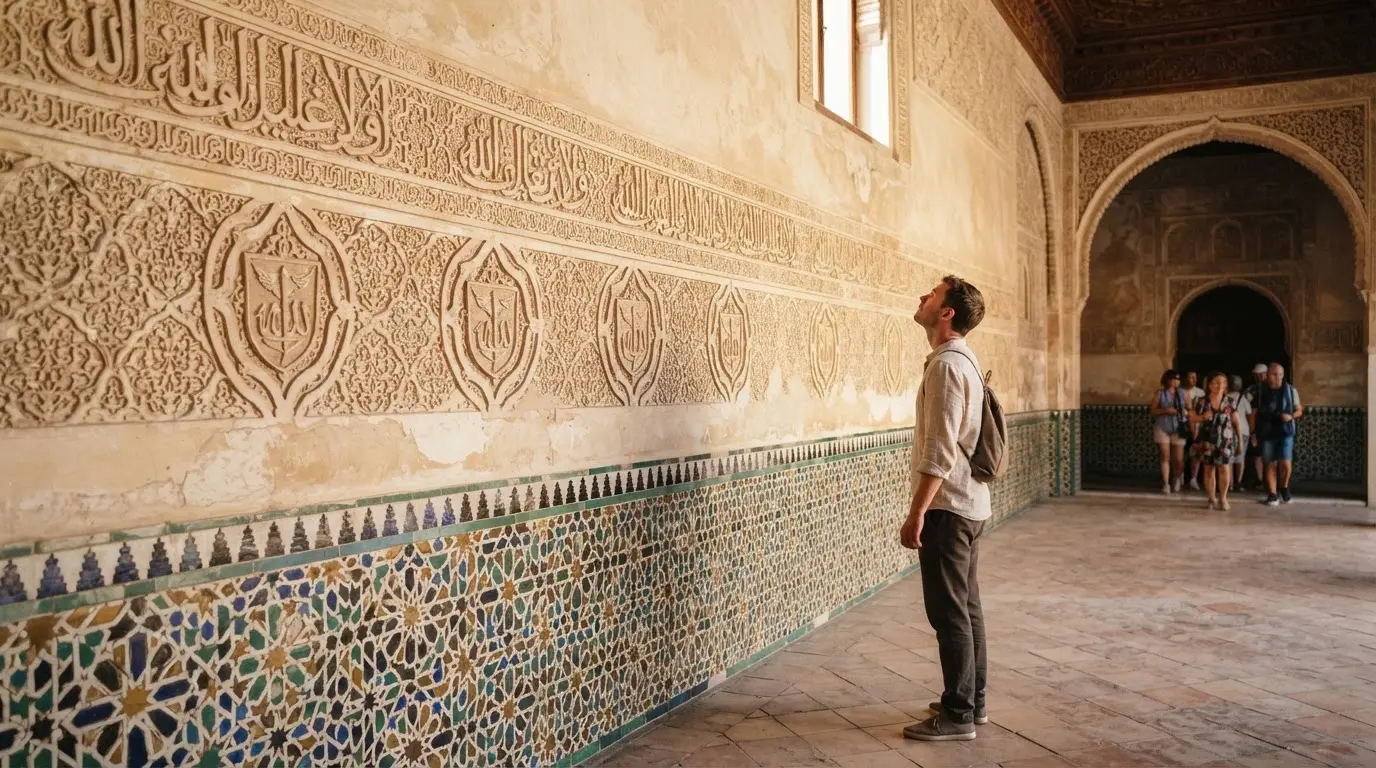
Alhambra Inscriptions Meaning: There Is No Victor but God
The Nasrid motto wa la ghalib illa Allah, no victor but God, recurs across the Alhambra's walls. What it means, where the legend comes from and how to spot it.
Recommended tours
Tours are selected for quality, not commission. We earn a small fee if you book — at no extra cost to you.
Each dig found the same thing, a cemetery with almost nobody in it.
Excavated, then forgotten again
Torres Balbás excavated almost the whole site, and the Rawda then slid into oblivion, a neglect that a study in the Alhambra's own journal in 2000 could still describe as lasting to its own day.[25] The second dig at the turn of the millennium, tied to the restoration, came after that long silence.
The cemetery's history reads as a series of removals: the bones carried off at the conquest, the tombstones scattered between Granada and Madrid, the garden lived in and built over, the excavated site left alone. Each owner took something and left less behind.
What is left: empty graves and a few marble slabs
What the excavators found was mostly absence. In the garden lay about seventy trapezoid tombs, 1 to 1.5 metres down, and all but one were empty.[15] An exhumed cemetery would look exactly like this, though so would one cleared by builders and time.
The slabs are the other half of the evidence. Of the four tombstones found in 1574, three survive,[10] and one of them is not in Granada. A fragment of Yusuf I's epitaph belongs to Madrid's Museo Arqueológico Nacional, which logged the marble on 10 February 1925 as a gift from Ignacio Bauer.[16][17] It is kept in the museum's storage rather than on public display.
To see what is left of the Rawda, you need two addresses:
- the Rawda itself, beside the Partal across Calle Real Baja[2]
- the Museo de la Alhambra, where pieces of the royal tombs left in place were recovered and conserved[18]
The stones kept in Granada
Some of the tombstones from the royal tombs are in the Museo de la Alhambra, and some, not all, carry epigraphs.[26] Torres Balbás noted in 1926 that two of the slabs found in 1574 were then kept in the Sala de los Reyes of the Casa Real.[28] His list of the kings buried in the Rawda names Muhammad II, Ismail I, Yusuf I and Yusuf III.[37]
The Muhammad II slab stood over the door of the Adarves garden until well into the nineteenth century,[38] and Yusuf III's was drilled with three holes, as if adapted for a fountain.[39]
The burial stone the Patronato chose as its piece of the month measures a little over 1.7 metres.[27] Stand beside a slab that size and the scale of what the cemetery once held comes through better than any plan of the garden does.
What a visitor can actually find
So the honest answer to where the sultans lie is that nobody can say. What a visitor can actually put a hand on is the plan of a royal garden and a few inscribed slabs in Granada. The Yusuf I fragment in Madrid is in storage, out of public view.
Start with the museum, where the inscriptions are, then walk to Calle Real Baja. The street that acts as a moat between the Rawda and the Partal palaces[2] is the clearest marker left of where the dynasty chose to bury its own.