A boy in a city half a century into Castilian rule
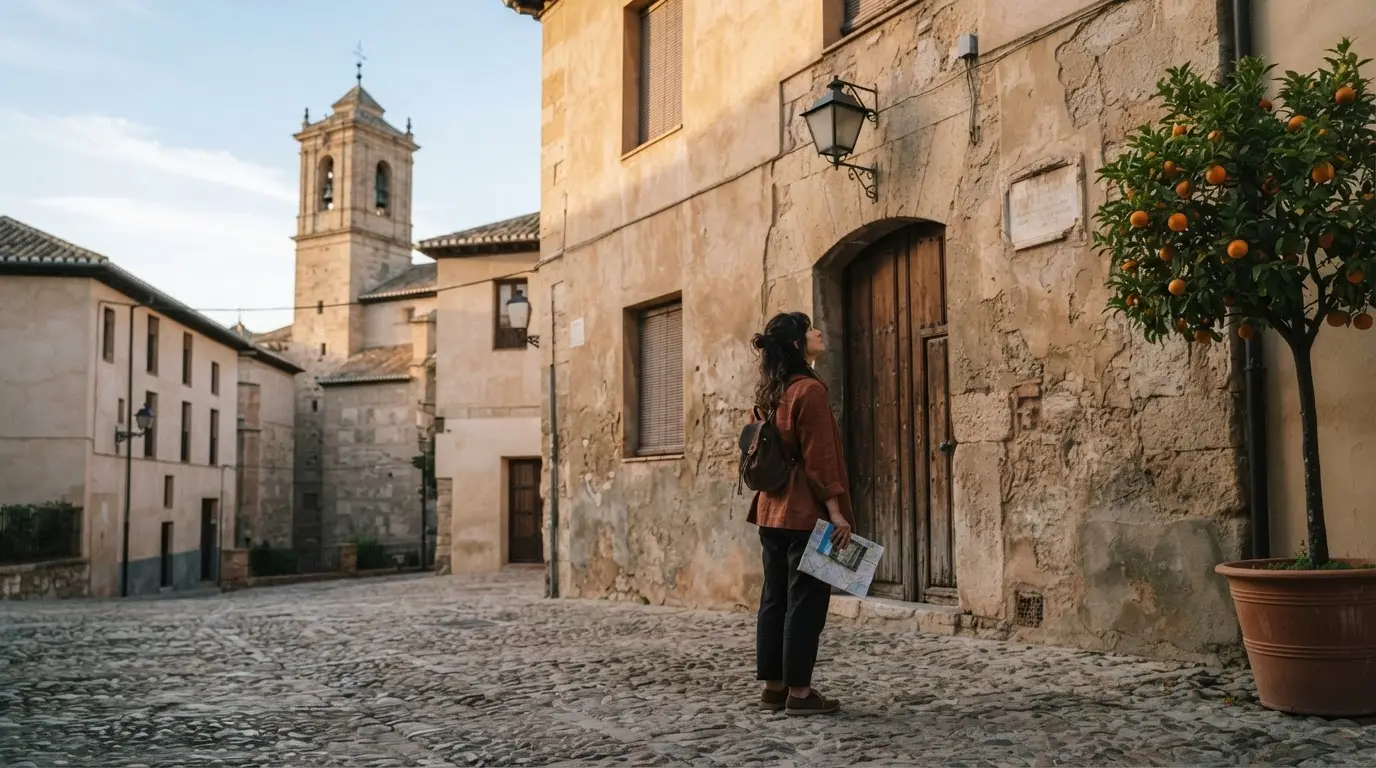
Granada in 1548 was a city still learning what it had become. The Catholic Monarchs had taken it from eight centuries of Muslim rule only half a century earlier[8], so the conquest of 1492 sat inside the memory of the oldest people in the street. Up on the hill the Alhambra was a captured palace, and beside it the palace of Charles V was going up, a Renaissance statement planted in Nasrid ground.
Francisco Suárez was born into that city on 5 January 1548[1]. His father, Gaspar Suárez de Toledo, was a lawyer[9], and his uncle Francisco Toledo de Herrera was a philosophy professor who went on to become the first Jesuit cardinal[10]. This was a family in which learning was a career, not a luxury.
He lived in Granada until close to fourteen[11]. That is long enough to be a Granadino and not much longer; everything that made his name happened in lecture halls in Castile, Rome and Portugal. The city that formed him was also the city of the Morisco question, the unresolved aftermath of conquest that erupted in the Alpujarras a few years after he had gone.
Turned away by the Jesuits, then lecturing before a pope
Of fifty applicants to the Society of Jesus, Suárez was the one turned away, on grounds of weak health and what looked like a modest mind[12]. He was sixteen. The Society's first verdict on its future star philosopher was a polite no.
In the end he got in. He entered the Society at Salamanca on 16 June 1564, studied philosophy and theology there from 1565 to 1570, and was ordained in 1572[13]. While he was a student there, the 1568 Alpujarras rebellion broke out in the mountains above his native Granada.
Then the teaching began, and it kept him moving. His chairs, in order:[14]
- Valladolid, from 1576
- Rome, 1580 to 1585
- Alcalá, 1585 to 1592
- Salamanca, 1592 to 1597
- Coimbra, from 1597
In Rome, Pope Gregory XIII attended his first lecture[15], for the applicant who had been the one rejection among fifty.
He belongs to the generation usually filed under Spain's Golden Age, alongside Cervantes, Tomás Luis de Victoria and El Greco[16]. His medium was the lecture and the folio, not the novel or the canvas.
Fifty-four disputations and a very long reach
The year 1597 was the year of the book and the year of the move: the Disputationes Metaphysicae was published, and Philip II had Suárez transferred to Coimbra in Portugal[2]. The work is built from fifty-four disputations[17], each a topic argued in the scholastic manner, with a question, the objections to it and a reasoned reply.
Explore nearby · Monument
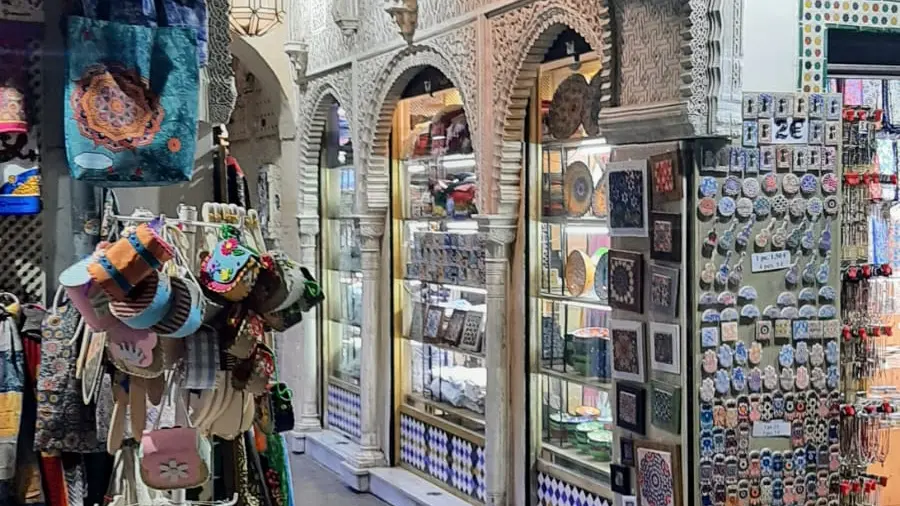
Alcaicería
Granada's historic silk market, rebuilt after 1843 in Neo-Moorish style. Small shops sell ceramics, taracea woodwork, spices, and leather goods. Free to enter.
Its reach is the point. Descartes, Malebranche, Leibniz, Hobbes and Berkeley each mention Suárez explicitly at least once[18], and Wolff cites him and thought highly of him[19]. How much Descartes in particular owes him is still debated[20].
The range went well beyond Europe. The Jesuit missionary Martino Martini, based at Hangzhou, attempted a Chinese translation of the Disputations in the mid-seventeenth century[21]. The Polish Jesuit Thomas Szpot's Historia Sinarum, 1641 to 1687, records that Martini began translating and explaining Suárez in Chinese for a Hangzhou convert, Cosma Zhu, who wished to translate the entire work[22].
Natural law, a royal order and the Eminent Doctor
De legibus, published in 1612, is where Suárez set out his natural law theory[23]. The Catholic Encyclopedia records that Mackintosh counted him one of the founders of international law[24], a later reading of his legal writing rather than a title he claimed.
Suárez remained at Coimbra until shortly before his death on 25 September 1617[25], his last two decades spent there[26]. Pope Paul V gave him the title that stuck, doctor eximius et pius, the Eminent Doctor[27].
Recommended tours
Tours are selected for quality, not commission. We earn a small fee if you book — at no extra cost to you.
For a Granada reader the useful way to hold these facts is as range. The boy who left the city at fourteen ended as a writer on law, metaphysics and theology whom a pope, a king and, a century and a half after his death, an order of Charles III aimed at Jesuit authors all treated as important.
What Granada kept: a plaque, a monument and an archive
Granada's memory of Suárez is quieter than its memory of Lorca or the Nasrids, but it is specific: a birthplace plaque, a monument and an archive.
None of them is a ticketed attraction, so treat this as a ten-minute stop on a walk, not a destination.
Plaque outside, archive inside
Confirm access before you go: the building is a working archive, not a visitor attraction, so plan the visit around the plaque and the monument rather than a tour of the interior.
Deep dive · Article
1066 Granada Massacre: When the Jewish Golden Age Ended in a Day
The 1066 Granada massacre killed Joseph ha-Nagid and thousands of the city's Jews in a single day, ending three decades of Jewish power under Samuel ha-Nagid.
The 1917 monument
A monument to Suárez was erected in 1917 in a niche at a corner of the archbishop's palace[6]. A niche is easy to walk past, so scan the palace corners rather than the street frontage.
The plaque and the Casa del Padre Suárez
On the street façade at Plaza del Padre Suárez 1, where the house of his birth stood[3], a plaque records that Father Francisco Suárez was born there on 5 January 1548; the city council agreed to dedicate it in 1896[4]. The Royal Chancellery Archive occupies the Casa del Padre Suárez and reopened there on 29 November 2005 after refurbishment[5]. It is a working archive of the Crown's old appeal court, so check access before you go.
Of the Suárez de Toledo family's original palace, the tower beside the Casa de los Tiros survives, with its two alfarjes, the carved wooden ceilings[7]. That is the physical inventory: one plaque, one monument, one archive, one tower.