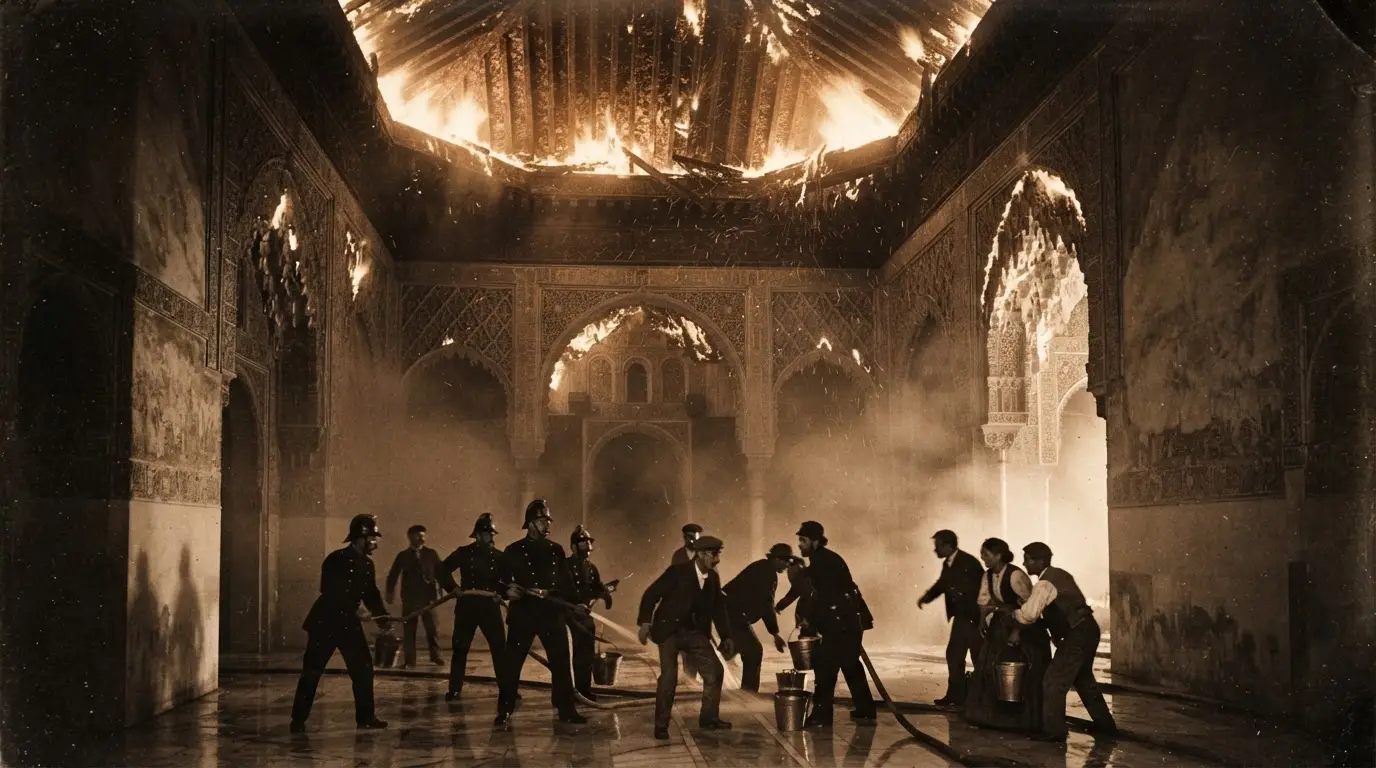

The night of 15 September 1890
The first flames were spotted from two places at once: from the Paseo de los Tristes, the riverside walk below the Alhambra in the Albaicín, and by a guard stationed near the church of San Nicolás on the opposite hill. Between that first sighting and anyone actually fighting the fire, half an hour passed[3]. Thirty minutes with the Sala de la Barca's roof already alight, and no one yet moving water toward it.
It got worse before it got better. Professional firefighters did not reach the Alhambra until close to midnight, roughly ninety minutes after the blaze started, and their first move on arrival was to cut through the hall's own timbers to stop the fire spreading into the adjoining rooms.[4] Whatever slowed the flames before that point came from whatever water was already on site, the same gravity-fed cisterns and pools described in how the Alhambra's water system works, pressed into service decades before anyone designed them with firefighting in mind.
The fire was not fully out until around four in the morning, roughly five and a half hours after it started. Several firefighters were seriously hurt fighting it, and three ended up in hospital.[2] By any measure it was a long, dangerous night for the people who put the fire out, and a far longer one for the people who would spend the next seventy-five years repairing what it left behind.
What burned, and what survived
How bad the fire actually was depends on which account you read, but the message relayed to city authorities that night is unambiguous about its scope. Three parts of the Alhambra were burning at once:[5]
- The Sala de la Barca, where the wooden dome and painted ceiling took the worst of the damage
- Part of the Comares Tower, immediately behind the hall
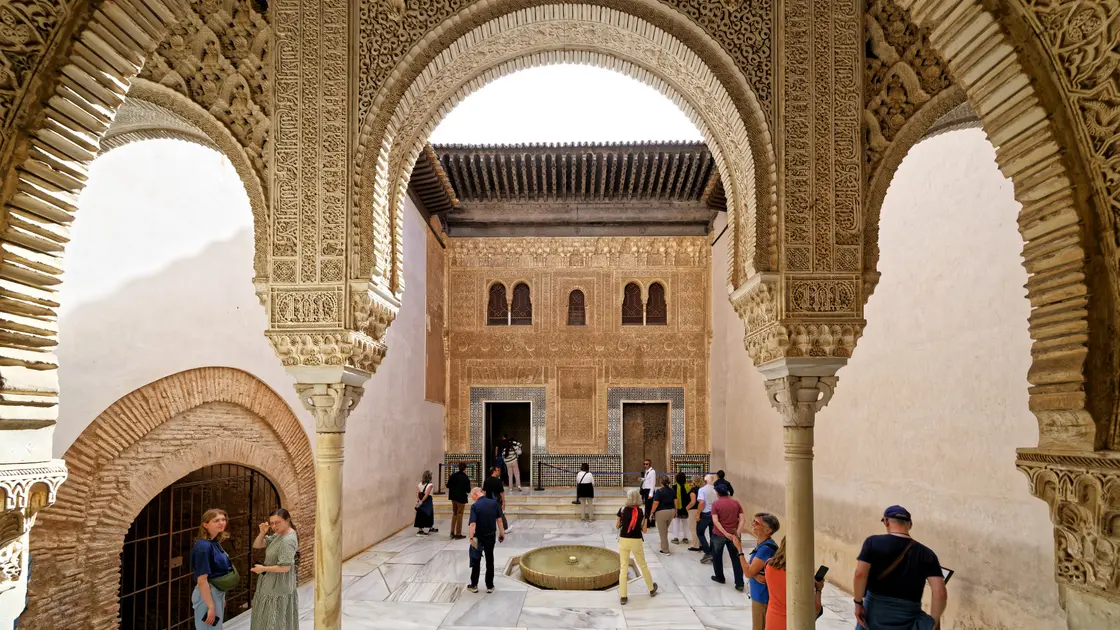
- The gallery connecting the Patio de los Arrayanes (Court of the Myrtles) to the Nasrid Palaces' Palacio de los Leones (Palace of the Lions)
Explore nearby · Monument
Alhambra
The Alhambra is Granada's UNESCO fortress-palace: Nasrid Palaces, Alcazaba and Generalife gardens. Tickets sell out weeks ahead; book via the Patronato site.
It could have been worse. Despite the scale of the blaze, it never crossed into the Palacio de los Leones itself: the fire stopped at the gallery, and the Court of the Lions and the halls around it came through the night untouched.[6]
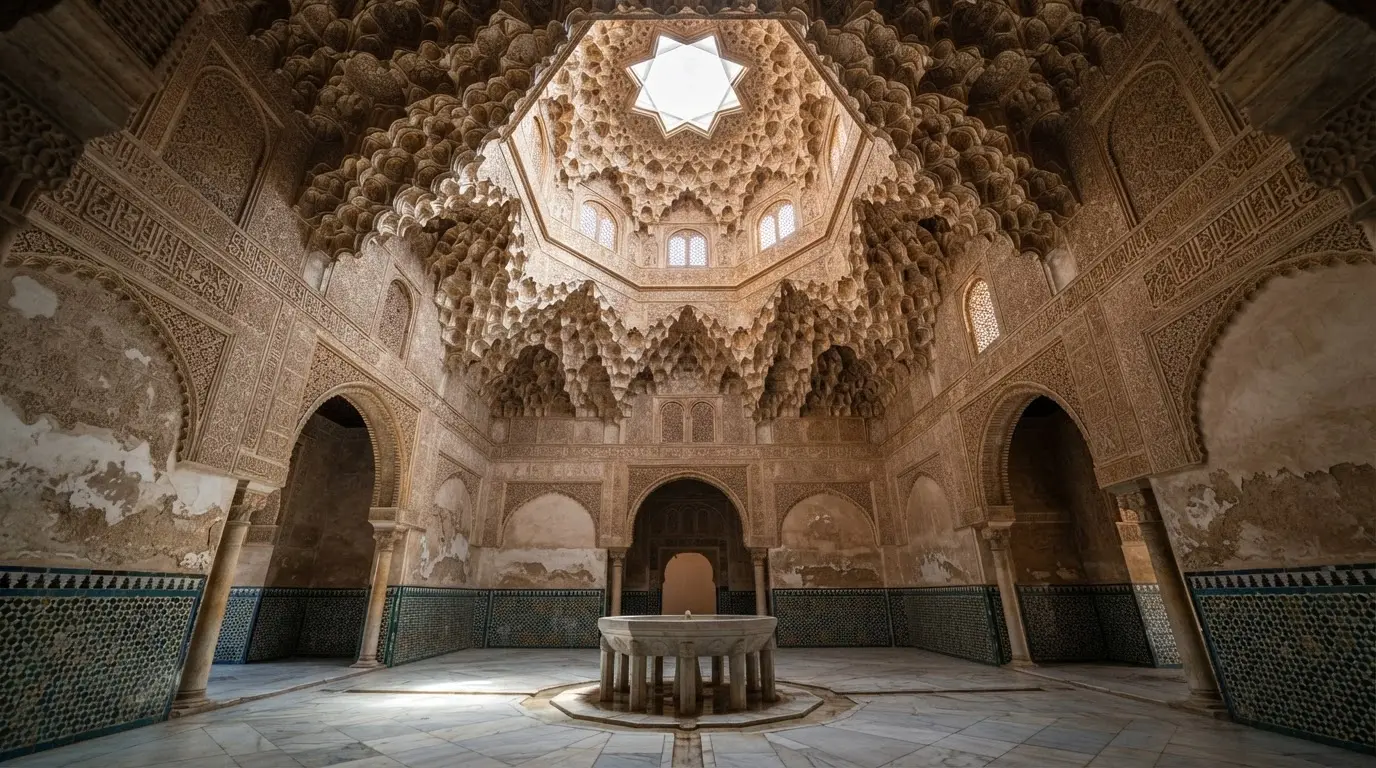
The most surprising part of the damage only emerged later, once photographs and drawings taken around the time of the fire were compared against what the newspapers had reported. The contemporary press described the Sala de la Barca's ceiling as destroyed outright. The images say otherwise: the muqarnas pendentives beneath the dome (the tiered, stalactite-like vaulting that carries the transition from the square hall below to the dome above, and one of the most admired and structurally fragile elements of 14th-century Nasrid architecture[18]) survived without significant damage.[7]
Arson, negligence, and a case that went nowhere
Investigators at the time were not convinced this was an accident. Several separate ignition points were found inside the hall, which pointed toward arson rather than a single stray spark. Two young workers from the Alhambra's own taller de arabescos (arabesque workshop), who had been in the building that same afternoon, were detained; no evidence against them held up, and both were released.[8]
The negligence case fared little better, though it did produce arrests. Days after the fire, an Alhambra caretaker, along with a porter and his son, were taken into custody. The upper gallery involved in the blaze had reportedly been in poor condition for some time and was being used, unofficially, to store hens and heaps of straw, exactly the kind of fuel a fire needs, sitting inside a 14th-century palace.[9]
Nobody was ever convicted of anything. What the fire produced, more reliably than a verdict, was change: it marked a turning point for how the Alhambra handled fire risk and site security, prompting rule changes meant to stop a repeat.[10]
From institutional embarrassment to institutional reform
The timing made the fire especially awkward. Mariano Contreras (the last of the Contreras restoration dynasty to run conservation at the Alhambra, a family whose approach favoured decorative completion over strict historical accuracy) had been appointed architectural curator only five months earlier, in April 1890. His tenure was already drawing criticism from other authorities before the fire; afterward, the criticism had a concrete disaster to point to.[11]
The fire exposed how vulnerable the site's management actually was, and the fallout unfolded slowly, over more than two decades:[12]
- An official report on the Alhambra's condition led to the creation of a Special Commission to oversee conservation and restoration
- 1913 — the Special Commission was dissolved
- 1914 — it was replaced by the Patronato de la Alhambra y Generalife, the body that still oversees the site's conservation today[13]
Deep dive · Article
Abencerrajes of Granada: the noble clan behind the legend
Abencerrajes of Granada: the noble clan who shaped Nasrid court politics for a century and became legend through a massacre story set in the Alhambra.
It took a fire to get there, but the shift from one controversial architect's personal judgment to an institutional body answerable for its decisions is arguably the fire's most lasting consequence, more durable, in the end, than anything that actually burned.
Rebuilding the Sala de la Barca, one photograph at a time
Before any of this, the room already had a nickname. By the end of the 16th century its ceiling needed repainting, and from then on it was informally known as the Sala Dorada (the Golden Room) alongside its formal name.[14]
What made a 75-year restoration even possible was documentation that predated the fire by more than half a century. In 1834 and 1837, architects Owen Jones and Jules Goury surveyed the Alhambra's interiors on site and published their drawings between 1842 and 1845[15], including detailed studies of the Sala de la Barca's muqarnas and the geometric principles behind them. That survey became one of the fullest surviving graphic records of what the room looked like before the fire — one of several sources, alongside photographs and salvaged fragments, that the 1960s restoration ultimately drew on. The same geometric logic Jones and Goury were documenting is unpacked further in the Alhambra's geometry, explained for architecture lovers.
The wood dome standing in the Sala de la Barca today is a reconstruction, not a survivor. A restoration team led by architect José Romera rebuilt it around 1960[16], working from Jones and Goury's drawings, from photographs taken before and just after the fire, and from unburned fragments of the original. The room reopened complete in June 1965 — seventy-five years, almost to the season, after the night it burned.[1]
The frame overhead now is pine, worked in interlaced lazo ataujerado strapwork: its end sections shaped as quarter-sphere niches with 12-point lattice decoration, and a central axis combining 12-point wheels with 8-point stars.[17] None of it is original 14th-century material. All of it is built to the original's exact geometry — which, for a room that came within half an hour of losing everything, is close enough to count. Visitors can see the finished reconstruction on the standard Nasrid Palaces route; a guided tour of the Alhambra is the easiest way to have someone point out exactly where the join between old stone and new wood sits.
75 years