Alhambra Crowds: How the World Fell for Granada's Palace
Alhambra crowds aren't accidental. A ruined fortress became a Romantic pilgrimage, then the world's most tightly visitor-managed site, capped since 2003.
Seven years resident in Granada. Specialist in Nasrid architecture, Al-Andalus history, and Andalusian walking routes.
Published
The Alhambra didn't become one of Spain's most-visited monuments by accident. It became one on purpose, in the 1830s, and has spent the two centuries since learning to ration the pilgrimage it created. The palace now runs within a few percentage points of the annual ceiling it fixed for itself in 2003.
29 March 2013, versus 1,942 on the quietest day[3]
In this article
Jump to a section
⌄
A ruin before it was a pilgrimage
Long before it had a queue, the Alhambra was a half-forgotten fortress-palace on the edge of a provincial Spanish city. Nasrid sultans lost the site in 1492; Castilian garrisons occupied parts of it afterward, and by the early 19th century whole wings sat roofless, colonised by squatter families living in rooms built for royal diplomacy. Visitors were rare enough that nobody bothered stopping them from carving their names into the stucco.
What UNESCO now calls the only preserved palatine city of the Islamic period (fortress, palace and residential quarter surviving together from a single era) spent most of its post-Nasrid life as exactly that: a neglected garrison town nobody thought worth protecting.[4] The pilgrimage that eventually saved it, and then very nearly overwhelmed it, did not begin with a government decree. It began with an American writer who could not stop apologising for how badly his own prose captured the place.
Washington Irving and the birth of the pilgrimage
In 1829, the American writer Washington Irving asked the Alhambra's governor and archbishop for permission to move into the Alhambra itself, and got it, largely on the strength of his literary celebrity.[5] What happened over the next three months turned a half-ruined Spanish palace into a destination the whole Romantic world wanted to see.
Irving lived inside the palace for about three months, in rooms later known as the Salas de las Frutas, and found the walls covered in the same graffiti any modern visitor recognises: names scratched into stucco by people who had nowhere official to record that they had come. Rather than add to it, he started a guest book, the Alhambra's first, so travellers could sign in ink instead of stone. It is still kept today.[6]
The book that reintroduced the Alhambra to the West
Tales of the Alhambra, the book Irving published from that stay, appeared in May 1832 in London and Philadelphia simultaneously, credited to his old pen name 'Geoffrey Crayon.'[7] It reintroduced a half-ruined Spanish palace to an entire reading public in Britain and America that had barely heard of it, and a plaque today marks the rooms where he wrote it.[8] Granada waited until 2009, the 150th anniversary of his death, to raise a bronze statue of him near the gate, inscribed with the phrase Granadans still use for him: 'son of the Alhambra.'[9] For the fuller account of his stay, his guide Mateo Ximenes, and the household that fed him, see Washington Irving and the Tales of the Alhambra.
From Romantic curiosity to mass tourism
Irving's book did what heritage bureaucrats spend careers trying to engineer: it made an entire class of European travellers want to see the place for themselves. The scholarly account of the Alhambra's tourism history puts it plainly: the seduction of Orientalism reached high-society travellers first, then mass tourism itself, as Spain became easier to reach.[11] By 1984, the accumulated pressure and prestige were formal: UNESCO listed the Alhambra and Generalife as a World Heritage Site, one of the oldest tourist attractions in the country to carry the designation.[12]
Management of the site had been institutionalised well before that listing. The Patronato de la Alhambra y Generalife, the trust still responsible for the site today, has run it since 1895, answering to the regional government of Andalusia.[13] For most of the 20th century it oversaw a slow trickle of visitors. That changed abruptly after 1992: the Seville Expo drew an unprecedented wave of tourism to Andalusia, much of it spilling into Granada, and the surge was sharp enough that the Patronato introduced its first formal visitor-limitation measures the following year.[14]
The quota era: capping a monument, half a metre at a time
The 1993 measures were the Alhambra's first real experiment in carrying-capacity management: a blunt instrument applied to a site with wildly different pressure points, but the first time anyone had put a hard limit on how many people could pass through a Nasrid palace on a given day.
Timeline
1993
First visitor-limitation measures
Daily caps of 8,400/7,200 (high/low season) follow the 1992 Expo surge.
1998
Nasrid Palaces capacity study
Sets a maximum load of 535 people inside the palaces at once.
1999
Half-hourly tickets cut to 350
First tightening of the Nasrid Palace entry bands.
2002
Half-hourly tickets cut to 300
Second tightening within three years.
2003
Annual cap fixed at 2,785,000
The ceiling has not moved since.
The first ceiling, 1993
The Patronato fixed a maximum daily capacity of 8,400 people in high season and 7,200 in low season[15], which translated into an annual ceiling of 2,850,000 visitors.[16] It was the Alhambra's first acknowledgment, in policy rather than in guidebooks, that the site had a physical limit.
Tightening the palace bottleneck, 1998-2002
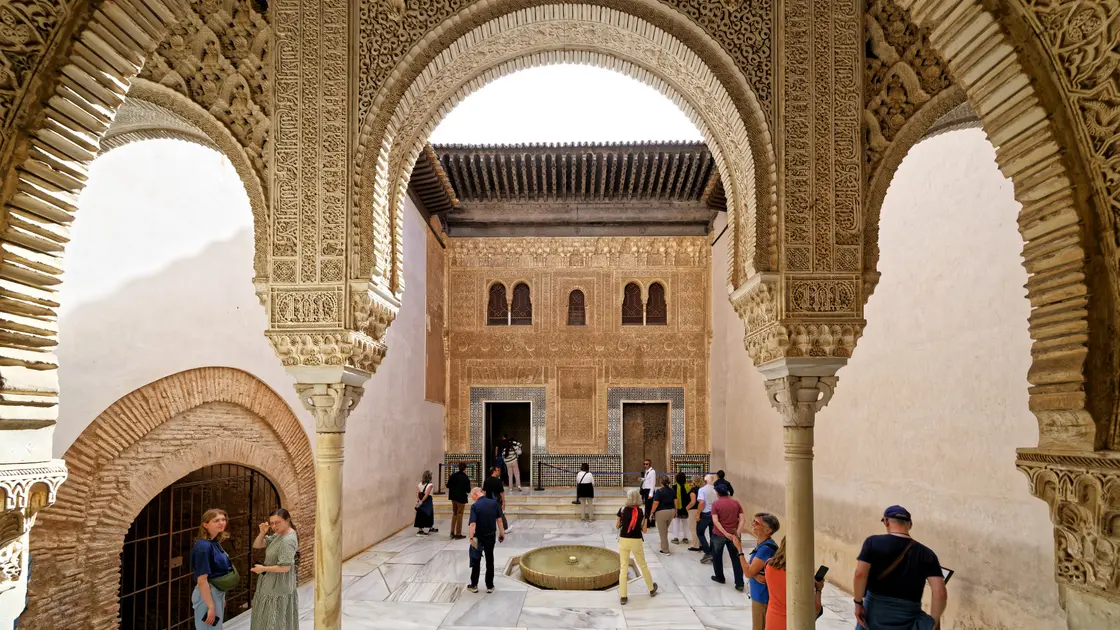
The next round targeted the genuine chokepoint: the Nasrid Palaces themselves, where marble courtyards and narrow stucco corridors cannot absorb a crowd the way an open esplanade can. A 1998 study fixed the Palaces' maximum load at 535 people at any one time, allowing roughly four square metres per visitor.[17] To hold that line, the Patronato cut the number of half-hourly Nasrid Palace tickets to 350 in 1999[18], then to 300 in 2002.[19] Every visitor funnelled through a timed half-hour slot today is walking through the aftermath of that arithmetic.
Group tours and the ceiling that never moved
That 2002 tightening fed into a bigger recalibration. In 2013, an earlier record year, the monument alone drew 2,315,017 visitors[20], and the Patronato's wider count for the site that year, including its museums and cultural activities, came to 3,244,847.[21] It was still comfortably under the limit. In 2003, the Patronato had fixed the Alhambra's maximum annual capacity at 2,785,000 visitors, a figure that has not changed since.[22] By 2019 that comfort was gone: annual visitor numbers reached almost 98% of that ceiling, a demand level that leaves the site almost no slack when a single month runs unusually hot.[23]
Part of what closed that gap was structural, not incidental. Between 1993 and 2019, group-tour visits to the Alhambra multiplied roughly fivefold, from 186,761 to 843,240 a year.[24] Coach parties, unlike independent travellers arriving in ones and twos, move in blocks that are hard to spread evenly across a day. By 2020, the pressure was enough that the Patronato introduced its most disruptive ticketing reform in two decades.[25] Reselling and commission sales were banned outright, leaving only two distribution channels: a general sales channel carrying 82% of capacity, and an institutional channel carrying the remaining 18%.[26]
What the crowd actually means today
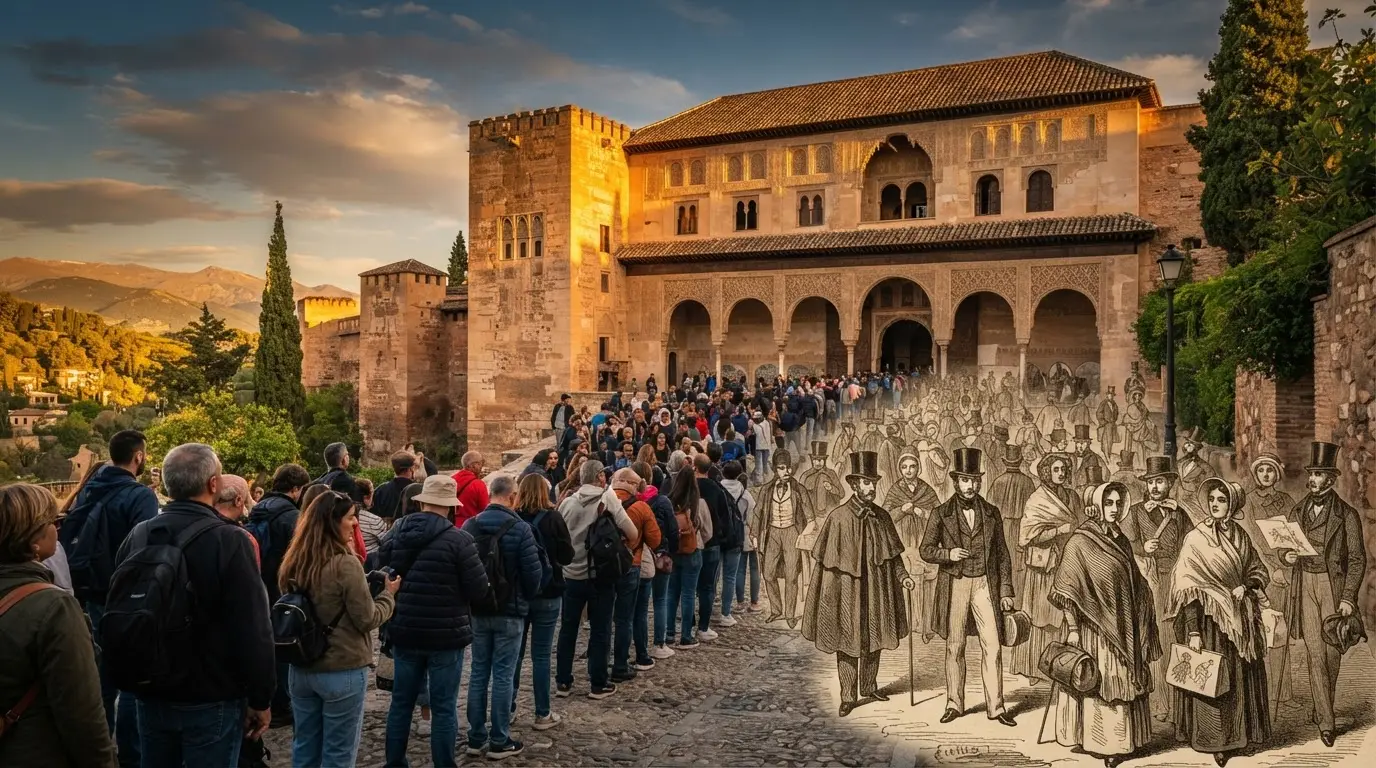
None of this happened because the Alhambra courted crowds. It happened because a ruin nobody watched became a pilgrimage nobody controlled, and the institution answerable for it has spent three decades converting that pilgrimage into something it can manage: fixed daily bands and a capped annual total, enforced by a ticketing system that treats a Nasrid corridor with the same seriousness as an airport gate. Anyone who has stood in the entrance queue on a July morning, sorted into a numbered time slot before they have even reached the Comares Tower, is standing inside that machinery, whether they recognise its history or not.
The crowding, in other words, is not a modern complaint about a timeless place. It is the direct, arithmetic consequence of a 200-year-old pilgrimage the site itself invited, and then spent thirty years learning to ration. For the architectural and political history behind what each sultan actually built inside those walls, see Alhambra rooms history political meaning. For the practical business of getting a ticket before the daily allocation runs out, that belongs on Alhambra tickets sold out, not here.
Very, by design as much as by accident. In 2019, annual visitors reached nearly 98% of the Patronato's fixed ceiling of 2,785,000, and the gap between the busiest and quietest days is stark: 9,054 people on the busiest day of 2013 (29 March) against just 1,942 on the quietest. The crowding is structural, tied to a hard annual cap and a fivefold rise in group-tour visits since 1993, not an occasional bad day.
How many visitors does the Alhambra get per year?
About 2.7 million in 2019, against a maximum annual capacity the Patronato fixed at 2,785,000 in 2003 and has not changed since. In 2013, an earlier record year, the monument alone drew 2,315,017 visitors, and the Patronato's wider count for the site that year, including its museums and cultural activities, came to 3,244,847.
Are there daily visitor limits at the Alhambra?
Yes, and they have tightened repeatedly. The Patronato fixed a site-wide daily capacity of 8,400 people in high season and 7,200 in low season back in 1993. Inside the Nasrid Palaces specifically, a 1998 study capped the maximum load at 535 people at once, and the half-hourly ticket allowance was cut to 350 in 1999, then to 300 in 2002.
When did the Alhambra become a tourist attraction?
In the 19th century, catalysed by Washington Irving's three-month residence inside the palace in 1829 and the book he published from it in 1832, Tales of the Alhambra. The Patronato de la Alhambra y Generalife was established in 1895 to manage the site formally, and mass-tourism-scale visitor management began in 1993, after a post-Expo surge in visitors to Andalusia.
Why does the Alhambra limit visitor numbers?
Because parts of it, especially the Nasrid Palaces, cannot physically absorb a large crowd without damaging the stucco, marble and narrow circulation routes. A 1998 carrying-capacity study set the Palaces' safe maximum at 535 people at once, based on roughly four square metres of space per visitor, and every ticketing reform since has aimed at holding that line rather than raising it.
Has the Alhambra's visitor cap ever been raised?
No. The annual maximum capacity has been fixed at 2,785,000 visitors since 2003 and has not moved since, even as demand pushed close to that ceiling by 2019. The 2020 reform that banned ticket resale and cut distribution to two channels changed how tickets are sold, not how many are available.
“He immediately asked the then-governor of the historic Alhambra Palace as well as the archbishop of Granada for access to the palace, which was granted because of Irving's celebrity status.”
“To prevent people from marking their visit on the ancient walls, he created the first guest book of the Alhambra, which keeps welcoming signatures of travellers today.”
“The Alhambra: a series of tales and sketches of the Moors and Spaniards was published in May 1832 in the United States by publishers Lea & Carey and concurrently in England by Henry Colburn, and attributed to "Geoffrey Crayon".”
“The book was instrumental in reintroducing the Alhambra to Western audiences. A plaque now marks the rooms in which Irving stayed while writing some of his book.”
“In 2009, they built a bronze statue of Washington Irving for the 150th anniversary of his death. It lies next to the Alhambra, surrounded by trees. One can read an inscription that says "son of the Alhambra".”
“In the 19th century, the first visitors began to arrive in the Alhambra. The writer Washington Irving (1783-1859) ensured that this heritage site would have a place in the imagination of Romantic travellers. The seduction of Orientalism was initially transmitted to high-society tourists and then to mass tourism.”
“Since 1895, the Patronato de Alhambra and Generalife (hereinafter, the "Trust") has been the managing body of the site, answering to the Regional Government of Andalusia.”
“Depending on this parameter and the visiting hours in the particular season, a maximum daily capacity was fixed at 8400 people in the high season and 7200 in the low season.”
“To guarantee that the estimated carrying capacity was not exceeded, in 1999, the number of tickets sold for each day pass was reduced to 350 every half hour.”
“For this reason, in 2020, the Trust once more modified the regulations on visits, introducing the most disruptive changes of the last two decades into the system of selling tickets.”
“The sale on commission or the resale of tickets is also expressly prohibited, and only two distribution channels are now included: the general sales channel (with 82% of the total maximum capacity) and the institutional channel (18% of permitted capacity)”