Alhambra Royal Mosque: From Nasrid Mosque to Santa María
The Alhambra royal mosque was completed in 1305 and later replaced by Santa María. Read its plan, surviving bath and difference from Granada's city mosque.
Seven years resident in Granada. Specialist in Nasrid architecture, Al-Andalus history, and Andalusian walking routes.
Published
The Alhambra royal mosque has vanished, but its site still explains how the Nasrid palatine city worked. Completed in 1305, converted after the Christian conquest and eventually replaced by Santa María de la Alhambra, it survives through a bath annex, a bronze lamp and a plan reconstructed from the historical record.
Mosque completed
1305
A lamp inscription records the completion date under Muhammad III[1]
Former mosque removed
1576
The converted building was demolished before the present church[2]
Church works
1581–1618
Santa María was built on the former mosque site during this span[3]
In this article
Jump to a section
⌄
A mosque inside the palatine city, not downtown Granada
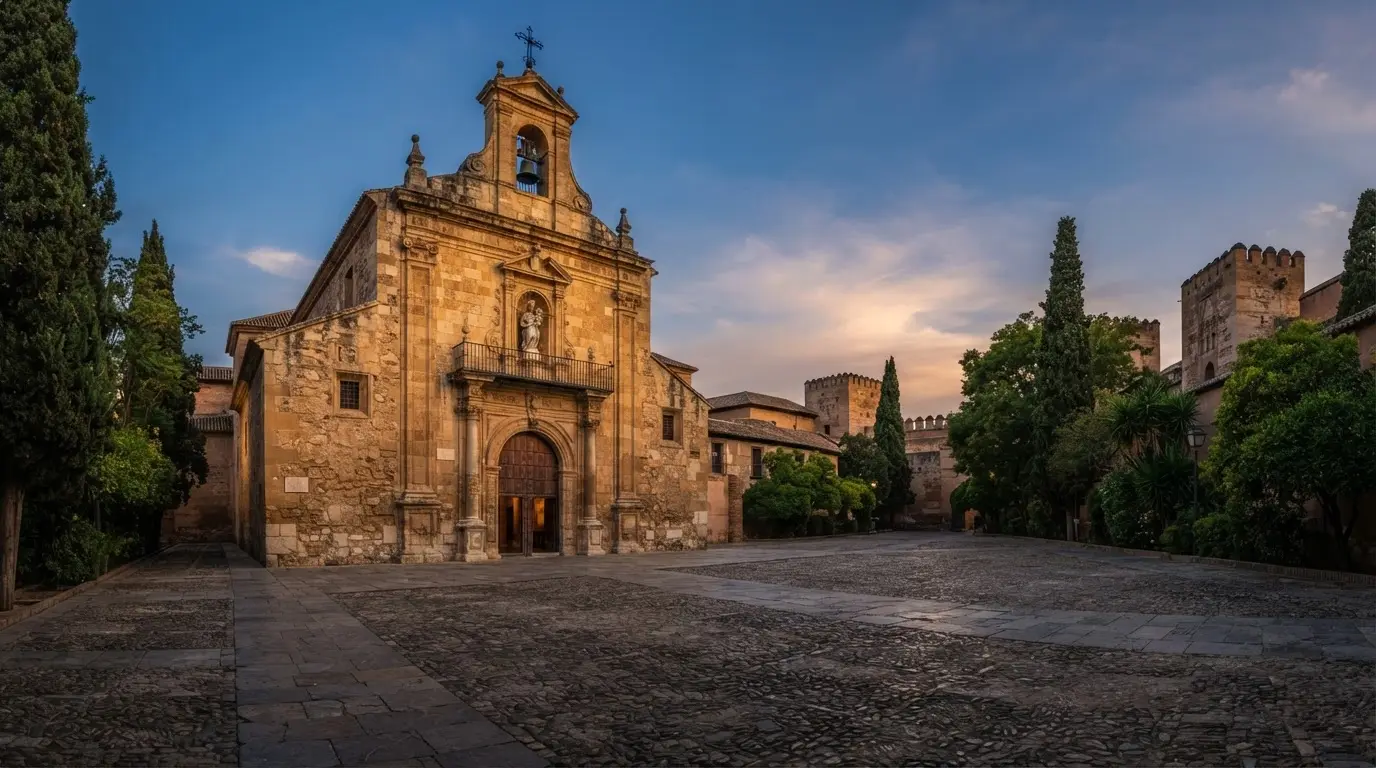
Muhammad III placed the Alhambra's main congregational mosque within the royal complex, on the site now occupied by Santa María de la Alhambra[4]. Its position matters. The Alhambra palatine city needed a place for communal prayer within its own streets, close to the residences, workshops and public spaces enclosed by the hilltop walls.
The word royal can mislead if it suggests a private chapel reserved for a ruler. The surviving evidence identifies a congregational mosque; it does not define every group allowed through its doors. A more accurate name is the main mosque of the Alhambra, an institution belonging to the Nasrid palatine city rather than the urban centre below.
That distinction prevents the most common mix-up. Granada also had a city-centre aljama mosque with a separate history. The two sites belonged to different settings and should not be folded into one vanished building.
Two mosques, two sites
Do not confuse the Alhambra mosque with Granada's former Great Mosque. That article follows the downtown site; this one stays inside the palatine city.
Three naves directed the eye towards the mihrab
The mosque used a hypostyle hall, a roofed prayer space organised by rows of supports. Three naves ran through it, divided by arcades set in rows of three[5]. This was a compact building rather than the broad forest of columns many travellers associate with the great early mosques of al-Andalus.
The central nave rose higher than the two flanking naves and led towards the mihrab; a slender minaret stood at the western end[6]. Height clarified direction. Even without the building, that hierarchy lets you picture the prayer hall as a sequence narrowing attention towards its liturgical focus.
Its main axis faced southeast towards the qibla, following the line of the adjacent street[7]. Architecture and urban plan therefore worked together. The vocabulary of Nasrid architecture helps with the decorative language elsewhere in the complex, but the mosque plan is best read through movement, alignment and prayer.
The bath and lamp carry the mosque beyond its lost walls
A mosque was more than its prayer hall. On the church's eastern side, part of the associated hammam survives[8]. The bath was built under Muhammad III with the mosque[9], tying bodily preparation and ritual practice to the same building campaign.
Water, heat and changing light would have made the bath a different sensory space from the timber-roofed hall. Yet the connection was functional. Ablution prepared worshippers for prayer, while a hammam also belonged to the daily life of an Islamic city. The surviving annex is therefore evidence of an institutional complex, not an architectural afterthought.
The other major trace travelled far from Granada. An ornate bronze lamp from the mosque is held by Madrid's National Archaeological Museum[10]. Its inscription provides the 1305 date attached to the building, turning a movable object into one of the clearest anchors for a structure that no longer stands.
This is why the vanished mosque is still legible. The bath fixes activity to the ground, while the lamp carries patronage and chronology in metal. Read together, they recover more than a lost floor plan: they show how worship depended on water, light and the ordered movement of bodies.
The political history of the Alhambra's rooms adds the courtly setting around that religious life. The mosque belongs to the same inhabited city as the palaces, not to a detached catalogue of monuments.
Conversion followed conquest; replacement came later
The Christian conquest of 1492 changed the building's use before it changed the site completely. The mosque was converted into a church after the conquest, then deteriorated by the late sixteenth century[11]. The evidence supports that sequence, but not an exact conversion date in 1492.
A source-bound chronology places the demolition of the converted building in 1576[2]. Construction of the present Santa María de la Alhambra followed from 1581 to 1618[3]. Keeping those dates separate matters: 1576 was not the start of one continuous forty-two-year church project[2].
Juan de Herrera and Juan de Orea supplied designs for the church, and Ambrosio de Vico completed it[12]. The result belongs to a later architectural and religious order, even though it occupies the former mosque site. The building visible today is a replacement, not the Nasrid prayer hall with a Christian interior inserted intact.
For the city-centre sequence after conquest, use the history of Granada's Great Mosque and cathedral site. Repeating that story here would blur two institutions whose locations and later buildings were different.
How to read the vanished mosque on Calle Real
Stand before Santa María and resist the temptation to imagine the church as a shell around the mosque. The Patronato describes the church as occupying the plot of the Mezquita Mayor and its bath, with part of the bath conserved nearby[13]. What survives is a site relationship, not a complete prayer hall hidden behind later walls.
Three clues give the visit structure:
The church fixes the mosque's position on Calle Real.
The bath preserves part of the associated complex on the eastern side.
The bronze lamp supplies the dated object that the architecture itself can no longer provide.
The absence is the point. Palaces dominate most accounts of the Alhambra, but a functioning Nasrid city also required communal religious space. Once you place the mosque back into that urban picture, Calle Real reads as a civic spine rather than a path between ticketed interiors.
Santa María should be read in its own right and as a marker of replacement. The stone church, the partial bath and the lamp now held in Madrid[10] belong to different moments. Together they make the former mosque visible without pretending that the lost building can be recovered whole.
Frequently asked questions
Where was the Alhambra royal mosque?
It stood inside the Alhambra palatine city on the site now occupied by the Church of Santa María de la Alhambra, beside Calle Real. It was the complex's main congregational mosque.
Who built the Alhambra mosque and when was it completed?
The Nasrid ruler Muhammad III commissioned the mosque. An inscription on its surviving bronze lamp dates its completion to 1305.
What did the Nasrid mosque look like?
It had a hypostyle prayer hall divided into three naves. The central nave was higher and led towards the mihrab, while a slender minaret stood at the western end.
Was the mosque converted into a church in 1492?
The available binding says conversion followed the Christian conquest, but it does not prove that conversion occurred in 1492 itself. The former mosque was later demolished before the present church was built.
Is Santa María de la Alhambra the converted mosque?
No. The mosque was first converted for Christian use, but that building was later demolished. The present church was built on the site in a separate campaign dated 1581–1618.
What survives from the Alhambra mosque?
Part of the associated bath survives beside the church. A bronze lamp from the mosque is preserved at the National Archaeological Museum in Madrid.
Was this the same mosque as Granada's city Great Mosque?
No. This was the congregational mosque within the Alhambra palatine city. Granada's former Great Mosque stood downtown and has its own institutional and architectural history.
“Las obras del templo se realizaron entre 1581 y 1618, completadas por el arquitecto Ambrosio de Vico siguiendo trazas de Juan de Herrera y Juan de Orea, aunque con fábricas muy humildes en comparación con los proyectos iniciales.”
“Muhammad III (r. 1302–1309) erected the Partal Palace, parts of which are still standing today, as well as the Alhambra's main (congregational) mosque (on the site of the current Church of Santa Maria de la Alhambra).”
“The roof was made of wood and the central nave, which led to the mihrab, had a higher ceiling than the two side naves. A slender minaret stood at the western end of the building.”
“One of the Alhambra Mosque's annexes, the baths (hammam), has been preserved on the east side of the church today and is accessible from the main street.”
“Little remains of the Alhambra Mosque which stood previously on this site, aside from an ornate bronze lamp now preserved at the National Archaeological Museum in Madrid.”
“la Iglesia de Santa María de la Alhambra, terminada a principios del siglo XVII sobre el solar de la Mezquita Mayor y su baño, este último conservado parcialmente en la casa donde nació y vivió el músico Ángel Barrios”