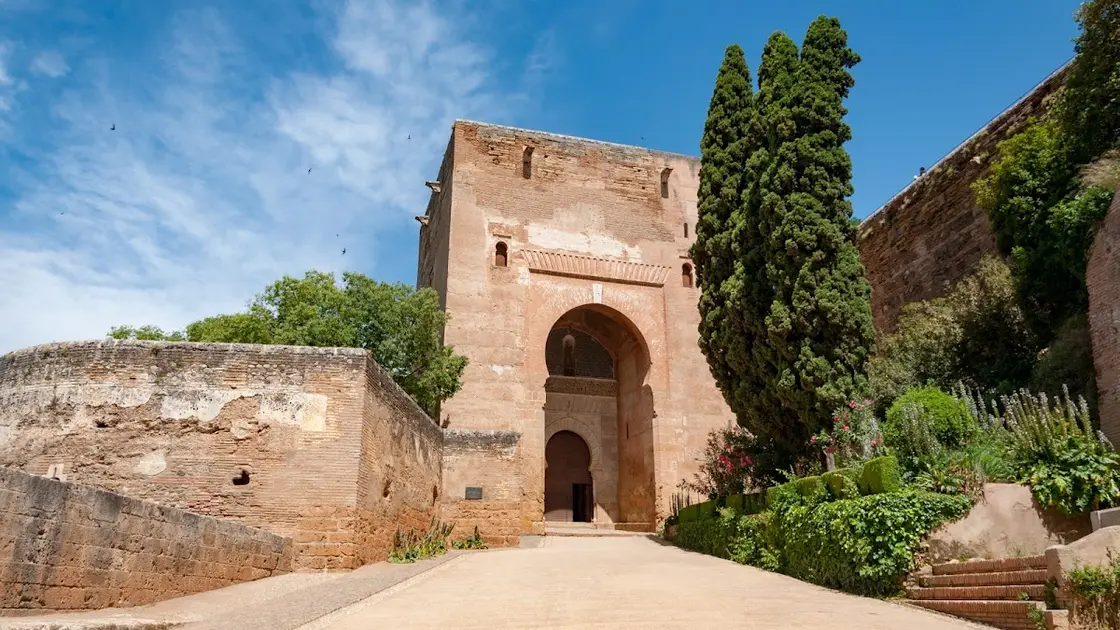
The Puerta de la Justicia was built in June 1348, in Muharram, the first month of year 749 of the Islamic calendar, by Sultan Yusuf I, who ruled the Nasrid dynasty from 1333 to 1354. It is the principal south-facing entrance to the Alhambra and the gate most visitors walk through today without realising they are passing through a layered political statement carved in stone.
The gate's Arabic name, Bab al-Shari'a, translates as the Esplanade Gate or Gate of the Law. The Latin name came later, attached by Christian writers who associated the arch with the justice courts the Nasrid sultans held within the palace complex.
When to Visit
Best season
Year-round
Quietest hours
8:30–9:00 AM at opening
Visit duration
15–20 minutes
The outer arch and the Hand of Fatima
The outer arch is a large pointed horseshoe set into a rectangular frame of Qur'anic verses praising Allah. At its keystone sits a carved Hand of Fatima, fingers spread, palm outward. The five fingers represent the Five Pillars of Islam: the declaration of faith, daily prayer, almsgiving, the Ramadan fast, and the pilgrimage to Mecca.
In folk tradition the hand also served as a charm against the evil eye. The inscription circling the frame reinforces the theological message: entry here was entry into a space governed by divine law.
Shoot the outer arch in the morning, not midday
The Hand of Fatima and the Qur'anic frame catch direct light in the morning. By midday the south-facing arch is in flat frontal light with no shadow depth. Arrive at 8:30 when the complex opens and the low angle still catches the relief carving. From below, a slightly elevated position — the stone bench on the right side of the approach path — puts you level with the keystone.
The bent passage and the Key
Pass through the outer arch and a narrower second arch appears ahead, set at an angle that forces anyone approaching to slow and turn. This bent-passage design was a deliberate defensive measure: it broke the sight line from outside and restricted how quickly a group could move through.
At the keystone of this inner arch, smaller than the outer, is a carved Key. The pairing is explicit: the Hand guards against harm, the Key asserts ownership. Together they represent the sultan's authority over who enters and what justice governs them once inside.