
Alcazaba Granada: A Fortress History Older Than the Alhambra
The Alcazaba predates Alhambra's palaces by 350 years: a 9th-century refuge fort rebuilt by Zirids, Nasrids, and Castilians into the fortress standing today.
Seven years resident in Granada. Specialist in Nasrid architecture, Al-Andalus history, and Andalusian walking routes.
Published
The Alcazaba is the oldest surviving structure at the Alhambra, and its documented history begins in 889, roughly 350 years before Muhammad I laid the first Nasrid palace foundations on the hill beside it. What stands today is the fourth rebuilding of that site: a 9th-century refuge fort, an 11th-century Zirid citadel, Muhammad I's 1238 Nasrid stronghold, and the Castilian gunpowder fortress that followed after 1492. This is that construction history, not the visiting logistics; for opening hours and tickets, see the Alcazaba, Granada page.
In this article
A 9th-century refuge: Sawwar ibn Hamdun and the pre-Nasrid fortification
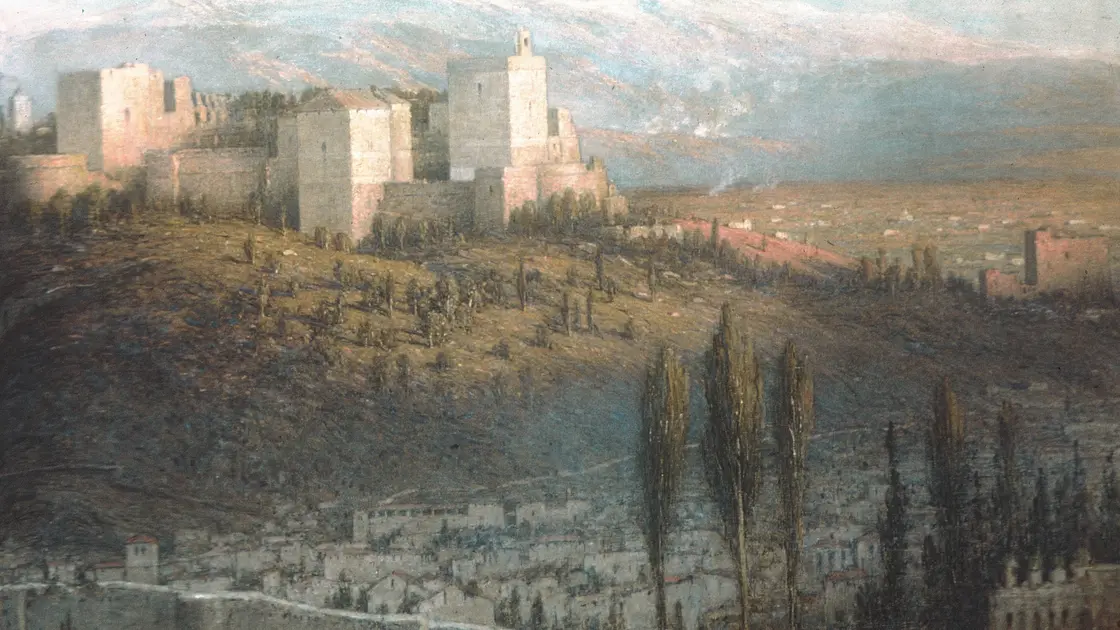
Before Granada had a single Nasrid stone in place, the western spur of the Sabika hill already had walls. The earliest documented fortification on the site dates to 889, during the civil strife, the fitna, tearing apart the Caliphate of Córdoba, to which Granada then belonged.[1] A local strongman named Sawwar ibn Hamdun took refuge in an existing fort on the hill and repaired it to withstand fighting between Arab, Muladi, and Berber factions contesting the emirate's weakening grip on the south.
Very little survives describing what that structure looked like. What matters is the sequence it starts: this pre-Nasrid fortification places the site's military life roughly 350 years before Muhammad I ever climbed the hill. Granada in 889 was a provincial town, not an independent kingdom, and its fort mattered because the Vega below it was contested ground during a decade of factional war. The refuge Sawwar ibn Hamdun repaired had none of the named towers visitors climb today. What it had was the same tactical logic every later builder, Zirid, Nasrid, Castilian, kept: a defensible spur where the hill drops toward the Darro river.
When the Cordoban caliphate finally collapsed in the early 11th century, al-Andalus splintered into competing taifa kingdoms, and Granada became the seat of the Zirid dynasty, Berber rulers whose fuller story belongs elsewhere. What concerns the Alcazaba is narrower: the Zirids built a new citadel on Sabika hill known as al-Qasaba al-Jadida, 'the New Citadel,' the term that eventually softened into the Spanish word alcazaba.[2]
This Zirid stronghold was considerably smaller than what stands today. It depended on a single onsite cistern for water, and its perimeter walls, studded with towers, descended toward the Darro valley rather than enclosing the full hilltop the Nasrids would later claim. A useful comparison sits a few hundred metres downhill in the Realejo: the Torres Bermejas, another set of Moorish defensive towers from roughly the same era, still standing as a reminder that 11th-century Granada was fortifying more than one hill at once. Neither structure resembled a palace. Both were built by people who expected to be attacked.
Muhammad I and the Nasrid refoundation of 1238
The turning point arrived in 1238, when a Granadan nobleman named Muhammad ibn Yusuf ibn Nasr, remembered as Muhammad I ibn al-Ahmar, founded the Nasrid emirate and moved his capital to Sabika hill.[3] The fuller political story of how he got there belongs to the Nasrid dynasty; what matters for the Alcazaba is that he did not start from nothing. He reused sections of the Zirid foundations to rebuild and enlarge the fortress, and completed an aqueduct that same year, supplying the hill with water and making the rest of the Alhambra hill possible.
This is the fact worth sitting with: the Alcazaba existed as a working military fortress before a single Nasrid palace was built beside it. Muhammad I is said to have lived briefly inside the fortress's Torre del Homenaje before purpose-built residential quarters went up elsewhere on the hill. The Alhambra that draws visitors today, with its stucco halls and courtyards, grew up around a fort that already had defensive walls, a garrison, and a water supply. Sequence matters here more than most guidebooks let on: defense first, decoration later, by roughly a full generation.
The three towers of the Nasrid ramparts
Three towers built into the Alcazaba's ramparts define its Nasrid-era skyline: the Torre del Homenaje (Keep), the tallest of the three at 26 metres, the Torre Quebrada (Broken Tower), and the Torre de la Vela (Watch Tower), the one every visitor photographs from the Mirador de San Nicolás across the valley.[1] The Keep anchors the fortress's interior and may have briefly housed Muhammad I before his household moved to purpose-built quarters. The Torre de la Vela stands at the fortress's western tip, overlooking the city and the Vega plain stretching toward the Sierra Nevada foothills.
Tower
Attributed to
Role
Torre del Homenaje
Muhammad I, 1238 campaign
Keep; possibly his first residence on the hill
Torre Quebrada
Disputed: Muhammad I (1238) or Yusuf I (14th c.)
Eastern rampart defense
Torre de la Vela
Muhammad I, 1238 campaign
Watchtower over the city and the Vega
Torre Quebrada's construction date is one of the few genuine disputes in the Alcazaba's history. One account attributes it to Muhammad I's original 1238 campaign, alongside the other two towers; another attributes it to Yusuf I, a full century later. No source settles the question cleanly, and rather than pick a winner, it is worth simply noting the towers were not all raised at once. The Alcazaba, like the rest of the Alhambra hill, was a construction site for generations, not a single building project.
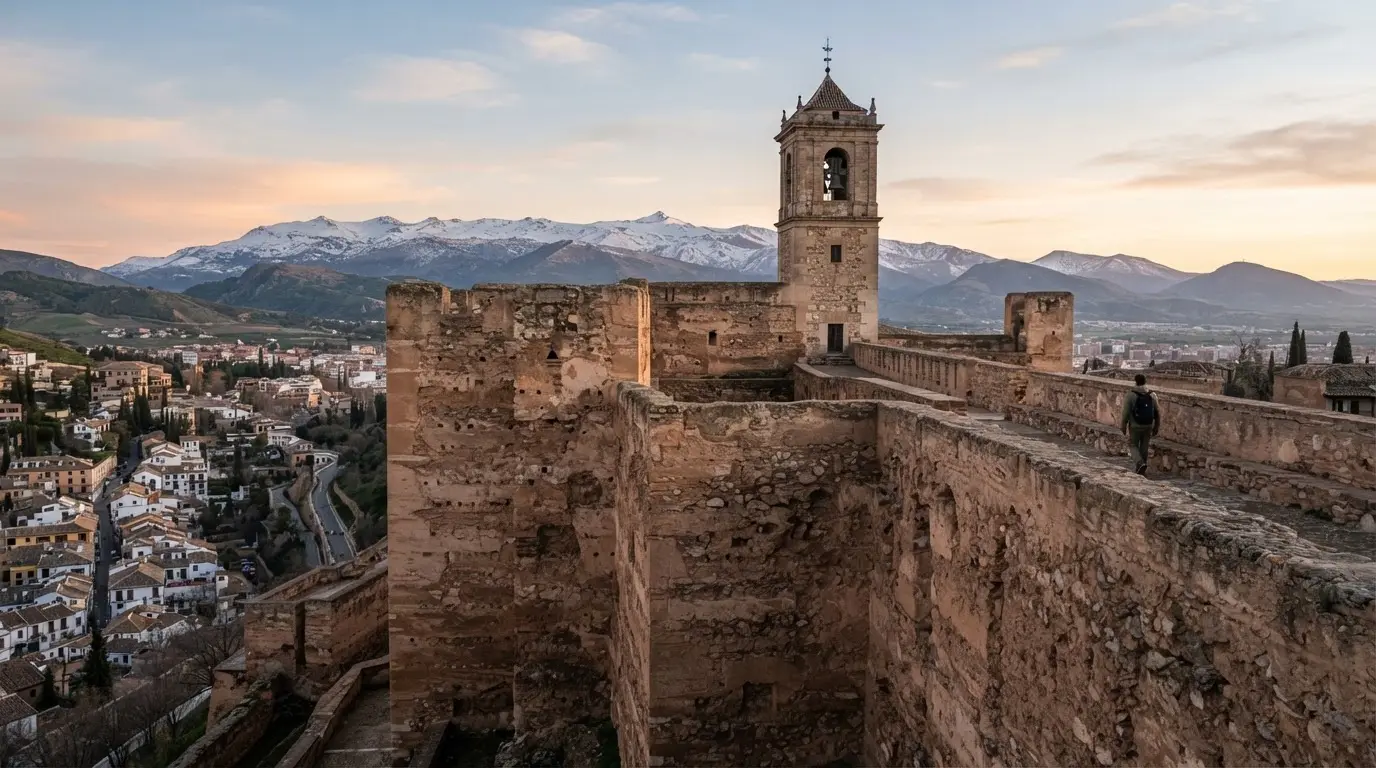
Torre de la Vela and Torre del Homenaje towers of the Alcazaba fortress in Granada, rising above ochre ramparts built during the Nasrid dynasty's 1238 refoundation
Torre de la Vela: the bell, the surrender, and the Día de la Toma
The Torre de la Vela's meaning shifts entirely at the end of the Nasrid period. On 2 January 1492, following Granada's surrender, the Castilian royal standard was raised over the tower, marking the end of nearly eight centuries of Muslim rule on the peninsula, an event covered in full in the Reconquista.[4] The Catholic Monarchs brought a bell from Castile known as La Vela, 'the sentinel,' to ring out the victory and, afterward, to regulate irrigation schedules for the farmland of the Vega below.
That bell has been recast more than once; the one that rings today dates to 1773.[5] Every 2 January, Granada marks the Día de la Toma (Day of the Capture) by ringing it continuously, a tradition the city still observes with an official ceremony. Local folklore held that any unmarried woman who climbed the tower to ring the bell herself would marry within the year, a piece of popular superstition rather than documented history, though guides still mention it on the day itself while watching tourists climb the stairs anyway.
Disaster and rediscovery: gunpowder, earthquakes, Napoleon, and Torres Balbás
Once the Alcazaba passed into Castilian hands, Spain spent roughly a century, from 1492 to about 1589, reinforcing it to withstand gunpowder artillery, even though the fortress saw almost no further combat. The upgrades did not spare it from disaster.
Timeline
1590
Gunpowder magazine explodes near the Torre de la Vela
A blast beneath the tower forces repairs across several ramparts.
1522 & 1821
Earthquakes strike the Alhambra hill
Structural damage compounds across three centuries of use.
1812
Napoleonic troops mine the fortifications
Retreating French forces destroy part of the complex during the Peninsular War.
1923–1936
Torres Balbás excavates and restores the Alcazaba
Clearance work uncovers the fortress's residential and garrison quarter.
Three centuries of gunpowder and earthquakes
In 1590, a gunpowder magazine sited near the Carrera del Darro, directly beneath the Torre de la Vela, exploded and badly damaged the tower, forcing repairs to it and to several neighbouring towers.[6] The complex was shaken again by earthquakes in 1522 and 1821, damage layered on top of damage that later restorers would spend a century untangling.[7] None of this made international news at the time. It simply meant that the fortress visitors see today carries scar tissue from at least three separate disasters before Napoleon's troops ever arrived.
Napoleon's retreat and the twentieth-century excavation
As French troops withdrew from Granada in 1812 during the Peninsular War, they mined the Alhambra's fortifications, destroying the Torre de los Siete Suelos almost entirely (it was not rebuilt until the 1970s) and leaving the Torre del Agua in ruins; both towers sit elsewhere on the Alhambra hill, and the Alcazaba itself escaped the worst of the demolition.[8] The precise story of a soldier cutting a fuse before more could be blown up circulates widely online without a single clearly attributable source. Treat it as local legend until a primary account settles the details.
What is documented is the recovery. Between 1923 and 1936, architect and archaeologist Leopoldo Torres Balbás led the excavation and restoration that cleared centuries of accumulated rubble from the Alcazaba's interior and uncovered its residential and garrison quarter: the barracks, cisterns, and street layout of the soldiers and families who once lived inside the walls.[9] That work is the basis for what we now understand the Alcazaba to be: not simply a defensive perimeter, but a self-contained military settlement, distinct in function from the palatial quarters that rose beside it a century later.
FAQ about alcazaba granada fortress history
How old is the Alcazaba of Granada?
The Alcazaba's history begins in 889, when Sawwar ibn Hamdun took refuge in an existing fortress on the site during civil strife in the Caliphate of Córdoba. That makes the fortress roughly 1,100 years old in its earliest form, though what stands today reflects a Nasrid rebuilding from 1238 onward, with later Castilian modifications.
Who built the Alcazaba of Granada?
No single builder is responsible. The earliest fort was repaired by Sawwar ibn Hamdun in 889. The Zirid dynasty built a citadel called al-Qasaba al-Jadida on the same spot in the 11th century. Muhammad I ibn al-Ahmar, founder of the Nasrid dynasty, rebuilt and enlarged it from 1238, and Castilian forces reinforced it after 1492 for gunpowder artillery.
What is the difference between the Alcazaba and the Alhambra?
The Alcazaba is the military fortress at the western end of the Alhambra hill, the oldest surviving structure in the whole complex. The Alhambra is the umbrella name for the entire hilltop site, including the Alcazaba, the Nasrid Palaces, and the Generalife gardens, built roughly a century after the fortress itself.
Who was Sawwar ibn Hamdun?
Sawwar ibn Hamdun was a local strongman who took refuge in an existing fortress on Sabika hill in 889, during a period of civil strife affecting the Caliphate of Córdoba, and repaired it to withstand the fighting. His is the earliest documented name connected to the site, roughly 350 years before Muhammad I founded the Nasrid dynasty there.
Why is the bell rung at the Torre de la Vela every 2 January?
The bell marks the Día de la Toma, the anniversary of Granada's surrender to the Catholic Monarchs on 2 January 1492, when the Castilian flag was first raised over the tower. The current bell dates to 1773, replacing earlier ones damaged by a 1590 gunpowder explosion and later earthquakes.
Did Napoleon's troops destroy part of the Alhambra?
Retreating French forces mined the Alhambra's fortifications in 1812, during the Peninsular War, destroying the Torre de los Siete Suelos almost entirely and leaving the Torre del Agua in ruins, both elsewhere on the Alhambra hill; the Alcazaba itself escaped the worst of it. The popular story of a soldier cutting a fuse in time is widely repeated but not clearly sourced.
What is the oldest surviving part of the Alhambra?
The Alcazaba is the oldest surviving part of the Alhambra complex. Its documented military history goes back to 889, roughly 350 years before Muhammad I began building the Nasrid Palaces beside it in the mid-13th century.