The Alpujarras Villages: Morisco Refuge After 1492
After 1492, the Alpujarras sheltered Granada's Morisco community for 80 years. Their tinaos, acequia channels, Berber chimneys, and flat launa roofs survive.
Seven years resident in Granada. Specialist in Nasrid architecture, Al-Andalus history, and Andalusian walking routes.
Updated Published
The Alpujarras did not become famous for white villages and mountain air. For the century after 1492, they were the one place in the Kingdom of Granada where a Morisco family could live at some remove from the Inquisition's reach. The same geography that makes the Poqueira gorge so photogenic today (high, steep, remote) made it defensible, and the building traditions those communities carried from Nasrid Granada into the mountains survived because nobody came to replace them.
The Capitulations of Granada in November 1491 promised the Muslim population of the surrendered city that they could keep their religion, their language, and their customs. Seven years later, Cardinal Cisneros had burned the Arabic manuscripts in the Plaza Bib-Rambla and forced mass baptisms. By 12 February 1502, a royal decree required every Muslim in the Crown of Castile to convert or leave.[1]
Most converted. Those who did became Moriscos: outwardly Christian, often privately Muslim. The Morisco history of Granada covers the full arc of forced conversion and eventual expulsion. What matters here is where the Morisco community actually went to live.
The Alpujarras, the southern slope of the Sierra Nevada running from Granada down toward the coast, had been a Nasrid agricultural heartland for silk production. After 1502, it became the effective Morisco hinterland. The villages there, strung along deep ravines, connected by mule paths, sitting at elevations that kept winter roads impassable, offered practical distance from Granada's Inquisition tribunal. Families who could not sustain the performance of Christianity in the city moved south into the mountains.
Between 1502 and 1568, the Alpujarras functioned as a semi-autonomous Morisco zone: taxed by the Crown, supplied with silk that the Granadan economy depended on, but left largely to its own customs. The village communities maintained Arabic as a spoken language, kept Islamic burial practice, and preserved building methods they had inherited from al-Andalus. The Crown tolerated this because the silk trade was too valuable to disrupt. When that calculation changed, what followed was the most violent episode in the history of these mountains.
~80,000
Moriscos forcibly expelled from the Kingdom of Granada after the 1568–1571 revolt. They were dispersed across Castile (Córdoba, Toledo, León, Seville) in groups small enough to prevent organised resistance.
Tinao, terrao, and chimney: the Berber architecture of the high villages
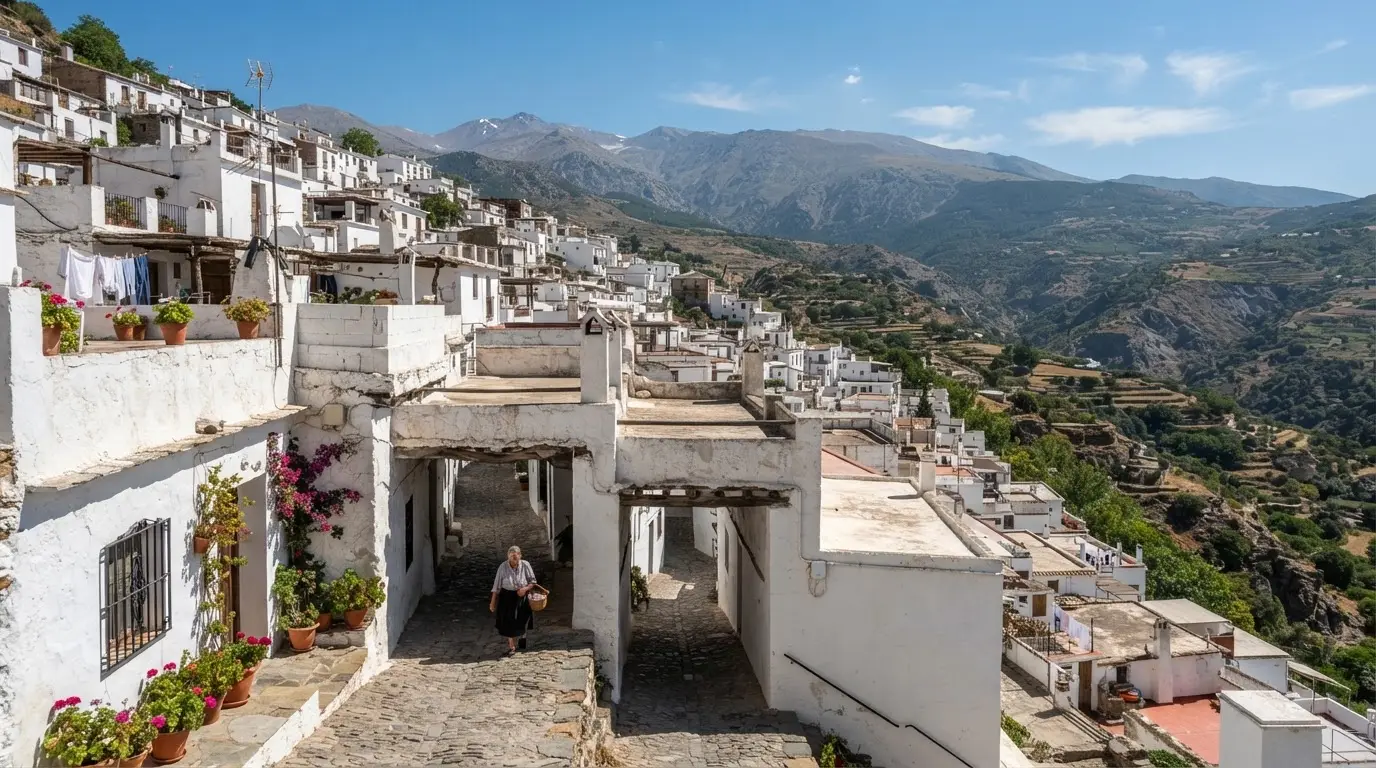
Walk into any of the Poqueira valley villages and within five minutes you will have walked under a tinao. These are covered passages, not decorative arches: they span the street between two houses, the upper floor of one building continuing across the road to connect with the building opposite, the whole thing resting on chestnut beams set into stone walls and roofed with slate slabs.[2] In some villages they are so frequent that you spend more time in shadow than in sun.
The tinao solved a specific problem. In a mountain village built on a steep ravine slope, ground is scarce. Extending the house across the street rather than down the hillside added living space without excavation. The passages also created covered livestock routes between houses, kept paths clear of snow, and provided shade in summer. They originated in the Muslim period and the Moriscos brought the form with them into the mountains intact.
Above the tinaos sit the terraos: flat rooftop terraces sealed with launa, a grey clay found only in the Sierra Nevada that swells when wet to form a waterproof membrane. Launa roofing requires maintenance: after heavy rain it needs to be rolled and re-smoothed. But it insulates against cold far better than tile, and in a village at 1,400 metres[2] this matters more than ease of maintenance. The terrao functions as an outdoor room from late spring through early autumn: a place to dry grain, hang washing, sleep in summer heat.
The chimneys are harder to miss. Truncated cone-shaped, they narrow toward the top and are capped with a flat slate slab held up on a small stone collar, leaving a gap around the perimeter for smoke to escape while the cap deflects wind. The design is identical to chimneys found in the Moroccan Rif and Atlas mountains. It is the same Berber building tradition that the Alpujarras Moriscos carried from their North African origins into al-Andalus and then, when driven south from Granada, preserved in these high villages.[2]
A shared Berber building tradition
The architectural resemblance to Moroccan mountain villages is not coincidental or romantic projection. It reflects the actual ethnic composition of al-Andalus: a substantial Berber population that arrived with the 8th-century Arab expansion and maintained its building methods across the peninsula for seven centuries. When the Moriscos of Granada retreated to the Alpujarras, they were, in part, returning to a construction vocabulary their ancestors had used in North Africa.
Acequia networks: a thousand years of Sierra Nevada snowmelt
The villages of the Alpujarras would not exist at their current locations without the acequia system: a network of irrigation channels cut from mountain streams to carry Sierra Nevada snowmelt across the terraced hillsides below each village.[2] The main channels, often called acequias madres (mother ditches), run for kilometres along near-level contour lines, channelling water from high-altitude streams before it falls too fast into the valley floor. From these primaries, smaller channels split off to individual plots in a distribution hierarchy that the Moorish engineers who designed it would recognise instantly.
The Alpujarras acequia network is Moorish in origin and dates to the period of Nasrid rule, though some channels may go back further to the Zirid dynasty of the 11th century. The engineering principle is the same that drives the Alhambra water system: water collected at altitude, distributed by gravity through ceramic-lined channels, arriving at the destination with enough pressure to fill cisterns and irrigate terraces without pumping.
What is unusual about the Alpujarras system is that it survived the 1571 expulsion largely intact. When the Morisco population was removed, the new Christian settlers who replaced them (arriving from Galicia, Asturias, and Burgos, farming cultures from wet Atlantic regions with no experience of dry-land irrigation) found the channels already there and used them because the alternative was watching their crops fail. Approximately 7,000 settlers from northern Spain remained permanently; far fewer than the Morisco population they replaced.[1] They maintained the acequias without fully understanding the hydraulic logic behind them, which is one reason some sections fell into disrepair.
Recommended tours
Tours are selected for quality, not commission. We earn a small fee if you book — at no extra cost to you.
The channels in active use today, particularly around Capileira and Pampaneira, carry water that has followed the same route for over a thousand years. The communities that maintain them still follow distribution schedules called turno de agua (water rotation) that echo the Moorish legal framework of riparian rights, adapted rather than replaced by the new settlers.
The 1567 decree and the Morisco rebellion
For sixty years after 1502, the Crown's interest in the Alpujarras was primarily fiscal. The Morisco silk trade generated reliable tax revenue, and disrupting it would have cost more than it gained. Philip II ended that calculation on 1 January 1567 with the Pragmática Sanción, a decree that banned:
The use of Arabic in any context, public or private
Moorish dress, including the haik and the use of henna
Traditional hammam baths
Zambra and leila musical celebrations
Islamic wedding customs
Locked doors on Fridays
Pedro de Deza, president of Granada's Audiencia, enforced the decree with a vigour that went beyond its letter: house searches, confiscation of personal items, prosecution of individuals for customs that had been tolerated for decades.[1] The three-year grace period nominally granted by the decree became irrelevant when Deza began enforcement immediately.
The response came on Christmas Eve 1568. In the village of Béznar, in the lower Alpujarras, a group of Morisco conspirators proclaimed Hernando de Córdoba y Valór as rebel king. He took the name Aben Humeya, claiming Umayyad descent, and the rebellion spread through the mountains within weeks. The full story of Aben Humeya's rise and assassination is its own chapter of the Alpujarras.
The geography that had sheltered Morisco communities for sixty years now sheltered a guerrilla war. Rebel forces grew from approximately 4,000 combatants to around 25,000 at the rebellion's peak, supplemented by small numbers of Berber volunteers from North Africa and Ottoman military advisers.[1] The village of Bubión, in the Poqueira gorge, sided with Aben Humeya's forces and was subsequently punished with the complete expulsion of its Morisco population.
Aben Humeya did not survive his own rebellion. Aben Humeya was strangled on 20 October 1569 in a coup led by Turkish military commanders within his forces who had lost confidence in his leadership.[1] His cousin Aben Aboo took command, but the appointment of Don John of Austria as Spanish commander-in-chief changed the military equation. Don John arrived with resources and authority his predecessors had lacked. By spring 1570, the rebellion controlled only isolated mountain valleys. Aben Aboo was betrayed and killed near Bérchules in 1571.
Timeline
1 January 1567
Pragmática Sanción signed
Philip II bans Arabic, Moorish dress, hammams, and Islamic customs. Pedro de Deza enforces through house searches.
24 December 1568
Rebellion begins at Béznar
Aben Humeya (Hernando de Córdoba y Valór) proclaimed rebel king on Christmas Eve.
October 1569
Aben Humeya strangled
Killed on 20 October 1569 in a coup led by Turkish military commanders within his forces. Aben Aboo takes command.
Early 1570
Don John of Austria appointed
Philip II's half-brother takes supreme command. Rebel territory reduced to isolated valleys.
March 1571
Rebellion suppressed
Aben Aboo killed near Bérchules. ~80,000 Moriscos expelled from the Kingdom of Granada into Castile.
The rebellion lasted 27 months, from December 1568 to March 1571. The human cost was severe on both sides. What followed was the systematic removal of the entire Morisco population of the Kingdom of Granada.
Village by village: Pampaneira, Bubión, Capileira, Trevélez
The four villages most visited today in the Alpujarras each carry a different piece of the Morisco story. For a later chapter in another village, Yegen, see Gerald Brenan in Yegen.
Pampaneira sits at the southern mouth of the Poqueira gorge,[2] the most-visited of the three gorge villages and the easiest to reach from Granada. Its tinaos are among the best-preserved in the region, spanning narrow streets where the temperature drops noticeably as you pass under the chestnut beams. The village was a Morisco settlement before 1571; the street plan you walk today follows the same organic layout the community built, adjusted to the hillside rather than imposed on it. The church of San Pedro, built over or beside a mosque site after the Christian takeover, is the only addition that breaks the pre-1571 fabric substantially.
Bubión is the village that sided with Aben Humeya during the rebellion. After 1571, the entire Morisco population was expelled and the village emptied. What makes Bubión unusual is that the buildings the Moriscos left behind were occupied, not demolished, by the incoming Christian settlers. The architecture survived because the settlers could not easily build differently in mountain terrain with local materials. The tinaos in Bubión include some of the most intact examples in the Alpujarras: original chestnut beams, original slate roofing, original stone abutments.
Capileira: acequias and the highest views
Capileira sits at the head of the Poqueira gorge,[2] the highest of the three gorge villages and the one with the most dramatic views across the Sierra Nevada. The Barranco de Poqueira ravine drops away sharply below the village streets. Capileira's acequia network is more visible than Pampaneira's. You can follow the main channel on foot along the hillside above the village, watching it feed the terraced plots that the Morisco agricultural community laid out and the current smallholders still work. Capileira lay within the rebellion's principal theatre in the Poqueira gorge.
Trevélez: Spain's highest village
Trevélez, at approximately 1,476 metres, is often cited as Spain's highest permanently inhabited village.[2] Its Morisco history sits beneath its contemporary reputation for cured ham. The village is divided into three distinct barrios (Alto, Medio, Bajo) stacked up a steep slope in a layout that the Morisco community organised around water access and altitude. The upper barrio, Barrio Alto, preserves the tightest concentration of traditional architecture: tinaos, launa roofs, the truncated cone chimneys. The lower barrios show more post-1571 construction. Trevélez was occupied and repopulated after the expulsion, but the northern settlers who arrived found the upper village too steep and cold for their purposes; they concentrated lower down, which left Barrio Alto largely as the Moriscos had built it.
What survives: architecture, acequias, and a contested legacy
The Morisco expulsion of 1571 removed the people. It did not remove what they had built. The resettlement of the Alpujarras was chronically underfunded: the Crown brought settlers from Galicia, Asturias, and Burgos, farming cultures with different habits, and offered them land grants and tax exemptions that still did not make the remote mountain villages attractive enough to fill the population vacuum. Of the settlers who arrived, roughly 7,000 remained permanently, far short of the Morisco population they replaced.[1] Large stretches of the Alpujarras were effectively abandoned for a generation.
The result is that the physical fabric of the Morisco Alpujarras survived almost by default. Nobody came to demolish it. Nobody had the resources or the motivation to rebuild in a different style. The new communities simply moved into existing houses and maintained existing infrastructure. Tinaos that the Moriscos built are still in daily use as covered passages and extended living space. Acequia channels that the Moorish engineers designed still carry Sierra Nevada snowmelt to terraced plots. The truncated cone chimneys still vent kitchens in houses where families have lived for five centuries without knowing, or needing to know, that the chimney design is Berber.
For visitors, the villages of the Poqueira gorge offer the most concentrated architectural experience. The Alpujarras day trip from Granada covers practical logistics for getting there. What the logistics guides do not cover is what you are actually looking at when you stand in a tinao in Bubión: the physical residue of a community that was driven here by force, built what it knew, survived for eighty years, and was then removed again. The architecture they left behind is not picturesque accident. It is the material evidence of a specific history.
The acequia system across the Alpujarras has been recognised by the Food and Agriculture Organisation of the United Nations as a Globally Important Agricultural Heritage System partly because of its continuous operation since the Moorish period. The channels are not a museum exhibit. They are working infrastructure, maintained by the communities that depend on them, following water-rights schedules that echo the Moorish legal framework adapted seven centuries ago for these specific slopes.
The wider Morisco story
The wider Morisco story, including the 1492 Reconquista that preceded it, the forced conversions, and the final 1609 expulsion across Spain, is examined in companion articles. The Alpujarras is the place where the architecture of that community survived because the mountains were difficult to reach and easy to defend, and because the settlers who replaced the Moriscos had neither the numbers nor the resources to build differently.
Frequently asked questions
Why are the Alpujarras villages white?
The whitewash on Alpujarras houses is lime render applied to the exterior stone walls. The practice predates the Morisco period and reflects a building tradition common across the southern Mediterranean and North Africa, particularly in Berber mountain villages of the Moroccan Rif and Atlas. The Moriscos who settled the Alpujarras after 1502 maintained this tradition because it served practical purposes: lime is a natural disinfectant, it reflects summer heat, and it seals the porous stone against moisture. Whitewash also marks the owner's maintenance of the property; letting it flake means the building fabric is being neglected. The characteristic white is lime, not paint. It requires reapplication every few years and the villages that look most striking today are the ones where this maintenance tradition has continued.
What happened to the Moriscos in the Alpujarras?
The Moriscos of the Alpujarras launched a rebellion in December 1568, triggered by Philip II's 1567 Pragmática Sanción banning Arabic, Moorish dress, and Islamic customs. The rebellion lasted 27 months. When Don John of Austria suppressed it in March 1571, Philip II ordered the mass deportation of the entire Morisco population of the Kingdom of Granada: approximately 80,000 people were marched out and dispersed across Castile (Córdoba, Toledo, León, Seville) in groups small enough to prevent further organisation. The Alpujarras villages were repopulated with Christian settlers from Galicia, Asturias, and Burgos, though only around 7,000 remained permanently. The Morisco communities dispersed into Castile continued practising Islam in secret. The remaining Morisco populations across Spain were finally expelled by Philip III's decree of April 1609, with most Granadan Moriscos settling in Morocco, particularly Tetuán.
What is special about Alpujarras architecture?
Alpujarras architecture is distinctive for three features absent from most of rural Spain: tinaos (covered passages spanning the street between connected buildings), terraos (flat rooftop terraces sealed with launa clay rather than tiles), and truncated cone chimneys capped with a slate slab and stone collar. These forms derive from Berber North African building traditions carried into al-Andalus by the 8th-century Arab-Berber expansion and maintained by the Morisco community through the centuries of Nasrid rule and after 1502. The launa clay used for roof sealing is found only in the Sierra Nevada; it swells when wet to form a waterproof membrane but requires periodic rolling and maintenance. The architecture closely resembles villages in the Moroccan Rif and Atlas mountains, reflecting the shared building heritage of the Berber populations on both sides of the Strait of Gibraltar.
What is a tinao in the Alpujarras?
A tinao is a covered passage spanning a street between two houses, formed by extending the upper floor of one building across the road to connect with the building opposite. The structure rests on chestnut beams set into stone walls, topped with slate slabs. Tinaos originated in the Muslim period as a practical solution to the problem of building on steep mountain terrain where ground is scarce: extending the house across the street rather than down the hillside added living space without excavation. They also created covered livestock routes between houses, kept paths clear of snow, and provided shade in summer. In the Poqueira gorge villages of Pampaneira, Bubión, and Capileira, tinaos are common enough that you move in and out of shadow constantly walking through the streets. Bubión in particular has some of the most intact original examples, with original chestnut beams and slate roofing still in place.
When was the Morisco rebellion in Granada?
The rebellion began on Christmas Eve 1568, in the village of Béznar in the lower Alpujarras. The trigger was Philip II's Pragmática Sanción of 1 January 1567, which banned Arabic, Moorish dress, hammams, and Islamic customs, enforced by Pedro de Deza, president of Granada's Audiencia, through house searches and immediate prosecution. The rebel leader was Hernando de Córdoba y Valór, who took the name Aben Humeya and claimed Umayyad descent. Rebel forces grew from around 4,000 to approximately 25,000 combatants at the peak. Aben Humeya was strangled on 20 October 1569 in a coup led by Turkish commanders within his forces; his cousin Aben Aboo took command but was killed near Bérchules in 1571 after Philip II appointed Don John of Austria as supreme commander. The rebellion was fully suppressed by March 1571, after 27 months. The Second Revolt of the Alpujarras (historians distinguish it from the First Revolt of 1499–1501) was the final major armed resistance by the Morisco community in Spain.