
A retreat above the palace, not part of it
Most visitors reach the Generalife after the Nasrid Palaces, slightly dazed, half-thinking the serious part is over. That is the wrong way around.
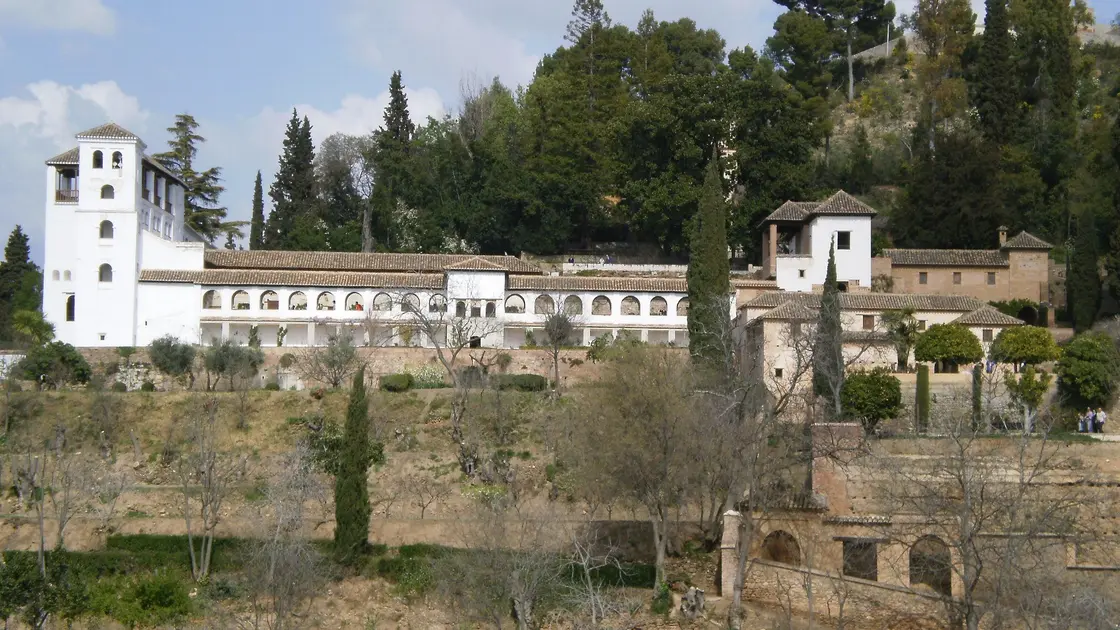
The Generalife sits on the Cerro del Sol, the hill immediately east of the Alhambra, separated from the main complex by a narrow ravine. It was the sultans' country estate — close enough to the fortified palace to be useful, high enough to catch a breeze, and fundamentally different in character. Where the Nasrid Palaces were ceremonies in stone (audience halls, throne rooms, galleries designed to impress visiting ambassadors), the Generalife was a working private retreat. Kitchen gardens on the lower terraces. Orchards. Shade. The sound of water that could be heard before you entered the gate.
The name comes from the Arabic Jannat al-'Arif, most commonly translated as "Garden of the Architect" or "Garden of the Overseer." Scholar Robert Irwin has noted the traditional etymology is disputed and the Arabic origin remains unresolved among historians. An inscription within the complex gives the building's formal name as Dar al-Mamlakat as-Sa'ida, the House of the Felicitous Kingdom. That name tells you more about its intended meaning than any translation debate.
Explore nearby · Monument
Alhambra
The Alhambra is Granada's UNESCO fortress-palace: Nasrid Palaces, Alcazaba and Generalife gardens. Tickets sell out weeks ahead; book via the Patronato site.
The core structure was built either by Muhammad II (r. 1273–1302), which most scholars now prefer, or by Muhammad III (r. 1302–1309), who added the mirador. The uncertainty matters: the site was continuously modified by subsequent sultans. Isma'il I remodelled it in 1319. Yusuf III reworked the southern sections around 1408–1417.[1] What you visit today is a palimpsest — layers of Nasrid decision-making over 140 years, with further alterations after the Reconquista.
The Patio de la Acequia: a garden in four parts
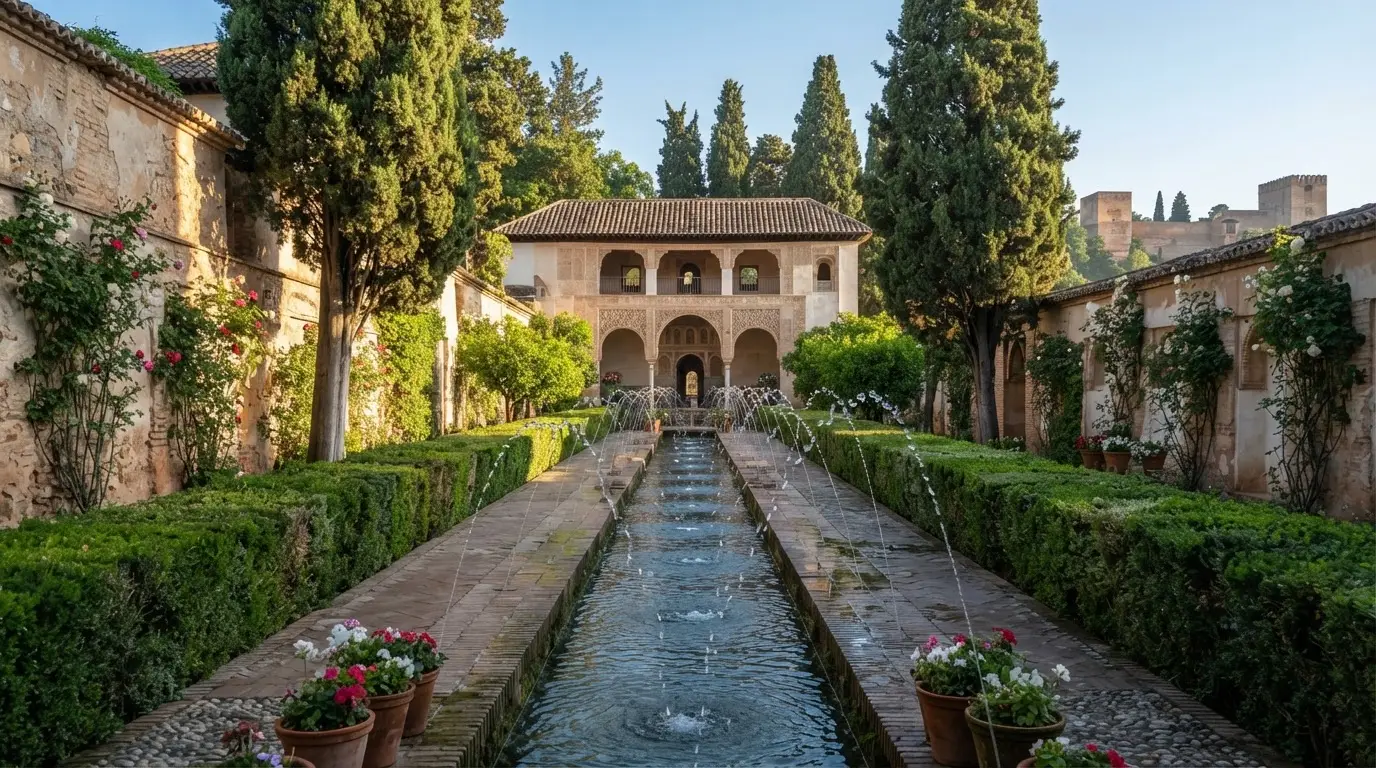
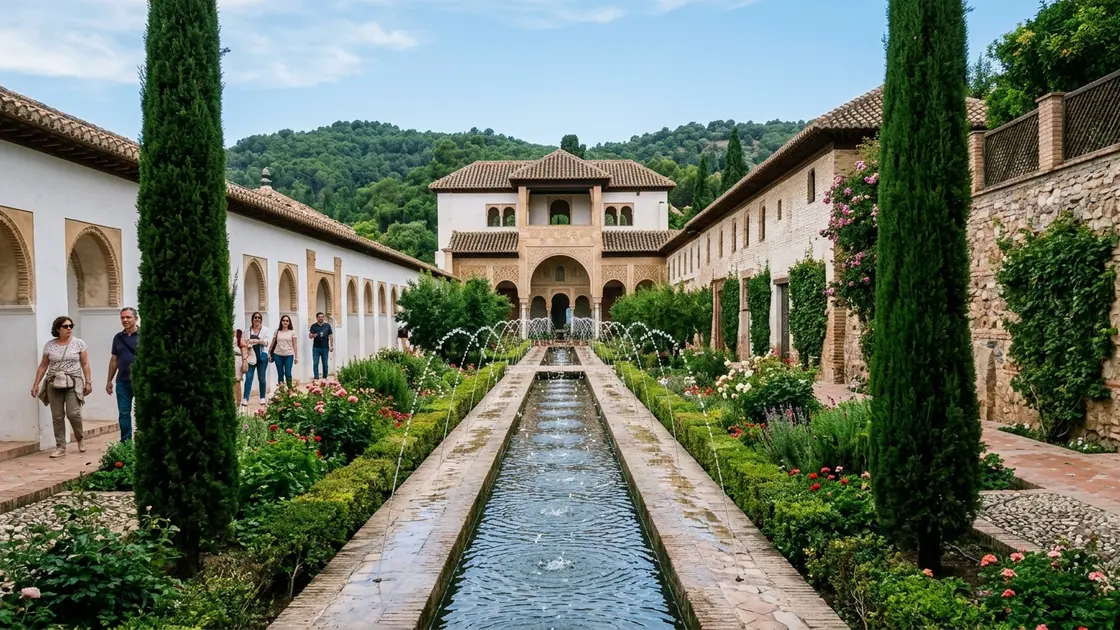
Walk through the main pavilion at the south end and the Patio de la Acequia opens in front of you: 12.8 metres wide, 48.7 metres long, with a narrow water channel running straight down its central axis. The myrtle hedges rise to shoulder height on either side, clipped flat on top. Cypress trees mark the corners. At the far end, a columned mirador frames the view back over the garden.
The proportions are not accidental. The Patio de la Acequia is a direct expression of the chahar bagh layout — the Persian "four gardens" design principle in which a space is divided into quadrants by two perpendicular water channels, with the crossing point at the centre.[2] In Islamic cosmology this pattern represents the four rivers of paradise described in the Quran: rivers of water, milk, honey, and wine. The Patio de la Acequia is elongated rather than square, but the quadripartite logic holds. The sunken planting beds on either side of the channel are its four quadrants.
48.7 metres
A practical note on the fountains: the arching jets of water you photograph today are a 19th-century addition. The Nasrid original was a straight channel with lower lateral spouts. The alberca (reflecting pool) effect of the original channel was quieter and more formal than the modern arrangement. Photographs from before the 20th-century restoration show a very different courtyard.
In 1958, a fire damaged part of the Generalife and prompted excavations that uncovered original Nasrid-era paths and sunken planting beds that had been obscured by later modifications.[3] The current orange trees and myrtle hedges approximate the Nasrid planting scheme but do not replicate it precisely. The 1958 fire was, in an irony typical of heritage sites, one of the more useful things to happen to the garden's archaeological understanding.
Water geometry: how the channel animates the space
Stand at the south pavilion and look down the Patio de la Acequia toward the mirador. The central channel catches the sky. In the morning, when the light comes in low from the east over the hill, the water reflects it back as a moving stripe of brightness along the garden's spine. The smell at this hour, in spring, is myrtle and damp stone. The same √2 proportional system and bayt modular grid that governs the Nasrid Palaces interiors extends to the Generalife's spatial ratios — explored fully in the our Alhambra geometry feature.
The water running through that channel arrives via the Acequia Real (Royal Canal), a gravity-fed aqueduct ordered by Muhammad I in the 13th century and engineered with a gradient of 2 to 3 per thousand, precisely calculated so that water moves steadily without eroding the channel bed. The principle the Nasrid hydraulic engineers worked to: "water must walk, not run." For the full story of how the Acequia Real works and how it supplies the entire Alhambra complex, the Alhambra's engineering article covers that engineering in depth.
What matters here is what that water does once it arrives. Within the Generalife, water was distributed to three distinct levels:
Recommended tours
Tours are selected for quality, not commission. We earn a small fee if you book — at no extra cost to you.
- The main courtyard level (Patio de la Acequia): channel flow and lateral spouts
- The upper terraces (Jardines Altos): fed by the Albercones reservoir, which held up to 400 cubic metres and used an animal-powered waterwheel mechanism to lift water beyond the reach of gravity flow alone[4]
- The Escalera del Agua: a staircase whose balustrades are hollow stone channels carrying running water for the full length of the climb
Each of these is a different expression of the same design principle: water as structural element, not ornament. The channel defines the axis of the Patio. The reservoir enables the terraces. The Escalera del Agua makes the act of climbing the hill itself a sensory experience.
The Escalera del Agua and the upper gardens
Most visitors stop at the Patio de la Acequia and turn back. This is a significant mistake.
The Escalera del Agua (Water Stairway) climbs the hillside above the main courtyard through a canopy of laurel trees, their branches meeting overhead to form a tunnel of shade. The balustrades on either side of the staircase are carved with continuous channels, and water runs down them for the entire length of the climb — you hear it before you see it, a low constant sound that changes pitch slightly as the flow moves over the stone joins. In July, when the exposed upper terraces are brutal in the afternoon heat, this staircase stays cool.
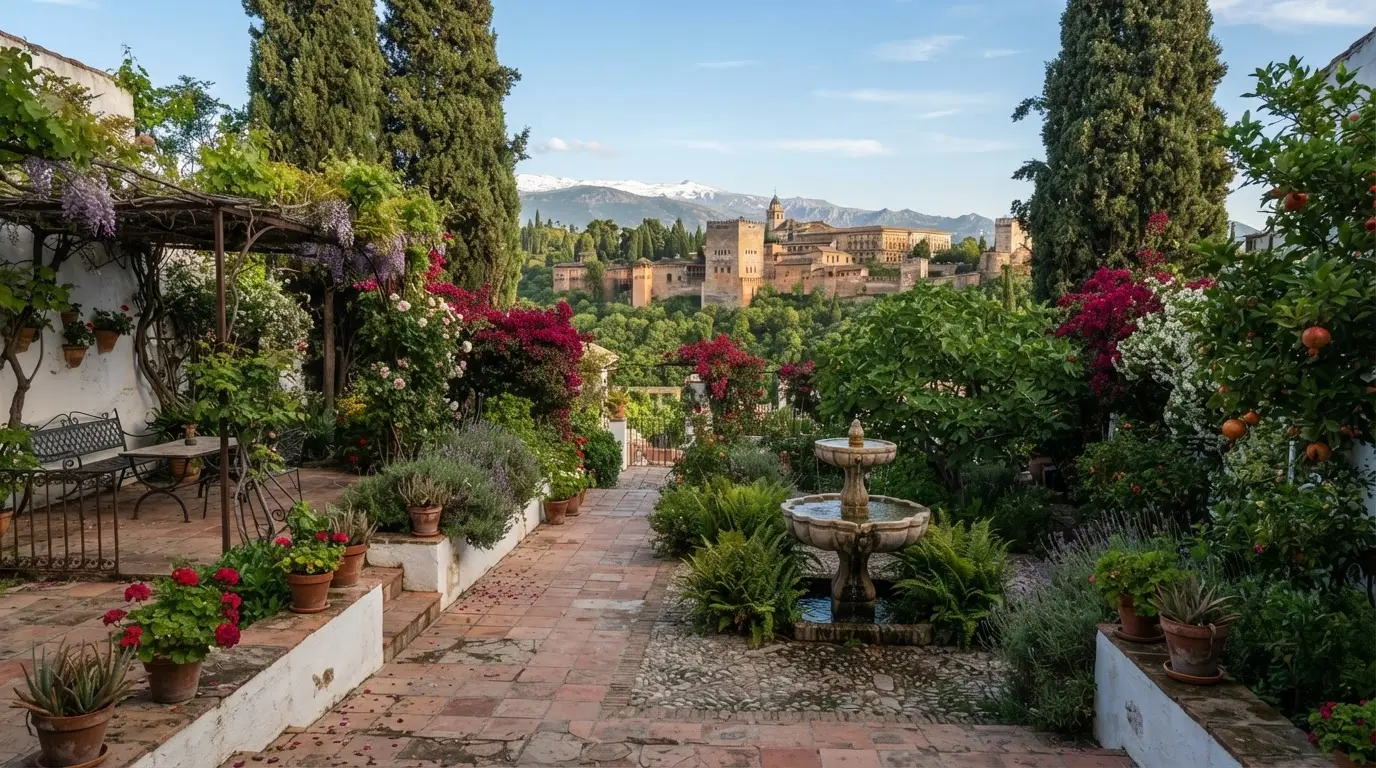
At the top, the Jardines Altos (Upper Gardens) open onto a sequence of terraced spaces with views across the Alhambra rooftops to the Albaicín and the snow-capped Sierra Nevada beyond when the season is right. These upper gardens are largely post-Nasrid in their current form, redesigned during the 19th and 20th centuries, but the terraced structure follows the original plan and the views have not changed.
Deep dive · Article
Cármenes of the Albaicín: Granada's Walled Garden Houses
Granada's cármenes are walled garden villas from Arabic karm (vineyard). Found across the Albaicín since the Nasrid period, two are open free to visitors.
Below the main complex, the Huertas del Generalife (Generalife Orchards) are cultivated terraces that supplied produce to the Nasrid court. The Generalife was not a purely ornamental garden. It was a working agricultural estate (orchards, kitchen gardens, livestock areas) alongside the ceremonial spaces. The huertas still exist as working terraces visible from the garden paths. Seeing them changes how you read the whole site: this was a farm with a beautiful courtyard, not a pleasure garden that happened to grow some fruit.
The Patio del Ciprés de la Sultana and the legend
On the north side of the complex, through a gate from the main garden, the Patio del Ciprés de la Sultana (Sultana's Cypress Court) contains the dried trunk of a cypress tree said to be one of the oldest specimens of Cupressus sempervirens in Granada. The trunk is dead. A plaque identifies it as a site of historical significance.
Attached to this trunk is a legend: Moryama (Maryam), wife of Muhammad XII, known to history as Boabdil, the last Nasrid sultan, was said to have met a knight of the Abencerrajes clan here in secret. When Boabdil discovered the affair, he had as many as 30 Abencerrajes killed in the Alhambra's Hall of the Abencerrajes, the rust-coloured stains on the marble basin there sometimes shown to tourists as blood. Good story. Almost certainly invented.
Historians are direct about this. The legend appears to have been fabricated or embellished by romantic travellers in the 18th century, likely fed by Washington Irving's Tales of the Alhambra (1832) and the appetite of European Orientalists for exotic narratives about Moorish courts.[5] There is no contemporary documentation for the story. The cypress trunk is genuinely old; the tale wrapped around it is not.
There is also a structural caveat that almost no tourist content mentions: the arcaded gallery that surrounds the Patio del Ciprés de la Sultana today dates to 1584–1586, built after the Reconquista by the new Spanish administration. The Nasrid patio was completely redesigned in the post-conquest decades. What you see is not a Nasrid space. It is a late-16th-century Spanish interpretation of what the space might have looked like, built within memory of the Islamic period it replaced.
When to visit: seasons, light, and logistics
The Generalife is included with all Alhambra tickets. Unlike the Nasrid Palaces, which operate on timed entry and sell out months in advance in summer, the Generalife has no timed slot. You can arrive at any point during your visit.
Most people visit in the wrong order: they do the Nasrid Palaces first (because the timed entry forces that), walk to the Alcazaba, and arrive at the Generalife tired and pressed for time. If your ticket allows flexibility, reverse this. Go to the Generalife and upper terraces first, when you have energy and the morning light is still low and useful.
Seasonal differences are real and worth planning around:
Go to the Generalife first, when you have energy and the morning light is still low and useful. Most visitors arrive tired, pressed for time, having saved it for last.
- April and May: roses, wisteria, and irises are at peak. The Patio de la Acequia is at its most photogenic. This is also the busiest period, so arrive before 9:00.
- June: the myrtle is freshly clipped and the garden smells sharply of it. Before the summer heat builds, this is the best month for the upper terraces.
- July and August: avoid the Generalife between noon and 16:00. The upper terraces have no shade. The Escalera del Agua and the lower courtyard stay cooler and are worth it at the right hour — early morning or evening.
- September and October: warm light, thinner crowds, and the ornamental plantings of the lower gardens are still in good shape. The best value-to-crowd ratio of any month.
- Winter: the gardens are quieter than at any other time. Snow on the Sierra Nevada appears above the upper terraces when conditions are right. The oleanders are cut back and the planting beds look bare, but the stone and water geometry reads most clearly without the summer growth obscuring the proportions.