From Granada council chamber to rebel court
Fernando de Válor y Córdoba was born around 1546 in the village of Válor, one of the settlements strung along the Alpujarras below the Sierra Nevada. He was not a peasant. His family claimed descent from the Umayyad caliphs of al-Andalus[1], a lineage that gave him standing among Granada's Morisco elite even after a century of forced conversion had stripped that elite of most of its formal power.
By his twenties he sat as a town councillor in Granada, one of the few Moriscos still permitted a civic role. That career ended abruptly: he was placed under house arrest after drawing a dagger during a council meeting[2], a detail that survives in the record precisely because it was unusual. Whatever the argument was about, it marked him as someone with a temper and a grievance: not a bad résumé for a rebellion looking for a figurehead.
The grievance itself had a clear origin. Philip II's Pragmática Sanción of 1567 had banned the Arabic language, Morisco dress, and Morisco social customs outright, with a three-year grace period that convinced almost nobody it was a genuine compromise. The wider fallout of that decree, and the expulsion it eventually led to in 1609, is its own story, told in full in Moriscos of Granada. What matters here is narrower: by late 1568, a faction of Morisco conspirators in the Alpujarras needed a leader with a plausible royal claim, and de Válor, with his Umayyad genealogy and his history of defying authority, was their candidate.
Christmas Eve, 1568: crowned king of Granada and Andalusia
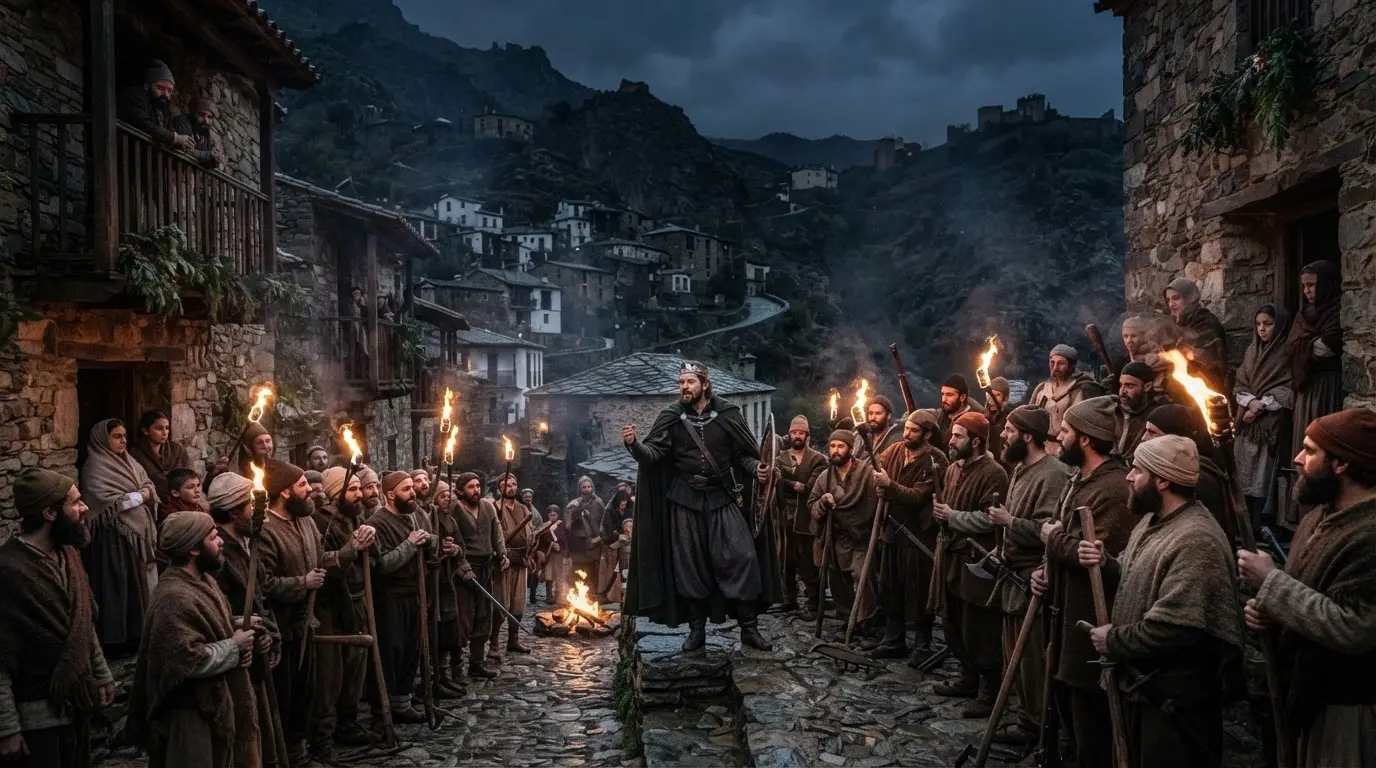
The proclamation happened at Béznar, in the Valle de Lecrín, on the night of 24 December 1568[3]. Representatives of Granada's crypto-Muslim community, along with delegations from across the Alpujarras, gathered in secret to acclaim de Válor as their king. They renamed him on the spot: Aben Humeya, an Arabic royal title rather than a personal name, chosen to evoke the Umayyad dynasty he claimed as his ancestors.
The ceremony was not improvised. His followers dressed him in purple, following what chroniclers describe as the old ceremonial ritual used for the kings of Granada[4] — a deliberate echo of Nasrid coronations from before 1492, staged to make the rebellion look like a restoration rather than an insurrection. Aben Humeya was proclaimed king not just of the Alpujarras but of Granada and Andalusia, a title with no realistic territorial backing but real symbolic weight for a population that had spent seventy years being told its old kingdom no longer existed.
He moved to consolidate the new court through marriage as much as military appointment: he took four wives from different areas of the rebellion, a strategy meant to bind rival Morisco factions and villages to his person[5]. It was a fragile kind of unity, built on alliance rather than shared command, and it would not survive contact with military defeat.
Growing an army in impossible terrain
What had begun as a revolt of roughly 4,000 combatants in the winter of 1568 became a guerrilla war of an estimated 25,000 by 1570[6], swelled by monfíes — mountain outlaws who had already abandoned their villages before the uprising and brought a harder, more violent edge to the fighting[10] — along with small numbers of Berber and Turkish volunteers.
Against them, the Crown initially sent the Marquis of Mondéjar with barely 2,000 foot-soldiers and 200 cavalry[7]. It was not enough, on paper, to hold a mountain range the Moriscos knew intimately and the Spanish were entering for the first time. The Alpujarras rewarded that local knowledge: rebels held the high ground, ambushed columns in narrow passes, and used their knowledge of the sierra terrain to launch surprise attacks[9]. The Alpujarras villages that visitors now drive through on the way to Trevélez and Capileira were, in January 1569, contested ground.
Things to do · Activity
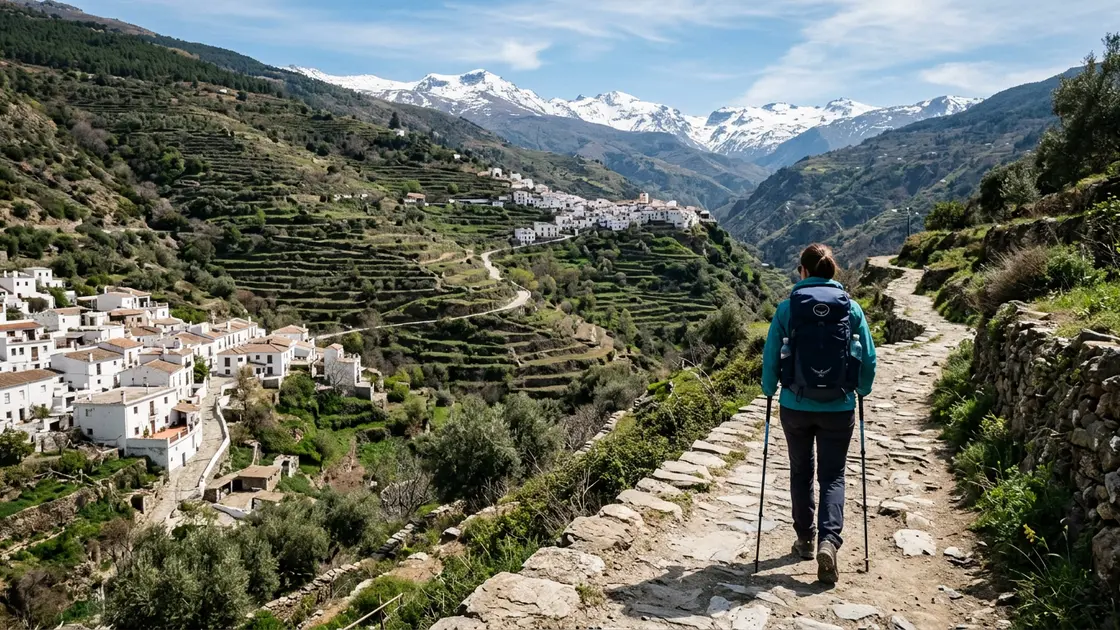
Alpujarras Hiking and Trekking Day Trip
Guided day hike through the Poqueira gorge linking Pampaneira, Bubión and Capileira on ancient Moorish paths. From €45 per person. Spring and autumn are ideal.
Recommended tours
Tours are selected for quality, not commission. We earn a small fee if you book — at no extra cost to you.
Mondéjar's advance still moved faster than the rebels expected. His forces forced the partially destroyed bridge at Tablate in January 1569[11], the first serious obstacle on the road into the mountains, and pressed on from there. It was an uncomfortably fast campaign for a king barely a month into his reign.
200 cavalry
A king in hiding: collapse and internal rivalry
Mondéjar's campaign was faster than it was sustainable. By mid-February 1569 the initial rebellion had been largely suppressed[8] — Aben Humeya's own position had deteriorated so badly that he was reduced to a wanderer, hiding in caves by day and only seeking shelter at night[14]. It is not the image later legend built around a rebel king, but it is the one the record supports.
Spanish troops located and raided his headquarters at Bubión, in the Poqueira valley, recovering the equipment and valuables stored there[12]: a material loss as damaging to his authority as any battlefield defeat, since a rebel king who cannot protect his own court has little left to offer his allies. Even so, Mondéjar's success cost him his command: he was criticised for showing what his superiors judged excessive clemency toward defeated Moriscos, and was removed.
The war did not end with his removal. It dragged through the summer of 1569 in sieges like the one at Frigiliana, where entire Morisco families had gathered together against a Spanish assault that lasted three months[13]. But for Aben Humeya personally, the damage of that February collapse never really healed. A king who spends the spring hiding in caves has already lost the argument that put him on the throne, whatever ground his followers hold through the summer.
The Turkish officers' coup
Aben Humeya was killed on 20 October 1569, strangled in a plot carried out from within his own camp[15]. The traditional account, repeated in most later histories though resting on a single chronicle tradition rather than an independently corroborated primary source, holds that a rival named Diego Alguacil told a group of Turkish officers serving among the rebels that he had supplied hashish meant to sedate their own captains, so they could be killed in their sleep that night. The Turks turned the plot on its head: they refused the offer of the kingship for themselves, proposed a local noble in Aben Humeya's place, and carried out their own coup instead, strangling the king who had meant to move against them. Whether that specific chain of events is exactly what happened, the underlying dynamic is not in serious doubt: the Turkish contingent had grown resentful of a Morisco leadership it judged ineffective, wanted local command for itself, and killed the king to get it.
It was a brutal irony. Aben Humeya had spent a year building alliances through marriage, through a genealogical claim, through a coronation staged to look like the return of a lost dynasty. None of it protected him from the men fighting under his own banner. His cousin, Aben Aboo (also known as Mulley Abdalla), took over as rebel leader, inheriting a command that had just demonstrated exactly how fragile it was. He too would be killed by his own men[16].
Aben Aboo and the war's last chapter
Command did not stabilise under Aben Aboo. Philip II had already appointed his half-brother Don John of Austria as supreme commander in early 1569, and by February 1570 Don John's forces had besieged and captured the rebel stronghold of Galera, ordering the village destroyed once it fell[17]. Elsewhere the fighting turned into a war on civilians as much as combatants: at Albuñuelas, Spanish troops killed the men who could not escape and enslaved roughly 1,500 women and children[18].
Aben Aboo tried to end it. In May 1570 he accepted Spanish surrender terms, then resumed fighting when Berbers arrived with unconfirmed reports of reinforcements on the way[19], reinforcements that never arrived. The war he had inherited from his murdered cousin finally ran out of road in 1571, when Aben Aboo was stabbed to death by his own followers in a cave near Bérchules[20], in the same mountains where the rebellion had begun just over two years earlier.
Deep dive · Article
1066 Granada Massacre: When the Jewish Golden Age Ended in a Day
The 1066 Granada massacre killed Joseph ha-Nagid and thousands of the city's Jews in a single day, ending three decades of Jewish power under Samuel ha-Nagid.
What followed was not the end of the Morisco story in Granada, only its next chapter. Roughly 80,000 Moriscos, about half of the kingdom's Morisco population, were rounded up and marched out of Granada into Castile in brutal winter conditions[21], a deportation distinct from, and thirty years earlier than, the general expulsion of Spain's Moriscos that Philip III would order in 1609[22]. The villages where Aben Humeya's guerrilla war was fought — Bubión, Capileira, the passes above Trevélez — are today walked by hikers rather than soldiers; the Alpujarras hiking trek that crosses them is the closest most visitors will come to standing on that terrain.