Jamon de Trevelez IGP: what the designation actually means
Most content you'll encounter about Trevélez ham calls it a DOP (Denominación de Origen Protegida). This is wrong. The official designation is IGP, Indicación Geográfica Protegida, the EU's Protected Geographical Indication.[1] The Consejo Regulador (Regulatory Council) and ICEX both use IGP consistently. Jabugo and Teruel carry DOP; Trevélez and Serón carry IGP. Two different EU quality schemes, two different legal frameworks.
The distinction is practical. DOP requires both the raw material and the production to originate in the defined area. IGP requires only that a significant stage of production occurs there. For Trevélez, the relevant stage is curación (curing) at altitude, which no other location in Spain can replicate by geography or climate.
1,200 metres
The IGP zone covers eight municipalities in the Alpujarras: Trevélez, Juviles, Busquistar, Pórtugos, La Tahá, Bubión, Capileira, and Bérchules. All lie high on the south face of the Sierra Nevada, above the threshold the IGP specification requires. A farm at lower elevation, or ten kilometres east in a warmer valley, cannot qualify.
To confirm authenticity when buying, check for three things:
- The PGI/IGP logo occupying at least 50% of the label
- A coloured seal (blue, red, or black) applied by the Regulatory Council
- A unique alphanumeric identifier traceable through the full production chain
Without all three, the ham is Alpujarras-style but not certified the DOP-protected ham IGP.
What altitude actually does to a curing ham
The phrase "cured by altitude" gets used often enough to sound like marketing. The science behind it is straightforward.
At 1,476 metres[4], Trevélez experiences cold, dry winters with temperatures well below freezing, followed by warm but not scorching summers. This seasonal oscillation replaces the industrial climate-control rooms used in lowland curing houses. The cold phase slows bacterial activity and firms the meat; the warm phase accelerates enzymatic breakdown and flavour development. Done over a long enough period at the right altitude, the result is a ham that tastes clean and restrained rather than aggressively salted.
The salazón (salting stage) at the start of the process uses sea salt only. Because mountain air does so much of the drying work, producers can apply far less salt than lowland equivalents. A finished Trevélez IGP ham has a sodium chloride content of ≤5%, against the 6–8% common in many other serrano hams.
Explore nearby · Monument
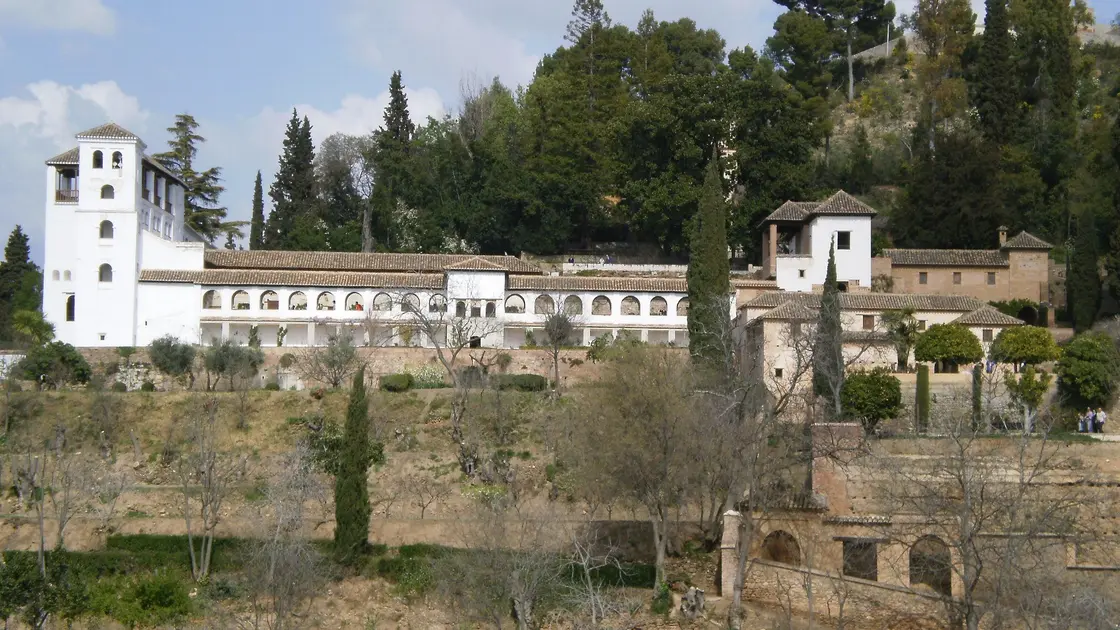
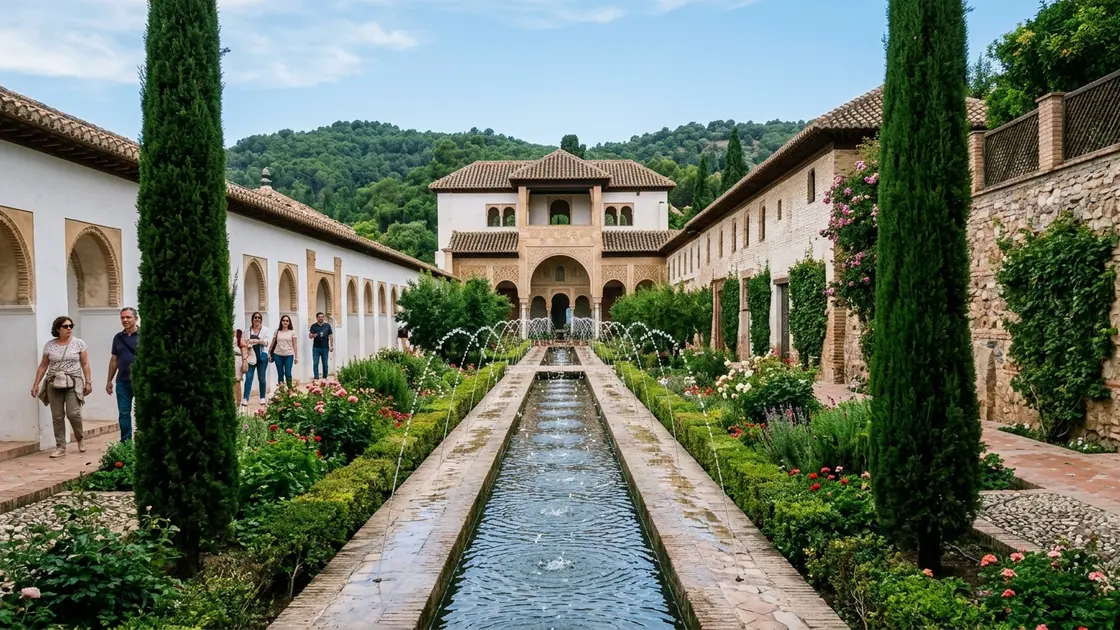
Generalife
The Nasrid sultans' summer estate above the Alhambra, with terraced gardens and the Patio de la Acequia, a 49-metre water garden from the 14th century.
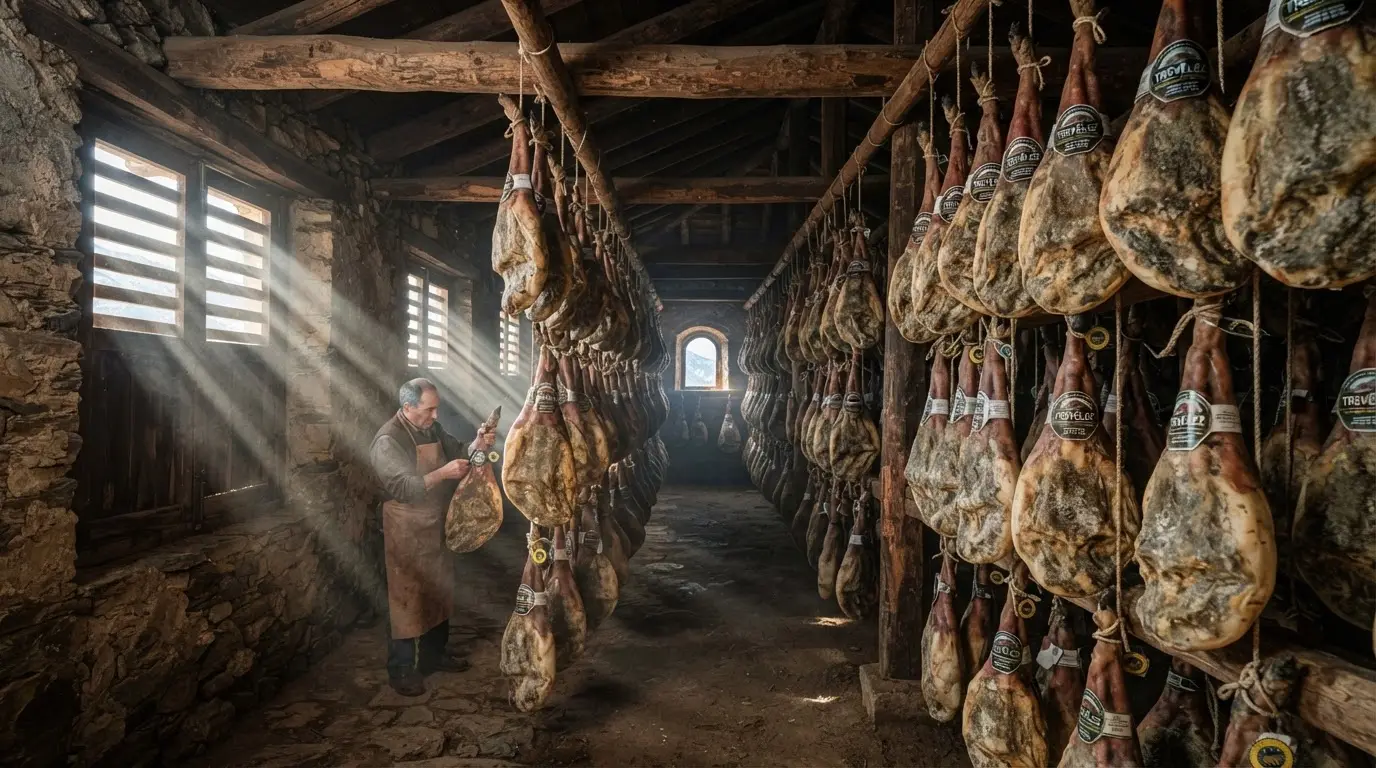
The evaporation target is steep. A fresh pork leg must shed at least 35% of its original weight before it can be certified. This is not a target you can accelerate artificially without changing the product. In a secadero (curing shed), ventilation slats face the prevailing mountain winds. The hams hang from beams in rows, losing water slowly and gaining the particular aroma that the indigenous microbiology of the Sierra Nevada foothills contributes.
Curing time runs from a minimum of 14 months for the lightest fresh legs (11.3–12.3 kg), to 17 months for mid-weight legs, and 20 months for the heaviest. All three categories can be extended by an additional three months, giving the blue/red/black seal system most retail buyers encounter: blue seal = 17 months, red seal = 20 months, black seal = 23 months.[2] The black-seal hams are the largest, oldest, and most concentrated in flavour.
White pigs, not black: the breed question
Trevélez ham comes from white-breed pigs, a point worth being clear about because the confusion with Jamón Ibérico is widespread.[3] The IGP specification requires crosses of Landrace, Large White, and Duroc-Jersey breeds, the same genetic stock used for most of Europe's commercial pork production. These are not the native black Iberian pig (cerdo ibérico) that produces Jamón Ibérico.
The two hams occupy different flavour profiles:
- Jamón de Trevélez (white pig, cereal-fed): lean, firm, delicately salted, clean flavour. Fat is subcutaneous rather than marbled into the muscle.
- Jamón Ibérico (black pig, acorn-fed at the finest grade): rich, nutty, heavily marbled because the Iberian pig's genetics allow fat infiltration into muscle tissue. Intense, complex, expensive.
They are different products at different price points. A plate of Trevélez slices with a glass of cold Fino sherry before lunch is not competing with a plate of Ibérico de bellota at dinner. The Trevélez ham is not acorn-fed (bellota), does not carry the pata negra designation, and cannot claim any of the Ibérico classifications.
Recommended tours
Tours are selected for quality, not commission. We earn a small fee if you book — at no extra cost to you.
The pigs must be castrated males or females. The pH of the semi-membranous muscle must fall between 5.5 and 6.4 at the point of slaughter, a quality gate that filters out stressed animals whose meat would not cure correctly at altitude.
A plate of Trevélez slices with a glass of cold Fino sherry before lunch is not competing with a plate of Ibérico de bellota at dinner.
For visitors in a Granada bar: when your free tapa arrives with sliced ham, it is almost always Trevélez or a close approximation. Order a full racion and a glass of Fino if you want to understand why the combination works. The prices for Ibérico make the category distinction clear.
Trevélez village: how to get there and what to do
Trevélez divides vertically into three quarters: Barrio Bajo at the bottom, Barrio Medio in the middle, and Barrio Alto at the top. The altitude difference between the lowest and highest point is roughly 200 metres. Barrio Alto preserves the most intact Alpujarran vernacular architecture: white cube houses with flat roofs, tinaos (covered stone passageways bridging opposite buildings across a lane), and flower-heavy balconies. The streets are sized for a donkey, not a car.
From Granada, the drive is 75 kilometres, approximately 1 hour 45 minutes by car. Take the A-44 south, exit at junction 175, then follow the A-346 and A-348 through the valley before climbing on the A-4130 to Trevélez. The road changes character completely on the upper section: tight switchbacks with sudden views across the Alpujarras terraces. If you are prone to car sickness, take the wheel.
By bus, ALSA (alsa.es) runs three daily services from Granada bus station. The route stops at Pampaneira, Bubión, and Capileira on the way up. The last return from Trevélez is around 17:00, which makes a same-day visit tight. Plan accordingly, or stay overnight in one of the village casas rurales.
Jamones Vallejo is the best-known producer for guided visits and was awarded best ham in Spain by the Agriculture Ministry in 2018. Most secaderos on the main street offer tours with tastings; some require advance booking, some do not. The smell of the curing rooms is distinct and unlike anything in a shop. Hams at different stages of the process occupy different levels of the secadero as moisture leaves them.
Beyond ham, the Trevélez River is one of Andalucía's better trout rivers, fed by Sierra Nevada snowmelt and cold enough even in summer for a genuine swim. The Siete Lagunas hike (Seven Lakes) starts from Trevélez, takes six to seven hours return, and reaches glacial lakes high in the Sierra Nevada. Trevélez is also the main trailhead for the Mulhacén ascent, mainland Spain's highest peak. In early August, an all-night pilgrimage departs the village at midnight to reach the summit at dawn.[4]
For lunch in the village, Mesón La Fragua (Calle San Antonio, 4; open 12:30–16:00 and 20:00–22:30) does generous Alpujarran portions on a terrace with views. Restaurante Piedra Ventana (Carretera Ugijar, 36; open 9:30–23:00) specialises in the river trout. The Guided Horseback Riding in the Alpujarras leaves from Lanjarón, 45 minutes downhill, and covers the same ancient bridle paths the ham merchants once used.
Where to buy authentic Trevélez ham in Granada
The safest place to buy certified IGP ham is directly from a secadero in Trevélez itself. Producers sell whole bone-in legs, bone-out legs (deshuesados), and vacuum-packed sliced portions. Prices for black-seal 23-month hams run to approximately €50–60 per kilogram and above; entry-level blue-seal legs start around €20–30 per kilogram, though these figures are approximate and should be confirmed at point of sale.[2]
In Granada city, look in specialist delicatessens in the Realejo and Albaicín neighbourhoods. Mercado San Agustín and the central market also carry certified product. The label check is non-negotiable: the IGP/PGI logo must occupy at least half of the front label. A ham labelled "estilo Trevélez" or "sabor Trevélez" (Trevélez-style, Trevélez-flavour) is not certified IGP. The word "estilo" is the giveaway.
For the most economical buying, a whole bone-in leg is the best value per kilogram but requires a jamonero (ham stand) and some practice with a slicing knife. Vacuum-packed bone-out portions are the practical choice for visitors who want to take product home. Pre-sliced packets work but degrade faster once opened.
The dish page for plato alpujarreño covers the classic mountain plate: ham, fried egg, black pudding, and local sausage together, the closest thing the Alpujarras has to a standard lunch order.
The Alpujarras beyond Trevélez
Trevélez is the highest village in the valley, but the drive from Granada passes through a sequence of villages that deserve time in their own right.
Lanjarón, the first town on the A-348, is known for its mineral water and its long-running spa tradition. It is the effective gateway to the white-village cluster above.
Pampaneira, Bubión, and Capileira occupy three levels of the Poqueira gorge, one of the deepest ravines in southern Spain. The three villages look identical from a distance, white cubes stacked against dark rock, but each has a different character at street level. Capileira at the top is the most visited; Pampaneira at the bottom has the best selection of Alpujarran craft shops for the woven rugs and blankets the region produces.
Bérchules and Cádiar, further east, are quieter and see fewer day-trippers from Granada. Both sit inside the IGP zone for Trevélez ham. Cádiar has a wine festival in October that local producers take seriously.
Deep dive · Article
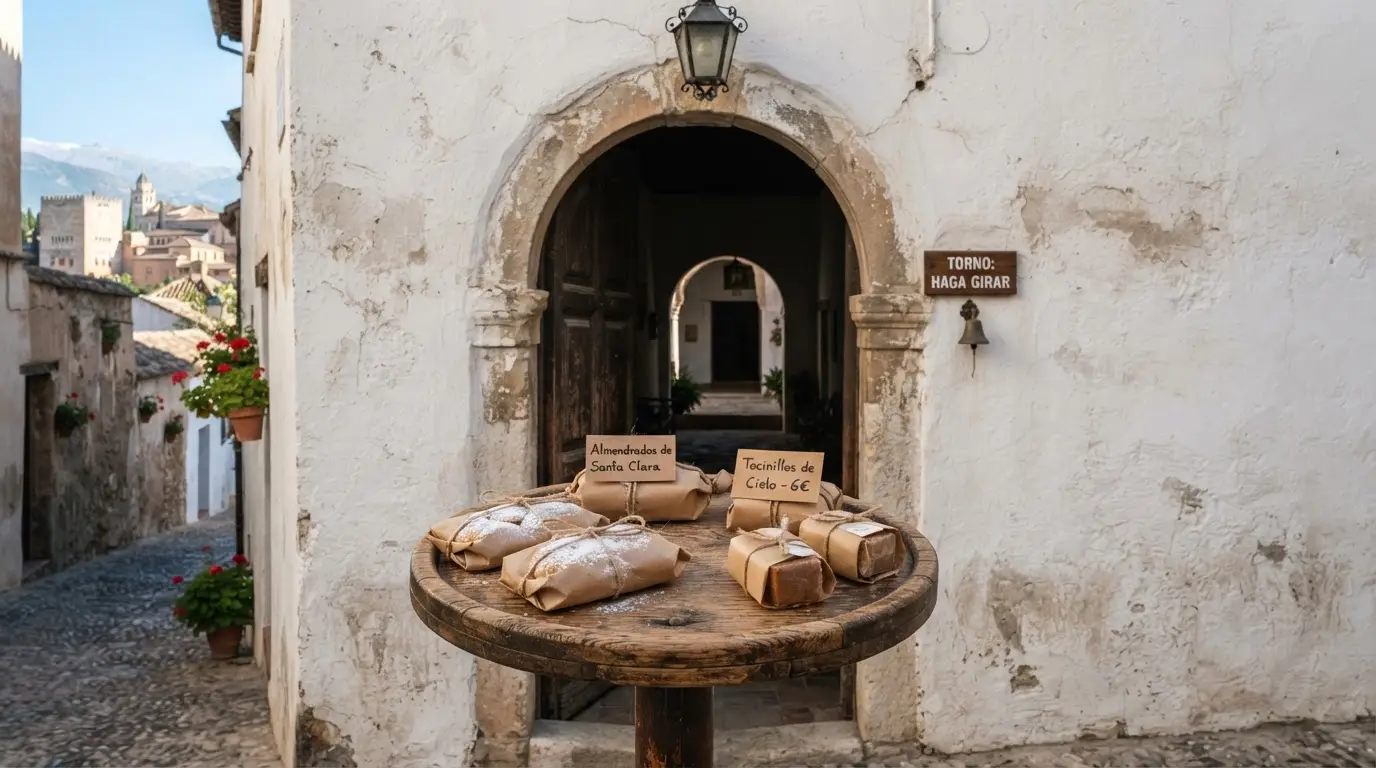
Convent Sweets in Granada: Buying Dulces Through the Torno
Nine convents in Granada sell sweets through the torno, a revolving shelf in the convent wall. Cash only, mornings only, and the greeting ritual is mandatory.
The Alpujarras was home to a distinct Morisco culture for decades after 1492. The Rebellion of the Alpujarras in 1568 ended with the forced dispersal of the remaining Morisco population across Castile. The terraced irrigation system they maintained, the acequia network fed by Sierra Nevada snowmelt, still runs through most of these villages and is still used for smallholder agriculture.[5] The tinaos visible in Trevélez's upper barrio belong to the same architectural tradition.
For a full day trip that covers more than the ham, build a loose route: Lanjarón for the first coffee, Pampaneira for the gorge views, Trevélez for the secadero visit and lunch, then back through Capileira with a stop at Era de la Cruz viewpoint for the panorama across the valley. The total driving adds up to around 160 kilometres. Entirely manageable as a day trip, but the Alpujarras rewards an overnight stay.