Lanjaron water spring pavilion at the Balneario de Lanjarón, a two-storey brick building with a side tower on the Bordaila hill, Sierra Nevada slopes behind in soft morning light

Lanjaron Water: The Sierra Nevada Spa Town Explained

Lanjaron water comes from a Sierra Nevada town with 50-plus springs. See how a disputed 1774 discovery, a state-sold spa and a bottling plant made the brand.

Portrait of James Walker
Written by

Seven years resident in Granada. Specialist in Nasrid architecture, Al-Andalus history, and Andalusian walking routes.

Published
Modern Granada1808–today
The consumer body OCU rates bottled Lanjarón as weakly mineralised,[1] yet the town's Capuchina spring is described as very highly mineralised.[2] The gap between the two is geology first and business history second, and both sit 43 km from Granada on the flank of Sierra Nevada.[3] If you only want the bottle, any supermarket will do; the town earns the trip if you want the other end of the range.
Distance from Granada
43 km
The balneario stands inside the Sierra Nevada Natural Park[3]
Spa mineral springs
6 springs
Five for drinking and one for baths, all used by the balneario[10]
Mechanical bottling plant
1964
First mechanical bottling line at the Lanjarón balneario[33]

Two kinds of water from one mountain

Lanjarón's river drains a basin of 54 km² that falls from 3,180 m to 230 m above sea level,[4] and that drop sorts the water before anyone builds a spa around it. The soft, light water that stays near the surface feeds a great many springs, and it is the water that goes into bottles.[5]
The name already describes the setup. It reaches us from al-Andalus, where it meant a place abundant in pools, springs and standing water,[6] on slopes with a Morisco past told in the Alpujarras Morisco villages. Danone, which owns the bottled brand, says the water is born above 3,000 m,[7] though that figure is the producer's own.
So the label on the bottle does not describe what the town's spa serves. The balneario draws on springs lower down and from deeper rock, and both ends of the range sit inside a single municipality.

Which fountain to drink from

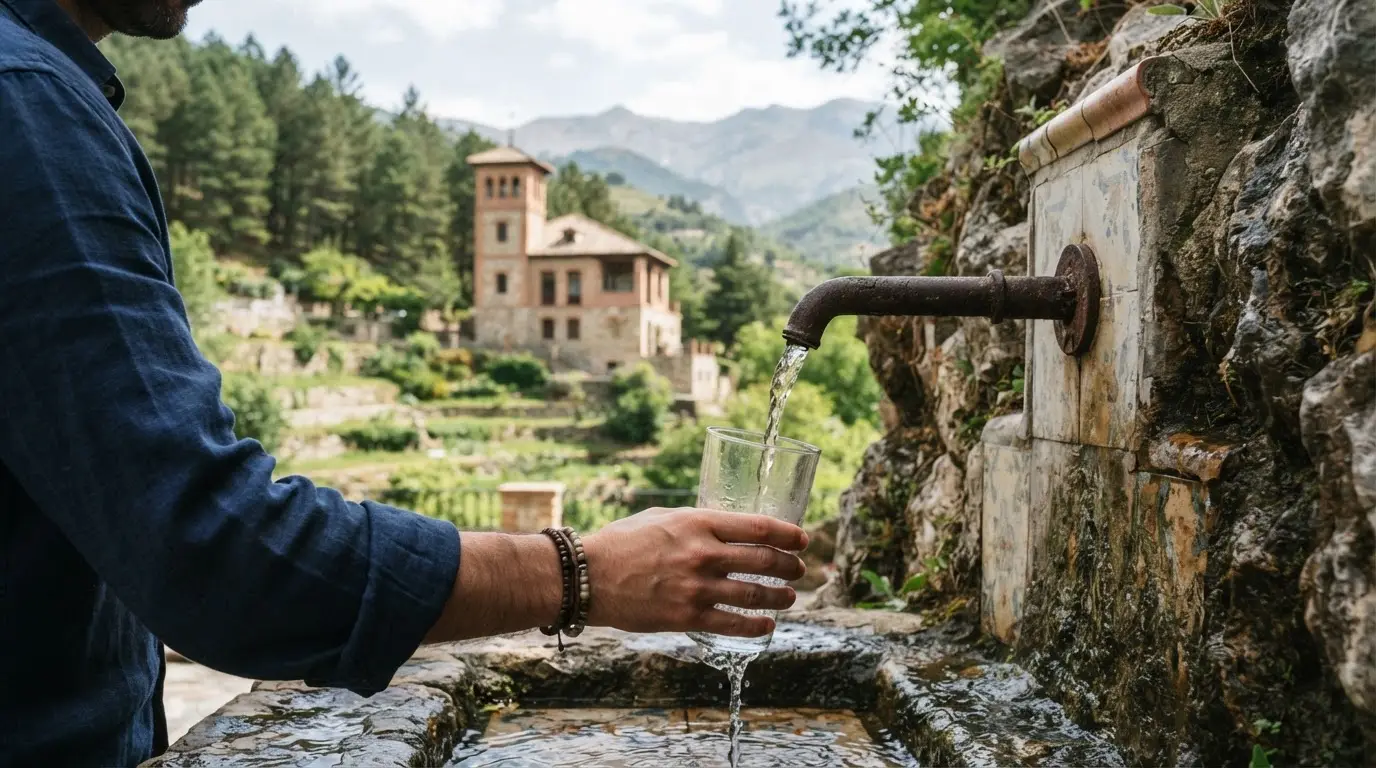
A public fountain in Lanjarón does not automatically mean spring water. Most in the town run chlorinated mains water, and three on the outskirts carry the fresh spring supply.[8]

The springs behind the balneario

Lanjarón has more than fifty springs, mostly on the Bordaila hill between the Salado and Lanjarón rivers, and the balneario stands on that same hill.[9] The spa works with just six of them,[10] so any tally of "the springs" depends on who is counting.
The balneario's own list is the one to trust for the drinking cure, with the effect and mineralisation it gives each spring:
  • Capuchina: purifying, indicated for constipation, liver and bile ducts; very highly mineralised[11]
  • Salud I: aids digestion; low mineralisation, slightly carbonated[12]
  • Salud II: aids digestion and digestive-tract problems; medium mineralisation, very carbonated[13]
  • Capilla: aids digestion and appetite; medium-low mineralisation, gaseous[14]
  • San Vicente: diuretic, for kidney and urinary-tract problems; very low mineralisation[15]
  • El Salado: used for baths rather than drinking; sedative, highly mineralised and ferruginous[16]
Capuchina was always the one patients asked for. Of roughly 19,000 spa guests recorded up to 1923, about 12,000 came for it.[17] That is a heavy lean toward a single spout for a spa with six.
Climber on compact limestone rock face at Los Cahorros canyon with waterfall visible in background and green vegetation-lined canyon walls

Things to do · Activity

Rock Climbing at Los Cahorros

350+ sport routes on compact limestone in the Monachil valley, 15 minutes from Granada. Grades 5a to 8c. Guided half-days from €80 with local operators.

The saltier, warmer, carbonated springs belong to faults in the mountain's flank, and a University of Granada hydrochemistry study singles out samples from Capuchina, Fonteforte and the Baños spring as chloride sodium-calcium water with higher mineralisation than the rest.[18][19] That is why a glass of Capuchina and a bottle of the soft surface water taste like products of different places.

A discovery nobody can date

The usual date is 1774, but only as the year some authors propose, and no document mentions the waters before 1790.[20] Sixteen years of oral tradition sit between the claimed discovery and the first paper.
A local heritage record repeats the date for the Capilla spring, which it says began to be used therapeutically in 1774, with the other nearby springs developed from it.[21] That is the same tradition restated, and someone has to drink the water before anyone writes it down.
The Capuchina spring turned up in 1792,[22] soon after the first written notices, and it went on to become the most used spring in the spa. The cautious reading is the right one: 1774 is the tradition's date, 1790 is the first a historian can put a finger on, and a flat "discovered in 1774" smooths over that gap.

From state asset to private spa

The spa began its modern life as public property. After the nineteenth-century disentailment laws the State sold it off in 1865, and the Duchess of Santoña became its first private owner.[23] Her small palace stayed attached to the grounds: Silverio Carrillo bought both the spa grounds and the Duchess's palace there,[24] and the whole lot changed hands in Madrid in October 1897 for 100,000 pesetas.[25] That put the Carrillo family in charge of the buildings that define the spa today, though not for long. Matilde Carrillo donated her share to her congregation, the Daughters of Charity of St Vincent de Paul.[26]
The rebuilding came in between. From 1927 a two-storey brick building with a side tower replaced the small house over the Salud I spring,[27] and it still gives the balneario its silhouette.
Alhama de Granada history in one view: a whitewashed hill town on the lip of a deep river gorge at golden hour, a church tower above steep rooftops, mountains behind, photorealistic

Deep dive · Article

Why Alhama de Granada's Fall in 1482 Opened the Granada War

Alhama de Granada was named for its 47 °C springs, fell to Castile in late February 1482 and lives on in the ballad Ay de mi Alhama. History and what survives.

The guest list shows how far the reputation travelled. Pedro Antonio de Alarcón, Lorca, Falla, Virginia Woolf and Bertrand Russell are among the names recorded in the town,[28] and Woolf's Bloomsbury circle also reached the Alpujarras by way of Gerald Brenan's years at Yegen.

From spa cure to supermarket shelf

Selling the water, as opposed to drinking it on the spot, started earlier than most people assume. A Junta de Andalucía archive document dates the bottling business to 1830 and a "modern plant" to 1950.[29]
The ownership that matters for the brand begins with the order's sale. Manuel Gallardo Torrens, a businessman from Santafé, bought the spa from it in 1946,[30] or in 1947 in Piñar Samos's academic history, which treats the purchase as the start of a new stage for the balneario.[31]
Salud and Fonte Forte table waters reached the market in 1959,[32] and Piñar Samos dates the first mechanical bottling plant to 1964.[33] The archive's 1950 "modern plant" and that 1964 "first mechanical" one sit fourteen years apart, so the accounts either describe different installations or the same one under different adjectives. In 1964 Gallardo Torrens told the minister Fraga Iribarne he was set on industrialising bottled-water production,[34] and by 1967 the company was a sociedad anónima.[35]
The brand then followed the usual path of regional Spanish water. In 2006 Font Vella and Aguas de Lanjarón merged, both already inside the Danone group.[36] The bottle on a supermarket shelf and the spa on the Bordaila hill now share a name and a hillside but not an owner.
Timeline
  1. 1774

    Traditional discovery date

    Given by some authors; no documents before 1790.

  2. 1830

    Bottling for sale begins

    Dated by the Granada provincial archive.

  3. 1865

    State sells the spa

    The Duchess of Santoña becomes the first private owner.

  4. 1946/47

    Gallardo Torrens buys the spa

    Two sources, one year apart.

  5. 1959

    Table waters launched

    Salud and Fonte Forte reach the market.

  6. 1964

    Mechanical bottling plant

    The first mechanical line is installed.

  7. 2006

    Font Vella merger

    Font Vella and Aguas de Lanjarón merge.

For a visitor the consequence is simple. The bottle gives you the soft end of the range, and only the balneario gives you the rest.

Seeing the springs today

The reason to go is the drinking cure itself. At the balneario the mineral-medicinal water is taken at a time and rhythm prescribed by the spa's doctor,[37] so it is not a sip from a tap, and Capuchina, the strongest of the five drinking springs, is the glass to ask about.
The balneario belongs to Relais Termal, which closed its purchase by acquiring 95% of the company's shares,[38] and it markets its Aquatherma circuit as the largest leisure and thermal circuit in Andalusia.[39] Hours and prices are for the spa to confirm.
In town, the architect Juan Domingo Santos turned the old slaughterhouse sheds into the Museo del Agua,[40] and its entrance pavilion evokes the eighteenth-century cover built over the Capuchina spring.[41] Opening hours and prices are worth checking locally before you go.
Lanjarón is the gateway to the Alpujarras, so it slots into the Alpujarras day trip from Granada as the first stop, and the road above it climbs toward the village behind jamón de Trevélez.

Frequently asked questions

What is Lanjaron water?

Lanjaron water is a natural mineral water from the town of Lanjarón in Granada province, bottled today under the Danone group. The same town has a historic balneario that uses six mineral-medicinal springs for drinking and bathing, which are a different thing from the soft surface water that goes into the bottle.

Is Lanjaron water good to drink?

The consumer body OCU classes the bottled water as weakly mineralised, and the soft, light surface water used for bottling is the gentle end of the town's range. The spa's stronger springs are taken at a time and rhythm prescribed by the balneario's own doctor.

Where is Lanjaron water from?

It comes from Lanjarón, on the southern side of the Sierra Nevada at the entrance to the Alpujarras, in the province of Granada. Danone says the water is born above 3,000 m, and the town's river basin does reach more than 3,000 m.

When was Lanjaron water discovered?

1774 is the traditional date, given by some authors, and the local heritage record says the Capilla spring was first used therapeutically that year. The earliest document referring to the waters dates from 1790, and the Capuchina spring was found in 1792.

How many springs does Lanjaron have?

The answer depends on who is counting. The town has more than fifty springs, mostly on the Bordaila hill, but the balneario uses six: Capuchina, Salud I, Salud II, Capilla and San Vicente for drinking, plus El Salado for baths.

Can you drink from the fountains in Lanjarón?

Most public fountains in town carry chlorinated mains water. Only three fountains on the outskirts carry fresh spring water, so check which one you are standing at before you fill a bottle.

Are the Lanjarón spa and the bottled water the same company?

No. The balneario now belongs to the Relais Termal group, while the bottled brand sits inside the Danone group after the 2006 merger of Font Vella and Aguas de Lanjarón. They share a town and a name, not an owner.

Sources

41 references Show
  1. ocu.org (opens in a new tab)

    “MineralizaciónDébil”

  2. balneariosrelaistermal.com — Area termal (opens in a new tab)

    “Agua de mineralización muy alta, bicarbonatada, clorudada, sódica y cálcica.”

  3. hosteltur.com (opens in a new tab)

    “El Balneario de Lanjarón se encuentra en el Parque Natural de Sierra Nevada, en un entorno privilegiado, a 43 kilómetros de la ciudad de Granada.”

  4. recyt.fecyt.es (opens in a new tab)

    “una superficie de 54 km 2 y unas cotas máxima y mínima de 3.180 y 230 m s.n.m., respectivamente.”

  5. Junta de Andalucía — 3508b227 9582 eeaa 816b 80e96898eb47 (opens in a new tab)

    “Las primeras son blandas y ligeras, dan lugar a un gran número de fuentes y son las que se utilizan para el embotellado.”

  6. Junta de Andalucía — 61eeeb2c8419b Documento del mes de abril 2021.pdf (opens in a new tab)

    “traducido como "campo o lugar abundante en charcos, fuentes o lagunas de agua"”

  7. danone.com (opens in a new tab)

    “Lanjarón es nuestra marca de agua mineral natural que nace en lo más alto de Sierra Nevada (Granada), a más de 3.000 metros de altura.”

  8. Wikipedia (opens in a new tab)

    “There are numerous fountains in the town, which carry chlorinated water, and three fountains with fresh spring water on the outskirts.”

  9. Junta de Andalucía — 61eeeb2c8419b Documento del mes de abril 2021.pdf (opens in a new tab)

    “Posee más de medio centenar de manatiales, localizados principalmente en la loma de la Bordaila, entre los ríos Salado y Lanjarón, donde se ubica su balneario.”

  10. balneariosrelaistermal.com — Area termal (opens in a new tab)

    “El Balneario de Lanjarón utiliza seis manantiales de aguas mineromedicinales, todos únicos, para la prevención y el tratamiento de distintas afecciones.”

  11. balneariosrelaistermal.com — Area termal (opens in a new tab)

    “Efecto depurativo, indicada para estreñimiento, hígado y vías biliares.”

  12. balneariosrelaistermal.com — Area termal (opens in a new tab)

    “Facilita la digestión. Agua de mineralización baja, clorudada, sódica, cálcica, bicarbonatada y ligeramente carbónica.”

  13. balneariosrelaistermal.com — Area termal (opens in a new tab)

    “Facilita la digestión, indicada para problemas en el aparato digestivo.”

  14. balneariosrelaistermal.com — Area termal (opens in a new tab)

    “Facilita la digestión y facilita el apetito.”

  15. balneariosrelaistermal.com — Area termal (opens in a new tab)

    “Efecto diurético. Indicada para problemas en riñones y vías urinarias.”

  16. balneariosrelaistermal.com — Area termal (opens in a new tab)

    “Efecto sedante. Agua de mineralización alta, clasificada como clorudada, sódica, cálcica, magnésica y ferruginosa.”

  17. revistas.ucm.es (opens in a new tab)

    “Ha de tenerse en cuenta que la Capuchina fue siempre la más singular y utilizada.”

  18. recyt.fecyt.es (opens in a new tab)

    “ambos relacionados con surgencias de mayor contenido salino, termales y con presencia de CO 2.”

  19. recyt.fecyt.es (opens in a new tab)

    “Excepciones son las muestras obtenidas en Fonteforte (65), Baños (12) y Capuchina (70), con facies clorurada sódica-cálcica, con una mayor mineralización.”

  20. Junta de Andalucía — 61eeeb2c8419b Documento del mes de abril 2021.pdf (opens in a new tab)

    “Según algunos autores en 1774, aunque no existen referencias documentales hasta 1790”

  21. adurcal.com (opens in a new tab)

    “En el año 1774 el agua del manantial "Capilla" empezó a ser utilizado con fines terapéuticos”

  22. revistas.ucm.es (opens in a new tab)

    “Poco después, en 1792, se descubre la Fuente Capuchina”

  23. Junta de Andalucía — 61eeeb2c8419b Documento del mes de abril 2021.pdf (opens in a new tab)

    “pasó a manos del Estado como consecuencia de los procesos desamortizadores, quién lo enajenó en 1865.”

  24. adurcal.com (opens in a new tab)

    “Su padre, Silverio Carrillo, compra los terrenos del Balneario y el palacete de la duquesa de Santoña”

  25. revistas.ucm.es (opens in a new tab)

    “En Octubre de ese mismo año, Silverio Carrillo adquirió en Madrid todo el lote en la cantidad de 100.000 Pts.”

  26. revistas.ucm.es (opens in a new tab)

    “decide donar su parte del Balneario a su Congregación de las Hijas de la Caridad de San Vicente de Paul”

  27. revistas.ucm.es (opens in a new tab)

    “El pequeño edificio que albergaba el manantial Salud I sería sustituido por una imponente construcción en ladrillo de dos plantas y torre lateral”

  28. Junta de Andalucía — 3508b227 9582 eeaa 816b 80e96898eb47 (opens in a new tab)

    “Pedro Antonio Alarcón, Federico García Lorca, Manuel de Falla, Virginia Wolf, Betrand Rusell, marqueses y condes, reyes y reinas, y otros muchos personajes”

  29. Junta de Andalucía — 61eeeb2c8419b Documento del mes de abril 2021.pdf (opens in a new tab)

    “La importante actividad económica derivada de su envasado, se inició en 1830, y en 1950 se construyó una moderna planta.”

  30. adurcal.com (opens in a new tab)

    “en 1946, otro vecino de Santafé, Manuel Gallardo Torrens, le compra a la Orden el Balneario”

  31. revistas.ucm.es (opens in a new tab)

    “A raíz de la compra del establecimiento en 1947 por otro empresario granadino –Manuel Gallardo Torrens– se abrió para el Balneario una nueva etapa”

  32. revistas.ucm.es (opens in a new tab)

    “En el año 1959 salieron al mercado por primera vez”

  33. revistas.ucm.es (opens in a new tab)

    “pero no sería hasta 1964 cuando se montó la primera planta embotelladora mecánica”

  34. revistas.ucm.es (opens in a new tab)

    “empeñado en industrializar la producción de agua envasada”

  35. revistas.ucm.es (opens in a new tab)

    “en 1967 quedó cons-tituida como sociedad anónima.”

  36. en.esic.edu (opens in a new tab)

    “En 2006 se fusionan Font Vella, SA y Aguas de Lanjarón, SA”

  37. balneariosrelaistermal.com — Area termal (opens in a new tab)

    “Toma de agua mineromedicinal en bebida, a un tiempo y ritmo prescrito por el médico del Balneario.”

  38. hosteltur.com (opens in a new tab)

    “después de que esta misma semana se cerrase la operación de compra por parte de la cadena, al haber adquirido el 95% de las acciones de la sociedad.”

  39. balneariosrelaistermal.com — Balneario lanjaron (opens in a new tab)

    “el mayor circuito lúdico y termal de Andalucía”

  40. arquitecturaviva.com (opens in a new tab)

    “Las naves del matadero se han adaptado a museo”

  41. arquitecturaviva.com (opens in a new tab)

    “Esta pieza evoca la cubrición del Manantial de la Capuchina, construida en el siglo XVIII”