Born in Alhama, without a name
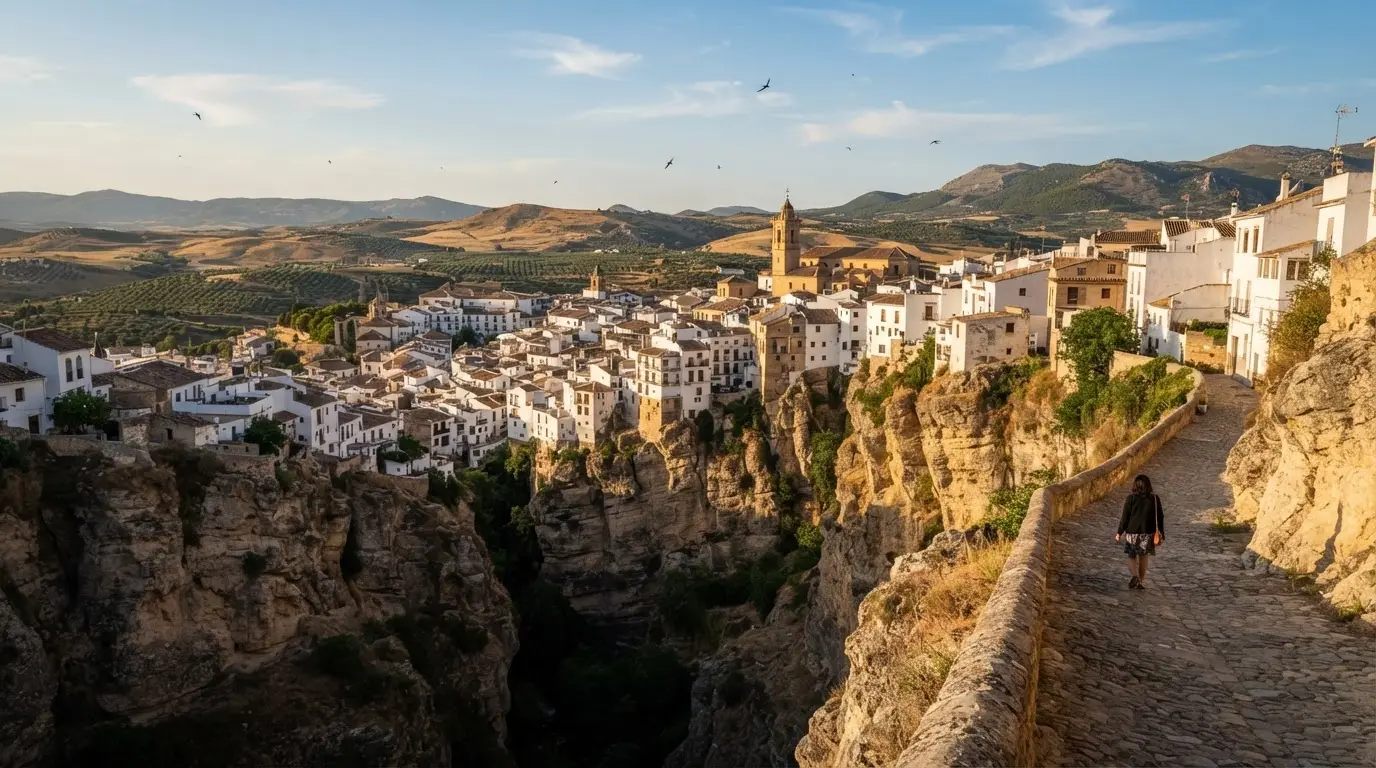
Alhama de Granada sits on top of a huge rocky spur above a deep pass where the river Alhama runs[1]. Castilian forces led by Rodrigo Ponce de León, Marquis of Cádiz, captured the town in February 1482[2]. Eleno de Céspedes was born there without a name[3], and into slavery.
The Archivo Histórico Nacional's summary of the trial file calls the person a native of Alhama, a slave and later free, who married a man and had a son[4]. The Real Academia de la Historia biography goes further and names the owner, Benito de Medina, as the biological father too[5]. Other accounts name other parents, and Hessel names none. Treat the genealogy as unsettled.
Freedom came with a new name, and the two main sources tell it differently. The Real Academia de la Historia says Eleno was freed at about eight and named Elena de Céspedes, in honour of the late wife of the father and owner[6]. Hessel has the name arriving nearly ten years after the birth, when the mistress of the household, also Elena, died[7], and describes the change as a life of "relative freedom" and, more important, of "mobility", both geographic and social[8]. Whether the name honours the owner's wife or the household's mistress is left open here, and so is the age. The male form came much later: over almost twenty years, Hessel writes, Elena became Eleno through a small orthographic change[9].
The first marriage was to a man. The Real Academia de la Historia says that at fifteen or sixteen Eleno married Cristóbal Lombardo, a mason from Jaén, and had a son, whom Eleno left with neighbours in Seville[10]. Hessel calls the marriage short-lived and says Lombardo allegedly died before or shortly after the birth[11].
A word on names, because the record and the scholars both waver. The Inquisition's scribes slid between masculine and feminine pronouns for the same person[12]. In his own testimony Eleno consistently described himself in masculine terms[13]. This article follows Eleno's own usage: Eleno, he. Period words such as hermaphrodite are quoted as the period's, and modern labels are credited to the scholars who apply them.
Soldier, tailor, surgeon
The Archivo Histórico Nacional summary compresses years into one sentence: dressed as a man, the war against the Moriscos of Granada, an examination for surgeon, a marriage to a woman[14]. Everything interesting happens between the semicolons.
The war was the Morisco rising in the Alpujarras, the mountain revolt told in our account of Aben Humeya and the 1568 rebellion. The Real Academia de la Historia says Eleno enlisted from Arcos de la Frontera in the troops the local duke offered Philip II[15]. Kagan, as summarised by Hessel, puts him in the company of Ponce de León[16]. A ducal levy and a captain's company are different anchors, and neither source says what a soldier from a slave household actually did in the sierra. The Alpujarras villages that visitors drive through today were the ground.
After the war came a trade. Hessel, drawing on Kagan, reports that the tailors' guild certified the former soldier but required the shop sign to read sastra, seamstress, because, in Eleno's words, "they knew I was a woman"[17]. A certificate and a sign that contradict each other: it is a small, exact picture of the problem.
Then Madrid. In about two years there Eleno learned the surgeon's trade and dropped tailoring for what Hessel calls the more respectable field of medicine[18]. A surgeon had more standing than a tailor, and a surgeon put his hands on other people's bodies. Both facts matter for what comes next.
The marriage licence and the examiners
The turn came over a marriage licence. After Lombardo, Eleno planned to marry a woman: María del Caño, a native of Ciempozuelos, in what Maganto Pavón, whose urology-journal paper transcribes the file, calls an unusual betrothal[19]. The Madrid vicar wanted the applicant examined before granting the licence.
The man he asked was Francisco Díaz, a royal surgeon-physician who specialised in genito-urinary disorders, which is the sources' own wording; Maganto Pavón himself calls him an urólogo. On 17 February 1586 Díaz and Dr Antonio Mantilla, a Madrid physician, examined Eleno at the vicar's request[20]. Díaz declared, "surprisingly" in Maganto Pavón's word, that the applicant was a man[21].
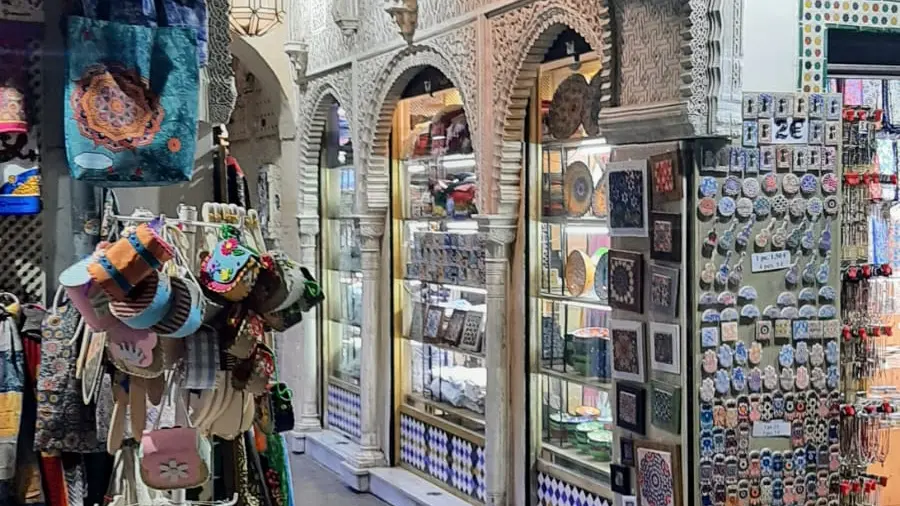
Explore nearby · Monument
Alcaicería
Granada's historic silk market, rebuilt after 1843 in Neo-Moorish style. Small shops sell ceramics, taracea woodwork, spices, and leather goods. Free to enter.
How many people looked at Eleno before the wedding depends on the source. Hessel, citing Vollendorf, counts nine doctors and midwives who unanimously declared him a man, after which Eleno received permission to marry[22]. Maganto Pavón counts differently: he records ten people at Yepes, surgeons, physicians and others, whom the town's alcalde ordered to look[23], separate from the Díaz and Mantilla examination. The two counts are not reconciled here, and neither is Díaz's examination.
Eleno and María then married at Yepes and lived together for more than a year[24]. Then came the collapse: Eleno was arrested at Ocaña and taken to the Inquisition[25]. The civil case at Ocaña had run for about a month, from mid-June to 4 July 1587[26]. The Inquisition's trial took place in Toledo in 1587 and, according to Maganto Pavón, drew great resonance in its day[27].
In Toledo, questioning centred on hermaphroditism from late July to October 1587[28]. The tribunal's own doctors, De la Fuente, Villalobos and the surgeon Juan Gómez, had examined Eleno in the Inquisition's jail on its order and reported on 13 August; Díaz was not one of them[29].
On 15 August, Díaz and the Yepes physician Juan de las Casas were called before the inquisitor Lope de Mendoza at Eleno's own request, as witnesses in his favour, and re-examined Eleno alongside the Inquisition's doctors[30]. Díaz and Casas then retracted their first report and said Eleno was a woman, as Mantilla had done at Ocaña[31]. Hessel compresses this into one reversal: at the first examination Eleno was fully male, "not even a hermaphrodite", and at the second, for the court, fully female[32].
The charges and Eleno's own defence
Two sets of charges framed the case. The civil case at Ocaña had turned on mocking the sacrament of marriage, possible sorcery and, above all, sodomy with another woman, the crimen nefando, which carried death by fire[33]. Before the Inquisition, the prosecutor Sotocameno formally accused Eleno of sorcery on 5 October 1587, meaning a tacit or express pact with the devil, and asked for torture to confirm it[34]. The case then went to judgment on two main imputations, heresy or apostasy and sorcery[35]. These are the file's accusations, reported as such. The vocabulary is the period's, drawn from marriage, deceit and the Devil, not from medicine.
Eleno's own account, as the sources report it, claimed a change of sex. Maganto Pavón has Eleno saying that Eleno had first been a woman and then the body transformed into a man's[36]. In Burshatin's translation, as Hessel quotes it, the scribe records that the strain of delivery produced a male member[37]. In Kagan's translation, also quoted by Hessel, Eleno adds:"I'd hurt myself while riding horseback and the root of my member became weak."[38] On the marriage itself: "I didn't think I'd erred, but rather that I'd married in God's service."[39]
Hessel relays Burshatin's point that the medical side of the defence leaned on a standard reading of book 7 of Pliny's Natural History, which accounted for such gender transformations[40]. The period's word for the condition was hermaphrodite. Hessel keeps it because it was the terminology of the time, and adds that in contemporary nomenclature this is a case of an intersex individual[41].
The court did not accept it. The Inquisition's doctors declared that Elena de Céspedes "nació y es mujer" and "nunca a sido hermafrodito", born a woman and never a hermaphrodite[42]. Hessel adds that the court appears to have highly doubted Eleno's account, because the final decision went against him[43].
Zocodover, December 1588: the sentence
Eleno was sentenced to appear at the public auto de fe held in Toledo's Zocodover square on Sunday 18 December 1588[44]. It was a penitent's role, not a condemned man's.
The archive summary lists an abjuration de leve, the milder grade, then a hundred lashes through the public streets of Toledo and another hundred through those of Ciempozuelos, followed by ten years in a hospital serving without pay in the infirmaries[45]. In the general scheme of inquisitorial abjurations, de levi was the grade used where the presumption of heresy was light, against de vehementi for grave suspicion and de formali for heresy fully ascertained[46]. That definition comes from a dictionary of Mediterranean, largely Italian, inquisitions, so it shows the scheme and not Toledo's own practice. Hessel's tally agrees on the weight: 200 lashes in all[47].
The court sent a surgeon to a hospital. Eleno served the term at the Hospital del Rey in Toledo[48]. Why the tribunal chose that placement is not something these sources explain.
Recommended tours
Tours are selected for quality, not commission. We earn a small fee if you book — at no extra cost to you.




Hessel follows Eleno to a later transfer, and there, as he puts it, "the documentation runs out"[49]. Whether Eleno lived to finish the ten years is unknown.
For how the Granada tribunal worked, read our account of the Inquisition in Granada.
What the record cannot settle
Everything above passes through other hands. Scholars have classified the case in several incompatible ways: as intersex, as transsexual, as a hypospadic male[50]. Each label belongs to the scholar who applies it, not to the sixteenth-century record.
Hessel declines the argument. Unlike other scholars, he writes, he has "chosen not to debate the gender of Eleno de Céspedes"[51]. A 2019 surgical-history paper from the University of Valladolid takes a different frame again and calls Céspedes "a reference as a female surgeon in the history of medicine"[52]. Neither is the Inquisition's frame, and neither is Eleno's.
What the sources do support is narrower, and enough. A person born into slavery in Alhama earned a surgeon's licence, was heard in Toledo and was punished in public. Where the war, the trade and the marriage fit together is for the historians to argue.
Deep dive · Article
1066 Granada Massacre: When the Jewish Golden Age Ended in a Day
The 1066 Granada massacre killed Joseph ha-Nagid and thousands of the city's Jews in a single day, ending three decades of Jewish power under Samuel ha-Nagid.
For the wider world behind the war, start with Moriscos of Granada. Eleno's own words survive only in other people's handwriting.