How Granada built Europe's southernmost ski resort: Ganivet's Andalusian Finland dream, the 1935 Veleta road, Cetursa's 1964 lifts, and the 1996 FIS Worlds.
Seven years resident in Granada. Specialist in Nasrid architecture, Al-Andalus history, and Andalusian walking routes.
Updated Published
The Sierra Nevada ski resort is an engineered thing: Granada built it in four campaigns over sixty years, and every stage left its mark on the mountain. The road came first, in 1935; the lifts and the village of Pradollano followed from 1964; and the 1996 Alpine World Ski Championships, postponed a year by a snow drought, put the finished resort on television sets across Europe.
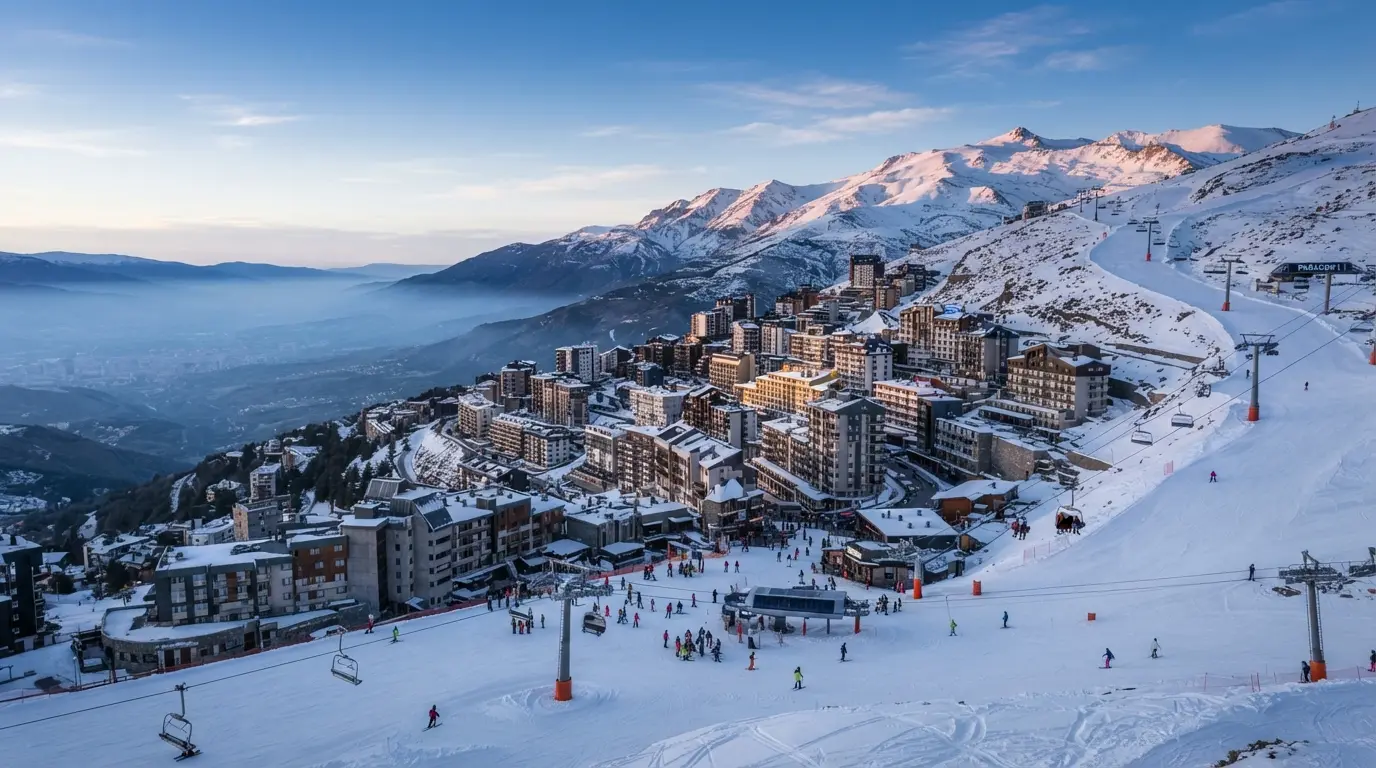
Pradollano is the village the Sierra Nevada ski resort grew around, terraced between 2,078 and 2,400 metres on the west flank of the mountains, which makes it the highest permanently inhabited settlement in Spain.[1] It was built to order in the 1960s and 1970s, and it remains the highest part of the resort you can reach without skis.
What Pradollano anchors is unusual for Europe. This is Europe's southernmost ski resort and the highest in Spain, and the season can run from late November to early May.[4] For most of the winter the Mediterranean coast sits two hours away and stays warm; the altitude does the work that latitude cannot.
The village itself is a single-minded place: one main street of hotel blocks and apartments, ski hire and shops, all of it climbing a hill that gets steeper the higher you go. It looks like what it is, a resort built fast and expanded whenever the mountain proved it could carry more. The practical side of a day on the slopes, passes, prices and equipment included, lives on the skiing at Sierra Nevada page.
For a first-time visitor the surprise is the journey: you drive up from Granada past olive terraces and snowless foothills, and the village appears at the top of the climb with the summit ridge behind it. Pradollano was built for the resort, not around it, and the whole arrangement is visible in a single glance from the plaza.
The relationship with Granada is close enough to feel odd: the city lies in the valley below, and on clear evenings the resort's lights are visible from the Albaicín. Locals treat the mountain as a public utility, a winter playground that belongs to the city the way the Alhambra does, only colder and noisier.
Ganivet's dream and the road to Veleta
The idea of a ski resort in Andalusia predates the resort itself by more than half a century. In the late 19th century, Ángel Ganivet, a Granada-born writer serving as Spain's consul in Helsinki, proposed in his letters turning the Sierra Nevada into what he called an Andalusian Finland.[5] The phrase stuck with the city the way few civic dreams do.
The dream found its first organisers among mountaineers. A club founded in the 1890s reorganised in 1912 as the Sociedad Sierra Nevada, Spain's third-oldest ski club and a pioneer in Andalusia[6], and that generation of members pushed for the first refuge in the high mountains, built at Hoya de la Mora in the early 1910s.
What actually opened the mountain to Granadinos was a road. In the 1920s the first Granada to Sierra Nevada road and a short electric railway brought the high peaks within a day's reach of the city, and work began on the summit route that would end the journey at the top. The driving force was Juan José de Santa Cruz, Granada's chief public-works engineer, who carried the project through its two decades of surveys and changes of plan.
The road reached the summit of Pico Veleta on 15 September 1935[7], ending about ten metres below the top, which made it the highest road in Europe.[8] The record made the road a curiosity of its time; what matters for this story is what it did in 1935, which was to turn the summit into a day trip. The original scheme had planned a tunnel under the summit ridge, a shortcut to the southern slopes; only a short section was ever driven, and mountaineers still shelter in the stub as a bivouac. The open stub is one of the strangest relics of the whole project. Today the same route is the A-395, and the resort sits 27 km from the city of Granada.[9]
The mountain Ganivet imagined as a piece of Scandinavia was now reachable, and the road made the ski dream concrete. It also made the case for the resort: the same climate that keeps the range white for months is the one that makes Granada itself run colder than the rest of Andalusia every winter. The wider mountain, its trails and its Alpujarras crossing, is mapped in the Sierra Nevada Granada guide.
Cetursa and the build-out, 1964 to the 1970s
The resort proper dates from 1964, when Centros Turísticos SA, Cetursa for short, was constituted as the company that would build and run the station. The same year produced the plan: the Plan Municipal de Granada sobre Sierra Nevada fixed Pradollano as the resort's residential and service nucleus, built around a rectangular plaza, with the slopes above served from Borreguiles.[10] The plan divided the mountain's roles cleanly, Pradollano for living and Borreguiles for skiing, and that division still organises the resort.
The first build-out was modest but decisive: nine mechanical lifts were installed across the Borreguiles, Veleta and Laguna de las Yeguas zones, and the pistes were cut to feed them.[11] Skiing on a large scale dates from 1969, when the Telesilla Parador chairlift opened and the Telecabina Borreguiles cable car carried skiers from the village up into the Borreguiles bowl.[12]
Around the lifts, Pradollano rose. The village's central square was laid out in the 1970s, first as Plaza de Monachil and later renamed Plaza de Pradollano, and the first hotels and apartment blocks went up around it. The plaza was the bet: a meeting point that would make Pradollano a place rather than a lift station. The first of those buildings went up with more faith than capital, some finished the same summer they were started. The pattern is still readable today, the plaza as pivot, the streets climbing away from it, and the cable car station standing at the top end.
Timeline
1935
Veleta road inaugurated
The summit road opens on 15 September, the highest road in Europe at the time, and the mountain becomes a winter destination.
1964
Cetursa founded
Centros Turísticos SA is constituted on 23 April; the Plan Municipal fixes Pradollano as the resort's residential nucleus.
1969
Large-scale skiing begins
The Telesilla Parador chairlift and the Telecabina Borreguiles open the Borreguiles bowl from the village.
1979
Banco de Granada crisis
The bank's collapse nearly closes the young station.
1985
Junta de Andalucía takes control
The regional government enters the shareholding and relaunches the resort.
1996
FIS Alpine World Ski Championships
Sierra Nevada hosts the Worlds, postponed from 1995 for lack of snow.
The 1979 crisis and the Junta's rescue
The resort nearly died before it was finished. In 1979 the Banco de Granada, Cetursa's principal shareholder, collapsed, and with it the station's financing; closure was genuinely on the table.[13]
Granada's city council moved first to keep the station alive, and in 1985 the Junta de Andalucía entered the shareholding at the head of a new investor group.[14] The rescue was not charity: the regional government treated the resort as an economic engine for the whole province, and it spent accordingly.
The money went into what the 1960s build-out had never had: modern lifts, snowmaking, and a village that could host overnight guests instead of day-trippers. The new management also arrived with an ambition to match the mountain: a world championship. The geometry made the case, a village at altitude, a vertical drop of more than a kilometre, and the Mediterranean visible from the summit ridge. The world championship bid was the way to prove the resort had arrived, and it was a gamble the new owners were willing to take.
The scare left a mark on the resort's culture. Granada had watched its flagship project almost vanish, and the Junta's takeover came with conditions: the station had to stand on its own economics. The discipline shows in what came next, every expansion argued in terms of guests rather than ambition.
The 1996 World Championships
The bet was called at the FIS congress in Montreux in 1990, when Sierra Nevada was named host of the 1995 Alpine World Ski Championships.[15] For a station that had been near closure eleven years earlier, the designation was the point of arrival.
Then the snow failed. The championships were postponed for lack of snow and finally held from 12 to 25 February 1996 at Sierra Nevada, near Granada.[16] The extra year was a gift: a full twelve months more of construction before the world's cameras arrived. For a station that had spent the 1980s catching up, the delay was the difference between hosting and merely surviving.
The championships were also a building programme. The biggest urban work was the Plaza de Andalucía, today the resort's heart, built over a four-level car park of 2,644 spaces.[17] The village grew to meet its guests: new hotels, new lifts, and the infrastructure a television audience expects.
Jerónimo Páez, Cetursa's first chief executive, later said flatly that without the World Championships there would be no Sierra Nevada.[18] Granadinos of a certain age know what he meant: the fortnight of February 1996, the village strung with flags, the races on television in bars across the city, and a resort that finally looked the part. The championships were the moment the station stopped being a local project and became a European one.
What the resort is today
The resort that emerged from the 1990s is the one visitors see now: a village base that sits at about 2,100 metres, with skiing up to just below 3,400 metres.[19]
Nov–early May
The season runs from late November to early May[20], and the resort keeps the largest ski offering in southern Europe open in a month when most resorts end their seasons[21].
The build-out decades set the scale that still holds: more than a hundred kilometres of pistes and a vertical drop no other Spanish station matches, cut into the same slopes the first nine lifts served. The season that once depended on luck now has snowmaking and the height to back it up, and the village is a year-round base rather than a winter-only camp. The lifts themselves are a different generation from the nine originals, but the arrangement is the one the 1964 plan drew on paper.
The same high ground has doubled for somewhere else entirely. In 2023, a 180-person crew based itself in the Los Peñones car park above Pradollano and built a second crash-site set near Laguna de las Yeguas for Society of the Snow's shoot in the Sierra Nevada, turning the resort's own winter terrain into the Andes for three months.
Recommended tours
Tours are selected for quality, not commission. We earn a small fee if you book — at no extra cost to you.
The road that started it all has had a quieter second life. Since 1999 it has been closed to general traffic beyond Hoya de la Mora, just above the station.[22] In summer the upper section doubles as a hiking access, and the trails it serves are covered in the Granada nature hiking guide.
Ganivet's Andalusian Finland turned out to be a Mediterranean invention: Europe's southernmost serious ski resort, visible from the city on clear winter mornings as a white slash above the Vega. The mountain that makes Granada in winter worth planning around is the one he pointed at from Helsinki, built at last.
Frequently asked questions
Did Sierra Nevada host the Ski World Championships?
Yes. Sierra Nevada hosted the FIS Alpine World Ski Championships from 12 to 25 February 1996, the only time the event has been held in Spain. The 1995 edition had been postponed for lack of snow, which gave the resort an extra year of construction before the event.
What is Pradollano?
Pradollano is the resort village of Sierra Nevada, terraced between 2,078 and 2,400 metres on the west flank of the mountains. It is the highest permanently inhabited settlement in Spain and was built from 1964 around a rectangular plaza, first laid out as Plaza de Monachil and later renamed Plaza de Pradollano.
How high is Sierra Nevada ski resort?
The village base sits at about 2,100 metres, and skiing runs up to just below 3,400 metres. That gives the resort a skiable vertical drop of 1,200 metres, the largest of any Spanish ski station.
Why were the 1995 World Ski Championships postponed?
A snow drought. The 1995 FIS Alpine World Ski Championships, awarded to Sierra Nevada at the 1990 FIS congress in Montreux, were postponed for lack of snow and finally held from 12 to 25 February 1996.
Who built and runs the Sierra Nevada ski resort?
Centros Turísticos SA, known as Cetursa, was constituted on 23 April 1964 to build and run the station. After the Banco de Granada crisis of 1979 nearly closed the resort, the Junta de Andalucía took control of the company in 1985 and remains its majority shareholder.
Is the road up Pico Veleta the highest paved road in Europe?
Yes. The road inaugurated on 15 September 1935 ends about ten metres below the summit of Pico Veleta, which made it the highest paved road in Europe. Since 1999 it has been closed to general traffic beyond Hoya de la Mora, just above the ski station.
How far is Sierra Nevada ski resort from Granada?
27 kilometres by road. The A-395 climbs from the city through the foothills to the resort village of Pradollano, the same route first opened to the summit in 1935.
“Sierra Nevada is Europe's southernmost ski resort,[3] and the highest in Spain.[4] Due to its high elevation, the skiing season can last from late November until early May.”
“Fue a finales del siglo XIX, en 1882, cuando el escritor granadino Ángel Ganivet, cónsul de España en Helsinki, comentaba en sus Cartas la idea de crear en Sierra Nevada lo que él llamó la “Finlandia andaluza””
“Tras arduos trabajos y diversas modificaciones en el trazado, el 15 de septiembre de 1935 se inauguró oficialmente el tramo que llegaba hasta el pico Veleta.”
“The access road that takes one to approximately 10 metres below the summit is the highest paved road in Europe across the mountains from Granada to the western Alpujarras.”
“se elabora el Plan Municipal de Granada sobre Sierra Nevada que establece en Pradollano un núcleo residencial y de servicio cuyo centro neurálgico iba a ser una plaza rectangular”
“Sierra Nevada cuenta con las primeras construcciones y hoteles, se desarrollan las pistas de esquí y se instalan los primeros 9 medios mecánicos en Borreguiles, Veleta y la Laguna de las Yeguas.”
“La práctica del esquí comenzó su despegue a gran escala con la construcción del Telesilla Parador y, posteriormente, la apertura de la zona de Borreguiles a través del Telecabina Borreguiles en 1969.”
“En el congreso de la Federación Internacional de Esquí, celebrado aquel año en Montreux (Suiza), Sierra Nevada era designada como Sede de los Campeonatos del Mundo de Esquí Alpino de 1995.”
“The FIS Alpine World Ski Championships 1996 were held 12–25 February in Spain at Sierra Nevada near Granada city. The championships were to be held in 1995, but were postponed due to lack of snow.”