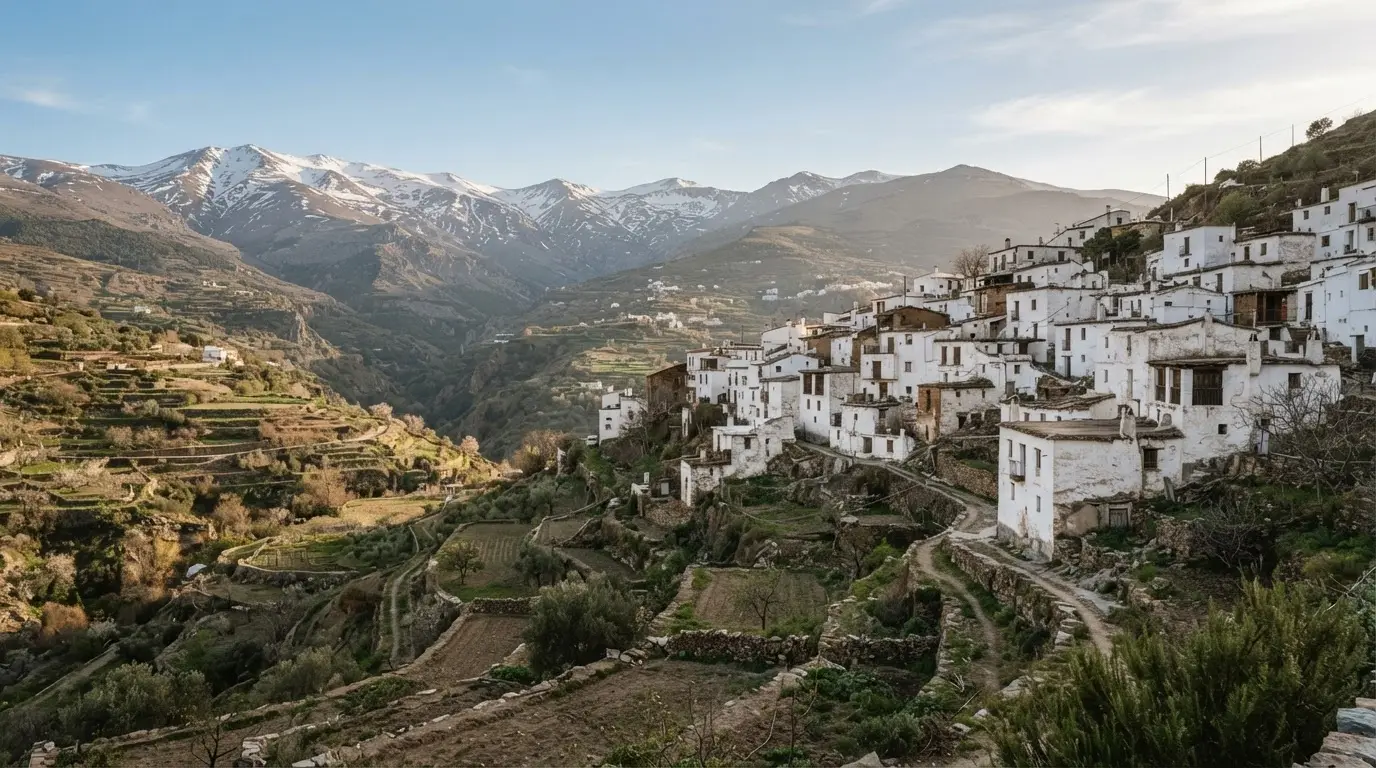
Why an English officer settled in Yegen
Gerald Brenan was born in Sliema, Malta, in 1894.[4] He moved to Spain in 1919 and, from 1920 on, rented a house in Yegen, a small village in the Alpujarras of Granada province.[5] Accounts differ on the exact year he settled, so treat any single arrival date with caution.
His own reason was practical. In South from Granada he said he chose Yegen for its favourable geography, including abundant water, at a time when the village had no paved road or public transport.[6] His biographer Jonathan Gathorne-Hardy put the oddity of it as "as if today, an Englishman decided to settle in a remote hamlet in Afghanistan".[7]
He rented a large house on Calle Era del Cañamo and eked out his army pension.[8] The way in ran across the Poqueira Ravine from Órgiva, by bus and then mule.[9]
The village he found was no ancient survival. Most of its people descend, the sources say, from settlers brought from northern Spain, mostly Galicia, after the Moriscos were expelled.[10] For that earlier chapter, start with the Alpujarras villages and their Morisco history.
Strachey, Carrington and the Woolfs: the Bloomsbury visitors
Remote did not mean cut off. The Legado Andalusí magazine lists successive waves of visitors:
- Dora Carrington and Lytton Strachey
- Virginia and Leonard Woolf
- Bertrand Russell[11]
Closest to Brenan were Ralph Partridge and Partridge's first wife, Carrington, who also had an affair with him.[12]
Strachey's visit, in the early 1920s, is the one everyone retells. He covered the road from Lanjarón to Yegen lying face down on a mule.[13] Lanjarón is the western gate of the Alpujarras and Yegen sits well to the east, so he crossed roughly half the range that way.
The Woolfs came later. Legado Andalusí dates their arrival to 3 April 1923;[14] I found no second source for the exact day, so read it as spring 1923. Brenan remembered Virginia "as a very different person, running through the hills among the olive trees and figs".[15]
Bertrand Russell and Patricia Spence had planned to rent Brenan's house for a summer.[16] Whether or not a guest stayed, Yegen became a place Bloomsbury wrote about, and Brenan wrote back.
South from Granada: the book behind the village
Legado Andalusí calls Brenan the most outstanding Hispanist of the last century on the strength of works such as The Spanish Labyrinth and South from Granada.[18] Of the two, the memoir is the one that put Yegen on the map.
The book, subtitled Seven Years in an Andalusian Village, appeared in 1957.[19] That is decades after the events, which is why it reads as remembered rather than reported. It is also the source for most of what is repeated about his Yegen years, so read it before you go.
Things to do · Activity
Alhambra Guided Tour
Book a licensed guide for the Alhambra and skip the queue. Expert commentary on the Nasrid Palaces, Alcazaba and Generalife gardens. Group tours from €49.
In 2003 it became Al sur de Granada, a Goya Award-winning Spanish film directed by Fernando Colomo, with Matthew Goode as Brenan.[20] Watch it for the casting; read the book for the village.
Later travellers followed the same trail. Bruce Chatwin was among those who came to the region at the end of the 1970s.[21]
The house, the street and the museum question
Brenan's house still stands in Yegen, at the head of the trails he walked.[22] Calle Gerald Brenan runs just below it.[23] Treat the house as a landmark to look at from the street.
Brenan came back in 1982 to film a documentary about his time in the village.[24] The village has been curating its own legend since.
Nearby Válor sets Brenan's twentieth century against a far older Alpujarran drama: it is the birthplace of the man who led the Morisco uprising, and the building survives.[25] His revolt is the subject of Aben Humeya and the Morisco rebellion of 1568.
Do not plan around a museum
Wikipedia's Yegen entry says a Brenan museum is being developed in the village.[26] I found no source confirming it is open, and none gives opening hours. Ask in the village or at the local town hall before you go.
Walking from Yegen and planning the day
Yegen is a walker's village. The GR7 hiking route passes through and takes you to Montenegro, 2 km away, and the small village of Yátor.[27] Two kilometres makes a short first leg for anyone arriving after the drive.
Above the whole region stands Mulhacén, at 3,479 m the highest peak on the Iberian Peninsula.[28] It belongs to the Sierra Nevada, a different outing from a Yegen day.
Deep dive · Article
20 Interesting Facts About Granada, Spain
Interesting facts about Granada Spain that guidebooks skip: disputed etymologies, the soldier who saved the Alhambra, and a river buried under Plaza Nueva.
No source I could verify gives a timetable for reaching Yegen from Granada, so check current bus and road information locally rather than trusting a figure from a blog. Plan a long day or an overnight; the east of the Alpujarras is far from the western villages most visitors see. For the wider valley, start with Las Alpujarras day trip from Granada.