How Alhambra Window Lattices Filtered Light and Guarded Privacy
How a Nasrid window lattice worked: an embedded frame, notched rails, interlocked battens, filtered light and privacy. What survives, and where to look for it.
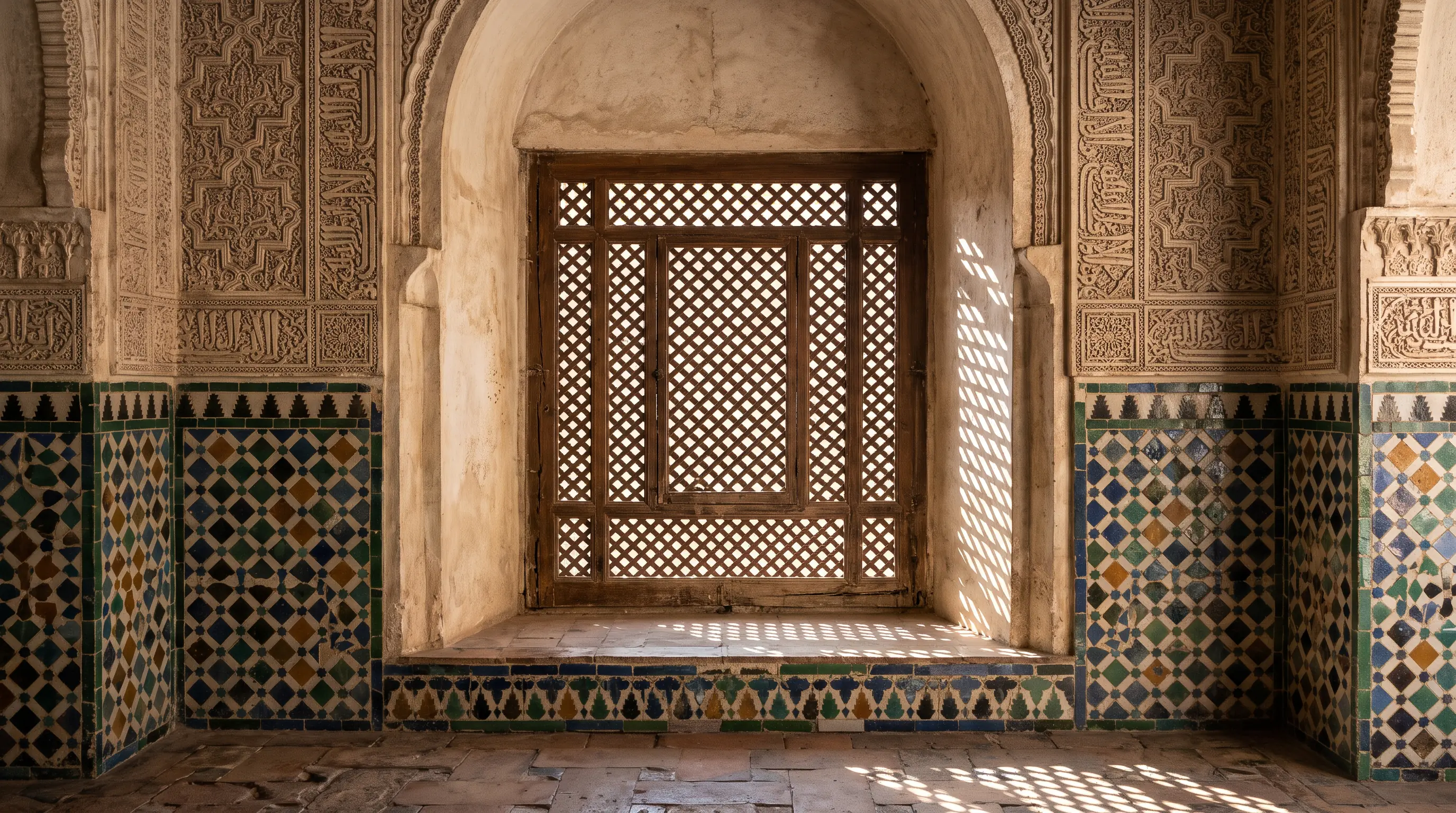
The Alhambra museum sorts its surviving window lattices into two material groups, plaster and wood.
In this article
Jump to a section
A window that filters light and keeps a household private
How a wooden lattice screen was put together
Three details recur in descriptions of the surviving timber screens:
- Peinazos are wooden strips assembled into the mesh on some screens.[13]
- Carretillos are turned pieces that join small cubic or hexagonal blocks on the more elaborate ones.[14]
- Polychromy survives as traces of paint, red above all, alongside incised agramilado decoration, so bare timber in a case is not the original look.[15]
Wood, plaster and the light they let through
Plaster and wood, the museum's two material groups, did different work in the wall:[1]
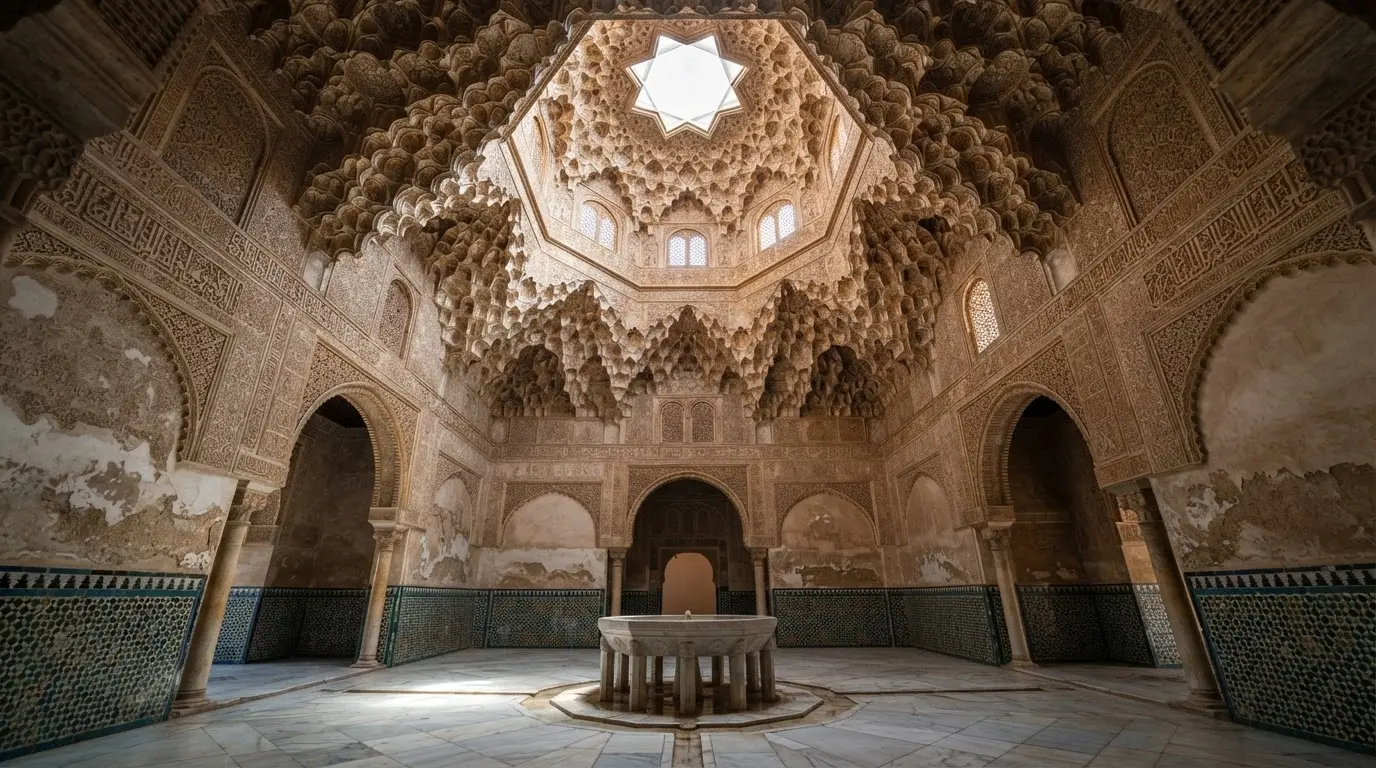
- Plaster screens filled high windows, such as those above the arches into rooms or in the upper lantern bodies of the qubbas, the domed halls of Nasrid architecture.[16]
- Wooden screens, unlike plaster ones, could be dismantled and reused in other spaces.[17]
What survives: museum fragments and a shuttered window
Explore nearby · Museum
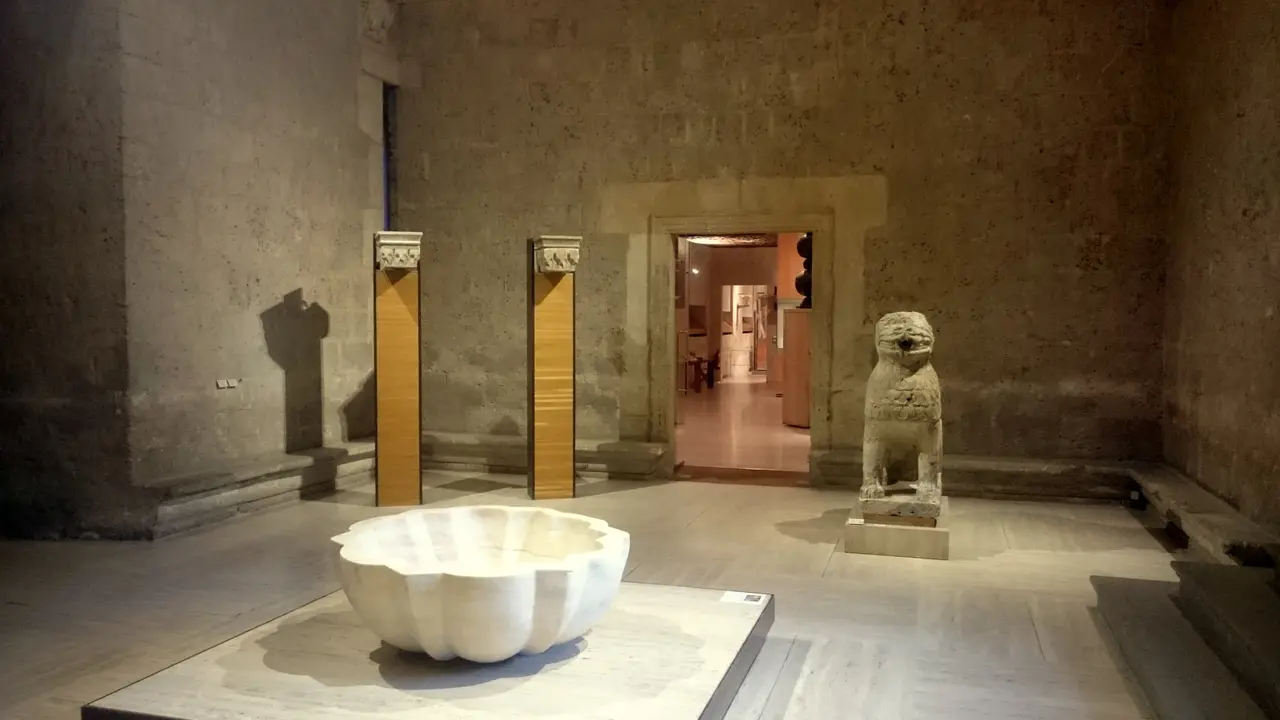
Museo de la Alhambra
Free Islamic art museum inside the Palacio de Carlos V, with Nasrid ceramics, carved stucco, and the Vase of the Gazelles. Context for the Alhambra visit.
Deep dive · Article
Abencerrajes of Granada: the noble clan behind the legend
Abencerrajes of Granada: the noble clan who shaped Nasrid court politics for a century and became legend through a massacre story set in the Alhambra.
Seeing them today: copies, cracks and what to check first
Recommended tours
Tours are selected for quality, not commission. We earn a small fee if you book — at no extra cost to you.




To see the evidence for yourself:
- Museo de la Alhambra: start here for originals, and confirm which are on show before you go.[20]
- High windows in the palaces: look up, above doorways and into the lanterns of the domed halls, where plaster screens sat.[16]
- Hall of Two Sisters: the room's one surviving lattice, with its two little doors, is among the originals the museum holds.[20]
Holding is not displaying
Frequently asked questions
What is an Alhambra window lattice called?
Were Alhambra window lattices made of wood or plaster?
How did an Alhambra window lattice filter light and protect privacy?
Can you still see original Alhambra window lattices?
Did Alhambra lattice windows have shutters or glass?
Sources
27 references Show Hide
- Patronato de la Alhambra — AL EN FEM Celosias v2.pdf (opens in a new tab)
“En el Museo de la Alhambra podemos distinguir dos grandes tipos de celosías en función del soporte material.”
- Patronato de la Alhambra — Lattice work previously unknown bahw window solutions (opens in a new tab)
“is based on the repetition of a single type of rail”
- Patronato de la Alhambra — AL EN FEM Celosias v2.pdf (opens in a new tab)
“La única celosía que se conserva de la sala de Dos Hermanas del palacio de los Leones tiene dos puertecillas que cerraban un vano cuadrado, es decir, un postigo.”
- Patronato de la Alhambra — Lattice work previously unknown bahw window solutions (opens in a new tab)
“These pieces filtered the light and offered privacy”
- Patronato de la Alhambra — Lattice work previously unknown bahw window solutions (opens in a new tab)
“the most commonly used system for closing off window spaces in the Nasrid era, namely lattice-frames.”
- Patronato de la Alhambra — AL EN FEM Celosias v2.pdf (opens in a new tab)
“These elements of private preserva-tion applied to both men and women”
- Patronato de la Alhambra — AL EN FEM Celosias v2.pdf (opens in a new tab)
“Todas cuentan con un marco o bas-tidor que sostiene la estructura.”
- Patronato de la Alhambra — AL EN FEM Celosias v2.pdf (opens in a new tab)
“Algunas son cua-dradas o rectangulares, mientras que otras tienen la parte superior se-micircular para adaptarse a un arco.”
- Patronato de la Alhambra — Lattice work previously unknown bahw window solutions (opens in a new tab)
“In structural terms they are made up of a thick frame, partially embedded into the wall and adapted to the shape of the space.”
- Patronato de la Alhambra — Lattice work previously unknown bahw window solutions (opens in a new tab)
“They are decorated with incised, tipped, painted rails which in addition to having a structural function, formed a geometric ribbon design.”
- Patronato de la Alhambra — Lattice work previously unknown bahw window solutions (opens in a new tab)
“Finally, on the sides of the rails there are a sequence of small notches into which an interlocked framework of battens were inserted.”
- Patronato de la Alhambra — Lattice work previously unknown bahw window solutions (opens in a new tab)
“The underlying modular background design allows us to understand the original format of this piece”
- Patronato de la Alhambra — AL EN FEM Celosias v2.pdf (opens in a new tab)
“Algunas se construyen mediante el ensamblaje de peinazos o listones de madera.”
- Patronato de la Alhambra — AL EN FEM Celosias v2.pdf (opens in a new tab)
“Otras, más elaboradas, incluyen una trama formada por pequeños taquitos de ma-dera −de forma cúbica o hexagonal− unidos mediante piezas torneadas llamadas carretillos.”
- Patronato de la Alhambra — AL EN FEM Celosias v2.pdf (opens in a new tab)
“restos de policromía, entre los que destaca especialmente el uso del color rojo.”
- Patronato de la Alhambra — AL EN FEM Celosias v2.pdf (opens in a new tab)
“También podían disponerse en las ventanas ubicadas sobre los arcos de entrada a las estancias o en los cuerpos lucernarios superiores de las qubbas”
- Patronato de la Alhambra — AL EN FEM Celosias v2.pdf (opens in a new tab)
“Otras celosías están hechas de madera y, a diferencia de las anteriores, podían desmontarse y reutilizarse en distintos espacios.”
- Patronato de la Alhambra — AL EN FEM Celosias v2.pdf (opens in a new tab)
“es probable que los huecos de las celosías estuvieran cerrados con vidrios arquitectónicos policromos.”
- Patronato de la Alhambra — AL EN FEM Celosias v2.pdf (opens in a new tab)
“dejaban pasar la luz de forma controlada y protegían del calor excesivo o del frío.”
- Patronato de la Alhambra — AL EN FEM Celosias v2.pdf (opens in a new tab)
“el Museo de la Alhambra custodia varias celosías originales procedentes de distintos espacios del conjunto palatino, como el cementerio de la Rauda, la sala de Dos Hermanas del palacio de los Leones o la Sala de las Camas del Baño Real del palacio de Comares.”
- Patronato de la Alhambra — Lattice work previously unknown bahw window solutions (opens in a new tab)
“Few survive today and most of those that do are incomplete and often in the wrong place.”
- Patronato de la Alhambra — AL EN FEM Celosias v2.pdf (opens in a new tab)
“Celosías nazaríes de madera procedentes de la sala de Dos Hermanas del palacio de los Leones (R. 3.841) y de la Rauda (R. 4.002)”
- Patronato de la Alhambra — En (opens in a new tab)
“This latticework is the result of the Mudejar reforms of the 16th century.”
- Patronato de la Alhambra — The ajimeces gallery (opens in a new tab)
“The ajimeces arched windows were originally balconies intricately decorated with wooden latticework, which was a common Nasrid architectural practice, though not much remains of it today.”
- revistaseug.ugr.es (opens in a new tab)
“The plaster lattices of the Alhambra and the Generalife have been affected by different alterations, the most recurrent being cracks.”
- revistaseug.ugr.es (opens in a new tab)
“The problems of deterioration or loss of the lattices pose different solutions ranging from the restoration of cracks and gaps to complete replacement with a copy or replacement with a glass.”
- digibug.ugr.es (opens in a new tab)
“The methodology consists in the evaluation of the image, getting points in common or distant in the construction of the scenes, due to the absence or presence of the lattice.”