What wa la ghalib illa Allah means
Wa la ghalib illa Allah is a short Arabic sentence that the Nasrid dynasty, rulers of Granada from 1238 until 1492, used as its motto.[4] The usual English is "there is no victor but God". From a sultan, on his own walls, it is a humble boast: whatever he wins, the winning is not his.
Translators do not agree on the noun. A Complutense University database of medieval iconography records that the line was traditionally rendered "No hay vencedor sino Dios", while a recent proposal reads it as "Soberano solo es Dios": sovereign is God alone.[5]
The gap is small on paper and large in tone. One version is about winning, the other about who rules. Neither is a verse of the Quran, but the wording sits close to phrases in surahs such as Al-Imran and Yusuf, which lends the slogan scripture's authority without making it scripture.[6]
Where the motto came from: a legend, a rival story and a shield
The popular story begins at the fall of Seville to Ferdinand III of Castile. It is told about Muhammad I, known as Ibn al-Ahmar, founder of the Nasrid dynasty.
Aramco World retold it in 1976, with the founder cheered as a victor over a city he had helped Castile take, and answering only that there is no victor but God.[7] The words, it adds, went onto the Alhambra's walls afterwards.
Treat it as tradition. A rival version, listed on Wikipedia, has an unnamed Nasrid ruler aiding the Castilians at Seville, so even the hero is in dispute.[8] The scene is also too tidy: a founder who prospers by serving his enemy, then disowns the triumph in a phrase his descendants carve everywhere.
The shield that usually carries the motto has its own contested pedigree. One camp sees a Castilian loan, the Order of the Band founded by Alfonso XI in 1330; another looks to Mamluk heraldry. Fernández Puertas argued from the painted stucco and an early wooden beam that the blazon was made in al-Andalus much earlier, around the start of the 14th century.[9]
Where to find the motto in the Alhambra
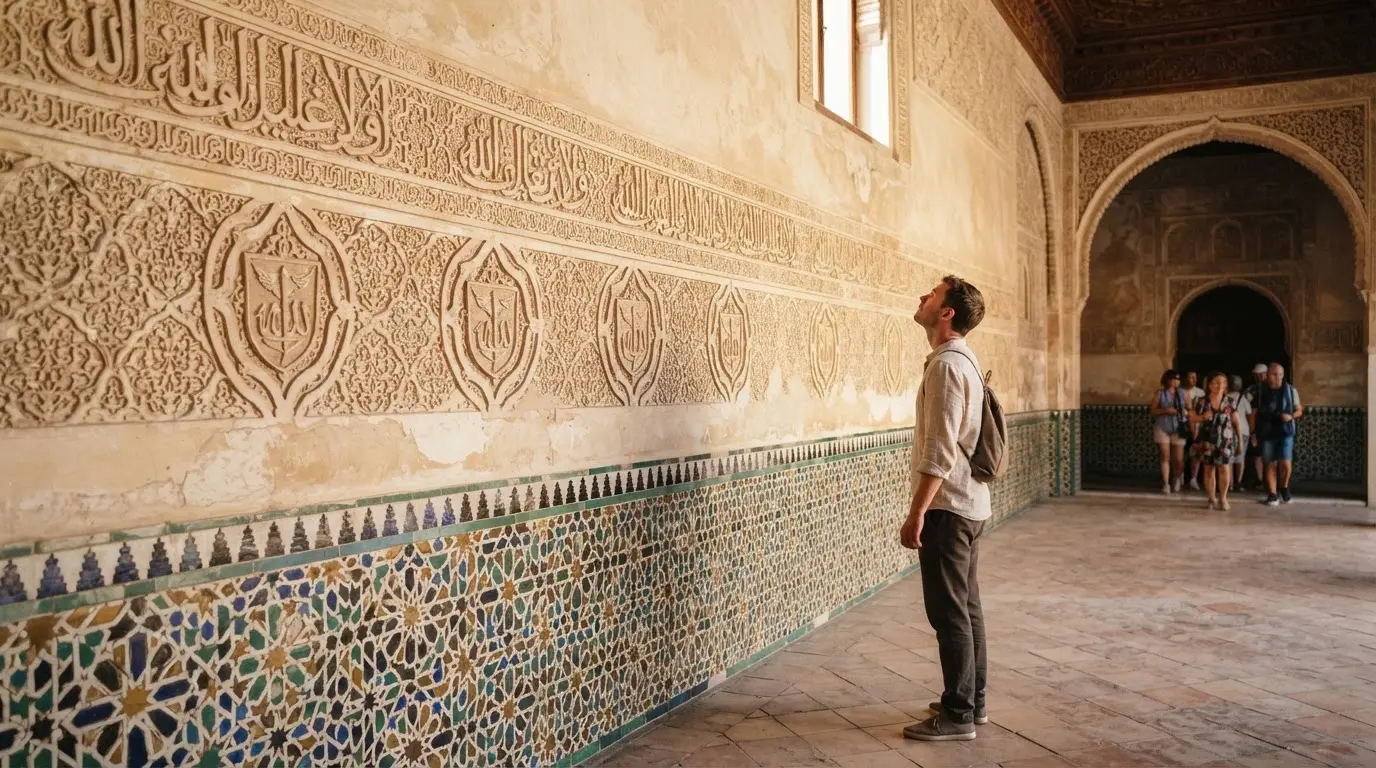
Look for the shield first. Spanish iconographers call the motto the galiba, the sultanate's official slogan, and set it in a band across the Nasrid shield, the escudo de la banda.[10] The emblem is bold and it repeats, so you can recognise it across a courtyard long before you can read a letter.
Comares is where to train your eye. The Patronato de la Alhambra, the body that runs the monument, says most of the Arabic inscriptions in the Comares Palace carry the dynastic motto.[11] Comares is one of the main blocks of the Nasrid Palaces.

Explore nearby · Monument
Nasrid Palaces
Three royal Nasrid palaces inside the Alhambra, including the Patio de los Leones and Hall of the Ambassadors. Entry is timed: arrive within your booked slot.
The Victoria and Albert Museum, which holds a Nasrid stucco roundel bearing the motto, goes further. It says the phrase is found in the decoration all over the Alhambra, and it names two places to look: the stucco of the Court of the Myrtles and the facade of the Patio del Cuarto Dorado.[12]
The slogan has company. Many other inscriptions are aphorisms, and one reads "Be sparse in words and you will go in peace", advice the motto itself obeys.[13]
How the motto sits among the other inscriptions
The Patronato de la Alhambra sorts the texts into five families:[14]
- Quranic: fragments of the sacred book
- Royal: praise of the sultan
- Dynastic: references to the motto
- Religious
- Poetic
Scripture is the surprise. In 2009 Castilla said that Quranic verses made up not even 10 percent of what his team had studied so far, and that verses and poems together were still a tiny minority.[2] The walls are mostly formula, and the poems that guides love to quote are the exception. Ibn Zamrak wrote the best-known verses, but the eye lands on the repeated slogan far more often.
Deep dive · Article
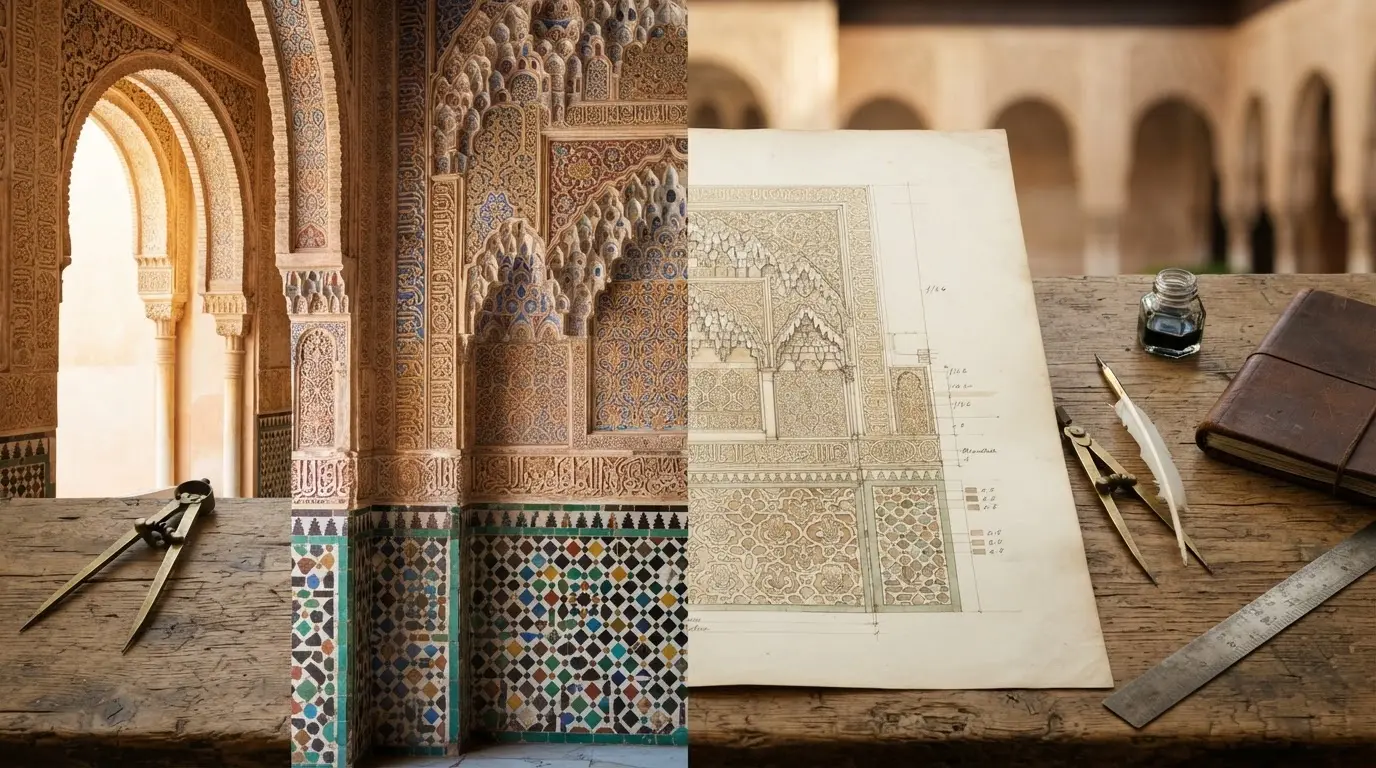
Alhambra 19th Century Restoration: What Contreras Changed
Rafael Contreras renewed parts of the Alhambra in the 1800s. See how Leopoldo Torres Balbás later changed the method through conservation and restraint.
Script adds a second layer. Besides Kufic and cursive, Castilla's team identifies a third, mixed hand that combines the two.[15] The same five words can look quite different from one panel to the next, which makes the motto harder to spot than its frequency suggests. The stucco craft behind it is covered in our guide to Nasrid architecture.
Castilla's overall conclusion, as summarised on medieval.eu, is that the walls were propaganda: one message in many registers.[16] It squares with how little of the corpus is scripture. If Quranic verses are under a tenth and poetry adds only a sliver, most of the rest is formula and message, and the motto is that message at its most compressed.
Counting the corpus, and reading it on site
Juan Castilla Brazales and his CSIC team started cataloguing in 2002. Seven years on, 3,116 inscriptions were decoded, just under a third of a corpus of about 10,000, and the motto already topped the frequency table, repeated hundreds of times in his words.[17]
That figure matches the first volume of the corpus, which registers 3,116 inscriptions in the Comares Palace alone.[18]
Some texts sit where no visitor will read them. The team found lettering on the inside of the stalactites that hang from the vault of the Hall of the Abencerrajes.[19]
Recommended tours
Tours are selected for quality, not commission. We earn a small fee if you book — at no extra cost to you.



The Patronato's own page for Puerta Vílchez's Leer la Alhambra presents it as a guide through the inscriptions that sets the carved texts beside Ibn Zamrak's Diwan.[20] It is the book for anyone who wants more than a slogan.
My advice: stop trying to read and start looking for repetition. Find the shield, find the band, then let the same shape announce itself again a few metres on. The reading can wait for a library. For which sultan commissioned which room, see Alhambra political history, room by room.
How to spot the motto in a room
- A shield in a roundel, crossed by a broad band
- Lettering whole in the band, split in two halves beside it, or round the shield[21]
- Roundels alternating with inscribed cartouches, as in the Court of the Myrtles[22]
- Kufic, cursive or the mixed hand: the same words in different clothes
- The same phrase again a few metres on