Nasrid Architecture: Muqarnas, Mocárabes, and Zellige Explained
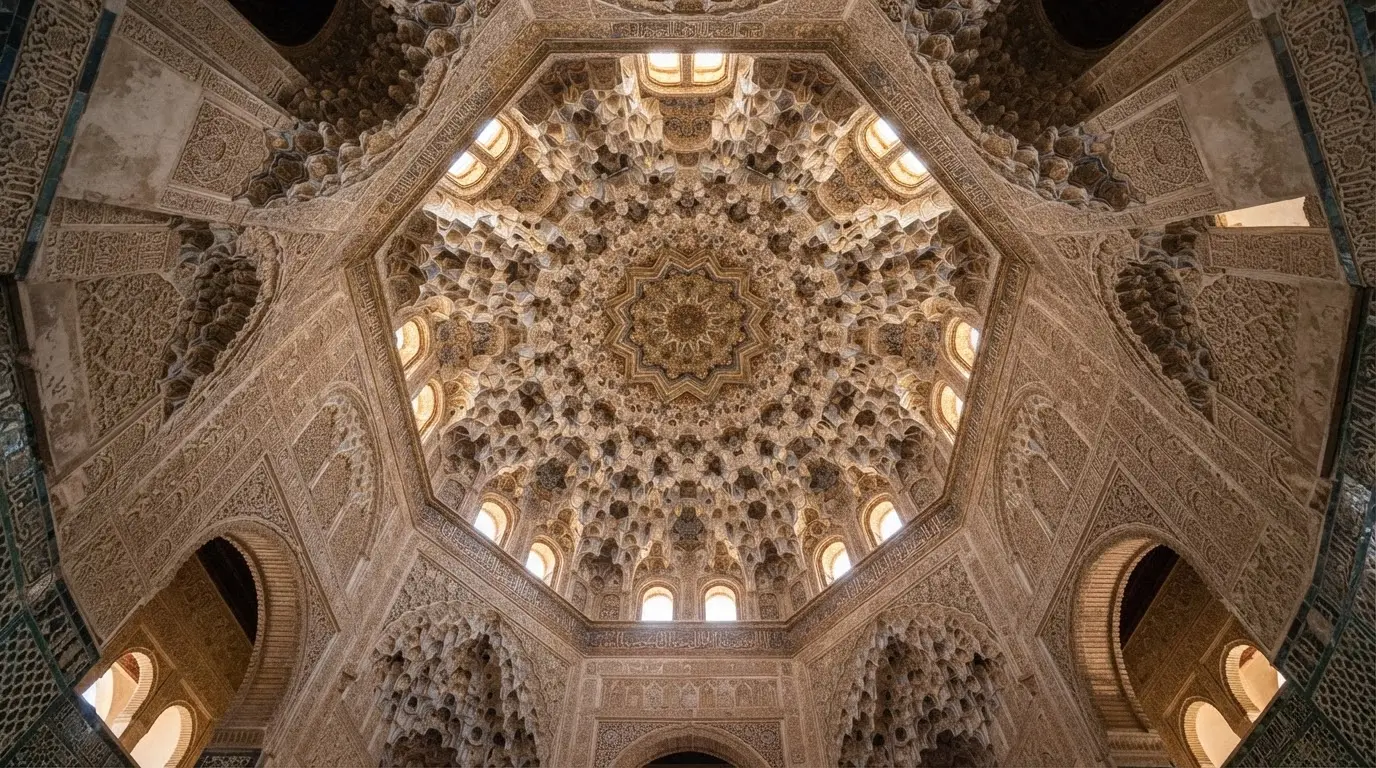
Muqarnas: the stalactite stucco vaulting in the Alhambra's Hall of Two Sisters, ~5,000 carved cells. How it differs from mocárabes and zellige tiles today.
Seven years resident in Granada. Specialist in Nasrid architecture, Al-Andalus history, and Andalusian walking routes.
Updated Published
Three overlapping techniques built the interior world of the Nasrid Palaces: muqarnas stalactite vaulting in carved stucco, zellige cut-tile mosaics at dado height, and the carved arabesque plasterwork in between. Understanding the distinction between them changes what you actually look at when you walk through the Alhambra. Each technique follows different rules and uses different materials. They are not variations on a theme.
In this article
Jump to a section
⌄
What the three techniques are and why the distinction matters
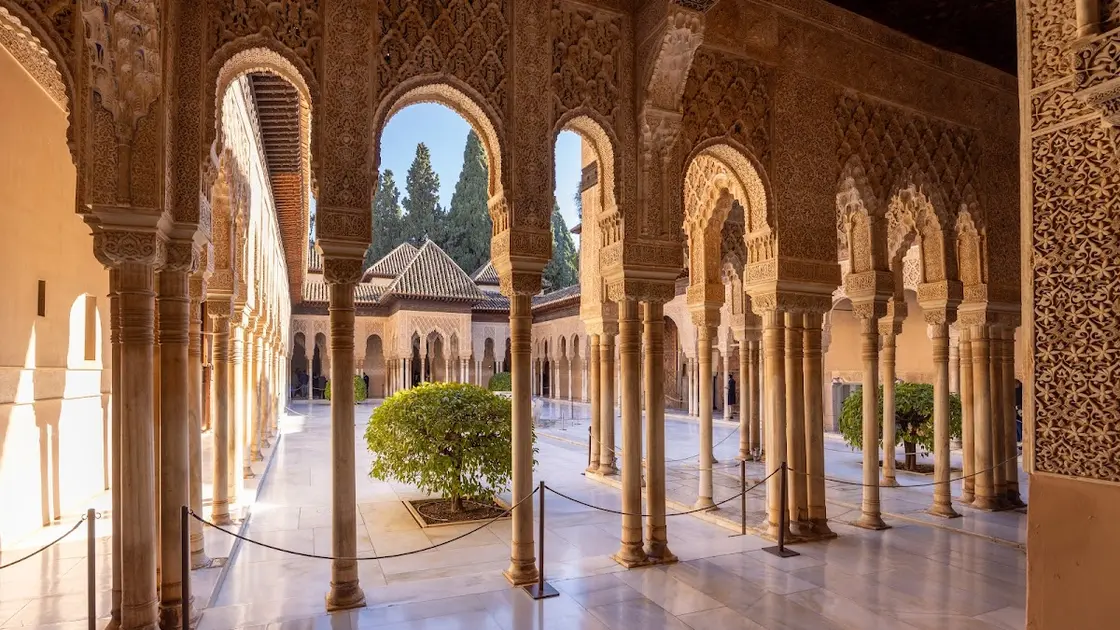
Most visitors to the Alhambra experience the decoration as a single overwhelming surface. The walls seem to dissolve into pattern; the light refracts differently in every room. That effect is the sum of three distinct craft traditions stacked vertically from floor to ceiling.
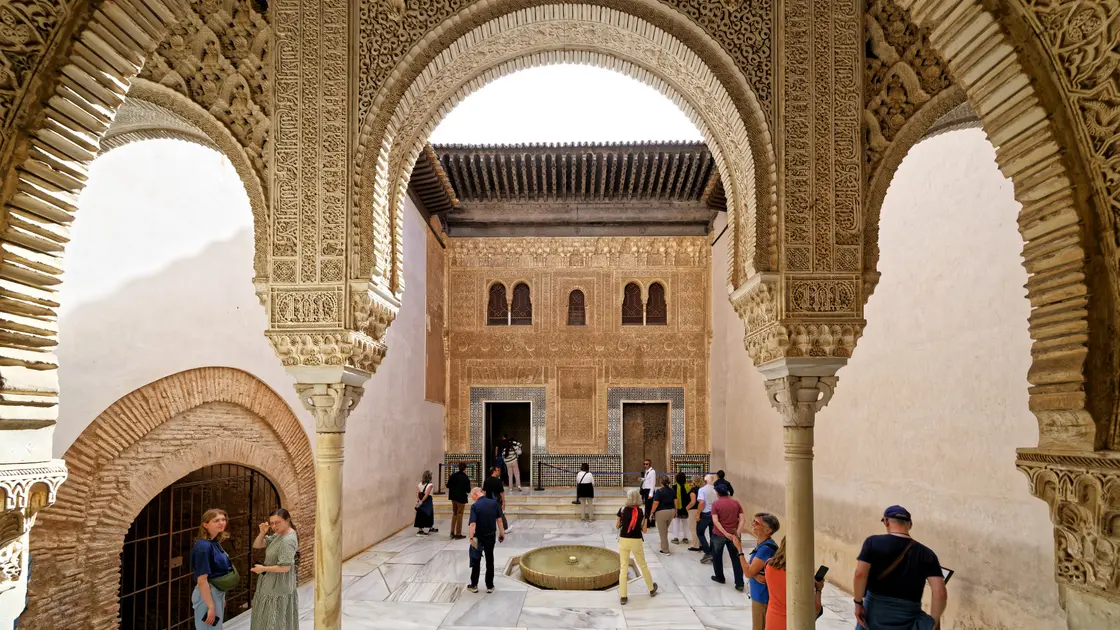
At floor level, up to roughly one metre, the zellige dado carries geometric tile mosaic: hand-cut glazed ceramic tesserae assembled into interlocking star-and-polygon patterns. Above the tile zone, yesería takes over: carved white stucco bearing arabesques, calligraphic bands, and the sebka diamond-lattice work that fills the upper walls. At ceiling height, muqarnas vaulting handles the transition from a square room plan to a dome or half-dome. In rooms like the Hall of Two Sisters, the stucco continues upward into approximately 5,000 individually carved muqarnas cells[2]; in the Comares Hall, the ceiling instead uses a completely separate technique: taracea, the wood marquetry inlay of cedar over 8,000 pieces. That last distinction matters more than most visitors realise, and this article returns to it.
The three-zone composition is not aesthetic accident. Each layer solves a specific physical problem. Zellige at dado height protects walls from moisture and abrasion in a way that painted plaster cannot. Carved stucco yesería carries calligraphic inscriptions that would be impractical to fire into ceramic. Muqarnas vaulting resolves the geometric mismatch between a square floor plan and a circular or octagonal dome, doing so without visible corbels or structural haunches.
3 layers
Every major room in the Nasrid Palaces stacks three layers from floor to vault: zellige ceramic mosaic at dado height, yesería carved stucco above it, and either muqarnas stalactite vaulting or a painted wooden ceiling at the top.
Understanding these distinctions also corrects a persistent tourist-guide compression: the Alhambra is often described as if it were a single decorative programme. In reality it was built over at least 150 years by successive Nasrid sultans, and different rooms represent different phases and different patrons. For the political history behind those sultans, see the companion piece on the Nasrid dynasty; for a room-by-room account of which sultan built what and what each space was designed to project about power, see the political biography of the Alhambra's rooms. This article stays on the craft.
Muqarnas and mocárabes: the honeycomb ceilings of the Palace of the Lions
Muqarnas is a form of three-dimensional tiered vaulting in which rows of prismatic cells project outward over those below, creating a stalactite or honeycomb effect that obscures the structural transition between a square chamber and a circular or octagonal dome above.[1] The term covers the whole category, from the stone muqarnas of Mamluk Egypt to the brick-and-plaster work of Ilkhanid Iran.
Mocárabe is the Ibero-Arabic term for the specifically Western form: pendant, downward-hanging prismatic elements built from a fixed repertoire of eight standard unit shapes. The key point is the standardisation. Each prismatic unit has the same side lengths; the variety of the overall pattern comes from how the identical units are assembled, not from variation in the units themselves. This is what allowed pre-fabrication: craftsmen could make hundreds of identical stucco modules off-site and assemble them at the point of installation, like a three-dimensional puzzle with a limited set of pieces.
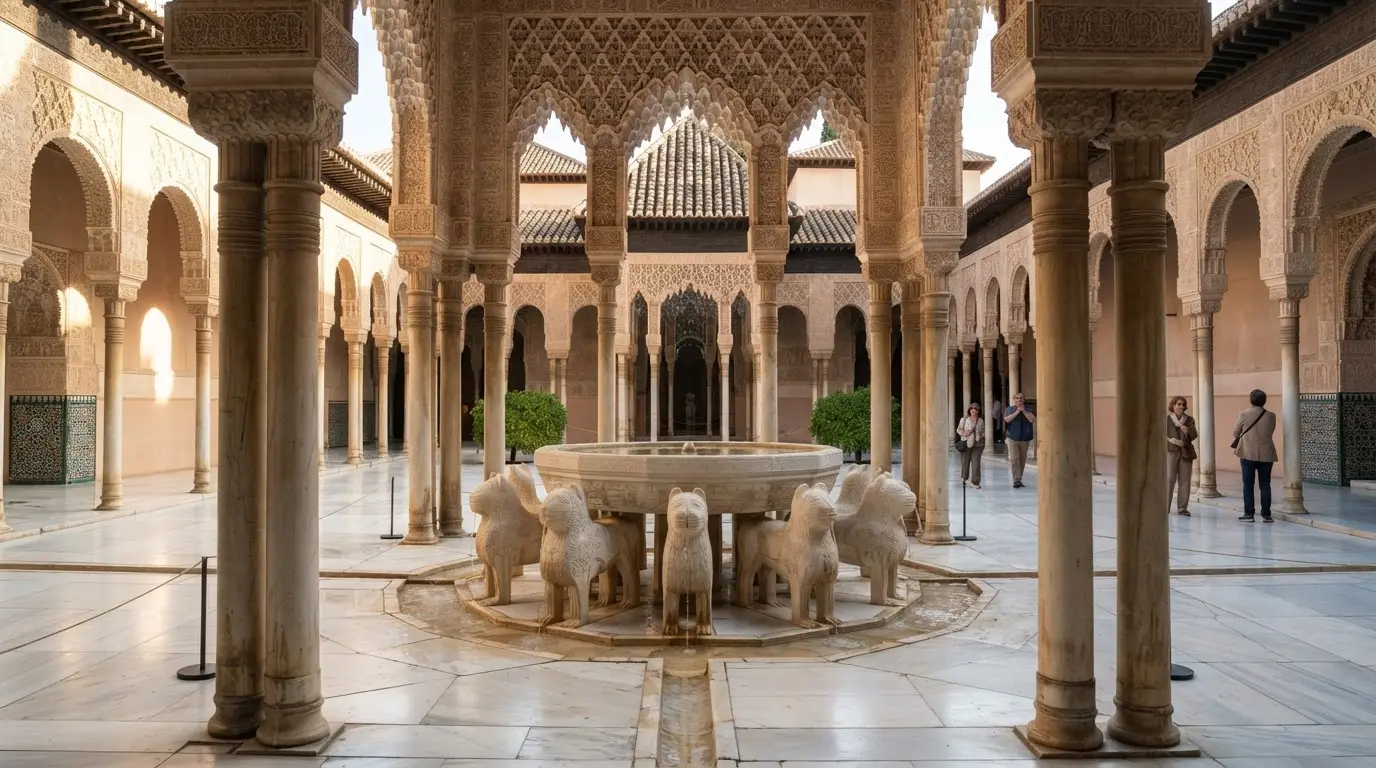
The Hall of Two Sisters (Sala de Dos Hermanas) in the royal Alhambra chambers contains the most complex mocárabe ceiling in the Alhambra. Approximately 5,000 individual stucco cells unfold from a central eight-pointed star summit, cascading outward and downward through sixteen secondary miniature domes around the perimeter of the main dome.[2] The room's floor area is modest, around 8 by 8 metres. The dome overhead creates the impression of a space three times taller than the walls suggest. A series of pierced windows just below the dome catches raking light throughout the day, so the shadow pattern shifts by the hour.
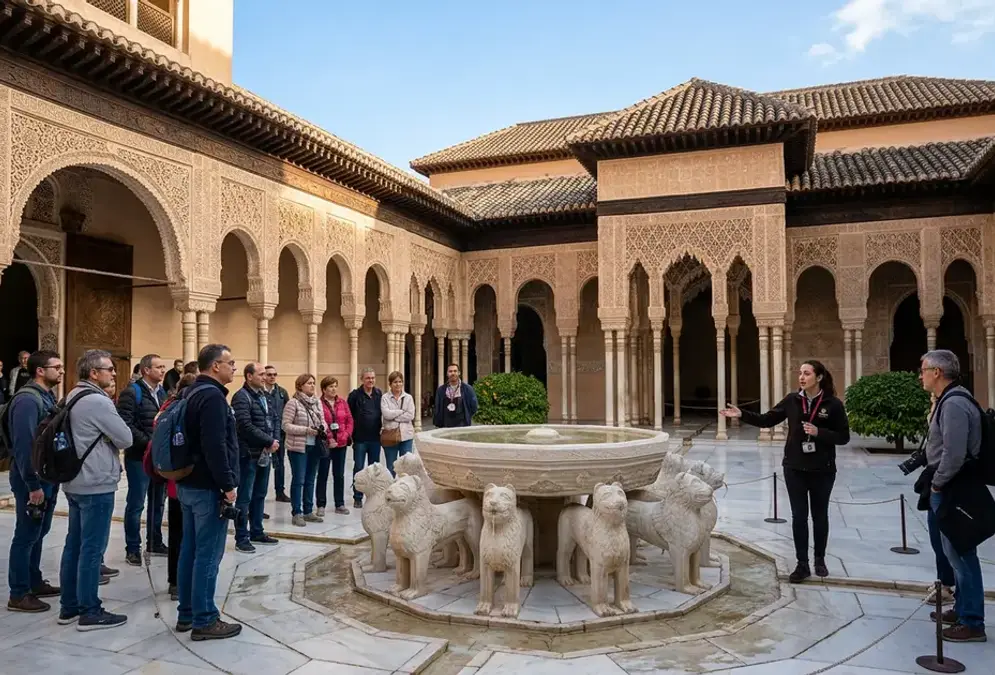
The Hall of Abencerrajes, on the south side of the Court of the Lions directly opposite the Hall of Two Sisters, holds the second great muqarnas showpiece of the Palace. Its summit is a sixteen-pointed star rather than an eight-pointed one, and the transition from square room to star plan is achieved through corner squinches, each of which is itself a miniature muqarnas composition. A small fountain pool at floor level would have reflected light upward onto the dome, doubling the effect.
“
“I am the garden that beauty adorns; you will know my true nature by the grace that adorns me.”
Ibn Zamrak (1333-1393), Court poet of Muhammad V, inscribed on the zellige dado of the Hall of Two Sisters
Both ceilings are carved from white stucco over a wooden armature. Traces of original polychrome survive: the mocárabes were once painted in reds, blues, and gold, and the white surface you see today is the underlayer.
Zellige and alicatado: the cut-tile mosaics at dado height
Zellige (called alicatado in Spanish, from the Arabic al-qaṭa'a, meaning "the cut") is a mosaic technique in which individually glazed ceramic tiles are hand-chiseled into precise geometric tesserae and assembled into patterns.[3] The process begins with a plain fired clay tile approximately 10 centimetres square, coated with a tin-oxide or lead glaze and fired again. After firing, a craftsman uses a small iron adze to chisel each square into whatever shape the pattern requires: star, rhombus, interlocking key, elongated polygon.
No two pieces are identical to each other in the sense that each occupies a unique position in the pattern. But the pattern itself is constructed from a finite vocabulary of shapes derived from girih geometry (covered in section five). Assembly proceeds face-down on a full-scale paper template drawn on the workshop floor; the completed panel is then lifted and applied to the wall surface in plaster.
In the Alhambra, zellige appears in every major room of the Nasrid Palaces as a dado band from floor level to roughly 1 to 1.5 metres. The finest surviving examples are in the Hall of Two Sisters, where the polychrome alicatado carries interlocking star-and-polygon patterns in blue, white, green, and black. Some tesserae in the Mirador de Lindaraja are only 2 millimetres wide, among the smallest known surviving zellige anywhere.[4] The Ibn Zamrak inscription runs in thuluth script immediately above the tile dado in the Hall of Two Sisters, physically readable by visitors today.
Recommended tours
Tours are selected for quality, not commission. We earn a small fee if you book — at no extra cost to you.
The dominant palette in Nasrid zellige is cooler than the Moroccan tradition: blue, white, green, black, and honey-yellow, set against white grounds. Moroccan Marinid zellige of the same period tends toward warmer, more saturated combinations of yellow, terracotta, and emerald green. The difference in palette is one of the clearer markers for distinguishing the two traditions when you encounter them side by side.
How the techniques arrived in Granada: the transmission from Iraq to Andalusia
Muqarnas most likely developed in Iraq under Abbasid or Buyid patronage in the late 10th to early 11th century.[5] The form appears in near-simultaneous examples from Iraq, Iran, and North Africa in the late 10th century, which has produced scholarly debate about whether it diffused from a single origin or developed independently in parallel regions. Most current scholarship favours a single Iraqi origin with rapid westward transmission.
From Iraq, the technique moved through Iran and Khorasan, then westward across North Africa via Fatimid and Zirid networks. Early fragments of zellige from al-Mansuriyya, near Kairouan in Tunisia, date to the mid-10th century and represent some of the earliest known examples of cut-tile mosaic in the western Islamic world. By the Almoravid period in the 11th and 12th centuries, both zellige and muqarnas were established in Morocco and al-Andalus. The Koutoubia Mosque in Marrakech (12th century, Almohad) contains one of the earliest surviving large-scale muqarnas mihrabs in the western Islamic world.
The Nasrid florescence in Granada (14th century, principally under Yusuf I and Muhammad V) came at the tail end of this westward transmission, drawing on three centuries of accumulated craft knowledge. What makes the Nasrid contribution distinctive is the degree of refinement rather than formal invention. The mocárabe repertoire was standardised, the zellige cutting precision was pushed to its limits, and the result is a completeness that later traditions in Morocco looked back to as a reference point.
Timeline
Late 10th century
Muqarnas origins
Muqarnas first documented in Iraq and Iran, under Abbasid and Buyid patronage. Near-simultaneous appearances fuel debate about origin; most scholars favour Iraqi provenance.
Mid-10th century
Zellige in North Africa
Zellige fragments from al-Mansuriyya near Kairouan (Tunisia) represent the earliest known cut-tile mosaic in the western Islamic world, under Fatimid or Zirid patronage.
11th-12th century
Spread westward
Almoravid and Almohad dynasties spread both techniques across Morocco and al-Andalus. The Koutoubia Mosque in Marrakech establishes the western muqarnas mihrab tradition.
1323-1356
Marinid Fes at its peak
Marinid Fes: the Attarine Madrasa (1323-1325) and Bou Inania Madrasa (1351-1356) demonstrate the full three-zone composition contemporaneously with the Nasrid Alhambra.
1333-1391
Nasrid apex
Nasrid Granada: Yusuf I builds the Comares Palace; Muhammad V completes the Palace of the Lions with the Hall of Two Sisters mocárabe dome and its approximately 5,000-cell vault.
The Al-Qarawiyyin mosque in Fes (founded 859, expanded significantly in the 12th century under the Almohads) contains early Moroccan zellige. The Attarine Madrasa (1323-1325) adjacent to it shows the three-zone articulation zellige/stucco/carved wood at a quality level directly comparable to the Alhambra's interiors, built a generation earlier than the Palace of the Lions.
The mathematics behind the ornament: girih, symmetry groups, and Escher
All three Nasrid craft traditions share a common geometric foundation: the girih system (Persian for "knot"), a set of five standard polygon types whose sides are all equal length:
regular decagon (10 sides)
regular pentagon (5 sides)
elongated hexagon
bowtie
rhombus
Any combination of these five tiles tessellates without gaps. Assembling them in different configurations produces the complete range of interlaced strapwork patterns visible in zellige, carved stucco, and wooden ceilings throughout the Alhambra.
Researchers Peter Lu and Paul Steinhardt, writing in Science in 2007, demonstrated that Islamic architects from at least the 15th century used a set of girih tiles decorated with lines at consistent angles.[6] When assembled, the lines across tile edges connect automatically into continuous interlaced strapwork without any calculation of individual angles at each joint. The geometry is self-describing: if the base grid is right, all the pattern lines follow by rule. Some patterns generated by this method exhibit quasi-crystalline symmetry, with five-fold rotational symmetry incompatible with standard periodic tessellation. Roger Penrose described equivalent structures formally in the 1970s, several centuries after Nasrid craftsmen built them empirically into floor and wall surfaces. For a room-by-room breakdown of how this geometry operates across the Nasrid Palaces — including the proportion systems governing room dimensions and the muqarnas dome mathematics — see the Alhambra geometry deep dive.
The Alhambra's geometric patterns are frequently cited as containing examples of all 17 mathematically possible two-dimensional wallpaper symmetry groups, the complete classification that mathematicians formalised only in the 19th century. This claim is substantially supported by multiple studies but contested at the margins: depending on methodology, some researchers count 14 or 16 rather than 17. The argument about the exact count misses the point slightly; whichever number is right, medieval craftsmen empirically discovered symmetry configurations they had no algebraic vocabulary to describe.
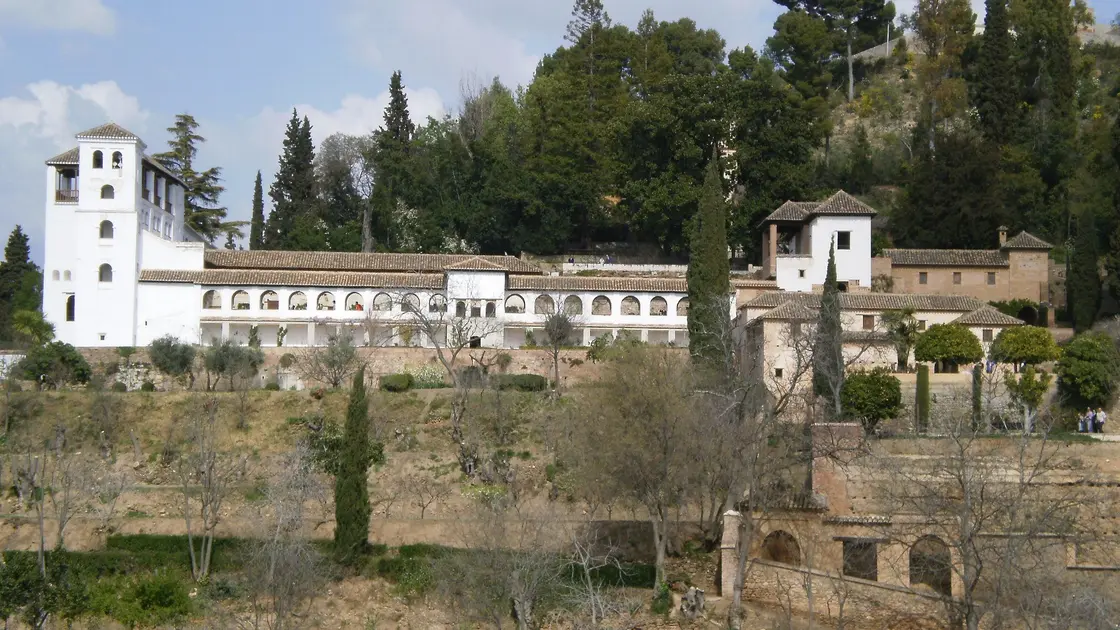
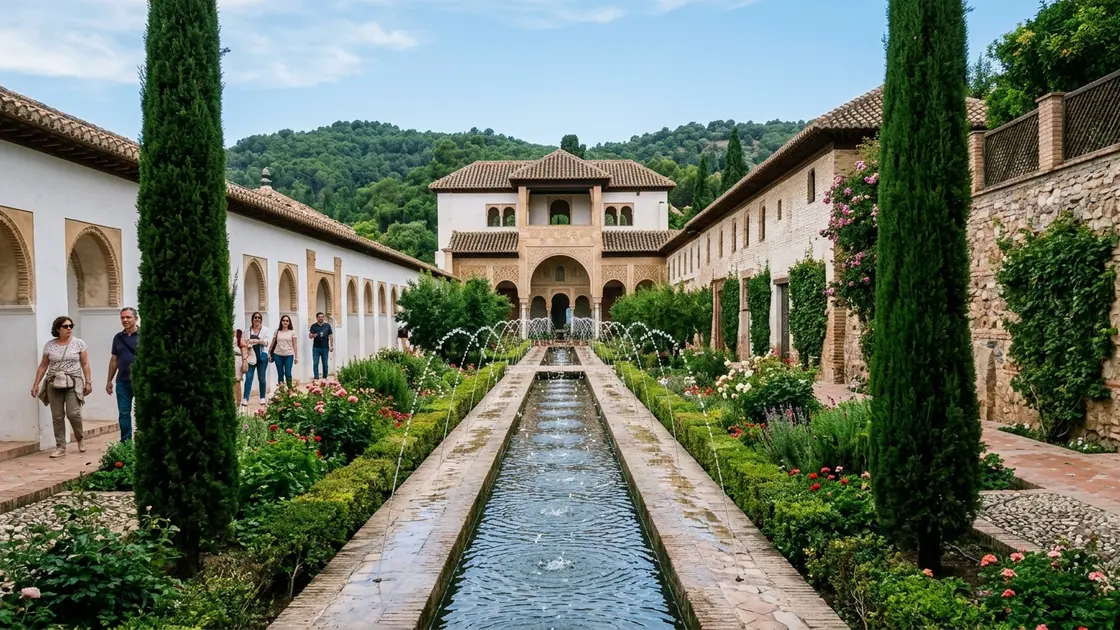
M.C. Escher visited the Alhambra twice: in 1922 and again in 1936. He made detailed observational studies of the zellige patterns, filling notebooks with geometry. He described the experience in a letter as "the richest source of inspiration I have ever tapped." The tessellation series that made him famous, the interlocking lizards, fish, and birds drawn so that positive and negative space alternate perfectly, came directly from those studies. The zellige dado in the Hall of Two Sisters that Ibn Zamrak's poem sits above is the same tiling Escher was copying into his notebooks. A visit to the Generalife's muqarnas on the same day shows the geometric vocabulary extended to outdoor water gardens, the same proportional principles applied at landscape scale.
Moroccan comparisons: Marinid craft and the Comares Hall distinction
The Nasrid Alhambra and the Marinid buildings of 14th-century Fes were built simultaneously under dynasties that maintained active diplomatic relations and almost certainly shared craftsmen, design templates, and possibly tile materials.[7] The Bou Inania Madrasa in Fes (1351-1356), commissioned by Abu Inan Faris, is the closest surviving parallel to the Nasrid palatial interiors: zellige dado, carved stucco arabesque mid-zone, muqarnas cornice, and carved cedar above. Visiting both sites reveals how much the two traditions share and where they diverge.
The craft tradition did not stop in 1492. After the Reconquista, Muslim craftsmen trained in the Nasrid workshops continued to build for their new Christian patrons, adapting the same horseshoe arches, sebka lattice, and artesonado ceiling vocabulary into the churches that replaced the Albaicín's mosques. This hybrid style — Islamic technique in the service of Christian architecture — is called Mudéjar, and the Albaicín's converted churches are among its finest surviving examples in Granada. For the full account of how these craftsmen navigated that transition and what they produced, see the article on Mudéjar art in Granada.
The formal vocabulary is essentially identical. What differs is palette and proportion. Moroccan Marinid zellige uses broader, more saturated colours: yellows, terracotta, emerald green, saturated cobalt. Nasrid Alhambra zellige is cooler and more restrained, dominated by blue, white, green, black, and honey-yellow. Moroccan stucco carving runs slightly deeper in relief. The Alhambra's stucco is cut with more delicate precision, relying on shadow rather than depth for its effect.
The Comares Hall (Hall of the Ambassadors) in the Comares Palace was where foreign diplomats were received. Its ceiling is also where the correction most needed by anyone studying Nasrid technique lives. The dome is not muqarnas. It is taracea: wood marquetry in which over 8,000 individually cut pieces of cedar, bone, and ivory are inlaid to create a pattern representing the seven heavens of Islamic cosmology.[8] The same mathematical principles that govern zellige and mocárabe design, star-polygon tessellation on girih proportions, are realised here in a completely different material and at a completely different scale.
Contrasting the Comares cedar dome with the stucco mocárabes of the Hall of Two Sisters makes the range of Nasrid geometric craft legible. Both rooms use the same governing geometry. Both achieve a ceiling that reads as a star-field. The Comares dome does it through warm, coloured wood inlay on a flat surface; the Two Sisters dome does it through monochrome carved stucco in three dimensions. The decision to use each technique was not interchangeable: the taracea of Comares required different workshops and entirely different structural logic from the mocárabe vault of the Palace of the Lions.
Frequently asked questions
What is the difference between muqarnas and mocárabes?
Muqarnas is the broad category of three-dimensional Islamic stalactite vaulting, found across the Islamic world from Iraq to Morocco. Mocárabe is the specific Ibero-Arabic term for the Western pendant form: downward-hanging prismatic elements built from a fixed set of eight standard unit shapes, characteristic of al-Andalus and Morocco. At the Alhambra, the two terms appear interchangeably in Spanish tourism materials, but academic usage reserves mocárabe for the inverted, hanging variety.
How many cells does the muqarnas dome in the Hall of Two Sisters have?
Approximately 5,000 individual stucco cells, unfolding from a central eight-pointed star summit downward through sixteen secondary miniature domes around the dome perimeter. The hall floor is roughly 8 by 8 metres, but the dome makes the space feel vastly taller than the walls suggest. The cells were carved from white stucco over a wooden frame and were originally painted in reds, blues, and gold.
Does the Comares Hall have muqarnas?
Not exactly. The famous ceiling of the Comares Hall (Hall of the Ambassadors, inside the Comares Tower) is not muqarnas but taracea: a wooden marquetry dome of over 8,000 cedar pieces representing the seven heavens of Islam. This is a completely different technique from the carved stucco muqarnas in the Hall of Two Sisters and Hall of Abencerrajes. Muqarnas appear in some arches and decorative cornices of the Comares Palace, but the main throne room dome is wood inlay.
What is zellige (alicatado) and where can I see it in the Alhambra?
Zellige, called alicatado in Spanish (from the Arabic al-qaṭa'a, meaning the cut), is a mosaic of individually hand-cut glazed ceramic tesserae assembled into geometric patterns at dado height. In the Alhambra, the finest examples are in the Hall of Two Sisters, the Hall of Abencerrajes, and the Comares Hall. Some tesserae in the Mirador de Lindaraja are only 2 millimetres wide, among the smallest known surviving zellige anywhere.
Did M.C. Escher visit the Alhambra?
Yes. Escher visited twice: in 1922 and again in 1936. He made detailed observational studies of the zellige geometric patterns, which directly inspired his famous tessellation series of interlocking animals and figures. He described the Alhambra as the richest source of inspiration he had ever tapped. The tessellation drawings of interlocking lizards and fish that made him famous came directly from the geometric vocabulary he studied in the Nasrid Palaces.
Does the Alhambra contain all 17 mathematical symmetry groups?
This is widely cited and largely supported. The Alhambra's geometric patterns contain examples of all 17 crystallographic wallpaper symmetry groups, the complete classification of two-dimensional periodic symmetries that mathematicians formalised only in the 19th century. Some researchers count 14 or 16 rather than 17, depending on methodology. Either way, medieval craftsmen empirically discovered symmetry configurations centuries before modern mathematics named them.
How did Nasrid builders achieve such precision without modern tools?
With compass, straightedge, plumb bob, and standardised templates. All girih patterns can be constructed using only compass and straightedge. Craftsmen worked from full-scale 2D templates drawn on paper or the workshop floor; for muqarnas, a limited set of eight standard prismatic stucco units was pre-fabricated and assembled three-dimensionally using the templates as guides. The geometry is self-describing: if the base grid is correct, all angles and projections follow automatically.
What connects the Alhambra's decoration to Moroccan architecture?
The Nasrid Alhambra and the Marinid buildings of 14th-century Fes were built simultaneously under dynasties with active diplomatic ties. The decorative vocabulary is essentially identical: zellige dado, carved stucco arabesque zone, muqarnas cornice, carved cedar ceiling. The Bou Inania Madrasa in Fes (1351-1356) is the closest surviving parallel to the Nasrid palatial interiors. Craftsmen, design templates, and possibly tile materials circulated between Granada and Morocco.
Why does Islamic architecture avoid figurative decoration?
Islamic aniconism, the theological principle discouraging figurative representation of living beings, channelled artistic energy into geometric, vegetal, and calligraphic ornament. Energy that might have gone into figurative sculpture went instead into ever more complex mathematical pattern-making, producing the muqarnas, zellige, and girih traditions of the Alhambra. The Alhambra is what happens when an entire artistic tradition turns toward geometry and keeps going for three centuries.