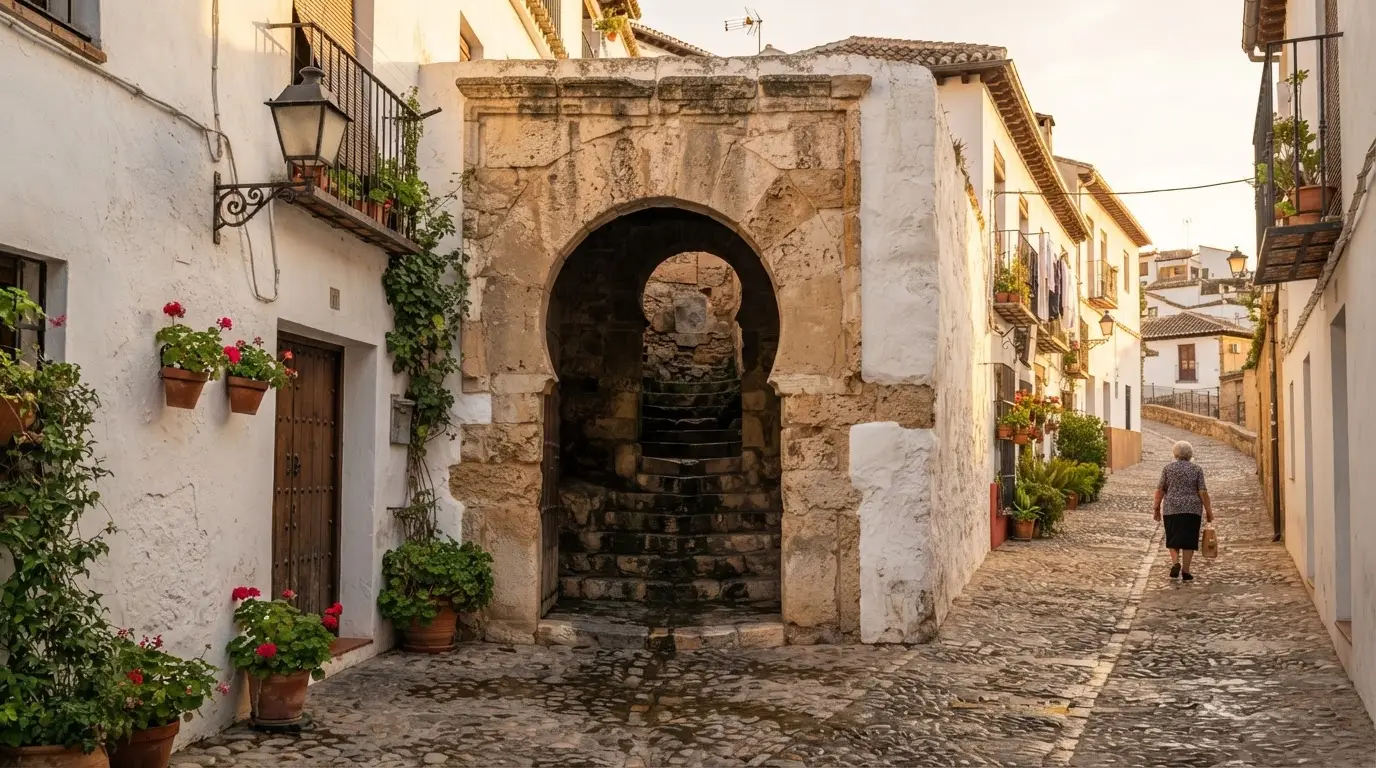

What aljibes are and why the Albaicín needed them
An aljibe (from the Arabic al-jubb, meaning pit or cistern) is a vaulted underground chamber designed to store large volumes of water for later use. The technology came to al-Andalus from North Africa and the eastern Islamic world, where managing water between seasonal rains was a matter of survival. In the Albaicín, it was a matter of urban logic.
The neighbourhood climbs a steep hill above the Río Darro. The river runs at the base; the streets sit 60 to 80 metres above it. Without a pressurised distribution system, carrying water up that gradient by hand would have consumed most of the population's working day. The cistern solved this problem by storing water close to where it was needed, filled overnight or at low-demand hours via the acequia network, drawn off through the day.
But the aljibes were not only about convenience. Islamic religious practice requires ritual purification (wudu) before prayer, five times daily. The mosques of the Albaicín needed reliable water supplies for ablution. So did the hammams (public baths), which were as much a civic institution as a hygienic one. The 26 surviving cisterns were built to serve the Albaicín as a functioning Muslim city, where water was simultaneously practical, ritual, and theological.
The typical aljibe is a rectangular or square underground chamber, 4 to 8 metres on a side and 3 to 4 metres high, roofed with one or more barrel vaults of fired brick. The interior walls were plastered with opus signinum, a hydraulic lime mortar that prevented seepage. Access came through a narrow opening at street level, sometimes arched in stone. Water was drawn by rope and bucket. The cisterns were usually shaded from direct sunlight, which reduced algae growth and kept temperatures low enough to slow bacterial activity.
Zirid origins and Nasrid expansion: building a water city
The Albaicín's cistern network was not built all at once. It grew over three centuries as the city's population expanded and its hydraulic infrastructure matured. The earliest surviving cistern, the Aljibe del Rey, dates from the Zirid period: built between 1038 and 1073[1] under Badis ibn Habus, the Berber emir who made Granada the capital of a taifa kingdom after the Caliphate of Córdoba fragmented in 1031. For the full political story of the dynasty that built this infrastructure, see the article on Granada's 11th-century Berber rulers.
The Zirid period (1013–1090) was when Granada first acquired serious urban infrastructure. The population of the medina was growing, the hill was being settled, and the existing water arrangements — wells, the river, seasonal springs — were no longer adequate. Badis ibn Habus commissioned the Aljibe del Rey as a centrally managed public cistern, its 300 cubic metres of capacity serving the quarter around it, replenished by the acequia that his engineers had already built from the springs at Alfacar.
The Nasrid dynasty (1238–1492) expanded the network substantially. As the Albaicín's population grew to somewhere between 25,000 and 40,000 people within its walls, the demand for water grew with it.[2] The Nasrids commissioned new cisterns across the neighbourhood, often attached to mosques or located at the convergence of major streets.[2] The vaulted brick construction became more refined: later cisterns show horseshoe arches, more careful waterproofing, and better integration with the street-level access points.
Explore nearby · Monument
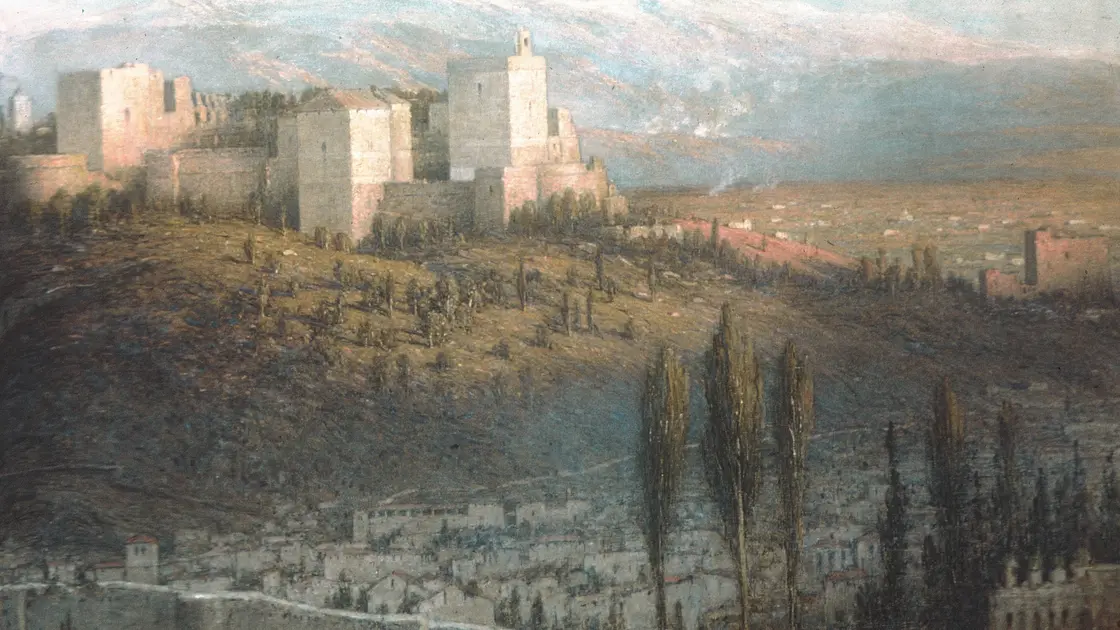
Alcazaba, Granada
Granada's oldest fortress and the military core of the Alhambra, built in 1238. Its Watch Tower delivers panoramic views of the Albaicin and Sierra Nevada.
By the late Nasrid period, the network covered the entire hill. Approximately 28 cisterns are documented across historic Granada,[2] with 26 surviving in the Albaicín today. Each served a distinct catchment area. The distribution was planned, not ad hoc: the spacing between cisterns roughly matches the maximum reasonable carrying distance for a heavy vessel of water.
The Acequia de Aynadamar: the channel that fed everything
Every cistern in the Albaicín depended on the same upstream source: the Acequia de Aynadamar, an irrigation channel whose name derives from the Arabic for "Fountain of Tears" ('Ain al-dam'). It originates at the Fuente Grande in Alfacar, a village 8 kilometres north of Granada where a powerful spring emerges from the limestone aquifer beneath the Sierra de la Alfaguara.[3]
The acequia was built in the 11th century during the Zirid period, roughly contemporary with the Aljibe del Rey.[3] The engineering logic was the same as the Alhambra's Acequia Real: tap a reliable upland spring, run the channel along natural contour lines at a slight gradient, and let gravity do the rest. The Acequia de Aynadamar entered the city from the north through the Puerta de Elvira area, then distributed through secondary channels across the Albaicín. The cisterns were fill-points in this network, topped up when the channel flowed and drawn down between fills.
The channel served the Albaicín for nine centuries. Its water supplied the cisterns and the gardens, orchards, and carmen walls that give the neighbourhood its characteristic terraced profile. The old Arabic term carmen — a private walled garden — is inseparable from the acequia network: without the channel, the gardens do not exist.
Recommended tours
Tours are selected for quality, not commission. We earn a small fee if you book — at no extra cost to you.
Then road construction in the 1980s cut through sections of the channel, interrupting the flow that had run continuously since the 11th century.[4] The Acequia de Aynadamar stopped supplying the Albaicín. The cisterns, already no longer in use for drinking water,[4] became disconnected from their original source entirely. Parts of the channel have since been restored by local water management authorities,[4] and sections near Alfacar are again carrying water. But the acequia no longer reaches the Albaicín as it once did.
The relationship between the Acequia de Aynadamar and the Aljibe del Rey distills Granada's entire Islamic hydraulic heritage into one neighbourhood: the same thinking that produced the Alhambra water system on the hill to the south, applied to a dense urban quarter that needed water delivered not to palace courtyards but to every household on a steep hill.
The Aljibe del Rey: inside Granada's largest medieval cistern
The Aljibe del Rey (King's Cistern) sits beneath a small plaza on the Calle Aljibe del Rey in the upper Albaicín. From street level it announces itself with a low arched entrance and a modest interpretation panel. Step inside and the scale changes: four underground vaulted chambers, each roofed with a barrel vault of fired brick, extend beneath the houses above. The total volume is 300 cubic metres[1] — equivalent to roughly 300 bathtubs of water, held underground at constant temperature, always full when the acequia was flowing.
The cistern measures 11 metres by 11 metres in plan and 4 metres high.[1] The four chambers share the same footprint, separated by thick masonry walls that carry the vault loads. The brickwork has survived almost intact for nearly a thousand years, which says something about the quality of the Zirid mortar. The walls are still coated in hydraulic plaster, still watertight in principle, though the cistern has not held water operationally since long before the Spanish Civil War.
300 m³
One detail makes the Aljibe del Rey unusual among the Albaicín cisterns: a central roof opening designed to supplement acequia-fed supply with rainwater.[1] Most cisterns relied entirely on channel water. The Aljibe del Rey's roof opening gave it a secondary supply during dry periods when the acequia ran low, and made it partially self-sufficient in wet winters.
Another detail is harder to find in the current interpretation. Historically, eels and turtles were kept alive inside the cistern.[1] They consumed algae and insects, maintaining the water quality without any chemical treatment. The practice was common in medieval al-Andalus; the Aljibe del Rey was unusual only in its size. The livestock also served as informal quality indicators: if the eels died, something was wrong with the water.
The cistern was restored in 1988 and has been managed by the AguaGranada Foundation since 2008.[5] Queen Sofía formally opened the interpretation centre in 2009. The visit takes about 30 minutes and includes access to the underground chambers. There is no charge currently, though hours vary by season; checking ahead before visiting is worth the effort. The Arab Baths of the Bañuelo, less than 10 minutes' walk downhill, give a complementary picture of how the same water network served the neighbourhood's public baths.
Visiting the aljibes today: the Route of the Aljibes
The most systematic way to explore the Albaicín's cistern heritage is the Route of the Aljibes, a walking circuit that passes 27 aljibes through the neighbourhood. The route is marked on maps available at the Granada tourist office and through the AguaGranada Foundation. Most of the cisterns on the route are not open interiors; they present as stone-framed openings in walls, blocked archways, or changes in pavement level that hint at the volume below. What the route offers is a spatial reading of the neighbourhood: once you start tracking the cisterns, the water logic of the Albaicín's street pattern becomes legible.
Beyond the Aljibe del Rey, several cisterns are at least partly visible:
- Aljibe de la Lluvia (Cistern of Rain) near the Calle Agua — one of the few with an exposed roof-fill opening still visible from street level
- Aljibe de San Cristóbal near the homonymous mirador, with its access arch largely intact
- Aljibe de la Gitana in the lower Albaicín, built into a slope and accessible in part from the street below
- Aljibe del Trillo near the Placeta del Trillo — partially excavated during street works and now incorporated into an open-air interpretation panel
Deep dive · Article
Abencerrajes of Granada: the noble clan behind the legend
Abencerrajes of Granada: the noble clan who shaped Nasrid court politics for a century and became legend through a massacre story set in the Alhambra.
For the Aljibe del Rey itself, the AguaGranada Foundation manages visits. The entrance on Calle Aljibe del Rey is the only access point. The interior tour covers all four vaulted chambers and includes panels on the acequia network and Zirid hydraulic engineering. No booking required for individual visitors.
The neighbourhood is best walked in the early morning when the light comes low over the rooftops and the lanes are quiet. The cistern entrances are easier to spot before the streets fill with people. From the Aljibe del Rey, allow 90 minutes to two hours to complete the full route at an unhurried pace. If you are walking the lower Albaicín, the Maristan of Granada — Muhammad V's 14th-century Nasrid hospital, whose therapeutic pool was fed by the same acequia network that supplied the neighbourhood's cisterns — is a two-minute walk from El Bañuelo and reopened to visitors in 2023. The Albaicín self-guided walk covers overlapping ground with more context on the neighbourhood's architecture and history.