Seven years resident in Granada. Specialist in Nasrid architecture, Al-Andalus history, and Andalusian walking routes.
Updated Published
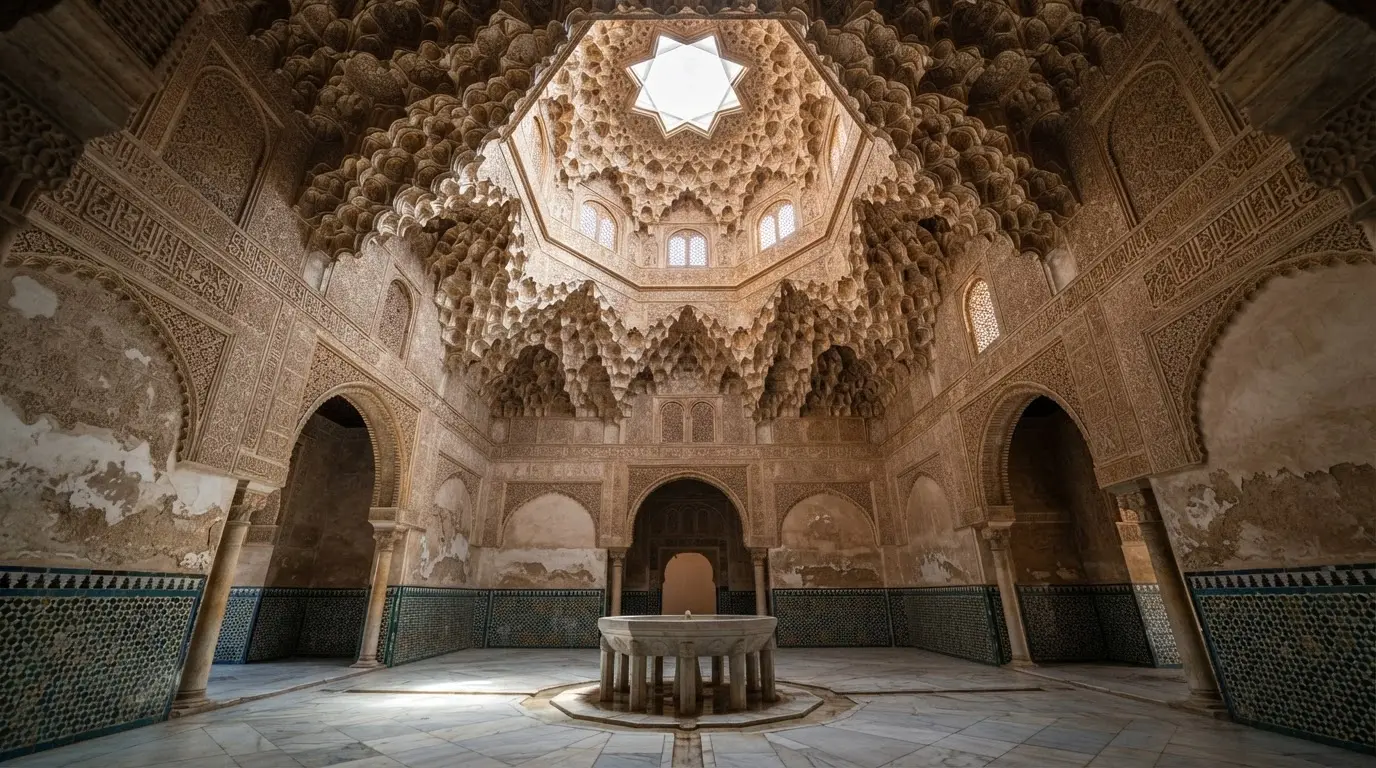
The Abencerrajes were the most disruptive noble clan in the Nasrid court, a North African family who backed losing claimants in succession crises, helped dethrone sultans, and eventually gave their name to a massacre story that never definitively happened. The Sala de los Abencerrajes in the Alhambra preserves the legend in stone: an octagonal muqarnas ceiling, a twelve-sided marble fountain, and a rust-coloured stain that guides have been calling blood for five centuries. What the Banu al-Sarraj actually did in Nasrid Granada is more interesting than the fiction.
In this article
Jump to a section
⌄
Who were the Banu al-Sarraj?
The clan known in Spanish sources as the Abencerrajes took their name from the Arabic Banu al-Sarraj, meaning the sons of the saddler. The family was of North African aristocratic origin, part of the broader Berber migration that had shaped Andalusian society since the early Islamic period.[5] By the 14th century they had become one of the most prominent noble lineages in the Nasrid emirate, the last Muslim state in Iberia, whose territory in the final two centuries of its existence barely extended beyond Granada and a narrow coastal strip.
The Nasrid court was not a stable institution. The emirate lasted from 1232 to 1492, but that span conceals a near-continuous record of assassination, deposition, and factional violence. At least six sultans were murdered or forcibly deposed during the 15th century alone. Noble families like the Abencerrajes did not simply advise the emir; they chose him, backed him, and replaced him when circumstances changed. The grand vizier position, effectively the prime ministership of the emirate, was the prize that powerful clans competed for, and the Abencerrajes held it more than once.
Their rivals in the most famous account of Nasrid court politics were the Zegríes, another noble faction with competing interests. The exact nature of that rivalry, its causes and its chronology, is partly obscured by the literary tradition that later absorbed both names. What is clear from the historical record is that factional competition in the Nasrid court was not simply personal; it tracked real divisions over foreign policy, succession, and the increasingly desperate question of how to survive pressure from Castile and Aragon.
Faction warfare: the Abencerrajes in Nasrid succession politics
The clearest documented moment in Abencerraje history is also the most violent the clan actually experienced, as opposed to the violence later attributed to them in legend. In 1462, Emir Abu Nasr Sa'd executed prominent Abencerraje clan members, including his own grand vizier.[5] The survivors fled north to Málaga and used their position to support rival claimants to the throne, backing Ismail IV as a counter-sultan against Sa'd's rule.[2]
This was not an isolated incident. The Abencerrajes had a consistent pattern across the mid-15th century of attaching themselves to particular claimants in succession disputes:
They backed Muhammad IX against Muhammad VIII in earlier succession conflicts
They supported Yusuf IV, who reigned briefly in 1432 with Castilian assistance
Their most consequential intervention came in 1483, when they helped Boabdil (Muhammad XI) dethrone his own father, Abu al-Hasan Ali[1], a coup his mother Aisha had spent years preparing from inside the palace household, as documented in the record of Nasrid royal women's political power
Timeline
1432
Yusuf IV backed by the Abencerrajes
The clan supports Yusuf IV's brief reign, backed by King Juan II of Castile. Yusuf IV dies within months; Abencerraje influence persists.
1462
Execution of clan members by Emir Sa'd
Abu Nasr Sa'd has prominent Abencerrajes executed, including his grand vizier. Survivors flee to Málaga and promote Ismail IV as a rival claimant.
1483
Abencerrajes back Boabdil's coup
The clan helps Muhammad XI (Boabdil) dethrone his father Abu al-Hasan Ali, splitting the emirate and beginning its terminal nine-year decline.
1492
Granada surrenders to Castile
Boabdil hands the keys of Granada to Ferdinand and Isabella on 2 January. The Abencerrajes lose all political standing.
That last decision is worth pausing on. By helping Boabdil seize power from his father, the Abencerrajes contributed to a period of near-total political paralysis in Granada. The emirate spent the years from 1483 to 1492 divided between Boabdil in Granada, Abu al-Hasan Ali and then his brother Muhammad XII controlling other parts of the territory, and Castile actively exploiting all three. The full arc of that Nasrid succession crisis and civil war — from the 1482 coup to the Battle of Lucena and Ferdinand's deliberate exploitation of the three-way split — is the context in which the Abencerrajes' intervention made its greatest mark. Granada fell nine years after the coup the Abencerrajes helped execute.
The clan was not uniquely responsible for that outcome. The structural problems were older and deeper: Castile's military and economic superiority, the loss of North African support, the shrinking tax base of a tiny emirate surrounded by hostile powers. But the Abencerrajes were participants in the factionalism that made a coordinated defence impossible. They chose Boabdil because it served their interests; it served Granada badly.
For the poet Ibn Zamrak, who composed the Alhambra's famous inscriptions during Muhammad V's reign a century earlier, the court was a place of cultural production despite its dangers. By the 1480s, that balance had shifted entirely toward danger.
The massacre legend and the Sala de los Abencerrajes
The most famous story about the Abencerrajes is the one with the least documentary support. According to the legend, a sultan, identified in different versions as either Abu al-Hasan Ali (Muley Hacén) or Boabdil, summoned the leading men of the Abencerraje clan to the Alhambra one by one and had them beheaded in the fountain chamber.[1] The trigger varies: in one telling, the Abencerraje leader was conducting an affair with the sultan's concubine Zoraya; in another, it was pure factional elimination. The stain on the central fountain is supposed to be their blood.
The stain is iron oxide in the marble, not blood. This is verifiable by looking at it: the rust-coloured deposit sits in the pores of the stone and has the even, distributed quality of mineral discolouration rather than a concentrated splash.[7]Iron oxide builds up wherever iron-rich water meets porous stone over centuries; the fountain has been running since the 15th century, which is time enough.
The massacre itself has no definitive historical record.[1] The story solidified in literary form during the 16th century, several decades after the events it claims to describe, and different versions contradict each other on both the perpetrator and the cause. This is a pattern familiar from other legends attached to the fall of Granada: details are vivid and emotionally coherent, but the documentary trail is thin. What the Nasrid court definitely did produce was political violence against noble clans, including the 1462 executions that actually happened. The legend may be a distorted memory of those events, or of others like them.
Recommended tours
Tours are selected for quality, not commission. We earn a small fee if you book — at no extra cost to you.
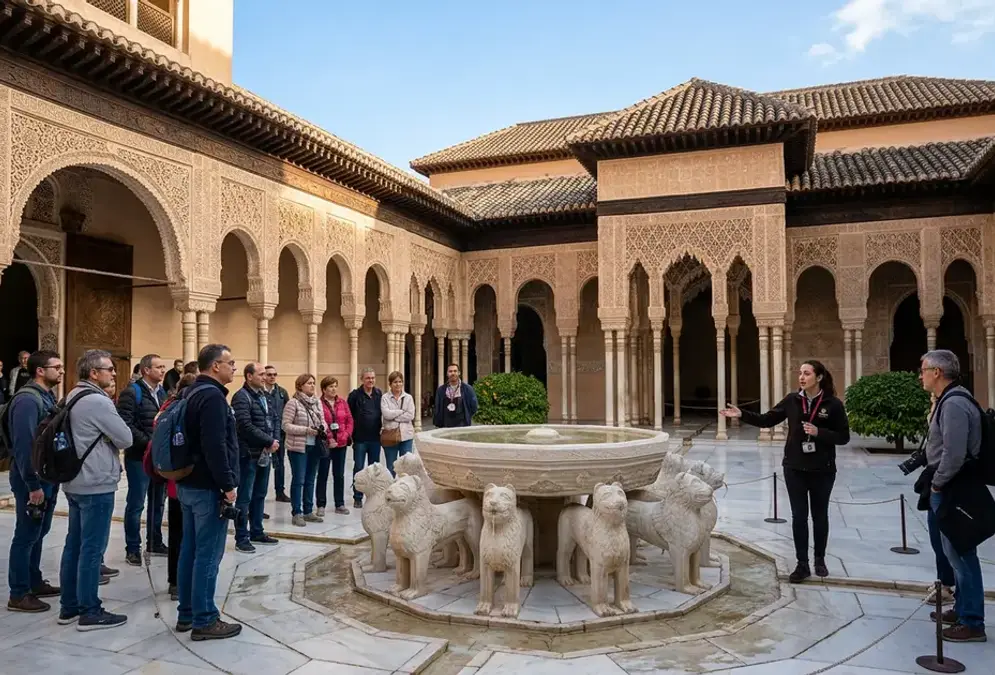
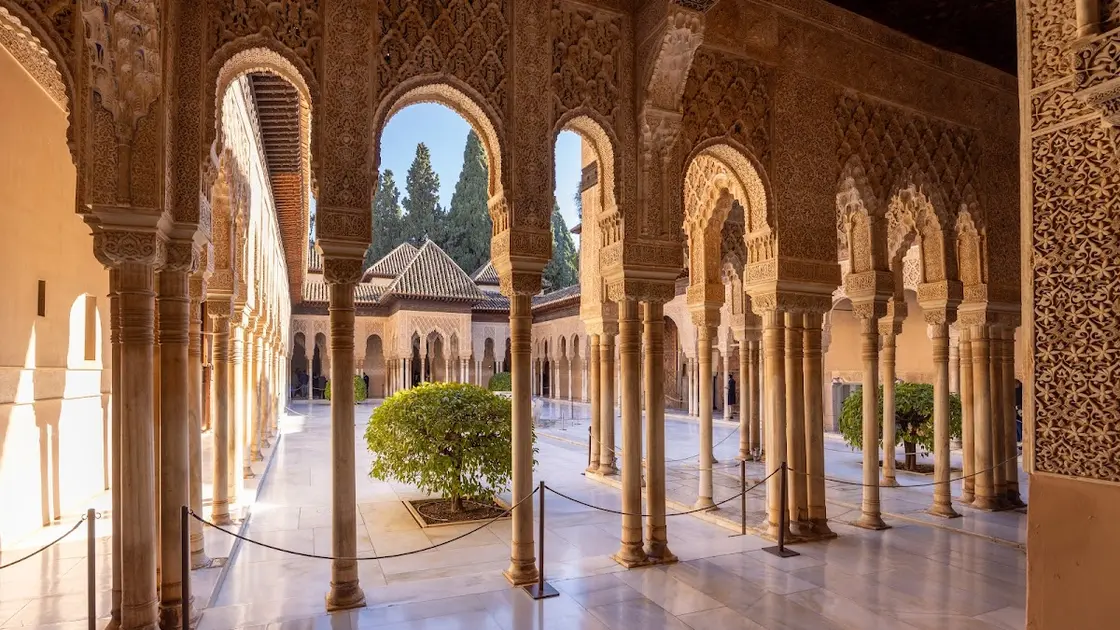
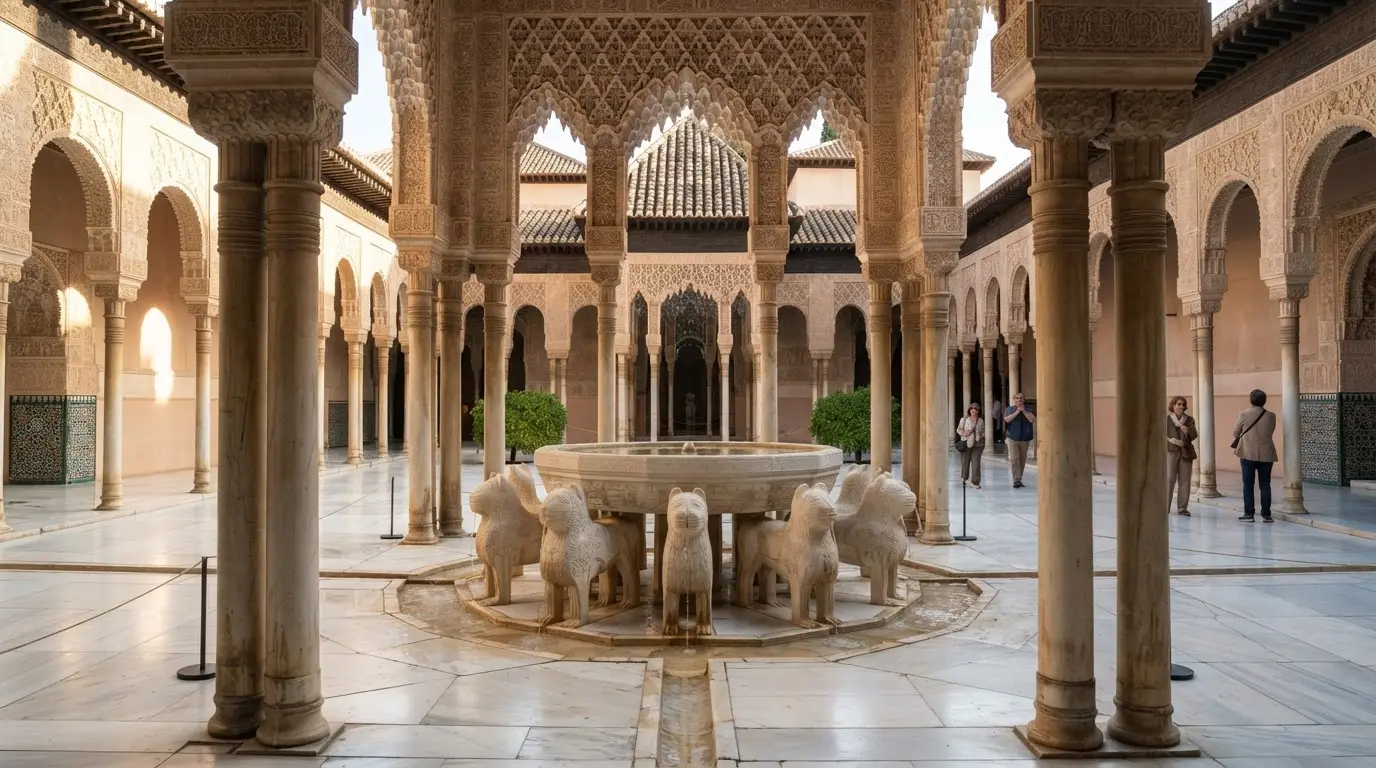
The Sala de los Abencerrajes itself is one of the most technically accomplished rooms in the Alhambra. It occupies the south side of the Court of the Lions, a square chamber with a central twelve-sided marble fountain.[3] The walls carry double arches on slender columns, and above them the room rises through eight pendentives into a muqarnas dome, the honeycomb stalactite vaulting for which Nasrid architecture is most celebrated. High windows at the drum level filter light downward through the dome, so the ceiling seems to glow from within while the floor level stays comparatively dim. The calligraphic inscription running around the chamber reads: There is no other help than the help that comes from God, the clement and merciful One.[3]
The room was built under Muhammad V in the second half of the 14th century, the same building programme that produced the Court of the Lions. The Abencerraje name was attached to it later, when the massacre legend was already in circulation. Whatever the chamber was originally called, it has been the Hall of the Abencerrajes in the tourist imagination since the 16th century, and the name appears to be permanent.
El Abencerraje y la hermosa Jarifa: the novela morisca
The literary tradition that kept the Abencerraje name alive for five centuries began not with the massacre story but with a very different tale. "El Abencerraje y la hermosa Jarifa" appeared in several versions in the mid-16th century; the most complete text was published in 1565 in Antonio de Villegas's Inventario.[1] The story centres on Abindarráez, a young Moorish nobleman of Abencerraje descent, who is captured on his way to meet his beloved Jarifa by the Christian captain Rodrigo de Narváez.
What follows is less a military narrative than a meditation on chivalry across religious lines. Rodrigo releases his prisoner on parole so that Abindarráez can complete his journey and marry Jarifa, then receives the couple back as voluntary captives in fulfilment of the nobleman's word. The Christian commander is so moved by this display of honour that he releases them both unconditionally. The story's argument is that nobility, defined as keeping one's word and loving with constancy, transcends the religious boundary that officially divides the characters.[1]
1565
The year Antonio de Villegas published the most complete version of El Abencerraje y la hermosa Jarifa in his Inventario. The story had already appeared in earlier versions, including an interpolation in Montemayor's La Diana. It became the founding text of the Spanish novela morisca genre.[1]
The novela morisca (Moorish novel) was a Spanish genre that emerged in the mid-16th century, after the fall of Granada, which allowed writers to imagine a romanticised Muslim aristocracy without the political threat that a living Nasrid court would have posed. The Abencerraje protagonist embodied qualities that Christian chivalric literature admired but which historical Muslim opponents had been denied: courage, fidelity, poetic sensibility. By placing those qualities in a figure from a defeated civilisation, the genre could celebrate them without political awkwardness.
The story was widely read and translated. It appeared in Jorge de Montemayor's pastoral novel La Diana in a version interpolated into the main text, which gave it a far larger audience than Villegas's Inventario alone would have provided.[1] The tension between the historical Abencerrajes, who backed coups and fled into exile, and the literary Abencerrajes, who exemplified doomed romantic nobility, was apparent to nobody at the time because the historical record was not the point.
Chateaubriand and the Romantic afterlife
The second great literary transformation of the Abencerraje legend came in the early 19th century. François-René de Chateaubriand published Les Aventures du dernier Abencérage in 1826, though it was written considerably earlier, drawing on his visit to Spain in 1807. The story centres on the last surviving member of the clan, Aben-Hamet, who returns to Granada generations after the Reconquista and falls in love with a Spanish woman descended from Rodrigo de Narváez. The romance is doomed; the lovers are separated by religion, history, and honour.
The novella gave French Romanticism one of its characteristic images: the noble exile contemplating a lost civilisation from the ruins of its greatest monuments. Chateaubriand's Aben-Hamet walks through the Alhambra, sees the Sala de los Abencerrajes, and mourns his ancestors.[6] The building becomes a mausoleum for a culture that produced great art and then was destroyed. This reading of Granada, melancholy, orientalised, politically non-threatening, shaped how educated Europeans understood the city for much of the 19th century.
The influence was direct and traceable. Washington Irving, whose Tales of the Alhambra (1832) is still sold in every bookshop near the monument, acknowledged the Chateaubriand tradition explicitly.[5] Victor Hugo's Orientales (1829) drew on the same romantic image of Granada. The Abencerraje name, by this point entirely detached from its origins in 15th-century Nasrid factional politics, had become a free-floating symbol of beautiful defeat.
The irony is considerable. The real Banu al-Sarraj were political operators who helped wreck the emirate they claimed to serve. The literary Abencerrajes were models of doomed nobility. The gap between those two things is a measure of what literary transformation can do with historical material over a few centuries.
After 1492: disappearance and survival
When Granada surrendered on 2 January 1492, the Abencerrajes lost every basis for political power simultaneously.[5] The emirate that had given noble clans their function was gone. The positions they competed for, grand vizier, court chamberlain, military commander, ceased to exist. Some converted to Christianity and attempted to integrate into the new order as moriscos; others emigrated to North Africa, joining the communities of Granadan exiles in Morocco, Algeria, and Tunisia. The documentary record of specific Abencerraje families after 1492 is thin.
What survived was the name, and it survived through literature rather than genealogy. The clan that had backed Boabdil's coup in 1483 was gone within a decade; the literary Abencerrajes were already being invented by the 1540s and 1550s in the earliest versions of El Abencerraje y la hermosa Jarifa. By the time Chateaubriand wrote his novella in the early 19th century, the connection between the name and any living family was purely notional.[6]
The Sala de los Abencerrajes today receives hundreds of thousands of visitors a year as part of the Nasrid Palaces circuit in the Alhambra.[4] Most enter, look up at the muqarnas ceiling, photograph it, and move on. A smaller number notice the fountain basin and are told about the blood stain. Very few are told about the actual political history of the clan, the 1462 executions, the backing of Boabdil, the nine years between the coup and the fall. The legend is more portable than the history, and the room's visual impact is independent of either.
The building itself is the most durable thing the Abencerrajes left behind, and they did not build it. Muhammad V built it. The clan simply became its tenants in the European imagination, occupying a room they had no historical connection to other than the name a legend gave them.
Frequently asked questions
Who were the Abencerrajes in Granada history?
The Abencerrajes (Banu al-Sarraj in Arabic) were a North African aristocratic family who rose to prominence as a powerful faction within the Nasrid court of Granada during the 14th and 15th centuries. They held the grand vizier position at various points and consistently backed particular claimants in succession disputes, including helping Boabdil dethrone his father in 1483. Their historical influence ended when Granada fell to Castile in 1492, but their name survived through Spanish and French literary tradition.
Did the massacre of the Abencerrajes really happen?
There is no definitive historical record of the massacre. The story, which describes a sultan summoning Abencerraje nobles one by one to a chamber in the Alhambra and beheading them, solidified in literary form during the 16th century, decades after the events it purports to describe, and different versions contradict each other on the perpetrator and motive. The Nasrid court did execute Abencerraje clan members in 1462, but this documented event bears little resemblance to the fountain-chamber legend.
What is the Sala de los Abencerrajes in the Alhambra?
The Sala de los Abencerrajes is a square chamber on the south side of the Court of the Lions in the Nasrid Palaces of the Alhambra. It has a twelve-sided central marble fountain, double arches on slender columns, and an octagonal muqarnas dome lit by high windows. The room was built under Muhammad V in the late 14th century. The Abencerraje name was attached to it later, once the massacre legend was in circulation. The rust stain on the fountain basin is iron oxide in the marble, not blood.
What is the novela morisca El Abencerraje?
"El Abencerraje y la hermosa Jarifa" is a mid-16th-century Spanish story, with the most complete version published by Antonio de Villegas in his 1565 Inventario. It centres on Abindarráez, a young Moorish nobleman of Abencerraje descent, captured by the Christian captain Rodrigo de Narváez on his way to marry Jarifa. The story explores chivalry and honour across religious lines. It became the founding text of the novela morisca genre and was widely read across Europe.
How did Chateaubriand use the Abencerraje legend?
In Les Aventures du dernier Abencérage (published 1826, written earlier), Chateaubriand imagined the last surviving Abencerraje returning to Granada after the Reconquista and falling in love with a Spanish woman. The novella made the Alhambra a symbol of lost civilisation and noble exile, and greatly influenced French Romanticism. Washington Irving's Tales of the Alhambra (1832) and Victor Hugo's Orientales drew on the same tradition. By this point the Abencerraje name was entirely detached from its Nasrid political origins.
How do I visit the Sala de los Abencerrajes in the Alhambra?
The Sala de los Abencerrajes is inside the Nasrid Palaces section of the Alhambra, which requires a timed entry ticket booked in advance. Book through the official Alhambra ticketing site at least three to four weeks ahead from spring through early autumn, longer in July and August. The room is on the south side of the Court of the Lions; enter at your slot start time to have a few minutes in the chamber before it fills. Look up at the muqarnas dome and then down at the fountain basin: the rust stain is visible in the marble rim.
What happened to the Abencerrajes after the fall of Granada in 1492?
The clan lost all political standing when the emirate ended. Some members likely converted to Christianity and remained in Granada as moriscos; others emigrated to North Africa with the large communities of Granadan exiles in Morocco and Algeria. The documentary record of specific Abencerraje families after 1492 is sparse. Their name survived through literary tradition rather than documented family history, beginning with the novela morisca in the 1560s and extending through Chateaubriand into the 19th century.
“The rust-coloured stain in the central marble fountain basin, attributed in legend to the blood of the Abencerrajes, is in fact iron oxide mineral deposits.”