Written by James Walker
Modern Granada · 1808–today
  • 5 min
  • 22 sources

Who Wrote 'Dale Limosna, Mujer', Granada's Blind Beggar Poem?

Who wrote 'Dale limosna, mujer'? Francisco A. de Icaza, a Mexican poet. Read the four lines, see where the Alhambra plaque stands and why its date is disputed.
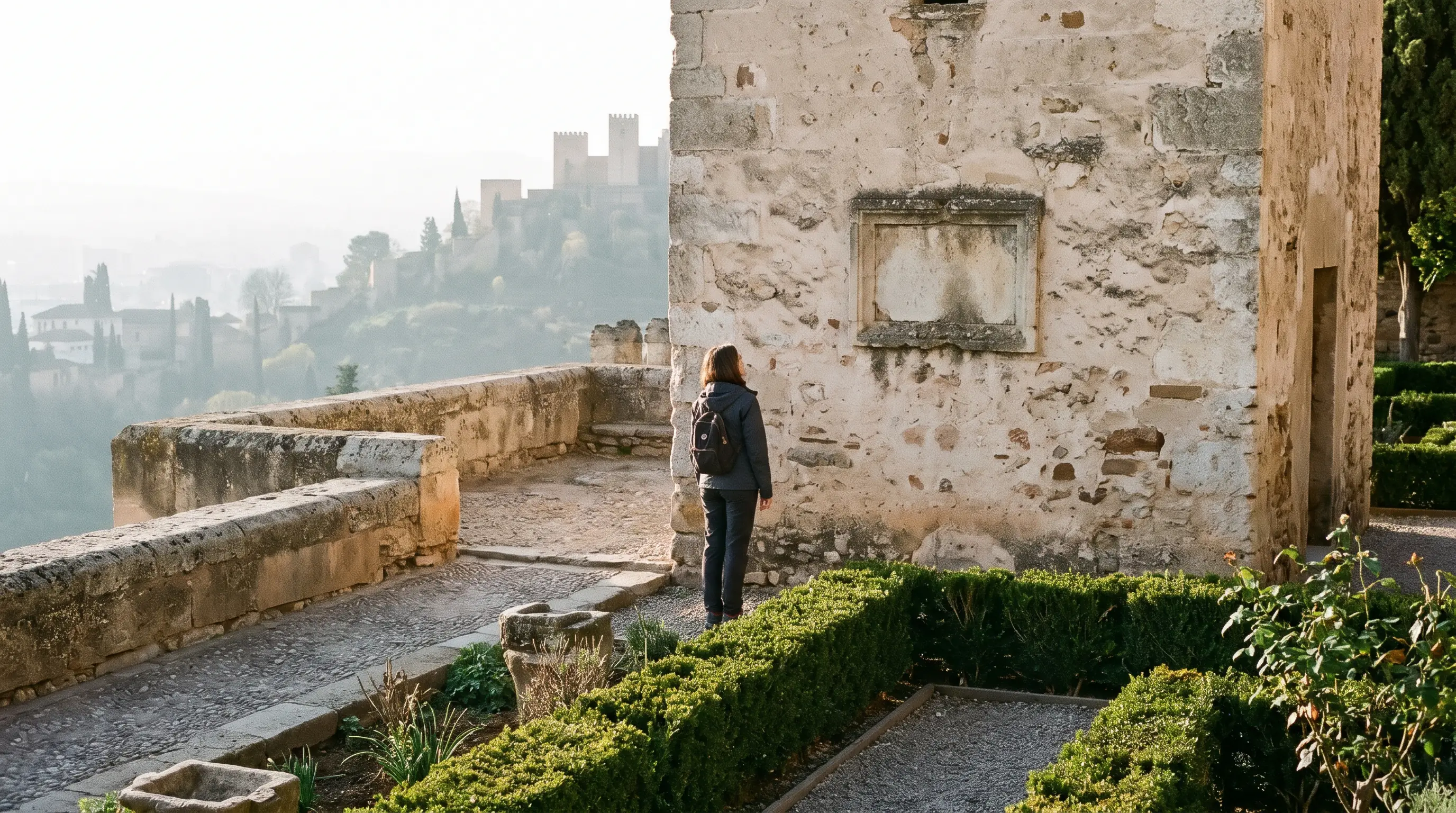
Weathered stone wall of the Torre de la Pólvora at the western end of the Jardín de los Adarves in the Alhambra's Alcazaba, a small engraved dale limosna mujer plaque on the masonry, clipped hedges in the foreground and the Torres Bermejas ridge in soft morning light

Icaza's four lines went into the walls of the Jardín de los Adarves in 1957, according to the Alhambra's own journal.

'Dale limosna, mujer' opens a four-line Spanish copla that means, roughly, give him alms, woman, for there is nothing in life like the sorrow of being blind in Granada.[5] The plaque sits on an outer wall of the Torre de la Pólvora in the Jardín de los Adarves, Alcazaba,[13] and the author was Francisco A. de Icaza, a Mexican diplomat, critic and poet,[4] whose lines were set into the garden walls in 1957.[1] Sources disagree on the plaque's exact date, and the honeymoon story usually attached to the poem is tradition rather than record.
Lines set into the wall
1957
Placed in the walls of the Jardín de los Adarves[1]
Garden size
50 x 8 m
Approximate dimensions of the rectangular Adarves garden[2]
Torre de la Pólvora closure
2 years
Closed for restoration before reopening to visitors[3]

What 'dale limosna, mujer' says, line by line

The poem is a single copla of four lines: Dale limosna, mujer, / que no hay en la vida nada / como la pena de ser / ciego en Granada.[5] In my rendering, it reads: give him alms, woman, for there is nothing in life like the sorrow of being blind in Granada. The speaker is a passer-by talking to the woman beside him, and the beggar himself never says a word.
Rafael Castillo of UNAM files the copla under the title Para el pobrecito ciego,[6] and Ortiz Domínguez reads it as an Andalusian-style copla whose praise of the city is built from absence: Granada is described only through what the blind man cannot see.[7] The trick works because the verse lists no sight at all. The Alhambra, the Darro and the Vega never appear, yet the reader fills them in, which is how four short lines with the last one cut off can carry a whole city.
The lines belong to Icaza's book La canción del camino, which followed two earlier collections, Efímeras and Lejanías. Both already carried Moorish imagery in a modernista tone,[8] so the Granada copla grew out of a vein he had been working since his first books.
What the lines leave out matters as much as what they say. There is no date, no gate, no named street, and no description of the beggar beyond his blindness. A visitor can therefore read the verse standing almost anywhere in the city, and many do, which is partly why it travels so easily from guidebook to postcard to tea towel. The plaque in the Alcazaba is only the version that comes with a wall behind it.

Francisco A. de Icaza, the Mexican poet who stayed in Spain

Francisco A. de Icaza (1863-1925) was a Mexican diplomat, critic and poet whose name turns up constantly in the letters, dedications and anecdotes of early twentieth-century Spain.[4] He reached the country in 1886, and Castillo counts him as practically the only Spanish American poet of the new sensibility, what became modernismo, living there at the time.[9]
When José Emilio Pacheco accepted the 2009 Cervantes Prize he borrowed a phrase for him, el mexicano de España y el español de México, the Mexican of Spain and the Spaniard of Mexico.[10] It fits a man who wrote about Andalusia from two sides of the Atlantic.
Granada was no stranger's destination for him. Icaza married Beatriz de León y Loynaz, a niece of the Marquesses of Esquilache and from Granada,[11] and in November 1924 Federico García Lorca wrote to his younger brother Paquito asking him to receive the elderly poet on a lecture visit to the city.[12] The verse about a blind man was written by someone with real ties to the place.
That matters for how the copla should be read. It is not a tourist's reflex on first sight of the Alhambra but the work of a poet who knew the city through marriage and family ties, and who chose to praise it by taking its best sight away.

Where the plaque is and when it went up
The plaque is fixed to an outer wall of the Torre de la Pólvora, at the western end of the Jardín de los Adarves in the Alcazaba.[13] It marks the spot where the wall running down to Torres Bermejas begins.[14]
The garden is a rectangle of roughly 50 m by 8 m,[2] and a small mirador attached to the tower is the way through into the Alcazaba's interior.[15] Few visitors realise that the lawn-and-hedge strip they are crossing is a later reuse of military ground.
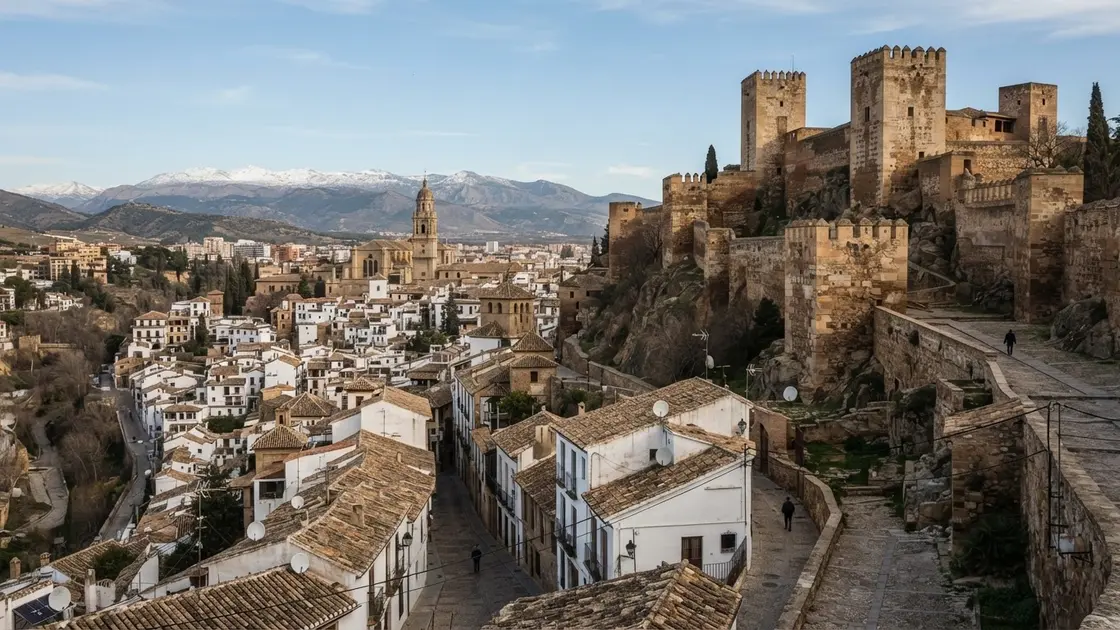
The Alcazaba fortress towers rising from the western end of the Alhambra hill, with Granada's old city below

Explore nearby · Monument

Alcazaba, Granada

Granada's oldest fortress and the military core of the Alhambra, built in 1238. Its Watch Tower delivers panoramic views of the Albaicin and Sierra Nevada.

The tower is a small Nasrid structure in the fortress's defensive system; in Christian times it was adapted for artillery and used to store gunpowder, which gave it its name.[16][17] Restoration that kept it closed for about two years uncovered a 16th-century artillery platform, later turned into the Jardín de los Adarves itself.[3][18] The garden that carries Icaza's lines is a repurposed gun emplacement.
The lines went into the garden walls in 1957,[1] at a ceremony whose speaker called the four verses the purest and most ardent praise of the city.[19] Castillo instead ties the plaque to 1963, the centenary of Icaza's birth, and places it on a tower of the Alcazaba.[20]

The honeymoon story and the blind man at the Puerta de la Justicia
The popular account has Icaza honeymooning in Granada when a blind man asked him for money, the lines coming to him on the spot.[21] The marriage to a woman from Granada is documented,[11] but the link between a wedding trip and the verse rests on retelling rather than a record from the time. Popular versions also tend to loosen the wording of the copla, which is one more reason to treat the anecdote as folklore.
A second candidate for the beggar has a place attached. The historian Cristina Viñes Millet wonders whether the blind man Icaza met on arriving in Granada was the one Ángel Ganivet described begging by the Puerta de la Justicia.[22]
The two stories are not rivals so much as different kinds of evidence. One is an anecdote told about a famous poem, the other a historian's question built on a named writer's description of a real beggar at a real gate. Neither survives as a firsthand account from Icaza himself, so a careful visitor can enjoy both while knowing which parts are folklore and which are inference.
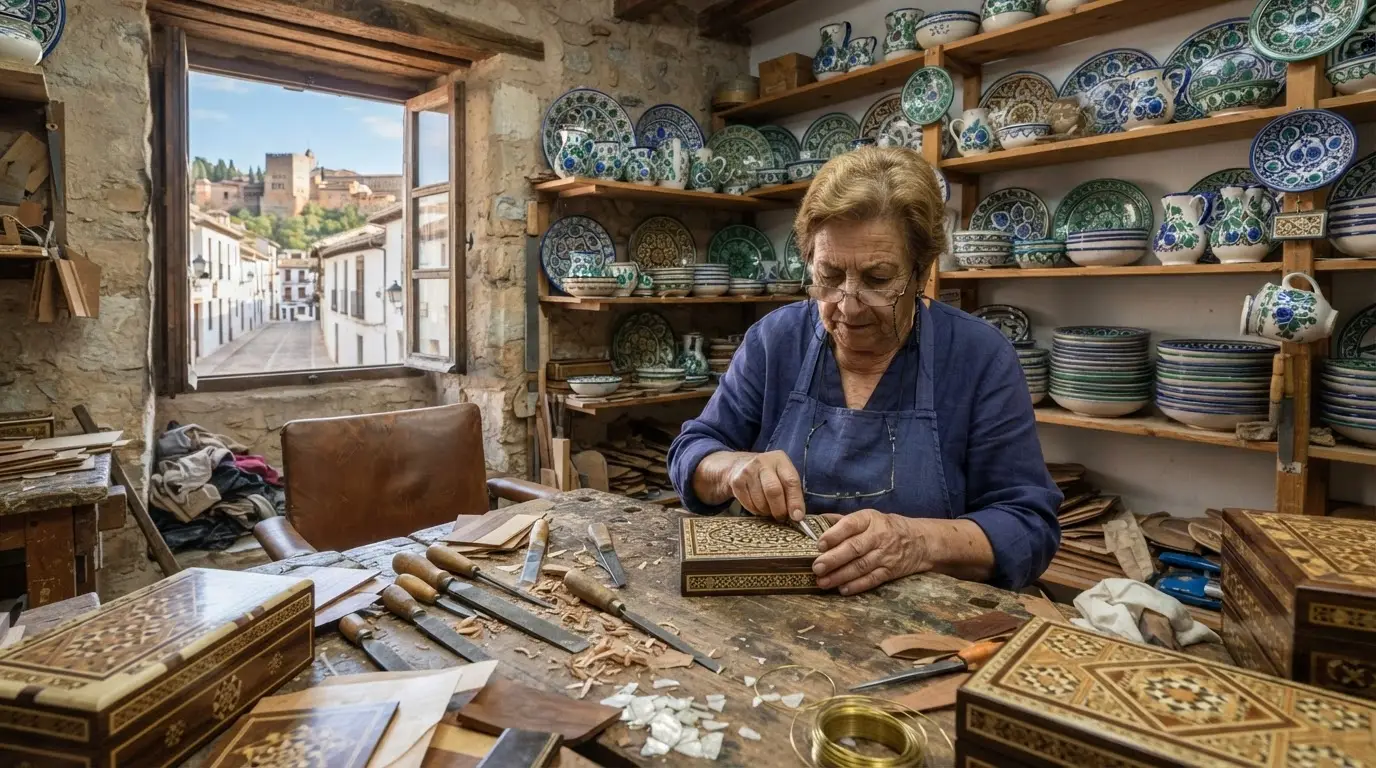
Granada artisan crafts — taracea marquetry boxes and Fajalauza blue-and-green ceramics with pomegranate motifs at an Albaicín workshop

Deep dive · Article

Granada Artisan Crafts: Taracea, Fajalauza Ceramics and Leather

Granada's taracea marquetry, Fajalauza ceramics, leather goods, and luthiery trace directly to Nasrid workshop traditions. A guide to finding the real thing.

Either way, the verse itself names no one, no date and no gate. The honeymoon and the Puerta de la Justicia are stories laid on top of four lines that stay deliberately anonymous.

Finding the lines inside the Alcazaba

Seeing the plaque means entering the Alhambra's monumental complex first, since the Jardín de los Adarves opens off a mirador into the Alcazaba.[15] What you need on the ground is short:
  • The plaque is on the outer wall of the Torre de la Pólvora, at the western end of the Jardín de los Adarves.[13]
  • Beside it, a small mirador attached to the tower leads into the Alcazaba, and the wall to Torres Bermejas starts at the same spot.[15][14]
  • Ticket types, hours and current access to the tower are on the Patronato's official site, alhambra-patronato.es; the tower has been closed for restoration before, so check before you plan around it.[3]
Icaza's lines are a twentieth-century addition to a fortress whose palaces carry Nasrid inscriptions in Arabic, and the contrast is the reason to stop: a Mexican poet's Spanish copla about a beggar, set into a wall built to hold off armies.[16]

Frequently asked questions

Who wrote 'Dale limosna, mujer, que no hay en la vida nada como la pena de ser ciego en Granada'?

Francisco A. de Icaza (1863-1925), a Mexican diplomat, critic and poet who settled in Spain in 1886. The copla belongs to his book La canción del camino.

What does 'Dale limosna, mujer' mean in English?

Roughly: give him alms, woman, for there is nothing in life like the sorrow of being blind in Granada. The speaker urges a woman to give money to a blind beggar, and the compliment to the city is that blindness there is the worst loss because Granada is so worth seeing.

Where is the 'ciego en Granada' plaque in the Alhambra?

On an outer wall of the Torre de la Pólvora, at the western end of the Jardín de los Adarves in the Alcazaba area, near where the wall running to Torres Bermejas begins.

When was the Icaza plaque placed in the Alhambra?

The Alhambra's own journal, Cuadernos de la Alhambra, gives 1957. One scholar, Rafael Castillo, ties it to the 1963 centenary of Icaza's birth instead, so the year is better supported than settled.

Was Francisco de Icaza on his honeymoon when he wrote the poem?

That is the popular story, but it is tradition. Icaza did marry a woman from Granada, yet the link between the wedding trip and the verse rests on later retellings rather than a record from the time.

Do you need an Alhambra ticket to see the Icaza plaque?

Yes. The Jardín de los Adarves is inside the Alhambra's monumental complex, so you need a ticket that covers the Alcazaba area. Check ticket types, hours and access to the Torre de la Pólvora on the official Patronato site before you go.

Was the blind beggar in the poem a real person?

The verse names nobody. The historian Cristina Viñes Millet wonders whether he was the blind man Ángel Ganivet described begging by the Puerta de la Justicia, but that remains a question, not a finding.

Sources

22 references Show
  1. cuadernosdelaalhambra.alhambra-patronato.es (opens in a new tab)

    “En 1957 quedarían plasmados para siempre en los muros del jardín de los Adarves.”

  2. granadadirect.com (opens in a new tab)

    “Su forma es rectangular, mide unos 50m x 8m.”

  3. Patronato de la Alhambra — En (opens in a new tab)

    “right before it has been opened to the public after two years closed for restoration works.”

  4. revistas-filologicas.unam.mx (opens in a new tab)

    “El nombre del diplomático, crítico y poeta mexicano Francisco A. de Icaza (1863-1925) figura, en efecto, con frecuencia en artículos, cartas, dedicatorias de poemas y anécdotas de principios de siglo.”

  5. revistas-filologicas.unam.mx (opens in a new tab)

    “Dale limosna, mujer, que no hay en la vida nada como la pena de ser ciego en Granada.”

  6. revistas-filologicas.unam.mx (opens in a new tab)

    “copla "Para el pobrecito ciego"”

  7. dialnet.unirioja.es (opens in a new tab)

    “Que es una copla de tipo andaluz, donde la admiración hiperbólica se construye –curiosa paradoja– a través de la elipsis, de lo no dicho, de lo ausente o de la carencia.”

  8. dialnet.unirioja.es (opens in a new tab)

    “No obstante, preceden a esta genial copla de La canción del camino imágenes moriscas de un acendrado tono modernista en sus dos primeros libros”

  9. revistas-filologicas.unam.mx (opens in a new tab)

    “adonde había llegado en 1886. Prácticamente él fue el único poeta americano poseedor de la nueva sensibilidad que vivía allí.”

  10. dialnet.unirioja.es (opens in a new tab)

    ““El mexicano de España y el español de México”; así ha llamado José Emilio Pacheco en su discurso de recepción del Premio Cervantes 2009”

  11. dialnet.unirioja.es (opens in a new tab)

    “por haber contraído nupcias con Beatriz de León y Loynaz, sobrina de los Marqueses de Esquilache y oriunda de aquel lugar”

  12. dialnet.unirioja.es (opens in a new tab)

    “pide a Paquito, su hermano menor, recibir al anciano poeta, con ocasión de alguna conferencia en aquella ciudad –en una carta de noviembre de 1924”

  13. ecured.cu (opens in a new tab)

    “colocada en un muro exterior de la torre de la Pólvora en el extremo Oeste del Jardín de los Adarves, recoge esta célebre frase”

  14. granadadirect.com (opens in a new tab)

    “Justo aquí empieza la muralla que llega hasta Torres Bermejas, aquí se colocaron en 1957 los famosos versos del poeta mejicano Francisco de Icaza dedicados a Granada”

  15. granadadirect.com (opens in a new tab)

    “En el Jardín de los Adarves hay un pequeño mirador adosado a la Torre de la Pólvora por el que se accede al interior de la Alcazaba.”

  16. Patronato de la Alhambra — En (opens in a new tab)

    “The ‘Torre de la Pólvora’ is a small medieval islamic tower which is a part of the defensive nasrid system of the Alcazaba”

  17. Patronato de la Alhambra — En (opens in a new tab)

    “In Christian times, the Torre de la Pólvora tends to addapt to the defense by the general use of the artillery, and it is known that in this place this kind of material was storing and using.”

  18. Patronato de la Alhambra — En (opens in a new tab)

    “this intervention which resulted in the discovery of a 16th century platform for artillery, later transformed into the garden Jardín de los Adarves preserved until today.”

  19. cuadernosdelaalhambra.alhambra-patronato.es (opens in a new tab)

    “«Nos reunimos aquí - se dijo entonces- en esta hora luminosa de Granada, para dejar prendidos en estos muros centenarios que ciñen los palacios de la Alhambra los cuatro versos de un poeta que hizo con ellos el elogio más puro y encendido de esta ciudad.»”

  20. revistas-filologicas.unam.mx (opens in a new tab)

    “se grabaron esos versos en una placa colocada en la torre de la Alcazaba, en la Alhambra, desde donde se contempla una de las vistas más hermosas de la tierra.”

  21. forbes.com.mx (opens in a new tab)

    “El poeta mexicano Francisco Asís de Icaza y Beña disfrutaba de su luna de miel en esta ciudad cuando un invidente se le acercó para pedirle dinero.”

  22. cuadernosdelaalhambra.alhambra-patronato.es (opens in a new tab)

    “No sé yo si el ciego que, al llegar a Granada, encontró don Francisco A. de Icaza y que inspiró esos versos sería el que”