Ángel Ganivet, Granada's own writer-diplomat, wrote Idearium Español from Helsinki, drowned in Riga in 1898, and returned to San José cemetery in 1925.
Seven years resident in Granada. Specialist in Nasrid architecture, Al-Andalus history, and Andalusian walking routes.
Published
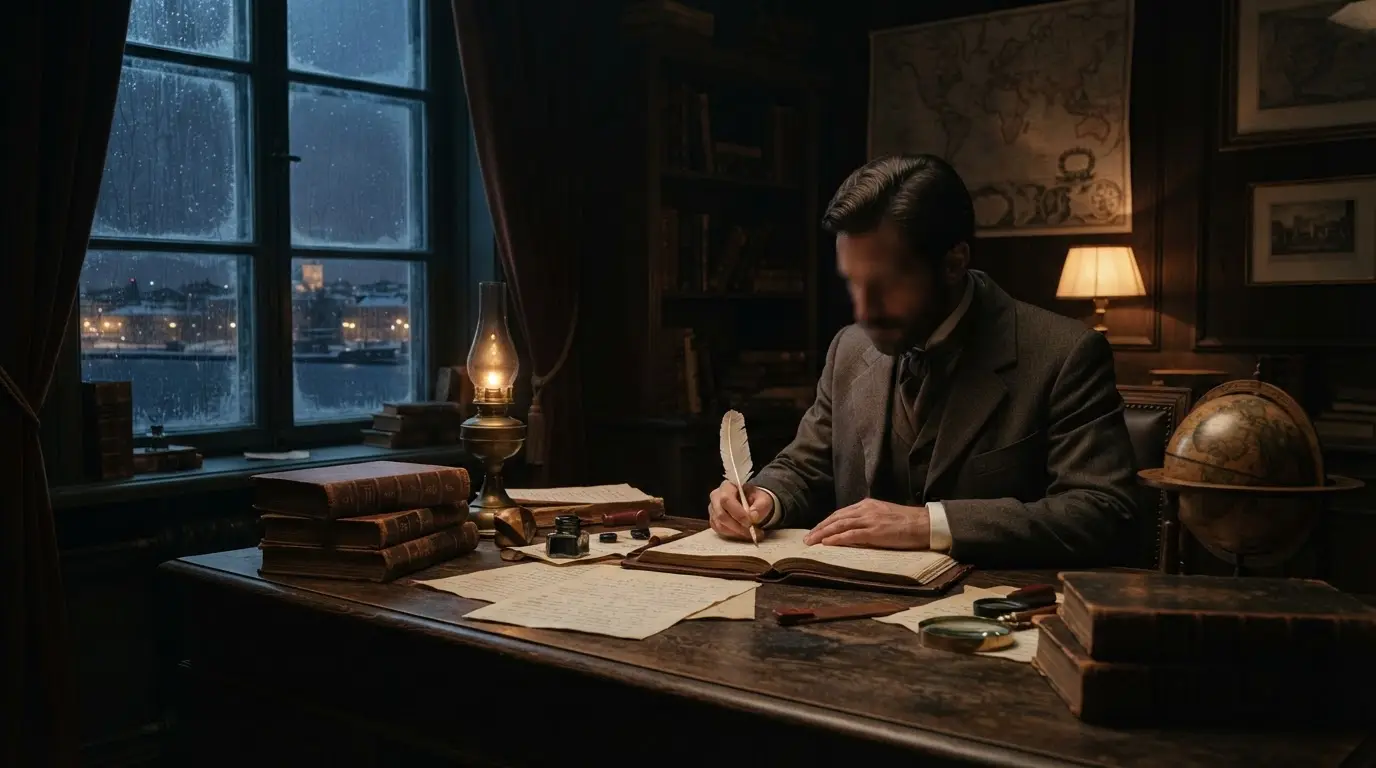
Ángel Ganivet was Granada's most unlikely diplomat: a writer who represented Spain in Antwerp, Helsingfors, and Riga while producing the book that made him a forerunner of the Generation of '98. He wrote Idearium Español from a consulate on the Baltic, arguing about Spain from the cold. He drowned in Riga's Daugava river in 1898, and it took a journalist's press campaign to bring him home to Granada twenty-seven years later.
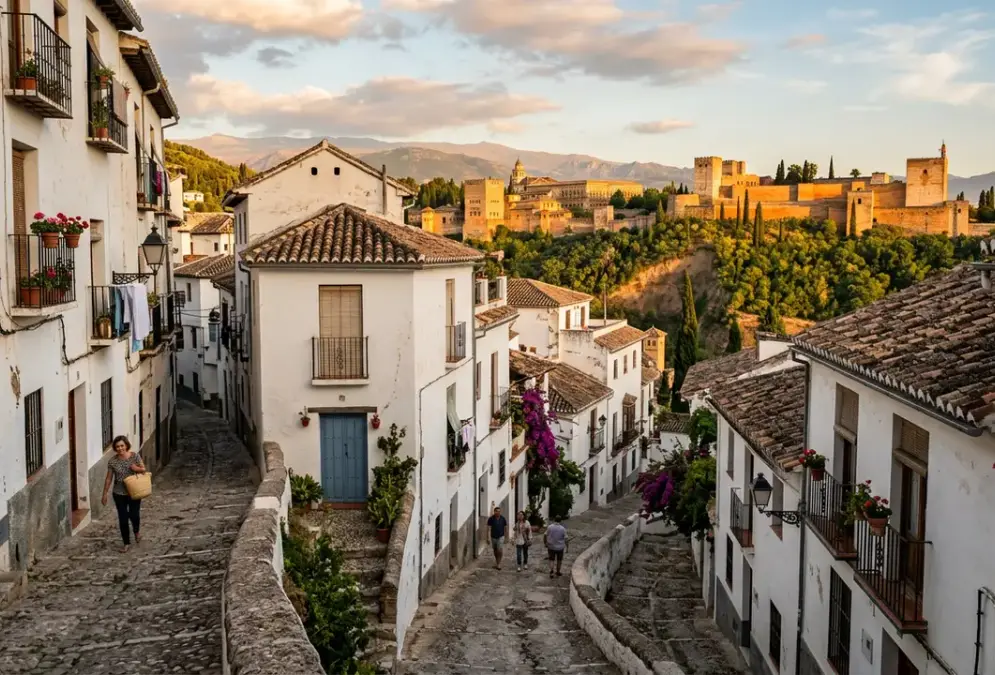
Ángel Ganivet García was born in Granada on 13 December 1865, into a middle-class family in a city still defined by the memory of Nasrid, Visigothic, and Roman rule, with the Alhambra rising over its rooftops and the old town's medieval lanes still traceable along the Carrera del Darro.[1] He studied law, then philosophy and letters, first at the University of Granada and later in Madrid.
In 1888 he began a doctorate in Madrid, earning it with highest honours for a thesis on the importance of Sanskrit, an unusual specialism that hinted at the wide, restless curiosity that would define his short career.[4] Three years later, in May 1891, he struck up a friendship with Miguel de Unamuno while the two studied together for entrance exams to a professorship in Greek, a friendship that outlasted the exam and became his most important intellectual correspondence.[5]
Ganivet did not win a university chair. He sat the entrance exams for Spain's consular corps instead, placed first, and was named vice-consul in Antwerp, where he spent four years before moving further north.[6] It was the start of a career spent almost entirely abroad, looking back at Spain from one consulate window after another.
Antwerp to Helsingfors: a diplomat writes
In 1895 Ganivet was promoted to consul and posted to Helsingfors, the Swedish name then used for Helsinki. He spent more than two years in Finland, joined there by his sisters Josefa and Isabel, and struck up a friendship with the Finnish painter Hanna Rönnberg. It was here, away from Spain, that he produced most of his literary work.[7]
The posting did not last. Spain's diplomatic corps suppressed the Helsinki consulate for lack of commercial activity, and in 1898 Ganivet took up the consulate at Riga, in what is now Latvia.[8] He expected another quiet posting. It became his last.
Across the three postings, Antwerp, Helsingfors, and Riga, Ganivet wrote as much as he administered.[9] His essay Granada la bella, a reflection on his home city's landscape and identity, was published while he was still in Helsinki, describing streets he had not walked in years.[9] It was also in these Helsinki years that his letters floated a lighter idea: turning the Sierra Nevada into an "Andalusian Finland," a dream told in full in the history of the Sierra Nevada ski resort.
Idearium Español and the diagnosis of abulia
Ganivet's reputation rests on one book above the rest: Idearium Español (1897), a set of essays on the Spanish national character that made him a precursor of the Generation of '98, the writers who tried to explain Spain's decline after the loss of Cuba, Puerto Rico, and the Philippines.[10][11] The same essay collection carries his best-known novel in its shadow: La conquista del reino de Maya, por el último conquistador español, Pío Cid (1897), a satire that uses a fictional colonial conquest to needle Spain's real imperial pretensions.[10]
His diagnosis in Idearium Español was blunt. Spain's fin-de-siècle crisis, he argued, came from a collective failure of will he called abulia, a paralysis that kept the country from acting even when it knew what needed to be done.[12] Historians of the period still reach for the word.
The debate behind the book played out in public first. The correspondence that completes Idearium Español, an open exchange with Unamuno on the future of Spain, ran as newspaper instalments in Granada's own El Defensor de Granada in 1898, under the title "El porvenir de España."[13]
A sequel novel, Los trabajos del infatigable creador Pío Cid, carried the same character into a longer story. His only play, El escultor de su alma, appeared only after his death. Cartas finlandesas collects his articles on Finnish society, written with the same mix of observation, irony, and cultural comparison that runs through Granada la bella — a Spaniard's eye turned briefly on someone else's country.[14]
Riga, and the end, November 1898
Riga in 1898 was meant to be another workaday post. Ganivet arrived after the Helsinki consulate closed, taking charge of a Spanish office in a city he had never planned to end up in.[8]
By then he was a sick man. He suffered from progressive syphilitic paralysis, and he had contemplated suicide for years before he ever reached Latvia.[15]
On 29 November 1898, disillusioned in love, Ganivet drowned himself in the Daugava river, then still widely known by its older name, the Dvina. He nearly failed: he was rescued once, and threw himself back in.[2] He was 32 years old.
The return to Granada, 1925
Ganivet's body did not come home for twenty-seven years. It took the journalist Enrique Domínguez Rodiño, born in Jerez, who wrote a series of press reports to raise Spanish public awareness of the forgotten consul-writer, to make repatriation happen.[16] His remains were brought back from Riga to Spain in 1925.[3]
Since that year they have rested in Granada's Cementerio de San José, in the city where he was born.[17] The funeral cortège's first stop, before the cemetery, was a monument the city had already raised to him four years earlier.[20]
That monument, sculpted by Juan Cristóbal, was inaugurated in 1921 in an emotional ceremony where Ganivet's nieces laid flowers at the statue's feet.[18] Its pedestal carries a carved half-open pomegranate, Granada's own civic symbol, with a simple inscription beneath it: "A Ganivet."[19]
Timeline
1921
Monument inaugurated
The city's monument to Ganivet, sculpted by Juan Cristóbal, is unveiled with his nieces laying flowers at its feet.
1925
Remains repatriated
After a press campaign by journalist Enrique Domínguez Rodiño, Ganivet's remains return from Riga to Granada's San José cemetery.
27 Mar 2014
Casa Molino protected
The Diputación de Granada declares the Casa Molino Ángel Ganivet a site of cultural interest.
The city's other memorial to him is more functional than monumental. The Casa Molino Ángel Ganivet is now a cultural centre run by the Diputación de Granada, custodian of his literary legacy and responsible for keeping it in circulation.[21][22] The Diputación declared it a site of cultural interest on 27 March 2014.[23] Granada is one of several Spanish cities, along with Málaga, Seville, and Córdoba, that named a street after him.[24] The man Granada nearly forgot outright is now one of its own footnotes, tucked in alongside other little-known Granada facts that rarely make the postcards.
Frequently asked questions
Who was Ángel Ganivet?
Ángel Ganivet García (1865-1898) was a Spanish writer and diplomat born in Granada. He served as a consul in Antwerp, Helsingfors, and Riga while writing the essays and novels that made him a precursor of the Generation of '98.
What did Ángel Ganivet write?
His central work is Idearium Español (1897), an essay collection on the Spanish national character. He also wrote the novel La conquista del reino de Maya, a sequel titled Los trabajos del infatigable creador Pío Cid, the essay Granada la bella, the collection Cartas finlandesas, and a posthumous play, El escultor de su alma.
How did Ángel Ganivet die?
He drowned in the Daugava river in Riga on 29 November 1898. He had suffered from progressive syphilitic paralysis and had contemplated suicide for years; he was rescued once during the attempt and then threw himself back into the water.
Is Ángel Ganivet from Granada?
Yes. He was born in Granada on 13 December 1865 and, after his death abroad, his remains were repatriated and now rest in the city's Cementerio de San José.
Why is Ángel Ganivet considered a precursor of the Generation of '98?
Idearium Español examined Spain's national decline through the concept of abulia, a paralysis of collective will, at the same moment younger writers were asking the same questions after the loss of Cuba, Puerto Rico, and the Philippines. His essays are usually credited as anticipating their concerns.
Where is the Ángel Ganivet monument in Granada?
The city inaugurated a monument to Ganivet in 1921, sculpted by Juan Cristóbal, with a pedestal inscribed "A Ganivet" beneath a carved pomegranate. It was the first stop of the funeral procession when his remains returned to Granada in 1925.
What is Idearium Español about?
It is a collection of essays on the Spanish national character, arguing that Spain's fin-de-siècle crisis stemmed from abulia, a collective failure of will. Its companion piece, an open newspaper correspondence with Miguel de Unamuno, ran in El Defensor de Granada in 1898.
“On 29 November 1898, disillusioned in love, Ganivet drowned himself in the Daugava River. Nearly failing in his attempt, he was first rescued but managed to throw himself into the river again.”
“En 1888 empezó el doctorado en Madrid; obtuvo el grado correspondiente, con nota sobresaliente y premio extraordinario, con la tesis La importancia de la lengua sánscrita.”
“En mayo de ese mismo año Ganivet alcanzó el primer puesto en unas oposiciones al cuerpo consular; por lo que fue nombrado vicecónsul en Amberes, tomando posesión en julio; pasó cuatro años en la ciudad belga.”
“En 1895 fue ascendido a cónsul y destinado a Helsingfors, nombre sueco de la actual Helsinki. En los más de dos años que pasó en Finlandia, acompañado por sus hermanas Josefa e Isabel, entabló amistad con la pintora Hanna Rönnberg, produjo la mayor parte de su obra literaria.”
“Su estancia terminó cuando el cuerpo diplomático suprimió el consulado por escasa actividad comercial. Tomó posesión del consulado de Riga (Letonia) en 1898.”
“Es nombrado vicecónsul en Amberes e inicia su etapa diplomática. Publica en Helsinki Granada la bella. El consulado se traslada a Riga, donde muere el 29 de noviembre.”
“Su obra más importante, al lado de la novela La conquista del reino de Maya por el último conquistador español Pío Cid (1897), es el libro de los ensayos referentes al carácter español Idearium español (1897). Por esa obra filosófica Ángel Ganivet suele ser denominado precursor de la Generación 1898.”
“Ángel Ganivet García (13 December 1865 – 29 November 1898) was a Spanish writer and diplomat. He was considered a precursor to the Generation of '98.”
“El libro de Ganivet lo completa la correspondencia abierta con Miguel de Unamuno (1864-1936) que se refiere al tema. Por primera vez se publicó en 1898 en el periódico El Defensor de Granada y suele ser titulada El porvenir de España.”
“Este lugar fue también protagonista de otro multitudinario homenaje a Ángel Ganivet en 1925, año de la repatriación de sus restos mortales desde Riga hasta nuestra querida ciudad de Granada. Fue éste el primer lugar que visitó el séquito funerario.”
“El 27 de marzo de 2014 el Pleno de la Diputación Provincial de Granada acordó declarar de interés cultural sus Centros Palacio de los Condes de Gabia y Casa Molino Ángel Ganivet.”
“Los ayuntamientos de Almuñécar, Puebla de Vallbona, Granada, Málaga, Santa Cruz de Tenerife, Zaragoza, Sevilla, Córdoba y Madrid (en la Colonia del Retiro) han dedicado una calle a su memoria.”