Written by James Walker
Nasrid Granada · 1238–1492
  • 6 min
  • 40 sources

What Colour Was the Alhambra? The Lost Painted Plasterwork

The Alhambra's Nasrid plasterwork was painted in lapis lazuli blue, cinnabar red and gold. See what pigment analysis found and what later repainting changed.
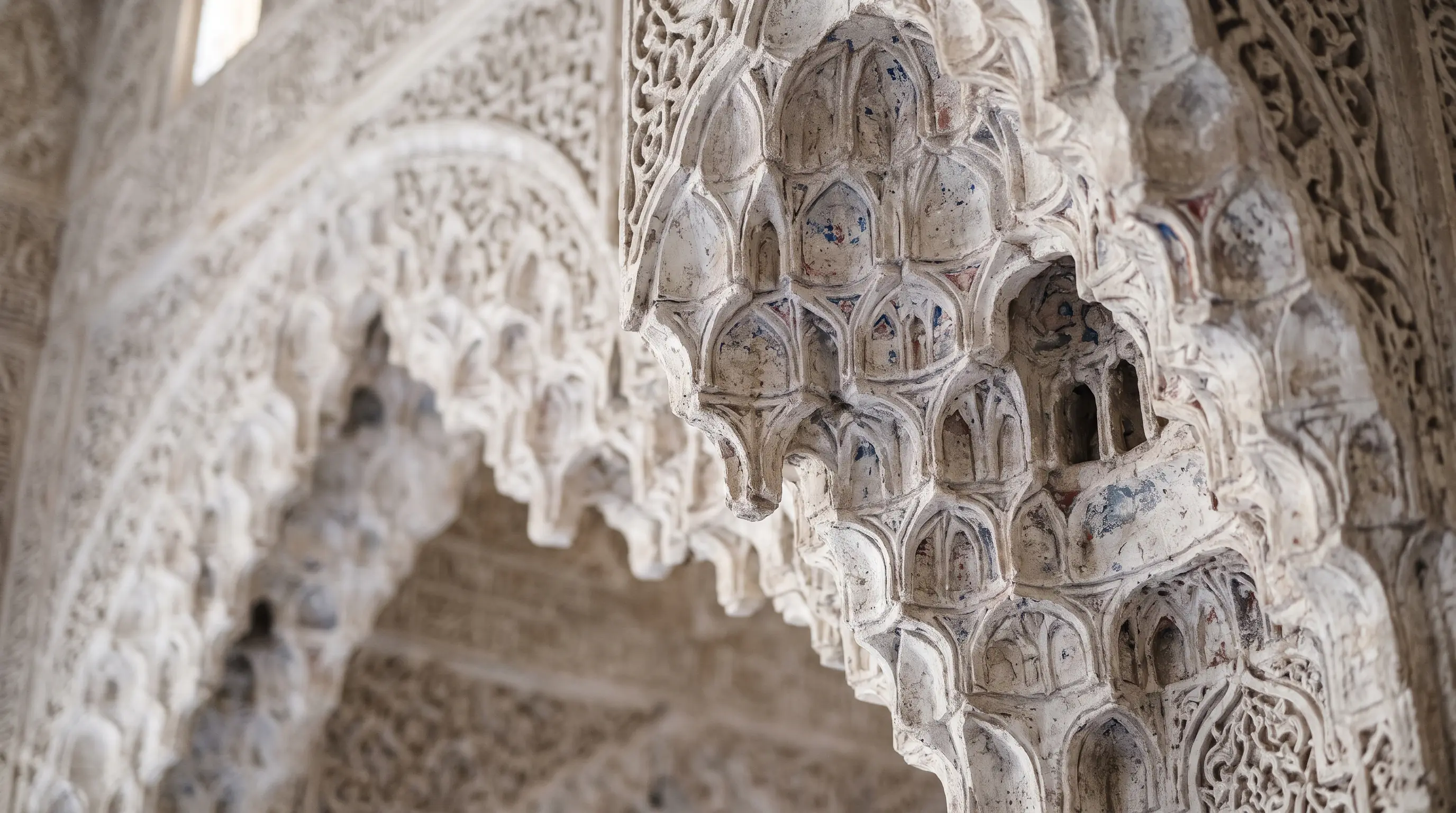
Alhambra original colours imagined on a Nasrid muqarnas vault, carved white plaster picked out in lapis blue, cinnabar red and gold leaf in warm lamplight

Cinnabar, red lead, carbon black and lapis lazuli were all identified by Raman spectroscopy in the Hall of the Kings vaults.

Much of the Alhambra's carved plaster reads as pale and monochrome now, yet the Nasrids painted it: two original palettes have been identified, an early scheme of blue, red and black and a later one adding green and gold, all on a white ground[1]. The paint has not lasted. Red has largely vanished from the sampled polychromy, and what remains is faint or darkened and cracked[4], while the Room of the Beds in the Comares baths preserves a controversial 19th-century redecoration that imitated the lost original look[5]. Anyone picturing a fully painted Nasrid hall is extrapolating from patches.
Nasrid colour schemes
2 palettes
Early blue, red, black; later red, blue, green, black, gold[1]
Identified by Raman
4 pigments
Cinnabar, minium, carbon black and lapis lazuli in one hall[2]
Earlier vault repairs
2+ repairs
Made in the 19th and 20th centuries to consolidate the vaults[3]

Two palettes on a white ground

The Nasrids painted their plasterwork in two successive schemes: an earlier palette of blue, red and black, and a later one of red, blue, green, black and gold, with white as the background in both[1]. The early scheme turned up in the Partal's Muslim House and is attributed to Muhammad III (1302–1309)[33]. The later one belongs to the Mexuar and Lions palaces, decorated in the late Nasrid period and possibly under Muhammad V (1362–1391)[34]. The vault plasterwork of the Hall of the Kings shows the richer scheme, painted in red, blue, green, gold and black[6]. The muqarnas, mocarabes and zellige of Nasrid architecture were therefore only half the effect; paint did the rest.
The colour went on dry, probably as a secco paint bound with an organic medium, the method reported for other Islamic decoration[7]. The white ground is gypsum, and its outer face has a distinctive violet cast, a trait not reported elsewhere[8].
A pale carved wall in a Nasrid palace is therefore no evidence that the room was meant to be pale. White was the ground, not the finish, and the paint that sat on it has spent centuries fading, flaking or being painted over. Pale is what survives.

Blue, red and gold: the pigments behind the palette

Blue began as azurite and later became lapis lazuli[9], the same early-versus-late contrast as the two palettes. Natural azurite was identified on the plaster of the Partal's Muslim House, the early palette, while natural lapis lazuli turns up in the other areas sampled[10]. Lapis was as expensive as gold and, in architecture, was kept for the richest settings, the Alhambra among them[11]. The mines of Badakhshan in Afghanistan are believed to have been the only source of the pigment used in medieval Europe[12], which makes a lapis-blue vault in Granada a long-distance import.
Red was cinnabar, a mercury sulphide identified on the plaster of the Partal's Muslim House[13], together with red lead, or minium, which sits beside cinnabar on the plaster vaults of the Hall of the Kings[2]. Red is also the colour most often missing. Red lead darkens first, turning brown-black, and ends by losing its colour altogether[14]. Gone, not faded.
On the timber of the Mexuar's ceiling carpentry the palette narrows to white lead, cinnabar and red lead, lapis lazuli, carbon black and a tin-based false gold[15]. That gold contains no gold: on the carpentry's epigraphs it is varnished tin leaf over a gypsum ground[37], and the study's "golden tin" means tin gilded artificially with varnish[38]. Red lead had a practical job there too: Nasrid carpenters used synthetic minium to protect walnut and conifer timber against wood-boring insects[16].
Gold on the plaster decorated muqarnas and arch intrados[17]. It went on as leaf over a tin sheet, a support more flexible and easier to handle than the leaf alone[18], and the later palette lists it as gold over tin leaf[35]. That is real gold on plaster, not the Mexuar's varnished tin on wood. Most of it has since been lost from the sampled polychromy, the leaf fissuring along with the paint[19]. None of this was cheap: lapis lazuli, gold and cinnabar all appear among the expensive pigments credited to both Nasrids and Christians[26].

How pigment analysis reads a vault without scraping it

A spectrum names a pigment from its molecular fingerprint, and portable Raman spectroscopy was used on the vaults of the Hall of the Kings to separate cinnabar, minium, carbon black and lapis lazuli[2]. The method goes to the paint rather than taking the paint to a laboratory, which matters in a room whose ceiling is the exhibit.

~500 spectra

Useful Raman spectra from more than 300 points examined in the Hall of the Kings vaults[20]
A separate study went after the Hall of the Kings' painted leather ceilings, which are leather over wood rather than plaster. Portable X-ray diffraction and fluorescence found the reds there to be cinnabar and/or hematite[21]. It also detected red lead in the red-ochre and orange tones, and gold together with tin and iron[31]. Same minerals, different support.
Identification is only half the job, because the surface is a stack of campaigns. Laboratory stratigraphy of samples from the Hall of the Kings revealed re-decorations, with overlying pigment layers even of different colours[22].
Dating a layer is the hard part. A pigment that belongs to a later century works as a date stamp. Synthetic ultramarine, the cheaper blue used by the 19th-century restoration[9], turned up in one of the Hall of the Kings vaults and flags a recent restoration there[23].

Where the analysed paint sits: five places

The firmest evidence for painted plaster comes from the Hall of the Kings vaults, with smaller plaster samples from the Partal, the Court of the Lions and the Comares baths, and a separate study of the Mexuar's timber. Four of the five places below are plaster; the Mexuar entry is wood, and the Hall of the Kings leather ceilings covered above are a third support again.
  • Plaster, Hall of the Kings vaults: cinnabar was found hidden under layers of lime that were removed during conservation[24]
  • Plaster, Partal Muslim House: natural azurite for blue and mercury sulphide for red[10][13]
  • Plaster, Court of the Lions east pavilion: an intense blue of artificial lapis lazuli with barite, a later repair rather than the natural Nasrid stone[25]
  • Plaster, Comares baths, Room of the Beds: the 19th-century redecoration that imitated the lost Nasrid look[5]
  • Wood, Mexuar ceiling carpentry: painted in white lead, red, lapis lazuli, carbon black and tin false gold[15]
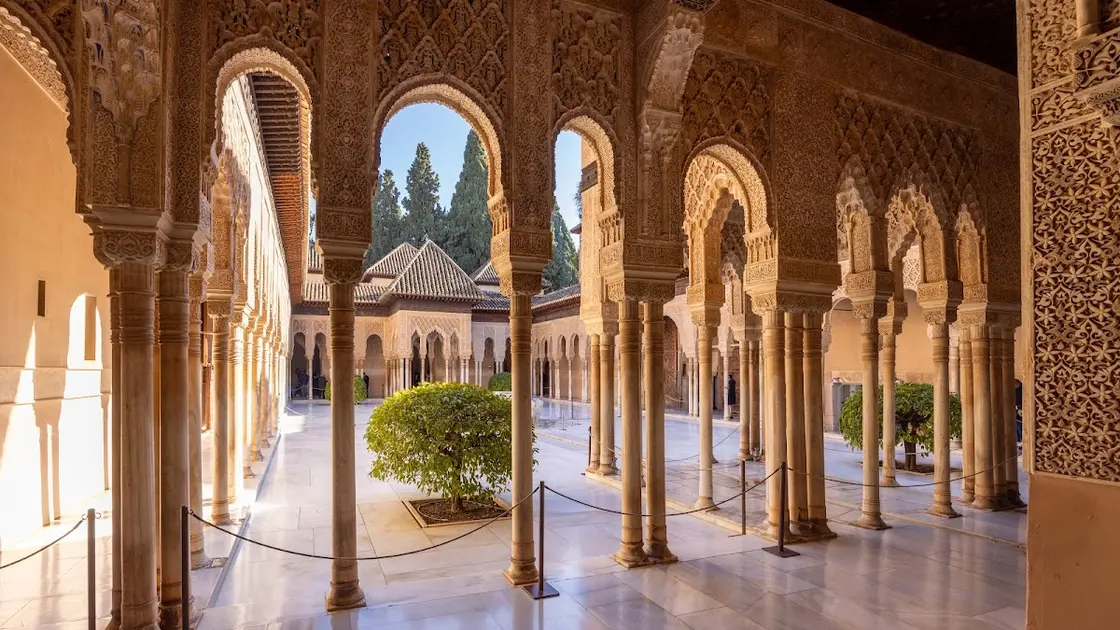
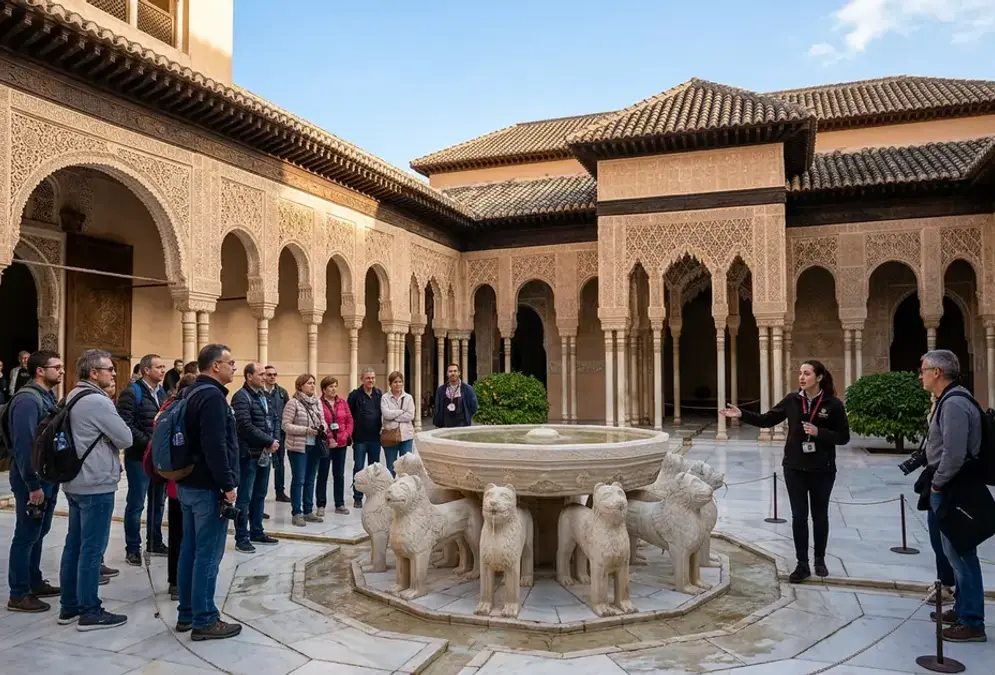
The Patio de los Leones in the Nasrid Palaces, with its central alabaster fountain supported by twelve lions

Explore nearby · Monument

Nasrid Palaces

Three royal Nasrid palaces inside the Alhambra, including the Patio de los Leones and Hall of the Ambassadors. Entry is timed: arrive within your booked slot.

Treat the list as a map of analysis, not a colour trail. The evidence comes from vaults and ceilings examined up close, and each area was sampled at limited points. Nothing here amounts to a fully surveyed room.

What later hands changed, from lime to Contreras's green
Lime hid red in at least one place: in the Hall of the Kings vaults, cinnabar was found under lime layers that conservators were removing[24]. Christian workers who repaired the decoration used the same costly pigments as the Nasrids, among them lapis lazuli, gold, cinnabar, azurite, malachite and tin[26]. The one Christian-era repair pinned down by pigment manufacture is the artificial lapis of the Lions Courtyard, and its date or campaign is not recorded[36]. The vaults themselves were consolidated in at least two earlier interventions, in the 19th and 20th centuries[3]. Across the Alhambra, the most important and generalised restorations belong to those same two centuries[32].
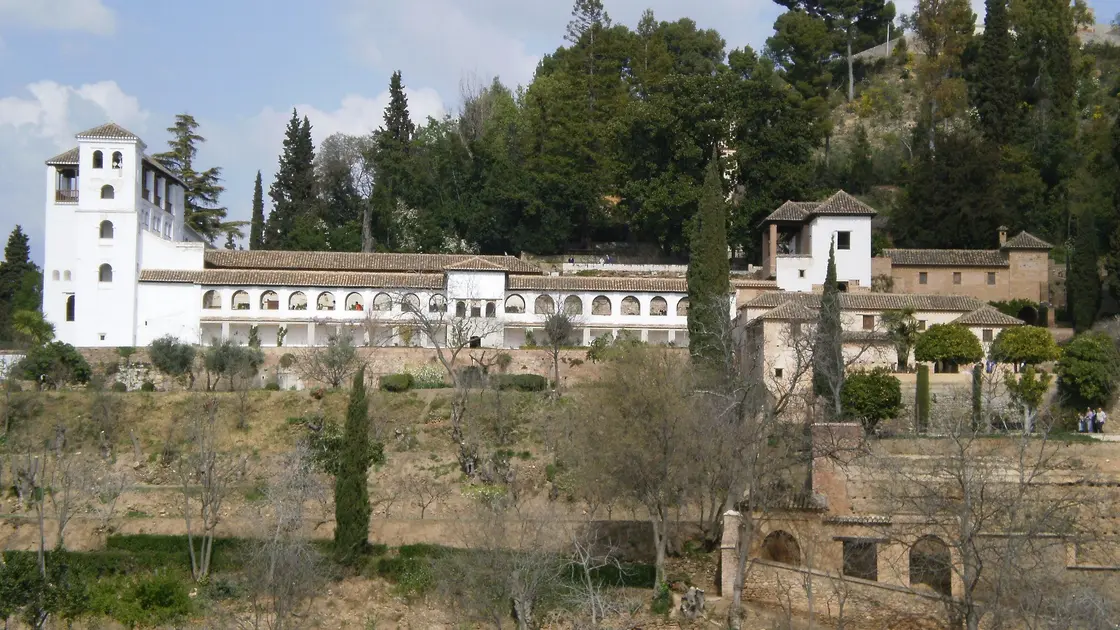
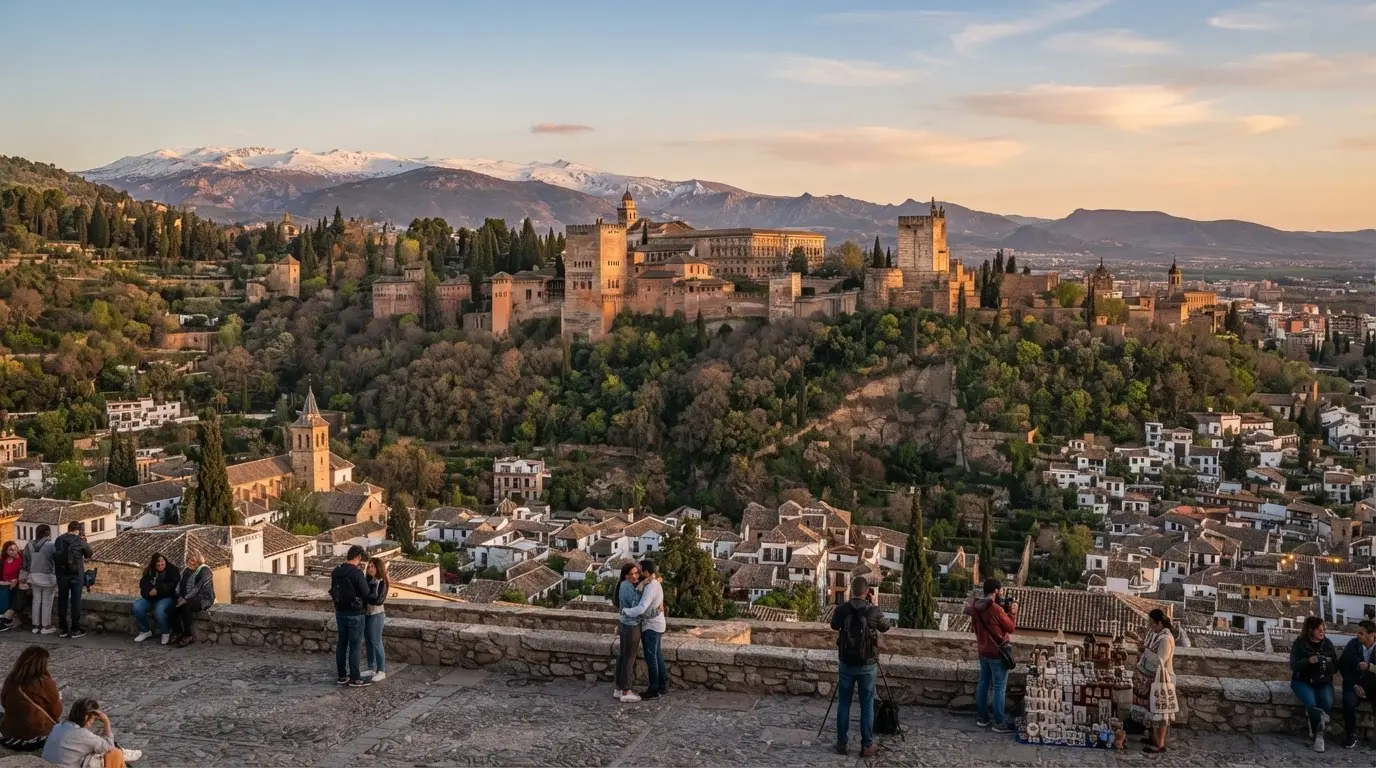
Wide-angle panoramic view of Granada Spain from Mirador de San Nicolás showing the Alhambra palace complex and Generalife gardens against the snow-capped Sierra Nevada mountains at golden hour, illustrating the interesting facts about Granada Spain

Deep dive · Article

20 Interesting Facts About Granada, Spain

Interesting facts about Granada Spain that guidebooks skip: disputed etymologies, the soldier who saved the Alhambra, and a river buried under Plaza Nueva.

Rafael Contreras, whose 19th-century restoration ran from 1847 to 1889 and is still argued over[39], was called the ornamental restorer for redecorating many areas in vivid colours to bring back an oriental look to the palaces[27]. At the Comares baths he began with a thick white lead preparation over the gypsum plaster[28].
His blue was the cheaper synthetic ultramarine rather than lapis[9], and his green was a poisonous copper-arsenic pigment typical of the 19th century[29]. Humidity is still a problem there, and the redecoration is now losing pigment adhesion[30].
The published record that predates Contreras is Owen Jones's Plans, Elevations, Sections and Details of the Alhambra (1842–45), the book that followed six months of drawing and plaster casting at the palace[40].
Under a painted vault, three questions sort the layers. Is the blue lapis lazuli or the cheaper ultramarine? Is the red cinnabar, or red lead that has begun to darken? Does the room belong to a vault repaired in the 19th or 20th century? Raman spectra can answer them; the naked eye usually cannot.

Frequently asked questions

What were the Alhambra's original colours inside the palaces?

Two original Nasrid palettes have been identified: an early one of blue, red and black, and a later one of red, blue, green, black and gold. White was the ground in both, and the paint sat on finished plaster and on wooden ceilings.

Was the Alhambra really painted blue and red?

Yes. Blue was azurite in the early period and lapis lazuli later, while red was cinnabar and red lead. Little of the red survives, because red has largely vanished from the sampled polychromy.

What pigments were used on the Nasrid plasterwork and wood?

Analysis has found azurite, lapis lazuli, cinnabar, red lead, carbon black, white lead and gold leaf over tin. The Mexuar's ceiling carpentry also carries a tin-based false gold.

Was real gold used in the Alhambra?

Yes, on plaster. Gold leaf decorated muqarnas and arch intrados, laid over a tin sheet. On the Mexuar's wood the gold effect is false, made from tin, and most of the real gold has since been lost from the sampled polychromy.

Why did the Alhambra's red paint turn brown or black?

Red lead darkens first, turning brown-black, and eventually loses its colour entirely. The red that remains in the sampled areas is faint, or darkened and cracked.

Is the colour you see in the Alhambra today original?

Not reliably. Synthetic ultramarine in one Hall of the Kings vault shows a recent restoration, an intense blue in the Court of the Lions east pavilion is artificial lapis lazuli, and the Room of the Beds keeps Rafael Contreras's 19th-century redecoration.

How do scientists identify pigments in the Alhambra?

In the Hall of the Kings vaults, portable Raman spectroscopy examined more than 300 points and produced about 500 useful spectra. Laboratory stratigraphy of samples then shows the layers of later repainting.

Sources

40 references Show
  1. ugr.es — Cardell 06.pdf (opens in a new tab)

    “Two original Nasrid palettes were also identified: an earlier, simpler palette of blue, red and black, and a later, more varied palette of red, blue, green, black and gold.”

  2. rujapre.ujaen.es — Download (opens in a new tab)

    “Different typical antiquity pigments have been identified: cinnabar, minium, carbon black and lapis lazuli.”

  3. rujapre.ujaen.es — Download (opens in a new tab)

    “The Hall has suffered at least two previous interventions during the XIX th and XX th centuries in order to consolidate the structure of the vaults.”

  4. ugr.es — Cardell 06.pdf (opens in a new tab)

    “In general the red colour is lost from the polychromy, and what remains either lacks intensity or is darkening and shows fissures.”

  5. rujapre.ujaen.es — Download (opens in a new tab)

    “This area keeps the testimony of the controversial restorations carried out in the 19 th -century in an attempt to imitate the lost original appearance of the authentic Nasrid plasterwork.”

  6. rujapre.ujaen.es — Download (opens in a new tab)

    “The plasterworks of the vaults were richly painted in a wide range of colors mainly red, blue, green, golden and black.”

  7. rujapre.ujaen.es — Download (opens in a new tab)

    “They were probably applied using a secco painting technique employing an organic binding medium as reported for other Islamic decorations in different monuments.”

  8. ugr.es — Cardell 06.pdf (opens in a new tab)

    “In the Alhambra, the white layers display a distinctive violet colour in their outer part, a characteristic that is not mentioned elsewhere [7].”

  9. rujapre.ujaen.es — Download (opens in a new tab)

    “Blue decorations were originally painted with either azurite [6,34] (in the early period) or lapislazuli [6–8] whereas the restoration of the 19 th century employed the cheaper synthetic ultramarine blue”

  10. ugr.es — Cardell 06.pdf (opens in a new tab)

    “Three kinds of blue pigment were identified, namely natural azurite in the Muslim House of the Partal Palace, and natural and artificial lapis lazuli in the rest of the areas studied.”

  11. ugr.es — Cardell 06.pdf (opens in a new tab)

    “Lapis lazuli, as expensive as gold, was principally used in miniatures, frescos and canvas painting, and always in rich decorations.”

  12. rujapre.ujaen.es — Download (opens in a new tab)

    “The lapis lazuli mines in the Badakhshan region of Afghanistan that have been exploited since ancient times are believed to have been the unique source of the lapis lazuli pigments used in Europe during the Middle Ages.”

  13. ugr.es — Cardell 06.pdf (opens in a new tab)

    “Mercury sulphide was used to provide the red colour (MH-J-R).”

  14. rujapre.ujaen.es — Download (opens in a new tab)

    “Thus, the alteration of minium initially produces darkening but ends with the total loss of the color.”

  15. ugr.es — Cardell09b.pdf (opens in a new tab)

    “The palette consists of a limited range of colours: white (lead-base pigment), red (cinnabar and red lead), blue (lapis lazuli), black (carbon-based) and false gold (golden tin).”

  16. ugr.es — Cardell09b.pdf (opens in a new tab)

    “Artists applied synthetic minium to protect the wood (Juglans regia and conifer) against attack by xylophages.”

  17. ugr.es — Cardell 06.pdf (opens in a new tab)

    “Specifically, in the Alhambra, gold was used to decorate muqarnas and the arch intrados.”

  18. ugr.es — Cardell 06.pdf (opens in a new tab)

    “the gold leaf was first applied to a tin sheet, a support that is more flexible, consistent and easier to handle.”

  19. ugr.es — Cardell 06.pdf (opens in a new tab)

    “Fissuring also affects the gold leaf, indeed most of the gold has been lost from the polychromy.”

  20. rujapre.ujaen.es — Download (opens in a new tab)

    “During this study, more than 300 points have been examined, resulting in ca. 500 useful spectra.”

  21. repositorio.iaph.es (opens in a new tab)

    “The results show that the red hues are made from cinnabar and/or hematite.”

  22. rujapre.ujaen.es — Download (opens in a new tab)

    “the presence of re-decorations with overlaying layers of pigments even of different colors was revealed.”

  23. rujapre.ujaen.es — Download (opens in a new tab)

    “Apart from this natural lapis lazuli, synthetic ultramarine blue was also found in one of the vaults showing up a recent restoration.”

  24. rujapre.ujaen.es — Download (opens in a new tab)

    “It was also found hidden under layers of lime that were removed during the on-going conservation works.”

  25. ugr.es — Cardell 06.pdf (opens in a new tab)

    “The particle size and morphology of the blue pigment and the presence of barite indicate an artificial origin for the lapis lazuli.”

  26. ugr.es — Cardell 06.pdf (opens in a new tab)

    “The use of expensive pigments such as lapis lazuli, gold, cinnabar, azurite, malachite and tin by Nasrids and Christians confirms the high esteem in which the Alhambra has been held throughout time.”

  27. rujapre.ujaen.es — Download (opens in a new tab)

    “He was named the “ornamental restorer” because of his esthetical interventions redecorating many areas with vivid colors in an attempt to return the oriental aspect to the palaces.”

  28. rujapre.ujaen.es — Download (opens in a new tab)

    “First, Contreras applied a thick preparation layer of white lead over the gypsum plaster.”

  29. rujapre.ujaen.es — Download (opens in a new tab)

    “The pigment used in the restoration of Contreras was one of the typical poisonous 19 th -century green pigments based on copper and arsenic.”

  30. rujapre.ujaen.es — Download (opens in a new tab)

    “Unfortunately, the humidity problems are still present, and the redecoration of Contreras is now suffering from lack of adhesion of the pigments.”

  31. repositorio.iaph.es (opens in a new tab)

    “Furthermore, XRD detected the presence of red lead in the red-ochre and orange tones, while gold is present together with tin and iron.”

  32. rujapre.ujaen.es — Download (opens in a new tab)

    “The most important and generalized restorations took place in the 19th and 20th centuries.”

  33. ugr.es — Cardell 06.pdf (opens in a new tab)

    “was identified in the Partal Palace (Muslim House) and attributed to the first Nasrid period (Muhammad III, 1302–1309), in agreement with the plasterwork results.”

  34. ugr.es — Cardell 06.pdf (opens in a new tab)

    “which were both decorated during the late Nasrid period and might be assigned to Muhammad V (1362–1391).”

  35. ugr.es — Cardell 06.pdf (opens in a new tab)

    “red cinnabar and lead oxide, green malachite, blue lapis lazuli, carbon black and gold (over tin leaf).”

  36. ugr.es — Cardell 06.pdf (opens in a new tab)

    “Christian interventions were identified thanks to the pigment manufacture (morphology and compo-sition), principally in the Lions Courtyard (Lions Palace).”

  37. ugr.es — Cardell09b.pdf (opens in a new tab)

    “for epigraphs, only false gold made of varnished tin leaf over a ground layer based on calcium sulphate was found.”

  38. ugr.es — Cardell09b.pdf (opens in a new tab)

    “golden tin (i.e., tin gilded artificially with varnish)”

  39. rujapre.ujaen.es — Download (opens in a new tab)

    “Particularly, the works of Rafael Contreras (between 1847 and 1889) became very famous and also controversial.”

  40. vam.ac.uk (opens in a new tab)

    “The resulting book, Plans, Elevations, Sections and Details of the Alhambra (1842 – 45), became one of the most influential publications on Islamic architecture of all time.”