Dar al-Arusa, the Palace Above the Generalife, Not Dar al-Horra
Dar al-Arusa, the ruined 'House of the Bride' on the Cerro del Sol above the Generalife, was found by chance in 1933. What survives, and how to see it today.
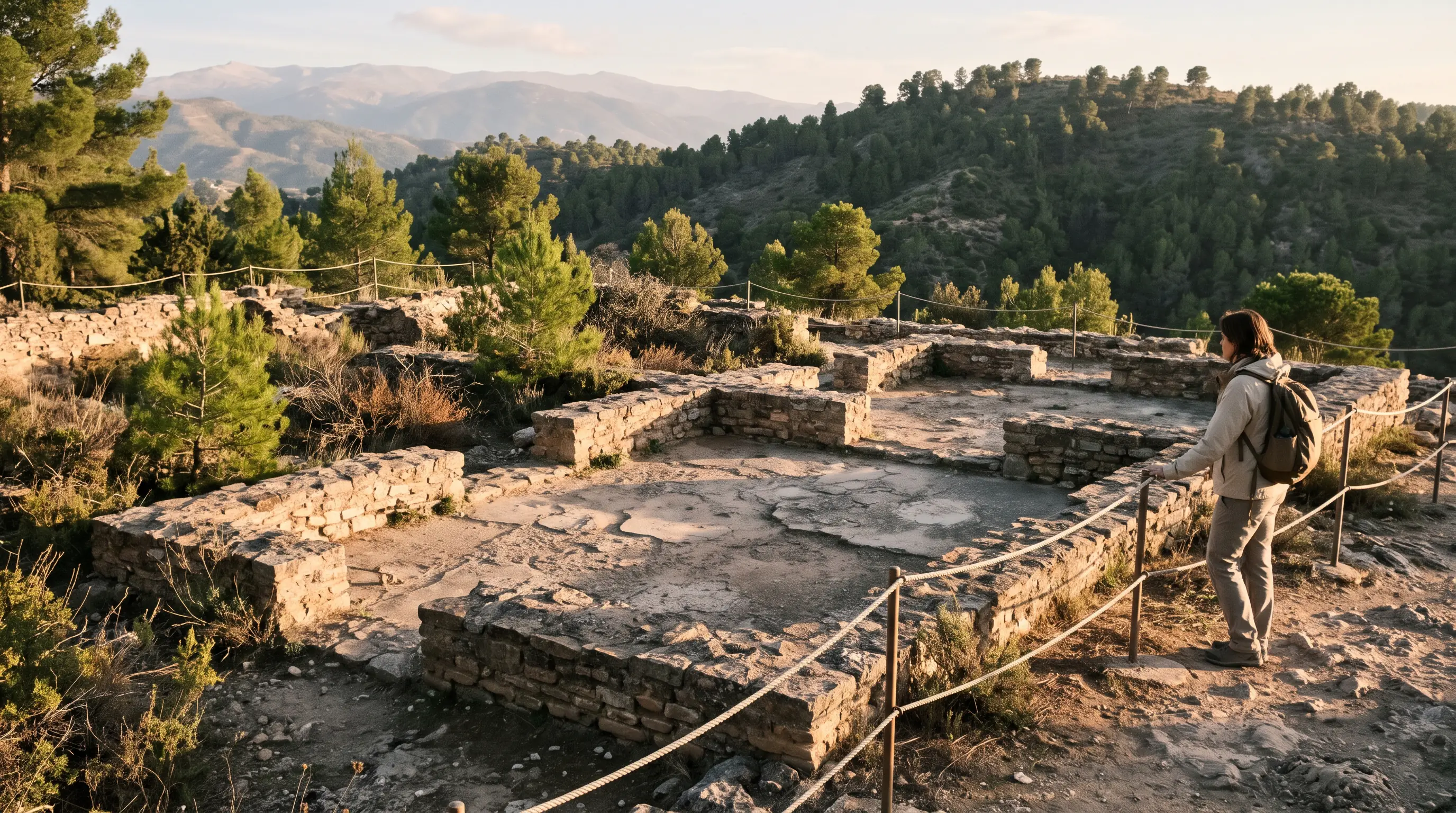
Pine planting on the Cerro del Sol exposed the site in 1933, and Torres Balbás's excavation ran for three years.
In this article
Jump to a section
Seeing it today without confusing it with Dar al-Horra
- Albercones de la Alhambra
- The Silla del Moro complex
- The Dar al-Arusa palace
- Alberca Rota
- Pozos Altos
- Aljibe de la Lluvia[23]
Check before you climb
A pine-planting job that turned up a palace
The Cerro del Sol: the hill above the Generalife
Explore nearby · Monument
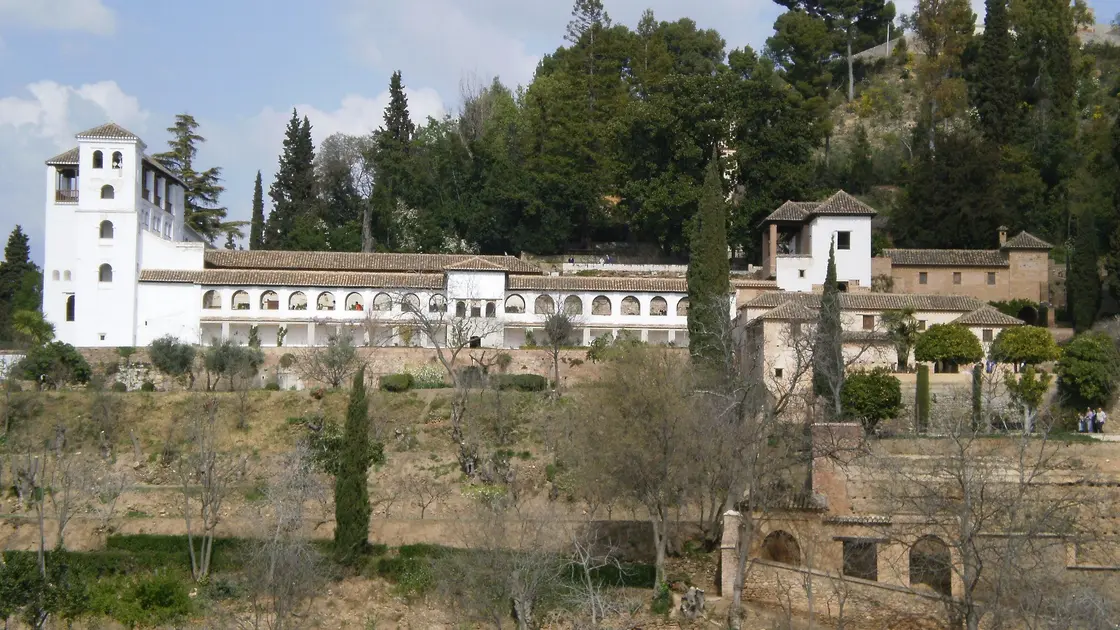
Generalife
The Nasrid sultans' summer estate above the Alhambra, with terraced gardens and the Patio de la Acequia, a 49-metre water garden from the 14th century.
What the ruins show: three courts, a gallery and a bath
- In the centre of the court, a pool with signs of canalization, perhaps a drain[14]
- On the western side, the ruins of a long gallery open to the courtyard[15]
- In the north-east corner, a hydraulic system that drew water from a well by waterwheel[16]
- Further east, the bathroom, with the partial remains of a hypocaust, the underfloor heating, beneath it[17]
- Around the whole site, a wall that may have been a barbican extending north and south[18]
Deep dive · Article
20 Interesting Facts About Granada, Spain
Interesting facts about Granada Spain that guidebooks skip: disputed etymologies, the soldier who saved the Alhambra, and a river buried under Plaza Nueva.
The bath, its fountain and the water lift
Recommended tours
Tours are selected for quality, not commission. We earn a small fee if you book — at no extra cost to you.
Frequently asked questions
What does Dar al-Arusa mean?
Is Dar al-Arusa the same as Dar al-Horra?
When was Dar al-Arusa discovered?
Can you visit Dar al-Arusa?
Where is Dar al-Arusa?
What survives of Dar al-Arusa?
When was Dar al-Arusa built?
Sources
41 references Show Hide
- Patronato de la Alhambra — Dar al arusa (opens in a new tab)
“The site was discovered by chance, while pine trees were being planted in the area in 1933.”
- Patronato de la Alhambra — Fountain from the apodyterium in the palace of dar al arusa (opens in a new tab)
“We have no exact chronology for Dar al-Arusa, although Torres Balbás situates it in the first half of the 14th century”
- Patronato de la Alhambra — Memoria 2025.pdf (opens in a new tab)
“celebró el día 14 de junio las Jornadas Europeas de Arqueología con una visita guiada gratuita a los yacimientos arqueológicos del Cerro del Sol”
- Patronato de la Alhambra — Fountain from the apodyterium in the palace of dar al arusa (opens in a new tab)
“was found by chance during reforestation work ordered by the Alhambra’s head conservator Torres Balbás in 1933.”
- Patronato de la Alhambra — Dar al arusa (opens in a new tab)
“The excavation, which was headed by the architect Leopoldo Torres Balbás, lasted three years.”
- Wikipedia — Dar al Arusa (opens in a new tab)
“aunque hasta 1933 no se descubrió la parte más importante del complejo, levantándose un plano de planta de los mismos por Leopoldo Torres Balbás, en 1936.”
- Patronato de la Alhambra — Fountain from the apodyterium in the palace of dar al arusa (opens in a new tab)
“The Dar al-Arusa Palace crowns the hill above the Generalife known as the Cerro del Sol or Sun Hill.”
- digibug.ugr.es (opens in a new tab)
“a su vez fuera de estos recintos excava la silla del moro y el Palacio de Dar Al-Arusa.”
- Patronato de la Alhambra — Minister for culture visits silla del moro mirador and lions (opens in a new tab)
“Silla del Moro, part of the defensive system of 14th-century Granada, is a remnant of the mediaeval buildings associated with the Alhambra and Generalife, along with the Dar al-Arusa and Alijares Palaces.”
- Patronato de la Alhambra — Minister for culture visits silla del moro mirador and lions (opens in a new tab)
“It was specifically located to watch over the Royal Water Channel which supplied the Alhambra and the Generalife.”
- Wikipedia — Alhambra (opens in a new tab)
“both of which were built in the 14th century and then abandoned some time after the 1492 conquest. Only traces of them remain today.”
- Wikipedia — Alhambra (opens in a new tab)
“several other country estates and palaces to the east of the Alhambra and the Generalife, located on the mountainside and taking advantage of the water supply system which ran through this area.”
- Patronato de la Alhambra — Fountain from the apodyterium in the palace of dar al arusa (opens in a new tab)
“The Palace was made up of three courtyards of different sizes and a bath in the south-east corner.”
- Patronato de la Alhambra — Dar al arusa (opens in a new tab)
“In the centre of the court are the remains of a pool, with signs of canalization—perhaps a drain.”
- Patronato de la Alhambra — Dar al arusa (opens in a new tab)
“On the western side are the ruins of a long gallery open to the courtyard.”
- Patronato de la Alhambra — Dar al arusa (opens in a new tab)
“On the northeast corner lie the remains of what has been identified as a hydraulic system involving the drawing of water from a well by waterwheel.”
- Patronato de la Alhambra — Dar al arusa (opens in a new tab)
“Further east was the bathroom, underneath which the partial remains of a hypocaust lie.”
- Patronato de la Alhambra — Dar al arusa (opens in a new tab)
“The entire site is surrounded by a wall that may have been a barbican extending north and south.”
- Patronato de la Alhambra — Dar al arusa (opens in a new tab)
“Fragments of plasterwork, pavings and tiles point to the importance of the palace.”
- Patronato de la Alhambra — Fountain from the apodyterium in the palace of dar al arusa (opens in a new tab)
“This fountain was in the centre of the _bayt al-maslaj_, the rest room or dressing room.”
- Patronato de la Alhambra — Fountain from the apodyterium in the palace of dar al arusa (opens in a new tab)
“It was inset into a square floor divided into four panels with glazed ceramic decoration.”
- Patronato de la Alhambra — Fountain from the apodyterium in the palace of dar al arusa (opens in a new tab)
“This piece was located around 1934 and remained in situ for the following 11 years until finally for conservation reasons it was moved to the Museum of the Alhambra in October 1944.”
- Patronato de la Alhambra — Memoria 2025.pdf (opens in a new tab)
“Itinerario: Albercones de la Alhambra, conjunto de la Silla del Moro, Palacio de Dar Al-Arusa, Alberca Rota, Pozos Altos y Aljibe de la Lluvia”
- Patronato de la Alhambra — Memoria 2025.pdf (opens in a new tab)
“EXCURSIÓN A LA DEHESA. Recorrido por la Silla del Moro y el Palacio de Dar al-Arusa.”
- Patronato de la Alhambra — Palacio de dar al horra (opens in a new tab)
“Palacio de Dar al-Horra, “Home of the Honest”, located in the Alcazaba Cadima”
- Patronato de la Alhambra — Palacio de dar al horra (opens in a new tab)
“It was so-named for having been the official residence of Aixa la-Horra, wife of Muley Hacén and mother of the last Emir of Granada, Boabdil.”
- Patronato de la Alhambra — Palacio de dar al horra (opens in a new tab)
“it eventually being converted into a Franciscan convent by Queen Isabel, inhabited from 1507 to this day by nuns of the order of St Clare.”
- en.andalucia.org (opens in a new tab)
“The Dar Al-Horra Palace can be visited through the “Dobla de Oro” programme of visits, organised by the Patronato de la Alhambra y El Generalife”
- Patronato de la Alhambra — Memoria 2025.pdf (opens in a new tab)
“14. EXCURSIÓN A LA DEHESA Segundo ciclo de primaria, secundaria, bachillerato, ciclos formativos y colectivos de acción social Silla del Moro y Palacio de Dar al-Arusa”
- Patronato de la Alhambra — Memoria 2025.pdf (opens in a new tab)
“Hora: 9:00 horas”
- Patronato de la Alhambra — Memoria 2025.pdf (opens in a new tab)
“Duración: 2:00 horas aproximadamente”
- Patronato de la Alhambra — Memoria 2025.pdf (opens in a new tab)
“Especialista: Fernando Martínez Ávila, Jefe del Departamento de Arqueología en el Patronato de la Alhambra y Generalife.”
- Patronato de la Alhambra — Memoria 2025.pdf (opens in a new tab)
“Asistentes a la actividad: 30”
- turismo.granada.org — Dehesa del generalife (opens in a new tab)
“Starting point: Alhambra Entrance Pavilion”
- turismo.granada.org — Dehesa del generalife (opens in a new tab)
“Length: 10,000m”
- turismo.granada.org — Dehesa del generalife (opens in a new tab)
“This route is marked out by plenty archaeological venues, such as Silla del Moro, Dar al-Arusa Palace and Aljibe de la Lluvia.”
- turismo.granada.org — Dehesa del generalife (opens in a new tab)
“The first 5km go up to Llano de la Perdiz.”
- turismo.granada.org — Cuesta del rey chico silla del moro (opens in a new tab)
“Starting point: Plaza Nueva”
- Patronato de la Alhambra — Localizacion y horarios (opens in a new tab)
“Located in the interior of the Palace of Charles V (Palacio de Carlos V), the Museum of the Alhambra offers visitors a unique possibility to see art or architecture objects from the Monument”
- Patronato de la Alhambra — Localizacion y horarios (opens in a new tab)
“15 OCTOBER – 31 MARCH WEDNESDAY TO SATURDAY 8:30 – 18:00 H SUNDAYS AND TUESDAY 8:30 – 14:30 H MONDAYS CLOSED”