What the Capitulations of Santa Fe actually say
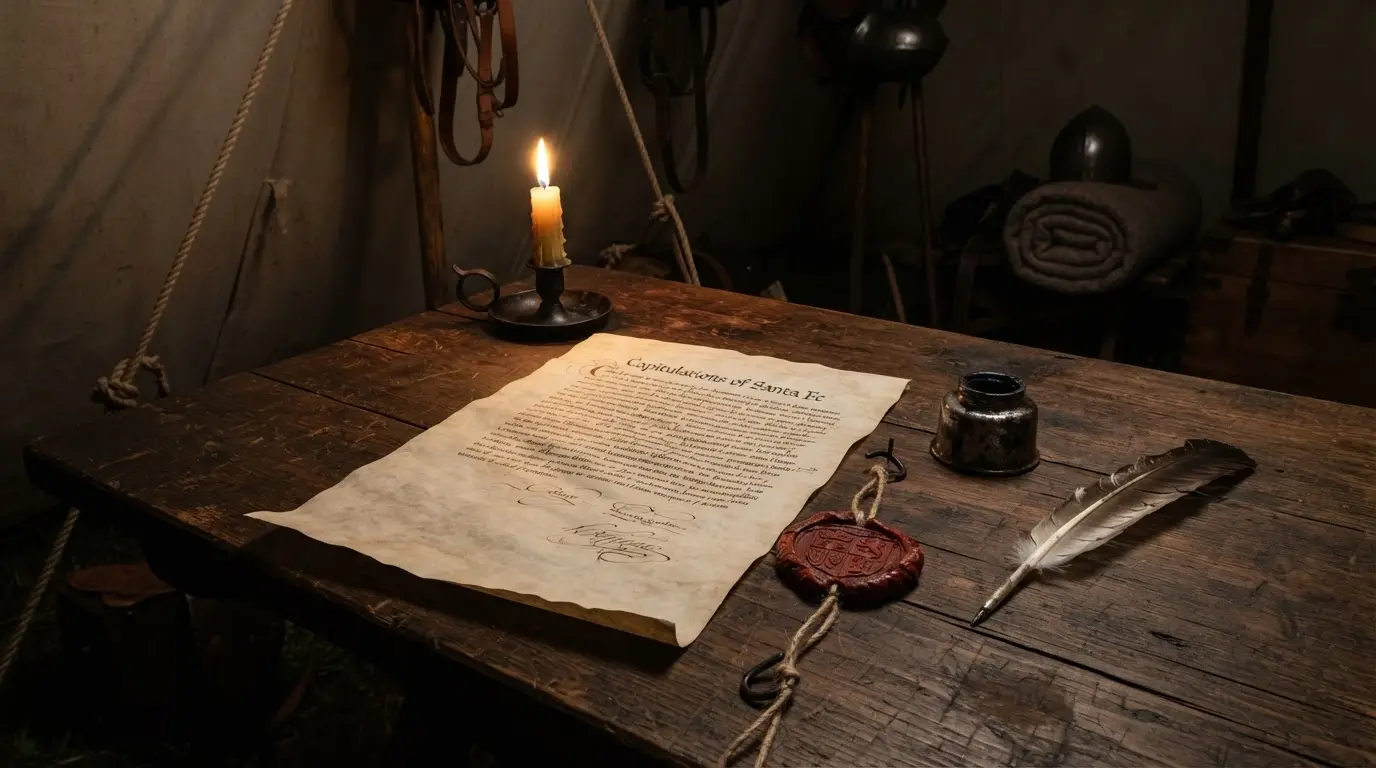
On 17 April 1492, at the military camp of Santa Fe outside Granada, Christopher Columbus and the Catholic Monarchs signed the document historians call the Capitulations of Santa Fe[1]. It reads less like a treaty and more like an employment contract with equity attached: if Columbus reached land across the western ocean, he would hold it as admiral of the Ocean Sea, viceroy, and governor-general of everything he found, carry the honorific don[4], and keep one-tenth of whatever gold, silver, pearls and spices came out of it, in perpetuity, for his heirs[2].
The signing happened here and not in the city itself for a mundane reason: Santa Fe sits about 11 km from Granada, in the flat farmland of the Vega[5], and the Catholic Monarchs had been using it as their base since before the fall of Granada in 1492 on 2 January — the Capitulations were sealed fifteen weeks after that surrender, not during the war itself[6].
The document's own opening words describe the reward as recompense for "what he has discovered in the Mares Oceanas and of the journey that now, with the help of God, he must make"[7] — grantors writing as though the discovery had already happened, months before a single ship left port. It is also, legally, an old form dressed up for new business: the capitulación itself was a standard maritime contract used in Catalonia since the 14th century, setting terms between a king and the men who agreed to arm ships for him[8]. Columbus did not get a bespoke deal. He got the same paperwork Aragon had been issuing to sea captains for a hundred years.
None of that explains why the monarchs finally said yes, after years of stalling. The answer usually given for that is the part worth checking.
The myth: did Granada's war chest pay for the voyage?
The tidy version says Granada's conquest bankrolled Columbus: the crown, flush with captured wealth, could finally afford to gamble on his voyage. It is a satisfying story, and it does not survive contact with the record.
Even the historiography treats the timing as an open question, not a settled cause. One standard reference on the Capitulations puts it plainly: historians have wondered "why the monarchs were so generous in their bestowal of privileges to the Italian; perhaps it was due to the recent fall of Granada, the prospect of converting pagan peoples, or the belief that if Columbus was successful, the crown could recover its investment"[9] — three competing explanations, offered side by side, none of them proven.
What the record does show clearly is who actually produced the money, and it was not the royal treasury. Luis de Santángel, keeper of King Ferdinand's household accounts, personally advanced the bulk of the funding and borrowed the rest without interest; the crown reimbursed him only afterward[10]. Santángel also administered the funds of the Santa Hermandad, Castile's rural police confederation[11] — the closest documented link between crown money and Columbus's ships, and it runs through one accountant's personal credit, not a war chest.
The fall of Granada mattered, but for a different reason than spoils. Before 1492, the monarchs had already turned Columbus down, not on the merits, but because they were, in the words the record attributes to them, "financially tied up with fighting the Moors"[12]. They kept him on a retainer of 12,000 maravedís a year from 1486 so he would not shop the plan to a rival crown while they made up their minds[13]. What Granada's surrender freed was not a treasury. It freed a calendar: a monarchy no longer fighting a war inside its own kingdom could reconvene a commission it had stalled for years.
So the honest sequence runs: refusal, retainer, the war's end, reconsideration, and then one accountant's signature standing behind the ships. Spoils never enter it.
Santa Fe: the camp where two very different deals were signed
Santa Fe did not exist as a town before the war. The Catholic Monarchs built it in October 1491 as Real de Santa Fe, a military encampment on the outskirts of the besieged city, and only formalised it as an actual town after Granada's surrender on 2 January 1492[14]. Its name, literally 'Holy Faith', declared why the camp existed: to finish the war, not just fight it. A fire had already destroyed much of the original canvas-and-timber camp, which is one reason the rebuilt settlement went up in stone and brick rather than tents[15].
This is also the ground where the Treaty of Granada was signed in 1491, Boabdil's surrender terms, the sixty-seven conditions the Catholic Monarchs promised the city's Muslims and then broke one by one. That is a different document, negotiated months earlier, between different parties, about a different subject: who would keep their faith, their property, their mosques. The Capitulations of Santa Fe, signed in the same camp the following spring, settled none of that. They were a private commercial arrangement between two monarchs and one Genoese navigator, and the only thing the two documents share is their address.
Explore nearby · Monument
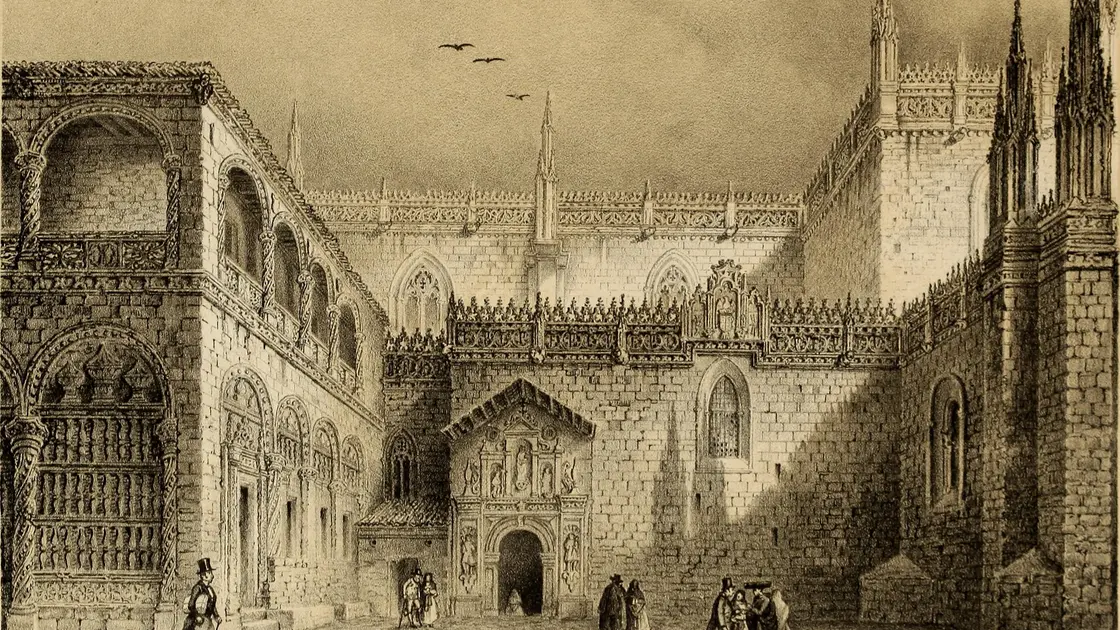
Royal Chapel of Granada
Isabelline Gothic chapel with the tombs of Isabella I and Ferdinand II. The sacristy holds royal regalia and paintings by Memling, Botticelli, and Bouts.
What survives, and what the paperwork was worth later
The original Capitulations document is lost. What survives is a confirmation copy issued in Barcelona in 1493, because the agreement was binding under Catalan law and needed a local confirmation to hold there[16]. That copy has sat in the Archive of the Crown of Aragon in Barcelona for more than five centuries[17], catalogued today as Royal Chancery Register No. 3,569, folios 135v–136v, under the hand of the royal secretary Juan de Coloma[18], not in the Archivo General de Indias in Seville, where most people assume Columbus's paperwork lives. In 2009 UNESCO added it to the Memory of the World Register[3].
The document mattered again a lifetime after it was signed. Spanish historians call the long legal saga that followed the pleitos colombinos, the Columbian lawsuits: in the mid-16th century, Columbus's descendants sued the crown for breaching its own terms, and they won. A court ordered an annual allowance that lasted until 1898, plus nobility titles their descendants still hold[19]. A contract drawn up in a siege camp to reward one navigator ended up funding a family for four centuries.
Deep dive · Article
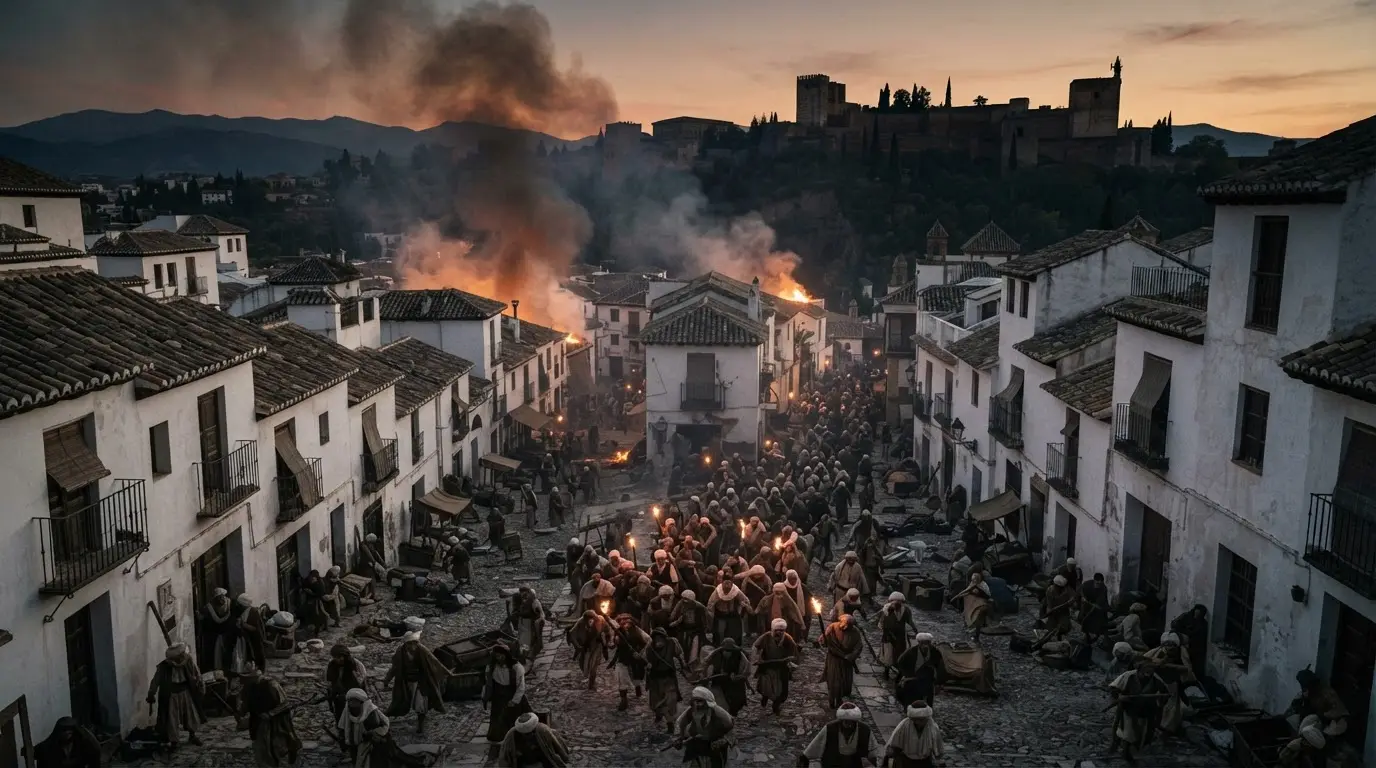
1066 Granada Massacre: When the Jewish Golden Age Ended in a Day
The 1066 Granada massacre killed Joseph ha-Nagid and thousands of the city's Jews in a single day, ending three decades of Jewish power under Samuel ha-Nagid.
The same monarchs who signed it were, within months, issuing the Alhambra Decree of 1492, expelling Spain's Jewish population, a reminder that 1492 was not one event but a cluster of decisions made from the same court, in the same short window. Isabella of Castile, whose signature sits on both documents, chose to be buried in Granada rather than in Castile, a decision the Royal Chapel across from the cathedral still honours.
Santa Fe today: what a visitor actually finds
Santa Fe is not a ruin and not a monument city. It is a working town of about 15,494 people[20] in the Vega de Granada, and the plan of its old centre still traces the cross-shaped military camp it began as. The walled centre keeps its four historic gates, an 18th-century parish church, the old Pósito granary building from the reign of Charles III, and a 1931 town hall in Neomudejar style[21]. Getting there from Granada is a short bus ride across flat farmland, nothing like the climb up to the Alhambra.
One detail locals mention more than historians do: Santa Fe, Granada is twinned with Santa Fe, New Mexico, and both cities' seals carry the same castle, lion, and imperial eagle[22], one Santa Fe having, indirectly, named the other. If you are here for the history, eat here too. The pionono de Santa Fe is a small, syrup-soaked pastry rolled into a cylinder and torched with cream on top, the one thing this town is actually famous for among Spaniards who could not place the Capitulations on a map. It has nothing to do with Columbus, and everything to do with why the trip is worth the short bus ride.