
What the treaty promised: the 67 clauses
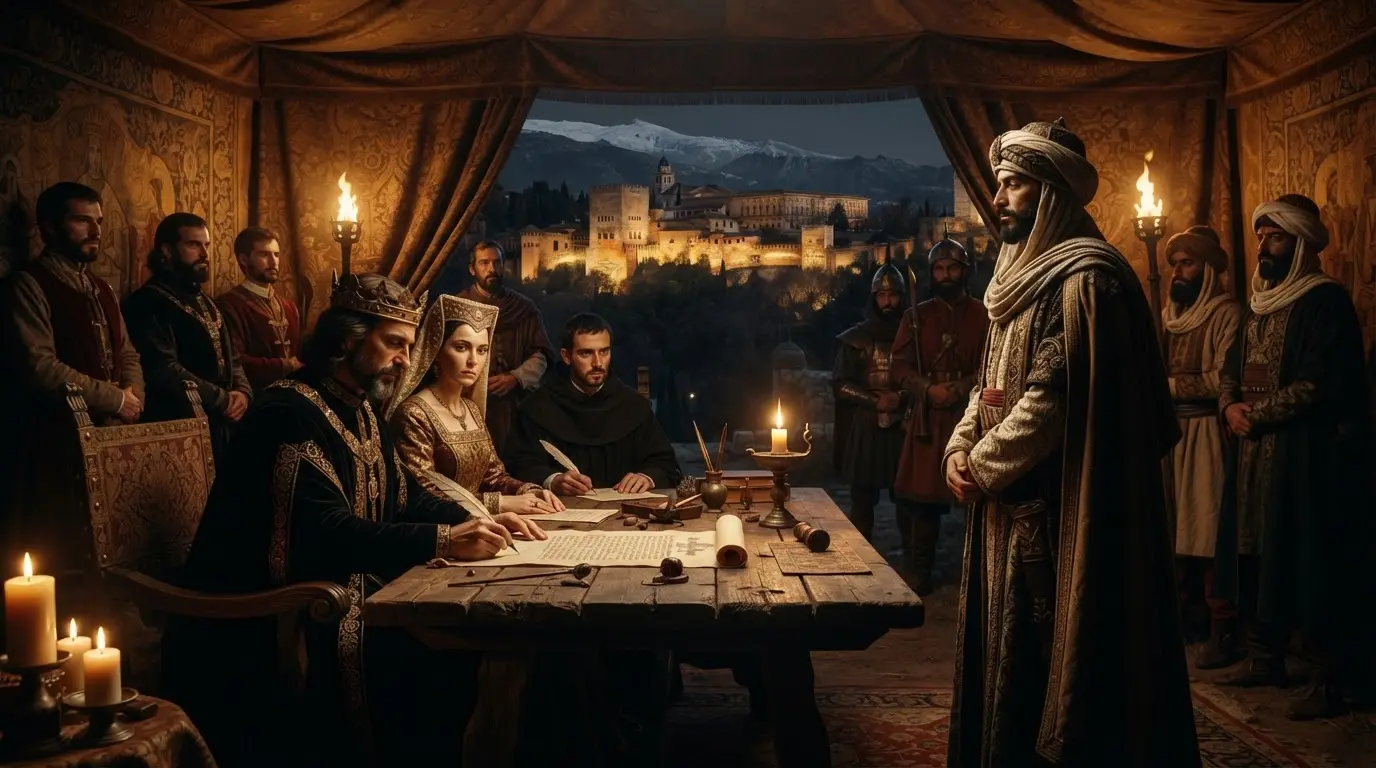
Historians call the document by several names: the Treaty of Granada, the Surrender of Granada, or the Capitulations of Granada. The substance is a single thing, a 67-article surrender signed and ratified on 25 November 1491 between Boabdil, the last Nasrid sultan, and Ferdinand and Isabella.[1] The count matters. Both surviving copies and this site's account of the Reconquista give sixty-seven articles.[1]
The clauses read less like a conqueror's terms than a charter of guarantees:
- Mosques and their religious endowments remained exactly as they had been in the time of Islam.[1]
- The call to prayer could not be interrupted, and any Christian caught mocking Muslim worship faced punishment.[1]
- Islamic law was preserved whole; no one was to be judged except by Muslim law.[1]
- Free emigration to North Africa, carried in the king's ships and charged nothing beyond the passage fee.[1]
For a defeated people these were remarkable terms, closer to vassal autonomy than occupation. The full text also covered property, weapons, and the safety of those who stayed. That generosity is exactly why the document could not survive contact with the religious politics of the Castilian court.
Signed at Santa Fe: the camp, the emir, the starving city
The signing happened at Santa Fe, a purpose-built camp on the Vega outside Granada. The town did not exist before the siege: the Catholic armies constructed it in 1490 to 1492 after a fire destroyed much of their original encampment.[7] It is an odd setting for one of the most consequential legal documents of Spanish history, and the name now survives mainly in the treaty's alternative title, the Capitulations of Santa Fe.
The man who signed for Granada was Boabdil, called Muhammad XII in the older numbering this site follows, the 22nd and last Nasrid ruler of the emirate.[6] Recent scholarship renumbers him Muhammad XI, but the point is unchanged: he was the last. Boabdil's story, his capture at Lucena in 1483 and his alliance with the Catholic Monarchs against his own uncle, is told in full elsewhere on the site. What matters here is what he was negotiating from: a city under siege since the spring of 1491, overcrowded with refugees and facing starvation.[1]
Those conditions explain why the talks ran in secret over several months. The negotiators feared a riot among a population not yet ready to concede.[1] The terms Boabdil eventually accepted were shaped by that desperation, which is also what made them so generous: Ferdinand and Isabella were buying a bloodless entry into the Alhambra, and they paid in guarantees.
Seven years of guarded enforcement under Talavera
For the first years after the fall of Granada on 2 January 1492, the treaty held. The man charged with enforcing it was Hernando de Talavera, appointed the first Archbishop of Granada in 1492 and the one churchman who actually tried to keep the Capitulations' promise.[5] Talavera's method was persuasion, not coercion: he studied Arabic, encouraged his clergy to do the same, and preached to the city's Muslims in their own language.[5]
The civic side of the treaty worked too. A joint municipal council was set up in Granada, and Muslims were allowed to elect their own representatives.[1] Ferdinand chose a deliberately laissez-faire policy, betting that daily contact with Catholic neighbours would quietly persuade Muslims to abandon Islam on their own.[1] That bet produced almost no converts, which is worth stating plainly: after seven years of patient, treaty-respecting evangelism, the Muslim community was still the Muslim community.
Talavera's Granada was the treaty actually working. The mosques stayed open, the muezzin called, and the city's Muslim quarter kept its rhythm. It was fragile from the start, because the people who wanted the treaty honoured, Talavera and a handful of others, were outnumbered at court by those who wanted it broken.

Explore · Neighbourhood
Albaicín
Granada's oldest neighbourhood: the Albaicín holds a UNESCO-listed maze of whitewashed lanes, Moorish cármenes, and the finest Alhambra views in the city.
Cisneros: the man who broke the treaty
In 1499 the treaty met the man who would break it. Cardinal Francisco Jiménez de Cisneros, Archbishop of Toledo and the most powerful churchman in Castile, arrived in Granada and decided that Talavera's patient method was a failure.[3] His verdict on preaching to Muslims in their own language was that it was giving pearls to pigs; he proceeded with forced mass conversion instead.[3]
Recommended tours
Tours are selected for quality, not commission. We earn a small fee if you book — at no extra cost to you.
Cisneros began sending uncooperative Muslims, especially the noblemen, to prison, where they were held under harsh conditions until they agreed to convert.[1] The pressure escalated fast. In December 1499 he wrote to Pope Alexander VI claiming that 3,000 Muslims had converted in a single day.[1] In the same campaign he ordered the public burning of every Arabic manuscript in Granada, sparing only those on medicine; contemporary sources put the number destroyed at no fewer than 5,000.[3] How firm that figure is gets weighed in a claim check on the Cisneros book burning of 1499.
“Giving pearls to pigs”
By January 1500 Cisneros could declare that "there is no one in the city who is not a Christian", and a papal letter that spring credited him with 60,000 forced conversions.[2] Even his own church council warned that the methods might breach the treaty.[1] The warning came too late. The guarantees the Capitulations had made, the open mosques, the uninterrupted muezzin, Muslim law, were already dead in practice, whatever the parchment said.
The Albayzín revolt and the treaty's legal death
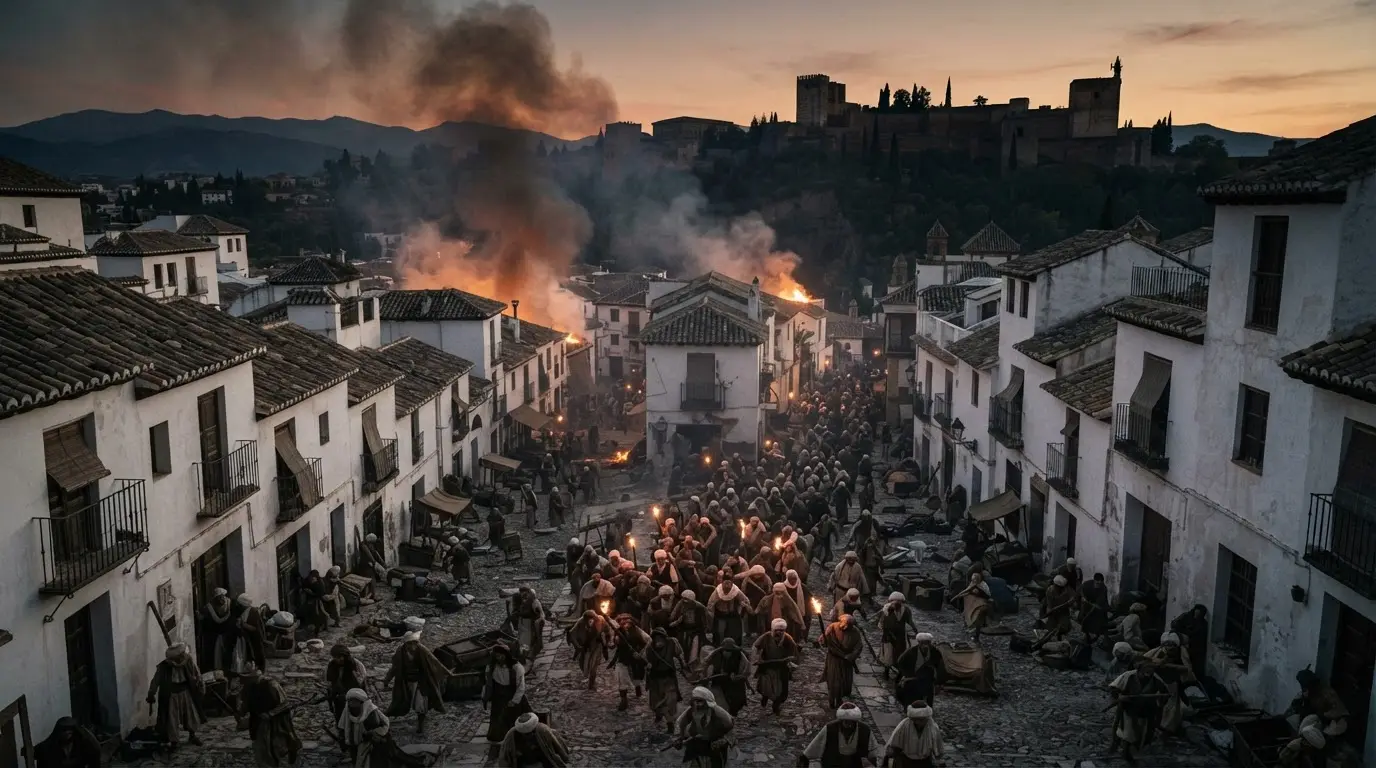
The population did not accept what Cisneros was doing. In December 1499 the Albayzín, Granada's Muslim quarter, rose in open and armed revolt after officials tried to reconvert a Muslim woman who had previously converted from Christianity.[1] The rising spread beyond the walls: its leaders fled into the Alpujarras mountains in January 1500, and Cisneros' campaign is credited with igniting the Rebellion of the Alpujarras that burned through 1499 to 1501.[2]
The crown crushed it with overwhelming force. Across the campaigns of 1500 and 1501, 80,000 Christian troops were mobilised and Ferdinand personally directed some of the operations.[2] Surrender terms for the defeated rebels almost always required baptism.[2] By 1501, the chroniclers record, not a single unconverted Muslim remained in the kingdom of Granada.[2]
The revolt gave the Castilian authorities exactly what they had been waiting for: a legal excuse to void the treaty. The rising, they argued, had released the crown from its obligations, and in 1501 the protections of the Treaty of Granada were formally abandoned.[4] The 67 clauses, which had survived seven years of enforcement under Talavera, were set aside in the space of a single campaign season.
80,000
12 February 1502: the edict that made the moriscos
The legal conclusion came with a date. On 12 February 1502, a proclamation was read in Seville, then carried town by town across the crown, giving every Muslim in Castile a choice: convert or leave.[2] The historian L. P. Harvey calls this the key date of the legislation.[2] All Muslim males aged fourteen or over, and all females aged twelve or over, had to accept baptism or be out of Castile by the end of April 1502.[2]
The exit door was fake. The edict nominally offered exile but forbade almost every destination that mattered: the neighbouring kingdoms were closed, and so were North Africa and the Ottoman lands.[2] In practice, as Harvey put it, Muslim presence under the old Mudéjar status came to an end "in such a summary fashion, at such short notice".[2] Most Muslims accepted baptism because there was nowhere legal to go.
Deep dive · Article
1066 Granada Massacre: When the Jewish Golden Age Ended in a Day
The 1066 Granada massacre killed Joseph ha-Nagid and thousands of the city's Jews in a single day, ending three decades of Jewish power under Samuel ha-Nagid.
The parallel with 1492 is deliberate. The same monarchs had expelled Castile's Jews in 1492 with a four-month conversion-or-exile ultimatum; a decade later they applied the same instrument to Castile's Muslims. The converts kept their language, their dress and their customs, and many practised Islam in secret. They were given a new name, moriscos, and their later story, from the 1568 Alpujarras revolt to the 1609 expulsion, belongs to another article. The Treaty of Granada's protections had lasted less than a decade.