The entry into Granada, 1492
On 2 January 1492, Isabella I of Castile and Ferdinand II of Aragon entered the city of Granada in formal procession, accepting the keys from the last Nasrid sultan, Muhammad XII (Boabdil). The ceremony ended 781 years of Muslim rule on the Iberian Peninsula. For Isabella personally, the moment carried an emotional weight that would shape the rest of her life and, ultimately, her choice of burial place.
The surrender was negotiated through the Granada Capitulations, signed on 25 November 1491, which guaranteed the Muslim population religious freedom, property rights, and legal protections. The handover was staged on the road below the Alhambra hill. Boabdil rode down from the fortress and met the monarchs near the present-day site of the Puerta de las Granadas. The most widely cited chronicle records him saying: "God loves you very much; these, my lord, are the keys to this paradise."
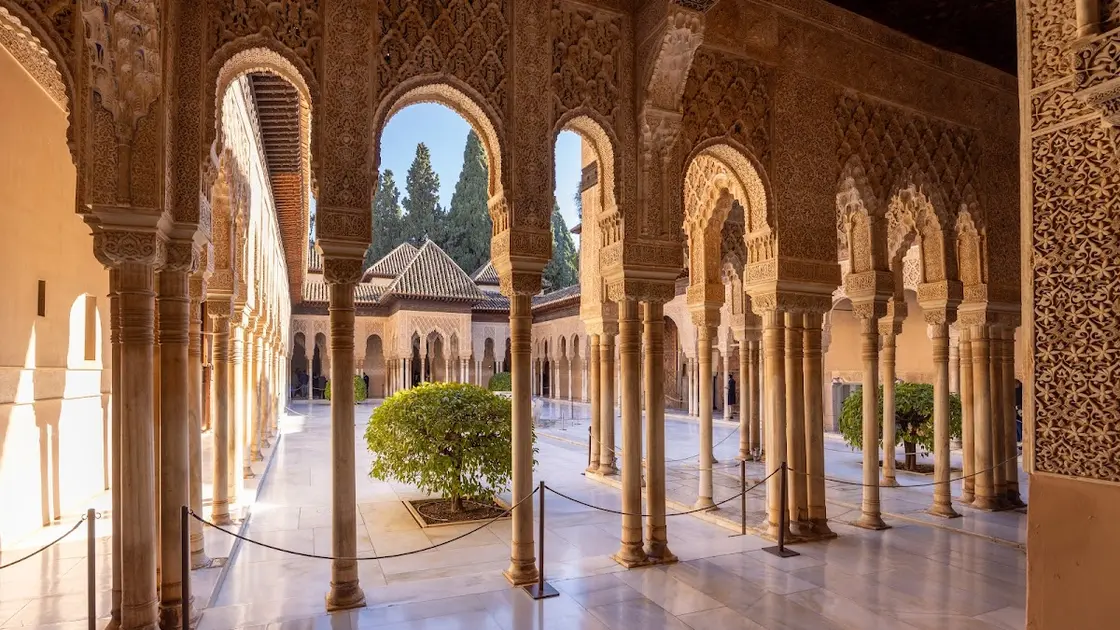
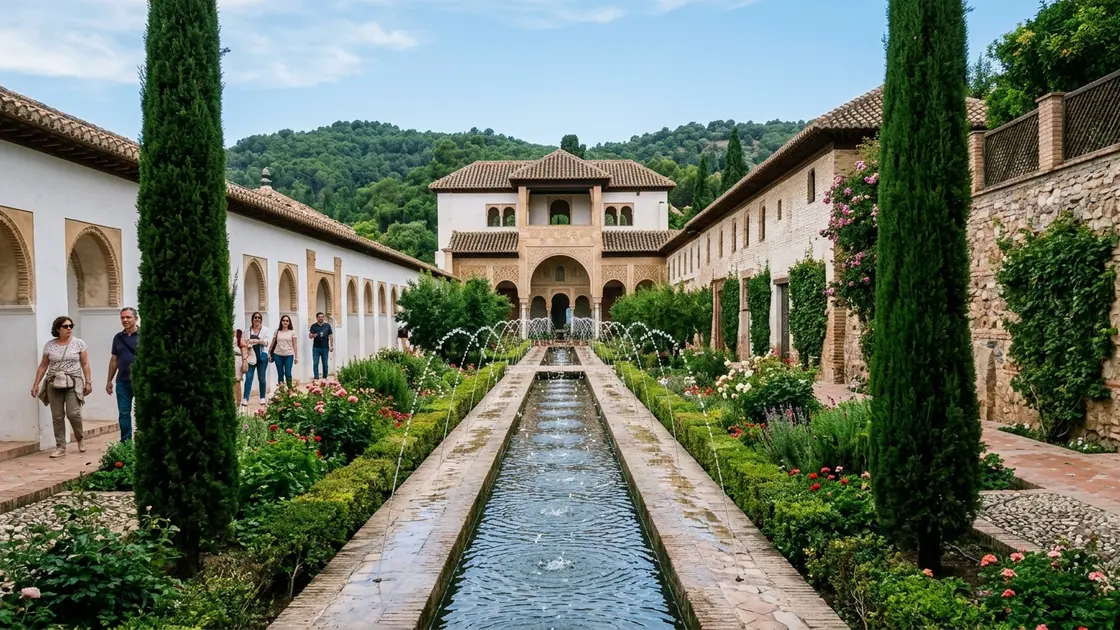
Isabella and Ferdinand did not simply visit Granada and leave. They took up residence in the Alhambra, occupying the Nasrid Palaces that Boabdil had vacated. The Comares Palace, the Court of the Myrtles, and the Hall of the Ambassadors became the seat of the Spanish court. From these rooms, the queen would govern Castile and Aragon for the next twelve years. The full story of that 1492 campaign is told in the Reconquista of Granada guide. Granada's town hall still marks that day of entry every 2 January, a ceremony now at the centre of Día de la Toma, the city's most politically contested annual holiday.
Governing from the Alhambra, 1492–1504
Isabella spent extended periods in Granada during the final decade of her reign, with extended stays in the Alhambra in 1492, 1499, and 1500–1501. The palace complex was not a ceremonial retreat. From the Hall of the Ambassadors — the throne room of the Nasrid sultans, with its muqarnas dome and walls inscribed with Arabic poetry — Isabella issued decrees, received ambassadors, and directed policy across two continents.
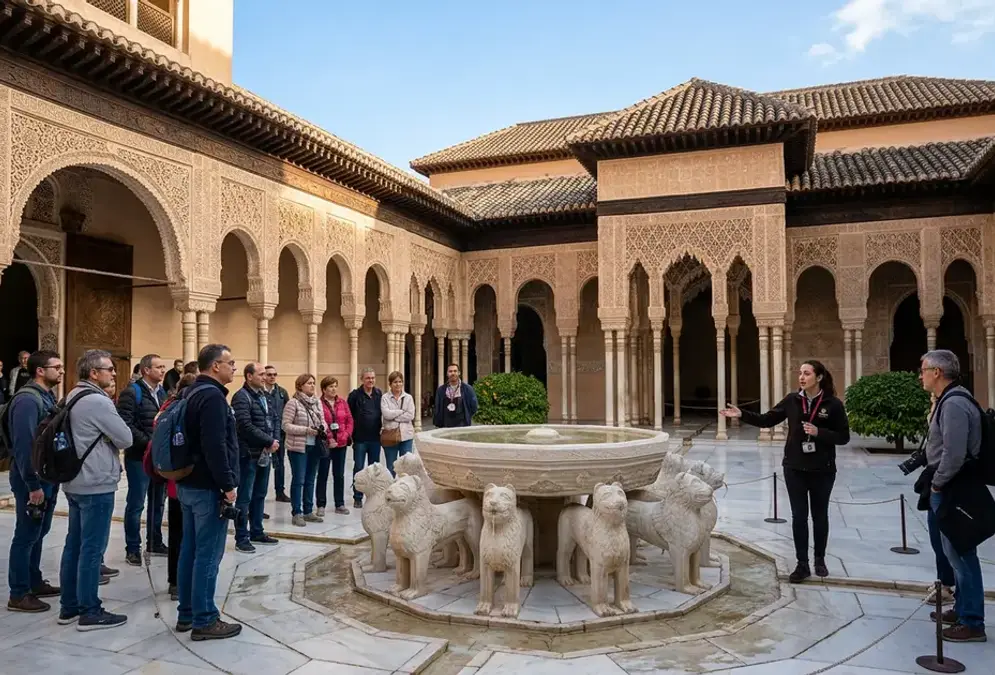
The most consequential document signed inside the Alhambra during her residence was the Alhambra Decree of 31 March 1492, ordering the expulsion of all Jews who refused conversion. Earlier that same year, in April, Isabella had received Christopher Columbus at the nearby camp of Santa Fe, approving the voyage that would make landfall in the Bahamas on 12 October 1492. The first indigenous people from the Americas arrived in Granada in 1493, presented to the queen in the Alhambra's Court of the Lions — a scene without precedent in European history.
By the early 1500s, Isabella had suffered a series of devastating personal losses: her only son Prince John died in 1497 at age nineteen, her eldest daughter Isabella of Aragon died in childbirth in 1498, and her grandson Prince Michael — briefly heir to both Spain and Portugal — died in Granada itself in 1500, a few weeks short of his second birthday. The city where she had achieved her greatest triumph became the place where she buried her youngest descendant.
The will of 1504: why Granada over Toledo
Isabella's original burial plan had been San Juan de los Reyes in Toledo, the Franciscan monastery she and Ferdinand had founded in 1477 to commemorate their victory at the Battle of Toro. But by the early 1500s, her attachment to Granada had overtaken that earlier commitment.
The Royal Charter, issued at Medina del Campo on 13 September 1504, states: "First we ordain that in the Cathedral Church in the city of Granada a worthy Chapel shall be built, where, when it pleases Our Lord to call us, our bodies shall be placed. This chapel will be called Of the Kings under the invocation of Saint John the Baptist and Saint John the Evangelist."
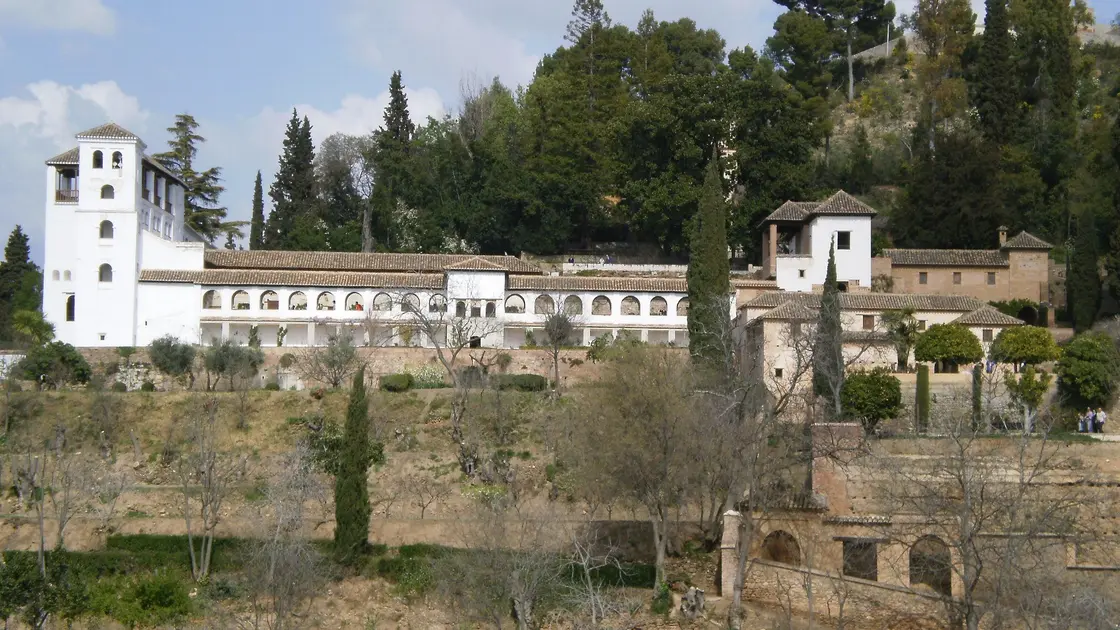
Her will specified that if the chapel were not ready at her death — which proved prescient, since construction had not even begun — her body was to be placed temporarily in the Monastery of St. Francis of the Alhambra, the Franciscan convent within the Alhambra complex. This was not a secondary choice. The location within the Alhambra held symbolic meaning: she would rest in the place that had been the seat of Nasrid power, in the city whose conquest defined her reign.
Recommended tours
Tours are selected for quality, not commission. We earn a small fee if you book — at no extra cost to you.
Three days before her death, on 23 November 1504, Isabella added a codicil to her will. Its primary concern was not burial arrangements but the treatment of indigenous people in the newly discovered lands. She implored Ferdinand and their successors to ensure that the Indians "shall not receive any affront against them or against their properties; on the contrary, they shall ordain to treat these peoples fairly" — a document later cited by Pope John Paul II as evidence of early human rights thinking in Spanish colonial law.
The journey from Medina del Campo to the Royal Chapel
Isabella died on 26 November 1504 at the Royal Palace of Medina del Campo in Valladolid, at age 53.[1] Her body, dressed as she had requested "in the habit of the blessed pauper of Christ, St. Francis," travelled approximately 500 kilometres south to Granada, crossing the Sierra Morena through the Despeñaperros pass. The cortège arrived and placed her remains in the Franciscan Convent of the Alhambra, exactly as her will had specified.
Ferdinand died at Madrigalejo in Cáceres on 23 January 1516, aged 63.[8] His body also made the journey to Granada and was placed alongside Isabella's in the same Alhambra convent. The Royal Chapel was still under construction — work had begun in 1505 under the architect Enrique Egas and would continue until 1517 — and would not be ready to receive its occupants for another five years.
On 10 November 1521, at the order of their grandson, the Emperor Charles V, the remains of both Catholic Monarchs were moved from the Franciscan convent to the completed Royal Chapel.[9] The transfer was conducted "amid strict solemnity," and the coffins were installed in the crypt beneath the central crossing, directly below the magnificent marble tomb that had been commissioned from the Florentine sculptor Domenico Fancelli in 1517.[6]
17 years
The Royal Chapel: tombs, crypt, and architecture
The Capilla Real de Granada was constructed between 1505 and 1517[2] in the Isabelline Gothic style, a transitional architecture combining late Gothic structural forms with Plateresque decoration and early Renaissance elements from Italy. The architect Enrique Egas designed the building, with contributions from Juan Gil de Hontañón and Juan de Badajoz the Elder. It is the largest funeral chapel in Spain[5], built as a single nave with an eight-angled presbytery.
Inside, a blue frieze runs along the upper walls, inscribed in Gothic characters with a Latin summary of the Catholic Monarchs' achievements: "This chapel was commissioned by the very catholic Don Fernando and Doña Isabella, king and queen of the kingdoms of Spain, Naples, Sicily and Jerusalem. These conquered the kingdom of Granada and subdued it to our faith... The Queen died on Tuesday the twenty-sixth of November of 1504. The King died on Wednesday the twenty-third of January of 1516. This work was finished in one thousand five hundred and seventeen." A monumental wrought-iron grille, the reja mayor forged by Maestre Bartolomé, separates the nave from the crossing.
Explore nearby · Monument
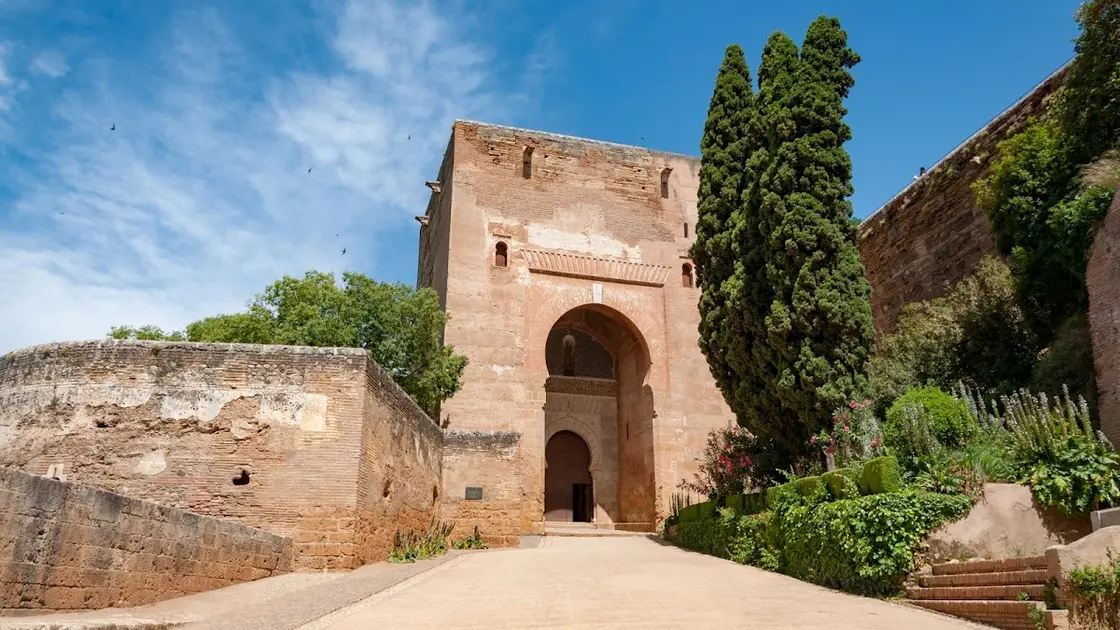
Puerta de la Justicia
Alhambra's main entrance, built by Yusuf I in 1348. A Hand of Fatima on the outer keystone and a Key on the inner encode the Five Pillars and royal power.
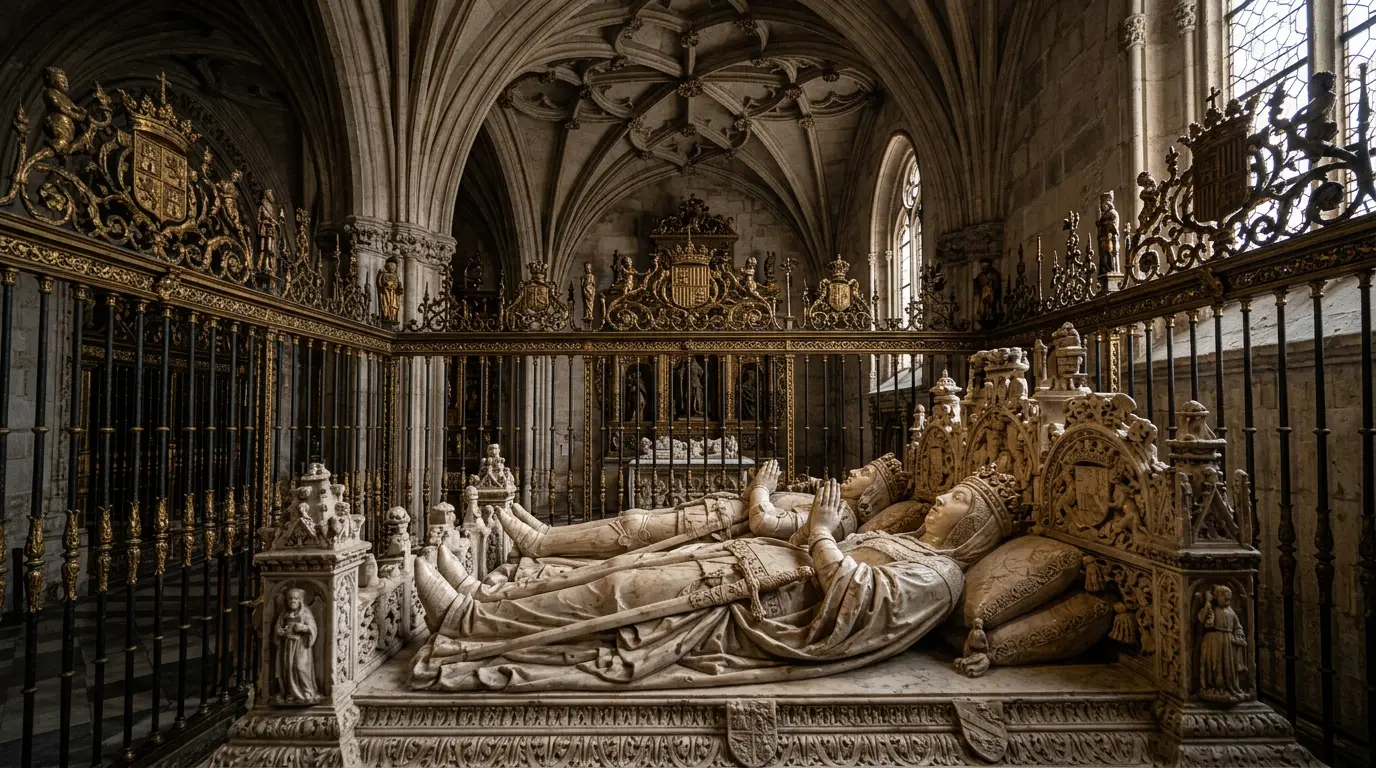
In the centre of the crossing, raised almost to altar height, stand the two marble mausoleums. The tomb of Isabella and Ferdinand is the work of Domenico Fancelli, completed in 1517, taking the form of a pyramidal frustum. Ferdinand's recumbent figure wears armour, his hands resting on his back — a military iconography distinctive among Spanish royal tombs. Isabella lies beside him dressed with deliberate simplicity. Below them, a small austere crypt holds the actual lead coffins, each identified by a single initial: I (Isabella), F (Ferdinand), alongside those of Joanna, Philip, and Prince Michael (M). The marble effigies above are cenotaphs. The queen who conquered Granada lies below in a plain lead box.
Visiting Isabella's tomb today
The Royal Chapel of Granada (Capilla Real) is at Calle Oficios s/n, immediately adjacent to Granada Cathedral. It is open for cultural visits Monday to Saturday from 10:15 to 18:30, and Sundays and religious holidays from 11:00 to 18:00. Admission is €5 (€3.50 for students up to age 25, children under 12 free)[7] and includes an audio guide. Free entry is available on Wednesdays, with tours departing at 15:15, 15:30, 16:30 and 17:00, but requires advance booking through the Archdiocese of Granada website.
The visit encompasses the main chapel, the royal tombs, the crypt with the five lead coffins, and the Sacristy-Museum, which holds Isabella's personal Flemish painting collection, her crown and sceptre in gilded silver, Ferdinand's sword, and the queen's personal books and vestments. The collection includes works by Rogier van der Weyden, Hans Memling, and Dieric Bouts — the art Isabella chose for her own devotion, explored in detail in the guide to the Royal Chapel's Flemish paintings. Allow at least one hour for a thorough visit.
Deep dive · Article
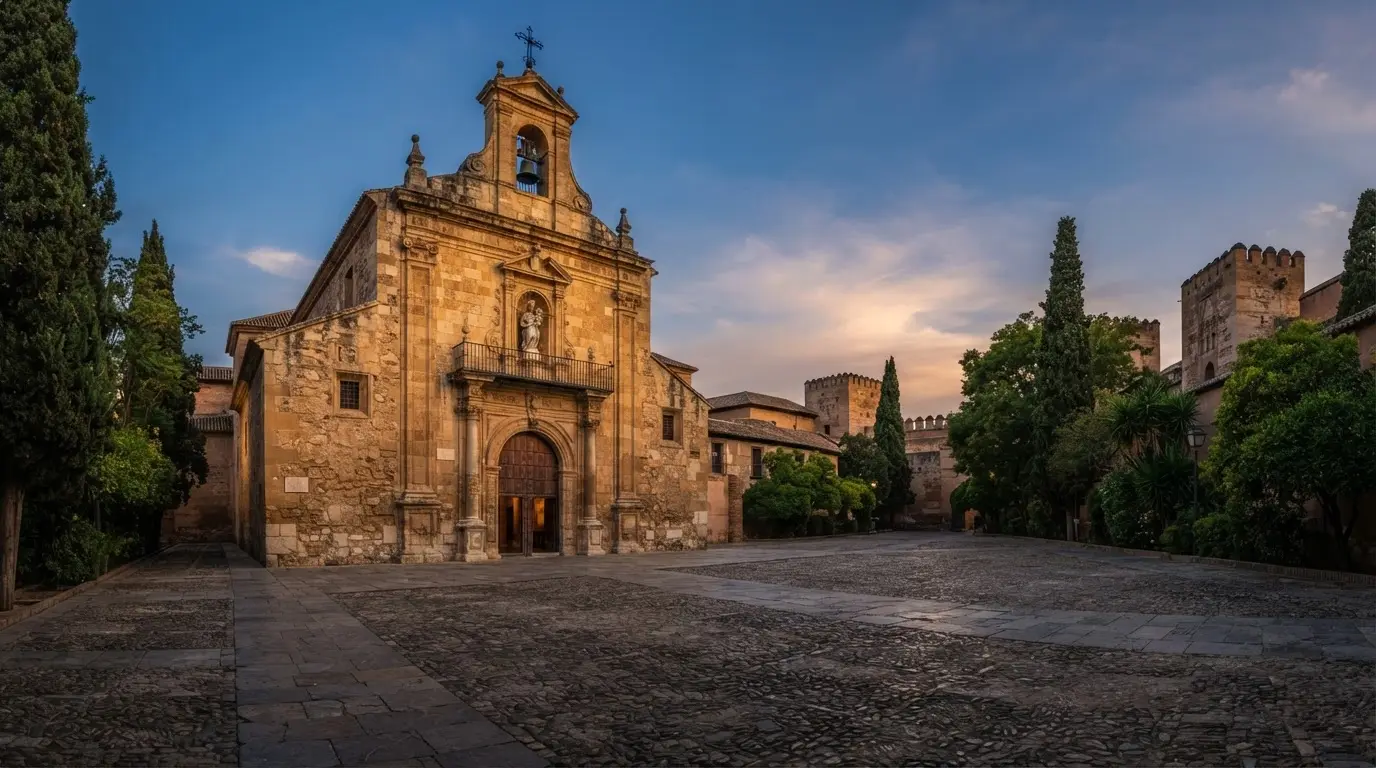
Alhambra Royal Mosque: From Nasrid Mosque to Santa María
The Alhambra royal mosque was completed in 1305 and later replaced by Santa María. Read its plan, surviving bath and difference from Granada's city mosque.