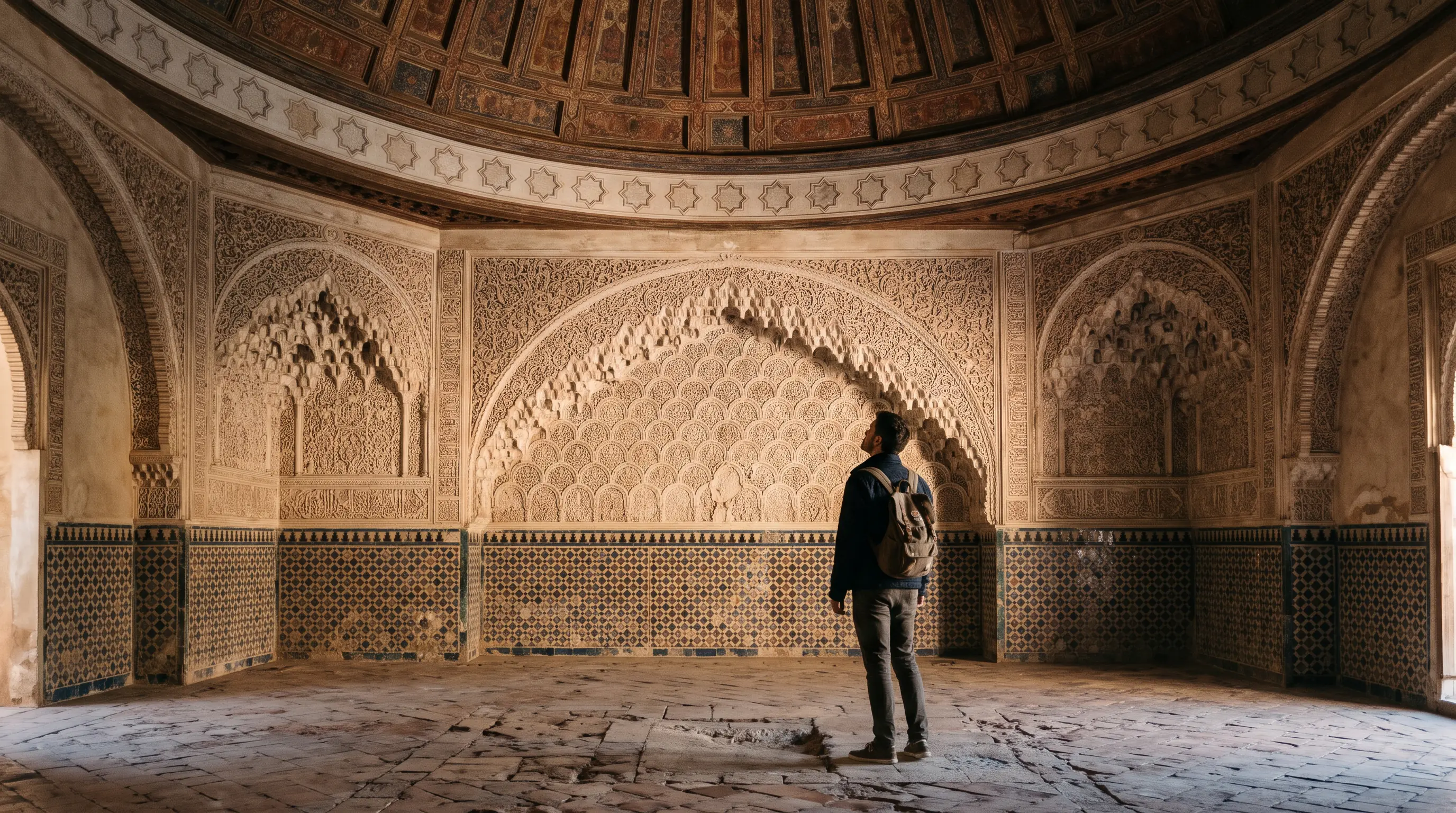
Visitor with a backpack looks up at the coffered dome of the hall of kings alhambra leather paintings alcove, Nasrid arches and tiled dado in warm light

Who Painted the Alhambra Hall of Kings Leather Ceilings?

The Alhambra's Hall of Kings ceilings are wood vaults sheathed in horse hide, painted in tempera. The date, the subjects and the painter are all still debated.

Portrait of James Walker
Written by

Seven years resident in Granada. Specialist in Nasrid architecture, Al-Andalus history, and Andalusian walking routes.

Published
Nasrid Granada1238–1492
A Christian knight and his lady at chess, a fountain of eternal youth and ten seated men in conversation share one hall's ceilings in a Nasrid palace, and nobody can say for certain who painted them. Spread across three elliptical vaults[1] in the Palace of the Lions, built around 1380[2], the ceilings of the Sala de los Reyes have been dated on technique and materials to between the mid-14th and early 15th century[3]. Treat any single confident date or painter's name as a hypothesis, not a settled fact.
Elliptical painted vaults
3 vaults
The painted bays of the Sala de los Reyes[1]
Palace of the Lions built
c. 1380
Under Muhammad V's second rule[2]
Restoration analysis
2001-2018
Technique and materials studied to date the vaults[3]

Wood, horse hide and egg tempera: what the ceilings are made of

Each painted vault is wooden, covered in unshaved horse hide tanned with alum, and the paint is tempera finished with gilding or silvering, laid flat and in relief in the manner of Islamic guadamecí leatherwork.[4] "Paintings on leather" is the shorthand, not the construction.
The alcoves are painted in egg tempera on leather and varnished with wax, a technique used nowhere else in the Alhambra.[5] That sets them apart from the carved plaster and tilework that dominate the neighbouring Court of the Lions.
Laboratory work commissioned by the Alhambra with the Andalusian Institute of Cultural Heritage (IAPH) found a gypsum primer with animal glue under the paint layers, which use egg yolk and linseed oil in the latest interventions.[6] The palette is mostly mineral:
  • Reds from cinnabar and/or hematite
  • Greens from malachite
  • Blues from lazurite and azurite
  • Ochres from clays

A date that slides across six decades

The honest answer to when they were painted is a range, and the range depends on the evidence. One line of argument ties the work to Muhammad V, who regained the throne in 1362 and died in 1391; on that reading the three bays were painted after 1362 and before 1391, though the precise date of completion is unknown.[7]
Not everyone accepts Muhammad V as the patron. Vallejo Naranjo, citing Pavón Maldonado, writes that if Muhammad V was not the author, the search has to move to his namesake successors.[8] One catalogue entry points to the reigns of Muhammad VII or Yusuf III,[9] who ruled 1392-1408[10] and 1408-1417[11] (dates per the rulers' regnal lists), within a few decades of the palace around them.
The restoration evidence is the widest net. Technique and materials alone point to a window running from the mid-14th to the early 15th century, wide enough to hold either proposal, so treat "late 14th century" as the safe shorthand and the early 15th as a live possibility.
What the date rests onWhere it points
Technique and materials analysed in the 2001-2018 restorationMid-to-late 14th century to early 15th century
A commission by Muhammad VAfter 1362 and before his death in 1391
A patron among Muhammad V's namesake successorsReigns of Muhammad VII (1392-1408) or Yusuf III (1408-1417)

Ten men in conversation: the central vault
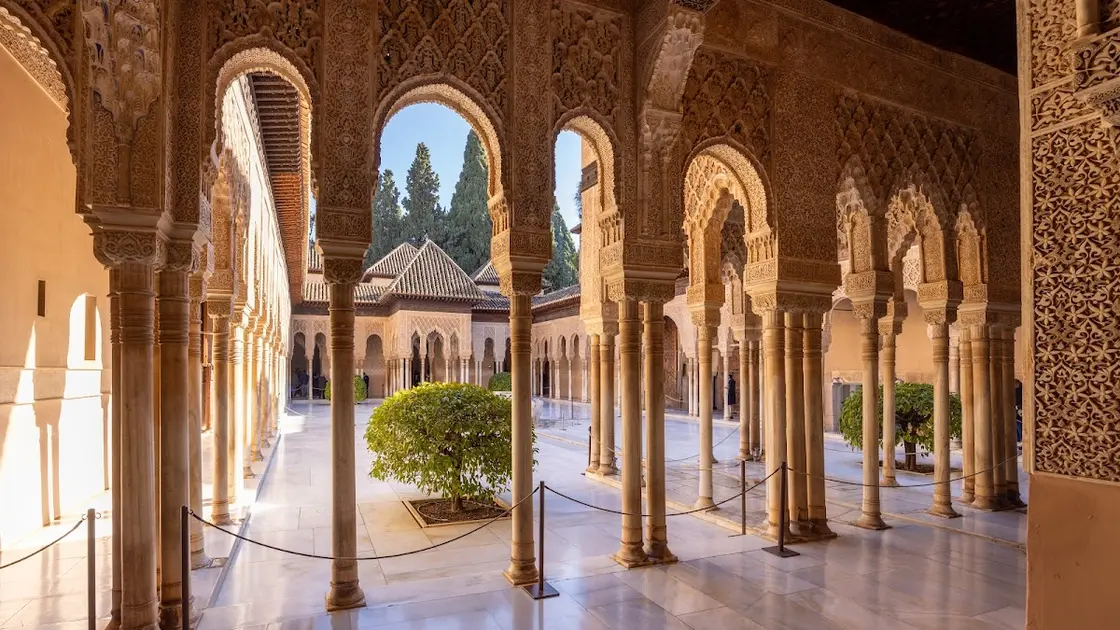
The central vault is thought to show ten Nasrid emirs seated in conversation, though the identification has also been tied to an assembly of qadis (Islamic judges) or a group of dignitaries. Their features and attributes belong to the Nasrid court, and that is the firm part of the reading.[12] Sources vary between emirs, sultans and kings, as they do between Sala de los Reyes and Sala de la Justicia for the hall itself; from here on the figures are called sultans, the Patronato's term.
Restorers found beneath the central vault's paint the underdrawing of a starred dome, a project dropped in favour of a proposal bolder in religious terms.[13] A star-shaped dome would have sat comfortably in the geometric vocabulary of Nasrid architecture, which makes the switch to painted figures all the more striking.
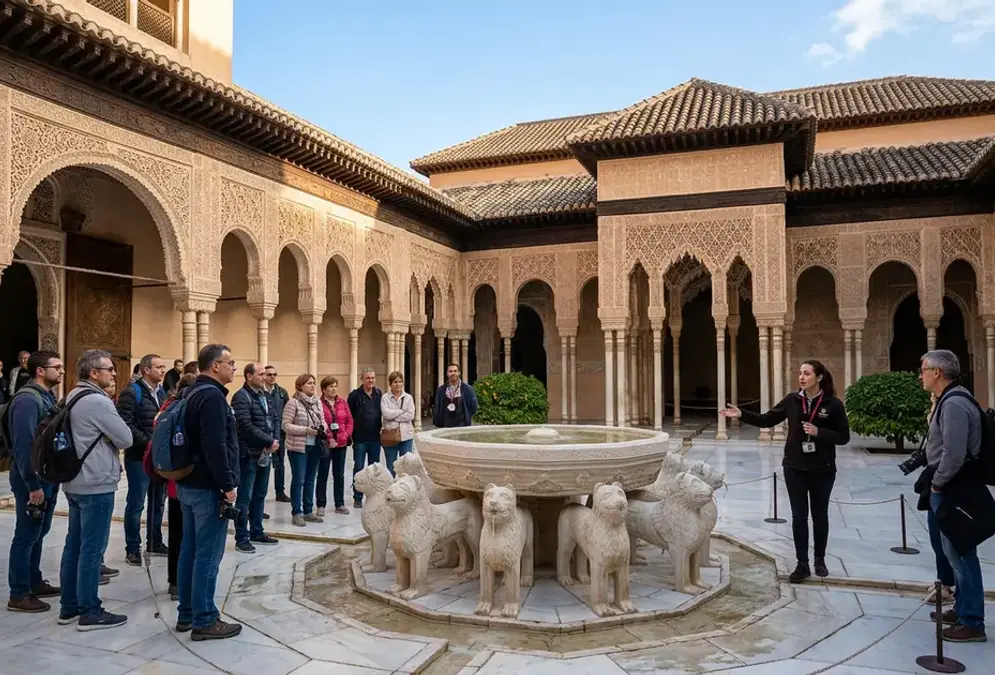
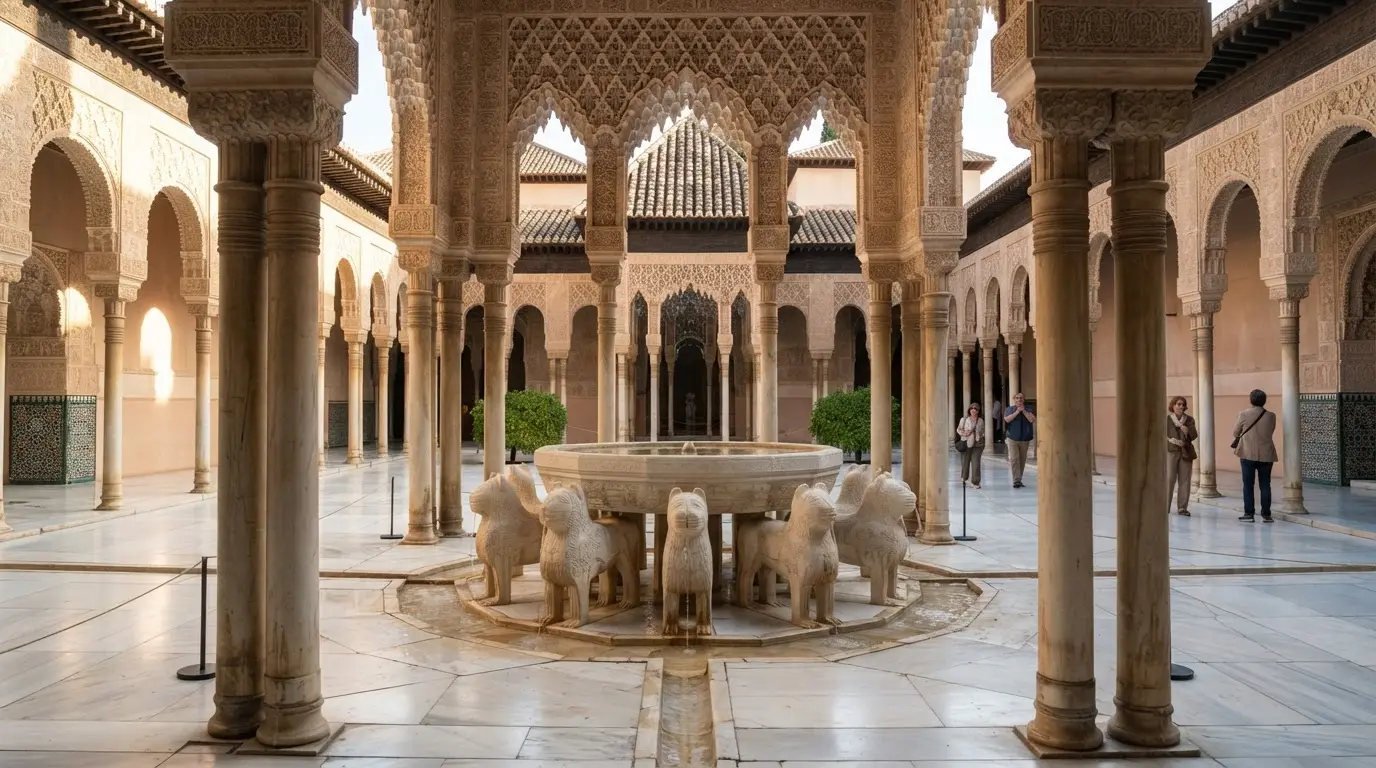
The Patio de los Leones in the Nasrid Palaces, with its central alabaster fountain supported by twelve lions

Explore nearby · Monument

Nasrid Palaces

Three royal Nasrid palaces inside the Alhambra, including the Patio de los Leones and Hall of the Ambassadors. Entry is timed: arrive within your booked slot.

The older idea that the sultans are ten historical Nasrid kings appears superseded in Vallejo Naranjo's account.[14] The hall takes its name Hall of Kings from this painting, and from the 18th century it was also called the Hall of Justice (Sala de la Justicia) and the Court.[15]

Courtly love, hunts and a Castilian order in the side vaults

The two side vaults leave the council behind for courtly love and chivalric affairs, set in a paradise garden that doubles as a catalogue of Nasrid flora and fauna, a detail that suggests the painters knew the place.[16]
The south vault runs through seven scenes and the north through nine, with the fountain of eternal youth and a castle of love facing each other at the centre of the north.[17] Among the south vault's scenes are:
  • a lady and a Christian knight at chess
  • a castle of love and a duel
  • hunts of deer and bear
  • a lion slain
  • a lady rescued from a wild man
Heraldry ties the ceilings to Castile: the arms of the Order of the Banda are painted in all three bays, a point many scholars have noted, and the order was a chivalric order founded in Christian Castile in 1330.[18]
What the Banda is doing there is argued. As Vallejo Naranjo reports them, Pavón Maldonado reads the central scene as Pedro I of Castile granting the Banda to ten Muslim knights in thanks for their help,[19] while Joaquina Albarracín takes it to show the Granadan kings who received the order, making the hall its members' seat.[20] Vallejo Naranjo herself suggests the red field on a gold band could be a heraldic licence of Muhammad V,[21] and finds in the Banda a message of acceptance and integration in the Western political concert.[22]
The romance link is argued scene by scene. Vallejo Naranjo reports Cynthia Robinson identifying the Christian knight attacking the wild man as Palomedes, Tristan's antagonist in the Tristan romance,[23] and Jerrilynn Dodds finding Breton-cycle iconography in six of the scenes.[24] Another academic account holds that the paintings were not meant to represent any particular romance but form a deliberate collage of romance scenes referring to the Banda.[25]
Hunts and games were not idle in this world. A 2014 study in Eikon/Imago reads them as the diplomatic framework through which medieval balances of power were expressed, occasions that actually promote political relations.[26]

Who painted them: a question still open
Authorship has never been fully resolved. The methods point both to Christian tempera painting and to Islamic leather painting, which keeps a joint Christian and Muslim workshop on the table; what seems clear is that whoever painted them was of peninsular origin or had long worked in the Iberian peninsula.[27]
Small details show the mix at work. The noble maidens wear painted nails and large earrings, read as an adaptation to the world of the women of the Nasrid court.[28]
Court of the Lions Alhambra Granada interior view, twelve white marble lion fountain in centre, 124 slender columns of the arcade receding in perspective, morning sidelight on muqarnas capitals

Deep dive · Article

Court of the Lions Alhambra Granada: Decoding the Courtyard

Court of the Lions, Alhambra Granada: 124 marble columns, a lion fountain 650 years old, a Quranic paradise built by Muhammad V. What to see and when.

Framing the ceilings as Christian imagery in an Islamic palace is, in one academic account, an oversimplification.[29] The scholarship has also lagged: the publisher's synopsis of Courting the Alhambra notes that, as of 2009, the ceilings had gone thirty years without serious scholarly attention.[30]

Restored in place: what to look for today

The vault paintings were conserved without being taken down or dismantled, in work that began in January 2007 after the IAPH had studied them since 2000. A protective facing and a support counterform were applied to the front so that the reverse could be studied and treated.[31]
The most recent reported work targets plaster rather than paint: a Patronato restoration of the interior stucco in the three side alcoves, budgeted at more than €109,000 and 14 months, in alcoves whose vaults carry the paintings known as the Fountain of Youth, the Kings and the Lady playing chess.[32]
Those three names double as a map of the vaults:
  • the Kings: the central vault, with ten seated men
  • the Lady playing chess: the south vault, where a knight and a lady sit at the board
  • the Fountain of Youth: the north vault, facing the castle of love
The Sala de los Reyes sits in the Palace of the Lions, within the Nasrid Palaces. Give each of the three vaults its own pause, because the side vaults carry the stories and the centre alone gives you only the council.

Frequently asked questions

What are the Hall of Kings Alhambra leather paintings made of?

Each of the three vaults is wooden and covered in unshaved horse hide tanned with alum. The paint is tempera, finished with gilding or silvering in the manner of Islamic guadamecí leatherwork. Laboratory analysis found a gypsum primer with animal glue and mineral pigments such as cinnabar, malachite, azurite and lazurite.

Who painted the ceilings of the Hall of Kings in the Alhambra?

Nobody knows for certain. Authorship has never been fully resolved: the methods tie to both Christian tempera painting and Islamic leather painting, so a joint Christian and Muslim workshop cannot be ruled out. What seems clear is that whoever painted them was of peninsular origin or had long worked in the peninsula.

When were the Hall of Kings paintings made?

Between the mid-14th and early 15th century, depending on the evidence. Analysis of technique and materials during the 2001-2018 restoration gives that range. A reading tied to Muhammad V suggests after 1362 and before 1391, while a patron among his namesake successors would point to Muhammad VII (1392-1408) or Yusuf III (1408-1417).

Who are the ten figures in the central painting?

The central vault is thought to show ten Nasrid sultans seated in conversation. Their features and attributes belong to the Nasrid court, but the figures have also been identified as an assembly of qadis or a group of dignitaries, and the thesis of ten historical Nasrid kings is judged superseded by one scholar.

Why does an Islamic palace have Christian-looking paintings?

The side vaults show courtly love, hunts and chivalric scenes, and the arms of the Order of the Banda, a chivalric order founded in Castile in 1330, appear in all three bays. Scholars call the label "Christian paintings in an Islamic palace" an oversimplification, and details such as the maidens' painted nails show adaptation to the Nasrid court.

Why is it called the Hall of Kings and the Hall of Justice?

Hall of Kings comes from the central painting, which is read as a group of Nasrid rulers. The names Hall of Justice (Sala de la Justicia) and Court were also used from the 18th century.

How were the Hall of Kings paintings restored?

In place, without taking the paintings down or dismantling them. The Andalusian Institute of Cultural Heritage (IAPH), which had studied the paintings since 2000, began the intervention in January 2007, applying a protective facing and a support counterform on the front so the reverse could be treated.

Sources

32 references Show
  1. Patronato de la Alhambra (opens in a new tab)

    “El conjunto de pinturas está distribuido en tres bóvedas elípticas”

  2. Patronato de la Alhambra (opens in a new tab)

    “construido bajo el segundo gobierno de Muḥammad V en torno a 1380”

  3. Patronato de la Alhambra (opens in a new tab)

    “analizados durante su último proceso de restauración 2001-2018”

  4. Patronato de la Alhambra (opens in a new tab)

    “Estamos ante un conjunto de pinturas cuyo soporte es mixto: una bóveda de madera sobre la que se crea un recubrimiento de piel de caballo curtida al alumbre sin afeitar”

  5. artofthemiddleages.com (opens in a new tab)

    “This hall includes a special technique not used elsewhere in the Alhambra: its eastern side alcoves are painted in egg tempera on leather, then varnished with wax.”

  6. repositorio.iaph.es (opens in a new tab)

    “Stratigraphic sections show a primer layer of gypsum with animal glue followed by pigments with egg yolk and linseed oil in the latest interventions.”

  7. mizanproject.org (opens in a new tab)

    “The precise date of the completion of the ceiling paintings is unknown.”

  8. revistas.ucm.es — 4564456602625 (opens in a new tab)

    “De no ser Muhammad V su autor, nos obligaría a buscar entre sus sucesores homónimos.”

  9. dome.mit.edu (opens in a new tab)

    “According to the clues from the painting about the kings, these paintings could correspond to the reigns of Mohammed VII”

  10. Wikipedia — Muhammad VII of Granada (opens in a new tab)

    “reigned 3 October 1392 – 13 May 1408”

  11. Wikipedia — Yusuf III (opens in a new tab)

    “Yusuf III (July 16, 1376 – November 9, 1417) was the thirteenth Nasrid ruler of the Emirate of Granada from 1408 to 1417.”

  12. Patronato de la Alhambra (opens in a new tab)

    “La identificación de los personajes de la bóveda central se ha ligado a sultanes de la dinastía nazarí, reunión de cadíes o grupo de dignatarios.”

  13. Patronato de la Alhambra (opens in a new tab)

    “un esbozo de una cúpula estrellada, proyecto desechado en favor de una propuesta más “arriesgada” a nivel religioso”

  14. revistas.ucm.es — 4564456602625 (opens in a new tab)

    “una vez que la tesis de los diez reyes históricos de la dinastía nazarí parece superada”

  15. dome.mit.edu (opens in a new tab)

    “It was also called Justice Hall (Sala de la Justicia) and Court (Tribunal) from the 18th century.”

  16. Patronato de la Alhambra (opens in a new tab)

    “Las dos bóvedas laterales desarrollan una temática que gira en torno al amor cortés y los asuntos caballerescos”

  17. Patronato de la Alhambra (opens in a new tab)

    “En la bóveda del lado sur aparece una sucesión de siete escenas.”

  18. mizanproject.org (opens in a new tab)

    “The arms of the Order of the Banda are explicitly painted in all three bays, a fact which has been recognized by numerous scholars.”

  19. revistas.ucm.es — 4564456602625 (opens in a new tab)

    “Pavón Maldonado interpreta la escena central como la concesión de la misma de Pedro I a estos diez caballeros musulmanes en agradecimiento a su ayuda”

  20. revistas.ucm.es — 4564456602625 (opens in a new tab)

    “alude a la bóveda central como una representación de los reyes granadinos que recibieron la Banda, dándole a la sala la funcionalidad de sede de sus miembros”

  21. revistas.ucm.es — 4564456602625 (opens in a new tab)

    “la elección del campo de gules sobre banda de oro podría ser, también, una licencia heráldica de Muhammad V”

  22. revistas.ucm.es — 4564456602625 (opens in a new tab)

    “la Banda contiene y aporta un mensaje superior de aceptación e integración en el concierto político occidental”

  23. revistas.ucm.es — 4564456602625 (opens in a new tab)

    “Robinson 94 identifica al caballero cristiano que ataca al salvaje, no como Enyas, sino como Palomedes, antagonista de Tristán de Leonís”

  24. revistas.ucm.es — 4564456602625 (opens in a new tab)

    “Dodds encuentra en seis de las escenas iconografía propia del ciclo bretón.”

  25. mizanproject.org (opens in a new tab)

    “but these paintings were not intended to represent any particular romance”

  26. revistas.ucm.es — 73387 (opens in a new tab)

    “Hunt days and games that actually promote political relations and are, ultimately, the diplomatic framework that expresses the difficult medieval balances of power.”

  27. Patronato de la Alhambra (opens in a new tab)

    “Con respecto a su autoría sigue sin esclarecerse completamente”

  28. Patronato de la Alhambra (opens in a new tab)

    “También lucen las uñas pintadas”

  29. mizanproject.org (opens in a new tab)

    “The denotation of the problem as “Christian” imagery in an “Islamic” palace is of course an oversimplification”

  30. blackwells.co.uk (opens in a new tab)

    “The ceiling paintings in the Hall of Justice of the Alhambra have not received serious scholarly attention for the past thirty years”

  31. iaph.es (opens in a new tab)

    “sin apear ni desmontar las pinturas”

  32. vivirediciones.es (opens in a new tab)

    “que suponen una inversión de más de 109.000 euros y cuentan con un plazo de ejecución de 14 meses”